Pace Yourself! What Can Make or Break a Story

You start reading a book, or watching a movie, and the beginning is a banger. You’re hooked. The characters are great, the story is enthralling, and the action is incredible. The first act is a masterclass in storytelling.

As you continue, though, you feel a nagging sensation that something has gone wrong. You aren’t gripped like you were in the first twenty minutes. Why all this pointless dialogue? Why spend five minutes on a scene that has no impact on the rest of the story? Did someone put the plot on a lifeboat and set it adrift? It’s just … wandering aimlessly.

But wait! You get to the end, and the last ten minutes suddenly pick up. Boom. Bam. Bang. The plot is resolved, the heroes win the day, end of story. It’s satisfying enough, but you’re left wondering why 70% of the story just dragged on and on.

Or maybe you run into a story with the exact opposite problem. You feel out of breath after finishing it, like you were never given a chance to rest. Who’s this person and why are they – never mind! Moving on! More action! More spectacle! Can’t contemplate our navels now!

You’re rushing from set piece to set piece at breakneck speed. Movies especially love to do this. The story is just an excuse to show off the cinematography. Maybe there IS a good story there, but it’s been broken up by a frenetic pace that prevents it from properly unfolding.

Pacing. That’s the keyword. A good story has good pacing. It’s the invisible, unappreciated ingredient that is key to cooking a good meal. Folks know when they dislike the protagonist. They understand bad writing. A poorly constructed setting betrays its flaws just by being experienced. Audiences know these things. But pacing is more subtle. When the pacing’s poor, you don’t always know what’s wrong, but you can sense that something is off.

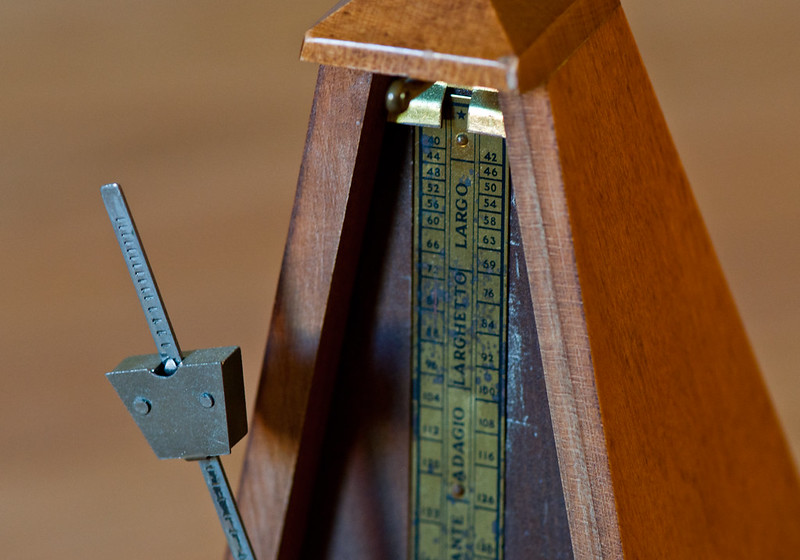
Pacing is the speed at which the story is told, in which everything, everything, you’ve written is unveiled at the times that best serve its progression, its development, the audience’s entertainment, and the impact of key scenes and events. Pacing is to storytelling like a metronome is to music. Go off-beat, and everything goes out of whack.

As the metronome helps the musician keep the proper rhythm, so does a writer keep their story at the proper pace
Metronome” by jronaldlee is licensed under CC BY 2.0.

To continue the earlier food analogy, a story is like a meal. Pacing is the speed at which you eat the meal. Eat too fast, and you barely get to taste the food. Eat too slowly, and the food is so cold and stale by the time you finish that it can hardly be considered tasty anymore. A writer needs to be like Goldilocks and find the pace that is juuuust right.

Naturally, stories being organic things with a knack for growing beyond the writer’s original intention – things that you could swear have minds of their own – there is no magic formula to apply to a story. Each tale is unique. There are so many factors to consider: the genre, the story’s message (if any), the amount of dialogue versus action, the length of the story, et cetera.

Moby Dick is a classic of American literature. It’s also all over the place with its pacing, stopping suddenly to discuss the physiology of whales and the philosophical repercussions of pursuing vengeance against the natural world. But it is as much a philosophical and encyclopedic work as it is a fable of the cost of revenge, and its opening chapter tells you to strap in for a long, introspective ride. There are certain expectations one automatically forms when seeing how much space that monster takes up on the shelf.

On the other hand, a short story is quite the opposite. It’s a short story, and a reader doesn’t go in expecting long, drawn-out retrospectives on life, the universe, and everything. The plot is much more straightforward, and the pacing moves swiftly. If you expect to finish a story in one sitting, you aren’t going to be pleased if nothing worthwhile happens in that time.

I could go on and on about this topic. Its poor execution is one of my biggest pet peeves in writing. But then, a blog post is a short piece of literature, too, isn’t it? Yes, even blogs need good pacing, and though I may complain about it, I’m no master myself. Live and learn, and occasionally complain about things you yourself aren’t very good at. But not too much, that’s just bad form.

Enjoy what you’re reading? Subscribe by email for updates on new posts and follow my writing career, musings on fiction and storytelling, and reflections about life in general.

Tragic Writing Mistakes I Learned Firsthand

They say failure is the best teacher. If that’s true, then I am a very, very good student. I’ve already made some doozies in my nascent writing career. I’m glad I did.

A God Walks Up to the Bar isn’t the first book I’ve ever written. Way back when I was a wee college lad, I wrote another book. I put a lot of effort into it, and I was proud of it at the time. Looking back …

It’s absolute garbage. I’ll never let it see the light of day. So, what went wrong?

Mistake the first: I starting writing without any sort of pre-planning or outline. OOF.

Now, I know that there are some writers who are able to wing it and don’t rely on outlines and plotting out story beats ahead of time. I’m not one of those people. I need something more than nebulous ideas. Good preparation not only organizes my ideas, but I develop new ones and discover the real plot of my story as I outline.

Having done none of that for my first-ever project, the plot, such as it was, was confused and schizophrenic, and the pacing was a jaw-dropping mess. As a naïve beginner, I just figured all writers knew what they were going to write, as if by some magical gift granted to all authors. That belief has since been thoroughly exorcised from my brain.

Mistake the second: Overambition.

Have you ever started a novel thinking it’s going to be a grand six-hundred page epic that will sell thousands of copies, change the literary landscape, and maybe even get audited for a film adaptation? That was what I believed when I first started writing. Again, this was in regards to a book I had not even bothered preparing for. I wrote and expected, oh, it would just be good. Magically.

I crammed about three novels’ worth of material into one book, I was tracking multiple characters across multiple locations at once, I ended with a big epic battle … and I thought all this was setting up more sequels. Again, I had never written a novel before and I didn’t really know what I was doing. Oh, such hubris! Oh, such an education!

Speaking of sequels …

Mistake the third: I wrote for the sequel, not the current story.

When I wrote my horrific-yet-highly-instructive first novel, I wasn’t writing it as a standalone. I was writing for the sequel, and the installments after that. I didn’t give my current project the attention and respect it deserved.

It’s a presumptive way to write a story, treating it merely as the setup for a larger franchise. It isn’t given time to develop its own identity, because you’re too busy teasing at future events and building up to payoffs that may never happen. Thus, the current story is robbed of its own identity.

So, I learned that every story I write, even if part of a bigger universe, should be able to stand on its own merits regardless.

Mistakes aren’t something to fear. They will happen, so I might as well get used to making them. Ah, well, I got some of the worst of my inexperience out of my system, and I like to think I’ve gotten better. I suppose I’ll find out for sure after I get published, eh?

Enjoy what you’re reading? Subscribe by email for updates on new posts and follow my writing career, musings on fiction and storytelling, and reflections about life in general.
Being Patient in Today’s World

We live in the world of “now.” Want a cup of coffee? Stop by Starbucks and get it now. Want to watch a movie? Stream it online now. Want to talk face-to-face with your third cousin twice-removed who lives on the other side of the planet? Schedule a Zoom meeting on your computer right now. This is the age of the instantaneous. Everything can be gotten at the moment you decide you want it.

I’m not knocking on modern conveniences. Technology has improved life across the board. Medicine and communications and transportation have all benefited from technological progress. But progress has its price. We don’t value patience that much, anymore. And I can only really say that because being a writer has made me much more aware of the importance of patience.

Writing a book isn’t a quick and easy task. I have to invest a great deal of time in crafting my story, outlining it, going through multiple drafts, editing and formatting the final product. It’s easy to feel antsy at times and just want to push it to the side because I’ve been working on it for over a year and still don’t have a published product. Will it ever get done? Is it worth it? Should I just move on to something else that yields immediate results?

Patience isn’t something that comes naturally to everyone. Maybe there are people out there who don’t struggle with staying level-headed and calm in all situations. I’m not one of them. I tend to rush through life and need to remind myself to slow down. It isn’t a virtue I’m inclined towards because, quite frankly, being patient is scary.

Hourglass” by John-Morgan is licensed under CC BY 2.0.

After all, to wait for something implies trust in that thing’s value and worthwhileness. Grabbing an egg sandwich from McDonald’s is different from cooking an omelet. One is quick and easy, the other takes time and effort to prepare. And time is precious, isn’t it? It’s the ultimate currency. We only have a fixed amount in the bank. So, what we are willing to wait for determines what we value the most. And when you spend time on something, that’s time you can’t get back.

Writing has taught me patience, bit by bit. The value of taking time to prepare the story and to make sure that I’ve chosen the right words. The time to submit my work to others for evaluation and feedback. Patience leads to quality, too. A rushed product is often a shoddy product. The best things in life take time to make. And patience takes courage. I invest time in writing because I trust it is worthwhile in the end.

One last thought: Patience entails an assurance and certainty that waiting will bear results. It is a form of faith, if you will, because it requires one to trust that a future we cannot yet grasp will yield something positive for us. Otherwise, why wait for it at all?

Enjoy what you’re reading? Subscribe by email for updates on new posts and follow my writing career, musings on fiction and storytelling, and reflections about life in general.

Urban Fantasy is … When, Exactly?

Last week , I shared my definition of urban fantasy. To reiterate: Urban Fantasy is any work of fiction that features supernatural and magical elements juxtaposed with real life in the modern day.

Now, I have a confession to make: This definition isn’t quite right, either.

But wait, you may ask. Your previous post discussed the issue at length. What else is missing?

Well, this definition is ignoring a very important question:

When exactly is modern day?

Charles Dickens’ A Christmas Carol features a fantastical story of ghosts set in Victorian London. A historical piece, right? From our point of view, maybe, but not from Mr. Dickens’ perspective. He wrote in what HE would recognize as modern day. So, technically, by the definition we’ve arrived at, A Christmas Carol is urban fantasy.

“Modern” is a relative term, isn’t it? The current year as of this writing is 2023. But a hundred years ago, if you asked someone when modern day is, they would reply that it is 1923. And a thousand years from now, the time we currently experience will be ancient history.

It’s all quite relative, isn’t it? But, before you start dreading some sort of lecture on Einsteinian physics, let me reassure you that all I am saying is that phrasing more specific than “modern day” is needed to explain urban fantasy.

Any piece of urban fantasy I or any other author publishes this year won’t be “modern day” in fifty or a hundred years. But while it is not modern, it is contemporary.

Surprise! Urban fantasy isn’t just a genre, it’s a subgenre. It falls under a much larger and broader heading: contemporary fantasy, also known as modern fantasy. It’s exactly what is sounds like. Any fantasy story that takes place in the author’s modern day is contemporary fantasy.

Remember when I said Harry Potter isn’t urban fantasy, but it is fantasy that takes place in modern times? I still hold that urban fantasy as a genre is dependent on the juxtaposition between real life and fantasy, which carries in certain parts of that franchise, but not at all times. But Harry Potter undoubtedly always falls under contemporary fantasy because its story takes place within the time in which it was written (give or take a couple years). Sometimes urban fantasy, but always contemporary fantasy. It’s a mix. Stories do that, because nothing ever falls into simple, cleanly defined categories, do they?

Anyway, let’s revise that definition one last time.

Urban Fantasy: Any contemporary work of fiction that features supernatural and magical elements juxtaposed with real life.

In other words, urban fantasy is fantasy meets real life at the time the author wrote it. Therefore, A Christmas Carol is urban fantasy. So is It’s a Wonderful Life, for that matter.

Genres sure are surprising things, aren’t they?

Enjoy what you’re reading? Subscribe by email for updates on new posts and follow my writing career, musings on fiction and storytelling, and reflections about life in general.
My Characters are Alive and Won’t Listen to What I Tell Them

Me when I start a writing session, ignorant of the defiance I am about to face
Image by mohamed mahmouse hassan licensed under CC0
Me when I start a writing session, cocky and ignorant of the defiance I am about to face …
Image is licensed under CC0

So, I sit down, turn on my computer, pull up my story file, and start writing. All is well. What will I have my characters do today? Dialogue. Action. Characterization. Building a world from words. I’m king of this world. Everyone has to do what I say. Right?

Hang on. Why did Bob say that? I didn’t tell him to say that! Who does Bob think he is? I didn’t write him to be such a jerk!

And why is Tiffany suddenly a lot snarkier than I imagined her? And since when was Arnold so philosophical? I’m writing a thrilling adventure, not an excuse to sit around and contemplate our navels!

It’s happening again. My story is coming alive before my very eyes. And it does not recognize my authority.

It happens to the best of us. We outline our work, we prepare, we research, then we sit down and actually start writing – and it all gets away from us. Scenes don’t play out the way we planned them. Characters put words in our mouths, rather than the other way around. The story shifts and rumbles, it wakes up, and our creation becomes a living thing. IT’S ALIVE!

But how can this be? How can the imaginary have a will of its own?

Don’t look at me. All I know is that I had no idea Hermes liked tequila when I started writing A God Walks Up to the Bar.

They start talking to you, these characters. They start telling you their likes and dislikes, their hopes and fears. And when you acknowledge that they are real people, or as close to real as is possible, you reach an epiphany. Your story is better for it. Like the journalist who sits down for an interview with questions prepared and is sidetracked by the subject’s fascinating anecdotes, the population of your created universe reveals new and tantalizing quirks that flesh it out.

And lo, the author is revealed to not be master of his creations, but a mutt tailing behind their antics
fox writing with a quill pen by 50 Watts is licensed under CC BY 2.0.

Still, it is somewhat bewildering when your story gets away from you. Even when your cast deigns to submit control back to you, you can’t always shake the feeling that you’re just along for the ride. You’re graciously being allowed to witness events as they unfold. A giddy experience, to be sure. I don’t entirely know what to expect when I begin a writing session. But doggone it, these folks need to have some respect! Stop pulling me off-track. We have a story to write! We have deadlines! I can’t be distracted by Alice’s unfolding tragic backstory and face the temptation of adding another 3,000 words! I’m writing genre fiction, not Les Misérables!

And so it goes. The writer lays the foundation, the characters give their input, I tell them what I want them to do, they push back, I push back, and somehow, out of this beautiful mess, a story is born.

I love being a writer.

Enjoy what you’re reading? Subscribe by email for updates on new posts and follow my writing career, musings on fiction and storytelling, and reflections about life in general.

Sit Down, Shut up, and Do the Work

We’ve all been there. The nagging in the back of your mind telling you that you’ve skipped out long enough on finishing that one last chore. Time to write out that shopping list for the big party next weekend. Time to balance your budget. Time to write thank-you letters to everyone who sent you house-warming gifts. Time to do your taxes.

“But I don’t wanna!” you say. “I can do it tomorrow!”

Tomorrow! Tomorrow! There’s always tomorrow!

And tomorrow comes, and you say, “Naw, I don’t feel like it. I need to be in the right mood.”

Sit down, shut up, and do the work.

Knuckle down and buck up. Your taxes aren’t going to do themselves. Letter self-writing technology hasn’t been invented yet. And you must be lucky if you’re rich enough that you can’t balance your budget in one afternoon. Grab a pen, or power up the computer, and get cracking.

Little chores are like gnats. They hover about you, buzzing incessantly, annoying you with the fact of their incomplete existence. Leave too many of them unfinished, and you have a real swarm of tasks waiting for the inevitable. They have to get done.

“I don’t wanna!”

Yeah, but you gotta, don’t you?

Novels don’t write themselves, either. That great story that’s been brewing in your mind since you were twelve – nobody else is going to write it, are they?

But what about my favorite show coming on in ten minutes? What about that cool video game I just bought? What about a walk in the park on this great sunny day? What about …

Life is full of distractions. What you do with your time shows what you really value. Want to write a book? Or just want to pay off your taxes and then go to bed? Then do it. Don’t wait for the perfect moment. Those moments are rare and usually exaggerated by the now-successful author when he pens his autobiography. Hindsight makes everything look easy. There’s a direct correlation between effort put in and results achieved.

So it all comes down to this: Sit down, shut up, and do the work.

Enjoy what you’re reading? Subscribe by email for updates on new posts and follow my writing career, musings on fiction and storytelling, and reflections about life in general.

On Inspiration

Where does inspiration come from? Where do the writers and artists of our time get their ideas? I can’t speak for others, but I get mine from everywhere imaginable. I’ve had weird dreams at 3 AM that stick with me and coalesce into workable material. Or maybe I have a particularly memorable conversation with a coworker that captures my attention. Or maybe I’m just going for a walk and a stray thought drifts into my brain. That happens a lot, actually.

There’s nothing in the world that has a stranglehold on the source of inspiration, and there is no “wrong” place to draw ideas from. In the end, all ideas have already been thought up, every story has already been told, and, as King Solomon says, “There is nothing new under the sun.” What there is, is taking a preexisting idea and molding it into a new shape, dressing it up in different clothes, and presenting it with your own unique flourish. Imitation is the sincerest form of flattery, and we all imitate what we know to some degree. In a sense, artists and writers are scavengers, but ones who learn to refine their tastes. We look through all kinds of sources and draw an element here and a concept there to incorporate into our own works.

I’m not talking about plagiarism, mind you. Plagiarism is lifting somebody else’s hard work wholesale, changing a couple names, and claiming it as your own. That’s just a lie, and it’s lazy to boot. Inspiration is an influence, not a theft. It gives you a core to build your own story around and craft into something that is still very much your creation.

Inspiration is everywhere. What you see depends on who you are and how your mind works. Don’t be afraid to be inspired by something that others look down upon. Inspiration can come from the unlikeliest places. An old video game from the 90’s, a funny webcomic, or an action figure – these are just as valid as classic literature and theater. I’m not ashamed of it. I absorb as much as I can, from as many places as I can, and with these I fill a deep well. When writing a new story, I can dip into that well as I need, and pull up all sorts of surprising ideas.

Enjoy what you’re reading? Subscribe by email for updates on new posts and follow my writing career, musings on fiction and storytelling, and reflections about life in general.

No Author is an Island

When I first started writing my book, I labored under a misconception. It was an easy mistake to make. I made an assumption about writing, one that, by all outward appearances, is apparently true. When you pick up a novel in the store, whose name do you see on it? The author’s. Maybe a few more names listed on the dedication page, a word of thanks to friends and family, but not much more. Oh, maybe the publishing company’s name, too, but that’s a business, not people. The writer is the one who gets the credit for the work.

As a self-publisher, I thought that writing was a one-person deal.

I am happy to say that I was very quickly proven wrong. Authors are not islands unto themselves, safely isolated from the hassle and responsibility of working with others, nor are they alone and dependent solely on their own skill and luck. Behind an author’s name are many, many other names, most of them willingly anonymous.

I wrote the book. Then I hired an editor to review my work. And I’ll contact an artist to create the book’s cover art. And then I’ll purchase my ISBN number and my business license so I can legally publish my work. And there is the commercial outlet through which my book is made available to the public. And yes, there are the friends and family who support me.

And let’s not forget the most important ones of all: the people who actually buy the book!

Even you, dear reader, are part of this process. Your very presence on this blog means that you’ve shown an interest in my work, maybe a passing interest, or maybe you’ll stick around for a while. Either way, you’re sharing in this journey alongside me. Interesting thought, isn’t it? No writer can truly say they made it by themselves. I find that oddly comforting. Writing isn’t lonely. It draws in folks who share a common interest and goal. It’s an unexpected side of the literary industry that I never expected, and I’m happy to have discovered it.

Enjoy what you’re reading? Subscribe by email for updates on new posts and follow my writing career, musings on fiction and storytelling, and reflections about life in general.

So … What’s This All About?

It’s a question we all have from time to time. Why do we do the things we do? I’m not talking about jobs or chores. That’s just stuff that needs to be done. I’m talking about what we like to do. Why do you write? Why do you paint? Why do you fish? Why do you do yoga, or boxing or football?

It’s like the climber who was asked why he wanted to climb the mountain. “Because it’s there!” he replied. Well, while my answer isn’t quite as glib, I can sympathize with that sentiment.

Why am I pursuing a writing career?

I can’t claim to speak for everyone, but this is how I perceive it. The best way to describe it is an itch. I have to write. It’s a necessity. It’s a little nagging feeling in the back of my skull that can’t be ignored, and the alternative is … madness! Okay, okay, I exaggerate, but I’m not kidding when I say that the desire to create is very, very strong. I think everyone has a bit of it in themselves, whether they know it or not. We all want to look back at our lives and say, “Yeah, I did what I loved. I made something I’m proud of. I accomplished something that I value.” A 9-5 job may pay the bills and support a comfortable lifestyle, but that’s not everybody’s idea of fulfillment, is it?

When you have a good idea, a good story bubbling up inside you or a great masterpiece that you want to paint, or even if your dream is of the perfect fish to draw out of the lake or that Holy Grail of puzzles found in some hole-in-the-wall dollar store, then you have your goal. You pursue that goal. It makes life fun, don’t you think, having something to achieve? So, my goal is to publish good, entertaining stories. There you have it.

A tad melodramatic? Yeah, maybe. And if you’re thinking, “Gee, you kind of sound like you’re describing an addiction,” then don’t get me wrong. It’s not that kind of tyrannical need that bullies you into submission. It’s a passionate need, an act of joy. And hey, if I’m going to write, I might as well as write for an audience, yeah? Where’s the fun in creating if you can’t share it with others?

Which is where this website comes in. I’m just getting started , so things are a little spartan around here at the moment. But it’ll grow. I’ll publish stories and trace my writer’s journey through this blog. I hope you’ll tag along for the ride.