Seizing Opportunity from Reader Feedback

Submitting your book to beta readers can be a daunting prospect. What if they don’t like it? What if their suggestions mean you have to overhaul your entire book? What if the book is no good at all? Writing for the public is always underpinned by a certain amount of nervousness. But we can prosper from reader feedback, both positive and negative. Responding to how other readers view your work, as opposed to what you see through your own eyes, requires a willingness to adapt, but it also offers a broad range of new opportunities.

Every reader is a different person with different experiences. That means that everyone has different ideas about the same thing. The point of hiring beta readers is to gain an understanding of how your book is perceived by others. We as writers tend to get too close to our own work. It’s our baby, and we coddle it. It’s not that we overlook flaws or plot holes, but rather that we don’t even realize they’re there. Having them pointed out to us can be painful, sometimes.

But once we take a day or two to mull over the feedback and start our next draft, a whole new world of possibilities opens up. Weaknesses in the story can be turned into new strengths. Filling in plot holes unlocks new avenues for the story and new directions for character development. Glorious opportunities to make your story even better, to develop themes and plot points that never even occurred to you.

None of us are perfect writers. We’ll never be perfect writers, and we won’t see every shortcoming in our work or the chances to capitalize on half-formed ideas. We need an extra set of eyes to see what we ourselves cannot, both the good and the bad. A little encouragement and a kick in the pants to sharpen those details that don’t sit right with readers.

Every book we publish will be better than the one before. Your first book might be hot garbage. Your second book is a slight improvement. You third is a breakthrough in quality. And so forth and so on. Can’t do it without listening to constructive opinions, though. No writer is an island. If you plan on publishing your work, you’re going to need to listen to your readers. And often, they have a lot of worthwhile things to say.

Many thanks for visiting my blog. I post updates on my writing career, I muse over storytelling and fiction, and I reflect on the curious and wonderful things in life.

Overused and Old Hat: Why I’m No Longer a Fan of Quipping

We live in an age of quips. Quipping has gripped modern entertainment. Quick, glib, clever one-liners are all the rage nowadays. You see it in blockbuster movies, television, comic books, and general writing. Pithy turns of phrase to sum up a situation, shove humor into it, or just to show off how clever the writer is.

And like anything in excess, people eventually become tired of it. One-liners aren’t bad in and of themselves, but I feel that overexposure to any style of writing can sour people against it. Like eating ice cream and pizza three meals a day for a month, something you originally enjoyed now just leaves you feeling sick and disgusted.

Humor is very important. Without it, a story can feel lifeless and dull. But humor comes in many forms, and we aren’t limited to the simple quip. I’m not saying that quipping is bad in and of itself. James Bond can get away with his cheeky one-liners all day long. But variety is the spice of life. More importantly, not every story needs that type of writing.

Maybe I should start from the beginning. What is quipping?

Dictionary.com defines “quip” as “a clever or witty remark or comment” or “a sharp, sarcastic remark; a cutting jest.” And that pretty much sums it up. Quips are one-liners, punchlines, and statements to show off a character’s biting wit. They can be used to characterize and flesh out the tone of a story, but modern writers, especially in film and television, have become obsessed with this one form of humor. What happens when you’re exposed to one, and only one, type of funny for ten years? It becomes boring.

What’s worse, writers can fall into the temptation to constantly strive to outdo themselves and each other. Stories lose their focus and become quip-a-thons. What wacky thing will the hero say next? And how will it completely disrupt the otherwise somber tone of the scene? Because that’s what a poorly used quip can do: It destroys the mood. Too often, I watch movies that are afraid to end on a quiet note. The tone needs “lightening up” with some funny, silly observation. And suddenly, the characters aren’t taking anything seriously. And if they aren’t, why should the audience? Main hero in mortal danger? He makes a quip, and it’s just a big joke, no reason to be on the edge of your seat. A scene of exposition establishing the stakes? Sum it up with some pithy, self-aware remark that illustrates the characters are more concerned with pointing out cliches and proving how clever they are than getting the job done. Guess the audience shouldn’t care, either.

Can you tell I really don’t like this style of humor?

I used to. I enjoyed Marvel movies. I liked Arnold Schwarzenegger’s cheesy one-liners. But overexposure soured me against quips. No, let me revise that statement. It soured me against every main character in the story using quips. That’s the biggest gripe I have against the style, because it makes every character basically the same. Oh, sure, they might have different motivations, different backstories, different personalities, but they all sound the same. Same remarks, same puns, same tendency toward glibness. They all react the same way to a situation. And that is, I emphasize again, boring.

That being said, there are stories I enjoy where quipping is used. I like The Dresden Files, and the protagonist’s tendency toward wise-guy remarks. And I don’t mind James Bond’s use of hilariously callous puns after killing someone. Heck, I enjoy the Marx Brothers’ old films, and Groucho Marx is a machine at quipping. A bona fide master. And you know why I can tolerate these examples? Because they are the only characters in the story who rely on quipping for humor. They stand out because of it. Other forms of humor are used by other characters. Rather than being the default fallback for extracting humor, their smart-aleck words are used to define their character and place in the story. It’s part of who they are.

What’s that old saying? If everyone is special, nobody is. I don’t know about that, but I do think that if everyone is funny in the same way, than nobody is funny at all. Put some variety into your story’s humor!

If you just so happen to be enjoying my blog, feel free to subscribe. I post updates on my writing career, I muse over storytelling and fiction, and I reflect on the curious and wonderful things in life.
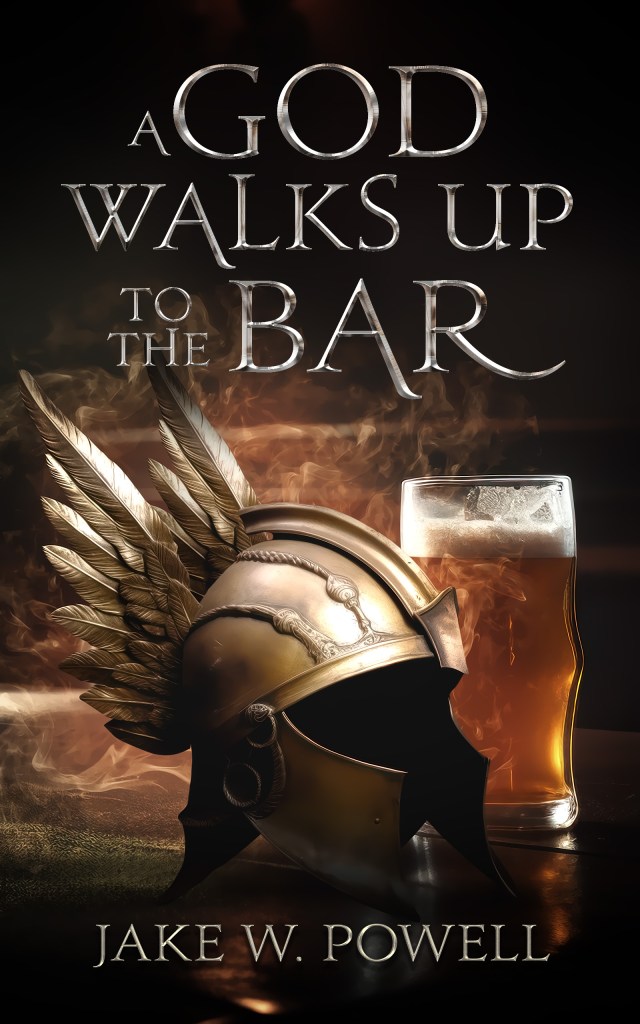
My first book, A God Walks up to the Bar, is available on Amazon.com. Witness the modern day adventures of the Greek god Hermes in a world much like our own – and with demigods, vampires, nymphs, ogres, and magic. The myths never went away, they just learned to move on with the times. It’s a tough job, being a god!

Image: “Dear Old Hat” by Muffet: Licensed under CC BY 2.0.

Writing Your First Draft: The Vomit Draft

Having gotten halfway through the first draft of my second book, I look back on the progress I’ve already made and have mixed feelings about it. On the one hand, I’m fairly confident my skill has improved somewhat since my first book. On the other hand, I see the myriad flaws still there and wish I could write a perfect book straight out of the gate. But writing is a feat where one plays the tortoise more than the hare. Slow and steady wins the race.

Also, the first draft of anything is going to be garbage no matter how hard you try. It’s just the nature of the beast.

In fact, I’ve come up with a nickname for first drafts: the vomit draft.

The first bout of writing isn’t necessarily pretty or neat. In fact, it can be downright ugly as you not only try to type out a coherent story, but also struggle with phrasing, dialogue, vocabulary, writer’s block, and coming to the grim realization that your story’s direction is slowly but surely veering away from your original vision. It’s a beautiful mess.

Knowing this, my goal in the first draft isn’t to write a masterpiece. It’s to just get all the words written. Spewing them out as they come to mind, as it were. Hence, the vomit draft.

We got to start somewhere, right?

Sometimes, I get frustrated and think that the garbage I’m writing is going to stay garbage regardless of rewrites. Sometimes, I go through a brief existential crisis as I wonder if being a writer is even my calling in life and maybe I should just stick to my day job. Sometimes, my mind struggles with even the most basic words. Who will want to read this?

But that’s not what the vomit draft is about. Making your story readable comes later. Right now, just get it all out. No holding back, no second-guessing, no graceful prose. Just write something to fill in the pages. It’s the foundation for what comes later. Every beautiful building is built upon a pool of poured cement. It’s not pretty, and it isn’t supposed to be.

Fortunately, nobody ever has to see our vomit drafts except ourselves. And we get a small consolation in knowing that this sorry state of affairs can and will become something much, much better.

If you just so happen to be enjoying my blog, feel free to subscribe. I post updates on my writing career, I muse over storytelling and fiction, and I reflect on the curious and wonderful things in life.

Image: “A sick cat” by wwhyte1968; Licensed under CC BY-SA 2.0.

Learning to Take It: Writing and Criticism

Criticism is a bit of a dirty word, isn’t it? Nobody wants it thrown in their direction. We fear it and worry that we might be its next target. More’s the pity, because criticism is a necessary part of the creative process. Heck, it’s a necessary part of being creative, period.

You learn to grow a thick skin when you’re a writer or artist or filmmaker. Putting your work out there … well, you’re going to get reactions. Some good, some bad, some just plain weird. When I gathered beta readers to read my work in progress, I asked for criticism. Demanded it really, because I need it. Where would we be without second opinions?

But the word has gone through an evolution that’s warped its original meaning. The way I see it, criticism isn’t a bad thing in and of itself. But look at how we use it in everyday conversation: “He criticized my tastes.” “She was critical of the restaurant he picked.” “They learned to ignore criticism of their actions.” It’s always in a bad context, isn’t it?

What criticism actually is is pretty simple: Evaluation of the quality of something. That’s it. Art critics evaluate the quality and merits of an art piece. Literary critics evaluate books. They are judges of whether something is good, based on more or less consistent criteria.

Oh, now there’s a dirty word. Judge. Who wants to be judged?

Well, if you’re writing a book, you’re going to be. People have opinions, and boy howdy are they happy to share them! Which can be a good thing, because otherwise how the blazes am I going to know if my work is any good or not? Or at the very least, if it’s having the effect on readers that I want it to have? And besides, plenty of people have stuff to say that is actually helpful and informative.

But criticism also invites the opportunity to show off one’s own creative side by inventing an endless tirade of elaborate insults that read well on websites and give people something to giggle at. Critics seem to have a knack for channeling their eloquence into spectacular putdowns. Doesn’t really portray the concept of criticism itself as something desirable.

Like I said, you have to grow a thick skin. And you have your own responsibility: Winnow out the kernels of useful feedback from the dross.

There’s positive criticism and there’s negative criticism. There’s evaluation of the failures and triumphs of your work. Listen, consider, and take the steps you need to improve. Criticism isn’t bad. We all need it to get better. Otherwise, we’re just working in isolation, never knowing if what we produce is truly worthwhile. And no writer can afford to be that solitary.  

Enjoy what you’re reading? Subscribe by email for updates on new posts and follow my writing career, musings on fiction and storytelling, and reflections about life in general.