How to Slay a Dragon, Part 2

Daddy?

What is it, kiddo?

I’m afraid to go to sleep. There’s a dragon outside my window.

Don’t be afraid. Be brave.

But dragons are scary! They’re so big and mean!

Then settle down here with me. Let me read you a story …

Do you remember being a kid? Do you remember the joys and the wonders? And the fears?

Kids quickly learn what fear is. Bravery takes a little longer to catch on. Sometimes, we need a helping hand.

Good thing we have fairy tales to teach us. They tell us that no dragon – no monster, obstacle, or problem – is invincible. They inspire us to surmount the impossible.

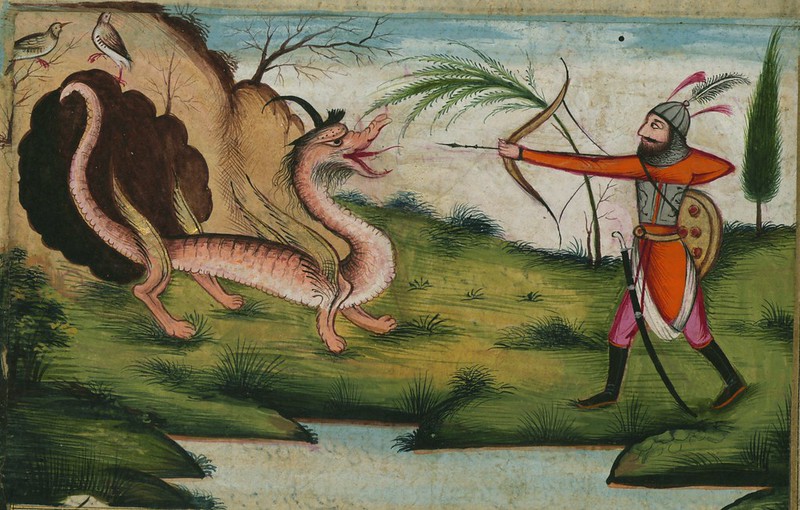
First, you have the setup: A dragon appears. The people tremble. It gobbles up their herds and destroys their homes. It sets up shop, and who’s going to ask a razor-toothed lizard the size of a semi to move? It may demand tribute – your daughters and sons will do, nicely, for starters. Oh, terrible day! What can they do to free themselves from this beast?

The dragon may have a name – Fafnir, Cetus, Smaug, Yamata no Orochi, Apophis – but just as often it does not. It varies in appearance, but its function is always the same.

Enter the dragon slayer. He, too, has many names, and he, too, is always the same person. He is the courageous one, the honorable one, the compassionate one. He takes pity on the poor villagers and vows to help them. He may be an underdog or he may already be renowned. Whatever the case, he fights the dragon. He slays the dragon. He wins.

Evil is beaten. Good triumphs. The nightmare ends.

These are the stories children read in fairy tales. These are the messages passed down by folklore from generation to generation. Evil doesn’t always have to win. There is a spark of hope in the darkness. The dragon slayer inspires us to realize that we aren’t stuck in the mud for the rest of our lives. Dragons aren’t unbeatable.

We grow up, and the dragons no longer look like giant lizards. They take many shapes and forms. They may be different for each of us depending on our circumstances, but we learn to recognize them. And we know that they can be beaten. Not with sword and spear, mind you. But with courage, perseverance, knowledge, and hope.

Because fairy tales taught us so.

Enjoy what you’re reading? Subscribe by email for updates on new posts and follow my writing career, musings on fiction and storytelling, and reflections about life in general.
How to Slay a Dragon, Part 1

Fairy tales do not give the child his first idea of bogey. What fairy tales give the child is his first clear idea of the possible defeat of bogey. The baby has known the dragon intimately ever since he had an imagination. What the fairy tale provides for him is a St. George to kill the dragon

G. K. Chesterton

Fairy tales are just for kids. That’s what they say, at any rate. Stories of adolescent fluff, beneath the notice of adults. When you grow up, you leave behind the silliness of youth, after all. Bogeymen and monsters and dragons are the stuff of kids’ nightmares, nothing more. Aren’t they?

Ponder this: Parents don’t teach their children that there is a monster under the bed. Where does the idea come from? Do kids instinctually understand that there are bad things in the world? The monster under the bed, the one hiding in the closet, the ghouls and dragons out to get you … Children fear these things. Indeed, children learn very quickly what it means to be afraid.

Every child knows in their heart that monsters are real.

Oh, dragons and bogeymen aren’t real. Those are just trappings. But evil is very much a real thing in this world. The monsters of youth never go away. Adults just learn to recognize them for what they really are.

What does all this grim talk have to do with fairy tales? Think of fairy tales as road maps. Entertainment combined with important facts about life. Stories are tricky things, wrapping up lessons in playful guises.

They teach us that yes, evil things do exist, and yes, they are scary. They give a shape to that indefinable dread all children feel. And then the child is able to give evil its first names: the Big Bad Wolf, the Bogeyman, and of course, the Dragon.

Children’s stories are a primer’s guide to evil. How’s that for a fractured fairy tale? And no, I’m not trying to ruin your childhood. We shouldn’t rip a fairy tale out of a child’s hand because it’s scary. Children already know what scary is. I certainly did growing up. But fairy tales teach children why monsters are scary.

The Big Bad Wolf will trick you and gobble you up! The Dragon is a greedy beast that breathes fire and burns down villages! Be afraid! Fear isn’t weakness, it’s smart to be afraid of things that are dangerous.

But what else is there to do? Are we to spend our whole lives shivering in terror of what lurks outside?

No, that’s not what fairy tales teach us. The Big Bad Wolf is slain by the brave woodsman. A hundred dragon slayers have slain a hundred dragons.

Evil can be defeated. That is the greatest lesson of fairy tales. That is why they endure. They give us hope. Like Mr. Chesterton said, they provide children with the knowledge that monsters can be beaten.

Fairy tales are primers on the dragons of life. They are also primers on how to slay those dragons.

Enjoy what you’re reading? Subscribe by email for updates on new posts and follow my writing career, musings on fiction and storytelling, and reflections about life in general.