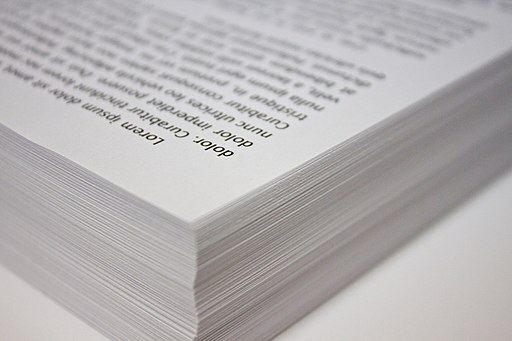
Image: “Stack of Copy Paper” by Jonathan Joseph Bondhus; licensed under CC BY-SA 3.0.
So, you’re writing your book. You feel pretty good about it. You got your first draft done, you send it to your beta readers, and the feedback starts trickling in. You take in the criticism and start your second draft. And you notice something odd. Many of your changes entail removing words, cutting out extra sentences, and shortening descriptions. Your word count is growing smaller. What gives?
Writing involves a lot of things. One thing I’ve discovered it needs is measurement. I don’t mean whipping out the tape measure to guess how thick your paperback will be. I mean making sure that every word matters. If your sentences go on and on and on then you’re going to bore your audience to tears, if you don’t just outright confuse them. On the other hand, using too few words can lead to your readers scratching their heads if you leave out important information. A writer is like a sculptor. He carves out the unnecessary material and leaves behind exactly what is needed to make the piece complete.
My first draft is the phase that I like to call “vomiting words.” Because that’s what I do. I get all my words out, regardless of whether they are good or not. First drafts are always garbage. There’s no helping that. But too many is better than not enough. There’s always plenty of time to parse things down later.
So, how do you make the most of fewer words? Here is what I’ve learned.
- Be simple. Don’t try to write fancy. Purple prose is like nitroglycerin. It blows up in your face at the slightest mistake. Don’t write “his face stretched into a wide, dour grimace.” Just write, “he grimaced.”
- Synonyms are your friend. There are single words out there that mean the same as three put together. Why waste space? Rather than “ran very fast,” you can use “sprinted” instead.
- Details matter to the plot. Readers expect the descriptions and conversations you include to have significance. So make sure everything you include in your final draft has a point! Don’t waste time on things that are irrelevant.
- Last, and certainly not least, don’t underestimate your readers’ intelligence. Unless you’re writing for three-year-old’s (and even then…), don’t treat your readers like idiots. They can fill in blanks for themselves, especially regarding mundane things. You don’t need to explain how someone puts on a shirt, or go into gross detail over the interior of an office building. Chances are, people already know. Let them exercise their imagination a little!
Of course, there are exceptions to these. There are always exceptions. And some stories are going to be longer than others, regardless. The point is not to trim everything out until only barebones, dry description remains. The point is to make your writing readable and coherent. Sometimes, you will have a very long and colorful description of a character or scene. If it’s appropriate for the story’s tone, or describes something that isn’t common knowledge, or the details will become important later on, have at it. But don’t overdo it. The point isn’t writing a lot of words. It’s writing just enough words.

The gods and beings of ancient myth never went away. They just moved on with the times.
My book, A God Walks up to the Bar, is currently available on Amazon.com. Venture into the world of the Greek god Hermes, a world filled with demigods, vampires, nymphs, ogres, magic, and trickery. It’s a tough job, being a god!
Enjoying my blog? Don’t want to miss a single post? Subscribe for updates on when I post and follow my writing career, musings on fiction and storytelling, and reflections about life in general!
 Jake W. Powell