
You start reading a book, or watching a movie, and the beginning is a banger. You’re hooked. The characters are great, the story is enthralling, and the action is incredible. The first act is a masterclass in storytelling.
As you continue, though, you feel a nagging sensation that something has gone wrong. You aren’t gripped like you were in the first twenty minutes. Why all this pointless dialogue? Why spend five minutes on a scene that has no impact on the rest of the story? Did someone put the plot on a lifeboat and set it adrift? It’s just … wandering aimlessly.
But wait! You get to the end, and the last ten minutes suddenly pick up. Boom. Bam. Bang. The plot is resolved, the heroes win the day, end of story. It’s satisfying enough, but you’re left wondering why 70% of the story just dragged on and on.
Or maybe you run into a story with the exact opposite problem. You feel out of breath after finishing it, like you were never given a chance to rest. Who’s this person and why are they – never mind! Moving on! More action! More spectacle! Can’t contemplate our navels now!
You’re rushing from set piece to set piece at breakneck speed. Movies especially love to do this. The story is just an excuse to show off the cinematography. Maybe there IS a good story there, but it’s been broken up by a frenetic pace that prevents it from properly unfolding.
Pacing. That’s the keyword. A good story has good pacing. It’s the invisible, unappreciated ingredient that is key to cooking a good meal. Folks know when they dislike the protagonist. They understand bad writing. A poorly constructed setting betrays its flaws just by being experienced. Audiences know these things. But pacing is more subtle. When the pacing’s poor, you don’t always know what’s wrong, but you can sense that something is off.
Pacing is the speed at which the story is told, in which everything, everything, you’ve written is unveiled at the times that best serve its progression, its development, the audience’s entertainment, and the impact of key scenes and events. Pacing is to storytelling like a metronome is to music. Go off-beat, and everything goes out of whack.
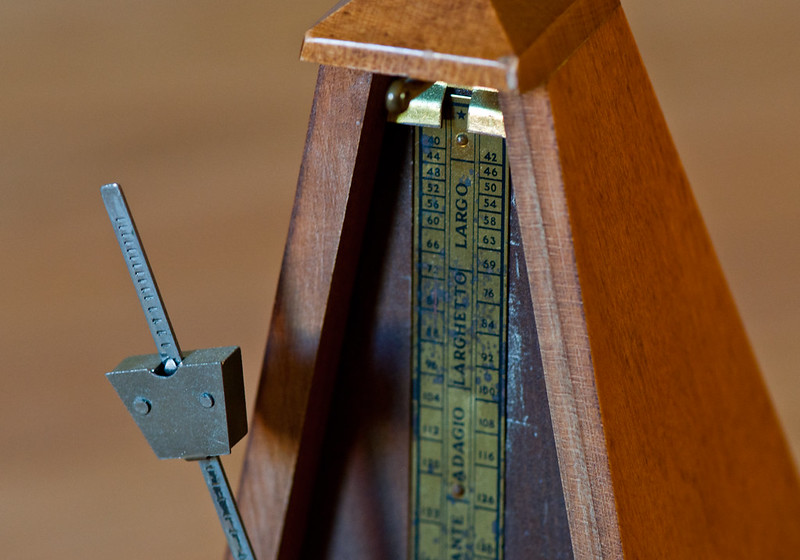
“Metronome” by jronaldlee is licensed under CC BY 2.0.
To continue the earlier food analogy, a story is like a meal. Pacing is the speed at which you eat the meal. Eat too fast, and you barely get to taste the food. Eat too slowly, and the food is so cold and stale by the time you finish that it can hardly be considered tasty anymore. A writer needs to be like Goldilocks and find the pace that is juuuust right.
Naturally, stories being organic things with a knack for growing beyond the writer’s original intention – things that you could swear have minds of their own – there is no magic formula to apply to a story. Each tale is unique. There are so many factors to consider: the genre, the story’s message (if any), the amount of dialogue versus action, the length of the story, et cetera.
Moby Dick is a classic of American literature. It’s also all over the place with its pacing, stopping suddenly to discuss the physiology of whales and the philosophical repercussions of pursuing vengeance against the natural world. But it is as much a philosophical and encyclopedic work as it is a fable of the cost of revenge, and its opening chapter tells you to strap in for a long, introspective ride. There are certain expectations one automatically forms when seeing how much space that monster takes up on the shelf.
On the other hand, a short story is quite the opposite. It’s a short story, and a reader doesn’t go in expecting long, drawn-out retrospectives on life, the universe, and everything. The plot is much more straightforward, and the pacing moves swiftly. If you expect to finish a story in one sitting, you aren’t going to be pleased if nothing worthwhile happens in that time.
I could go on and on about this topic. Its poor execution is one of my biggest pet peeves in writing. But then, a blog post is a short piece of literature, too, isn’t it? Yes, even blogs need good pacing, and though I may complain about it, I’m no master myself. Live and learn, and occasionally complain about things you yourself aren’t very good at. But not too much, that’s just bad form.
Enjoy what you’re reading? Subscribe by email for updates on new posts and follow my writing career, musings on fiction and storytelling, and reflections about life in general.
 Jake W. Powell