
Don’t let the title scare you away. I’m not talking about specific politics or social issues. Rather, this is about how fantasy can be a tool for analyzing society undercover. That is to say, the fantasy genre gives authors a knack for talking about real life without actually talking about real life.
Now, the fantasy genre isn’t real, obviously. That’s kind of the point. However, fantasy’s detachment from reality can give it a very unique perspective on the world we do live in.
This comes, I think, from the fact that the fantasy genre can be used to observe elements of our world by substituting real groups, issues, events, or locations with fictional analogues. These same analogues allow readers to perceive them more objectively than if they were the real thing. Real-life issues tend to get our defenses up, consciously or not, and we let our own biases color our lenses. Fantasy equivalents are, well, fantasy, so we don’t view them in the same way, even if they are equivalent to the same social issues that otherwise get our hackles up. It’s a bit of a literary trick, really.
Whether or not a writer gets their message across to the audience depends on two things: One, whether the readers recognize the subtext, and two, whether they connect the subtext with the correct issue. Yes, we must trust our readers to infer what we want them to infer. And sometimes, alas, they don’t. All writers reach a point where their authority dies, and their readership draws its own conclusions independent of the author’s intent. So, you might very well have been writing a hard-hitting social critique using elves and pixies, but the audience comes away thinking it was about the virtues of natural conservation rather than the consequences of war.
On the other hand, maybe your story has no message. You just wanted to write something fun and light. Yet, for some reason, readers are convinced there’s a hidden meaning buried in your writing. Tell me, dear reader, what is the message of Little Red Riding Hood? Is it just a story about a girl and her grandma who are eaten by a wolf, then saved by a woodsman, end of story? Or is it about:
The dangers of nature
Man’s triumph over nature
Listen to your parents
Pay attention to the task at hand
Don’t trust strangers
Rebirth from death into a better person
A metaphor for puberty
A metaphor for sexual predators
A metaphor for rape
A metaphor for how people read sex into everything
Axes are useful for killing animals
If you think a wolf looks like your grandmother, you really should buy glasses
And so forth.
Maybe we don’t really know for sure? Maybe there is no analogy, but there is applicability. Applicability is a very different animal. It is the reader’s independence of the writer and ability to view the story through their own lives and beliefs. In short, they see the story as matching their own notions.
Or maybe, we’re just thinking too hard about it all.
If you just so happen to be enjoying my blog, feel free to subscribe. I post updates on my writing career, I muse over storytelling and fiction, and I reflect on the curious and wonderful things in life.
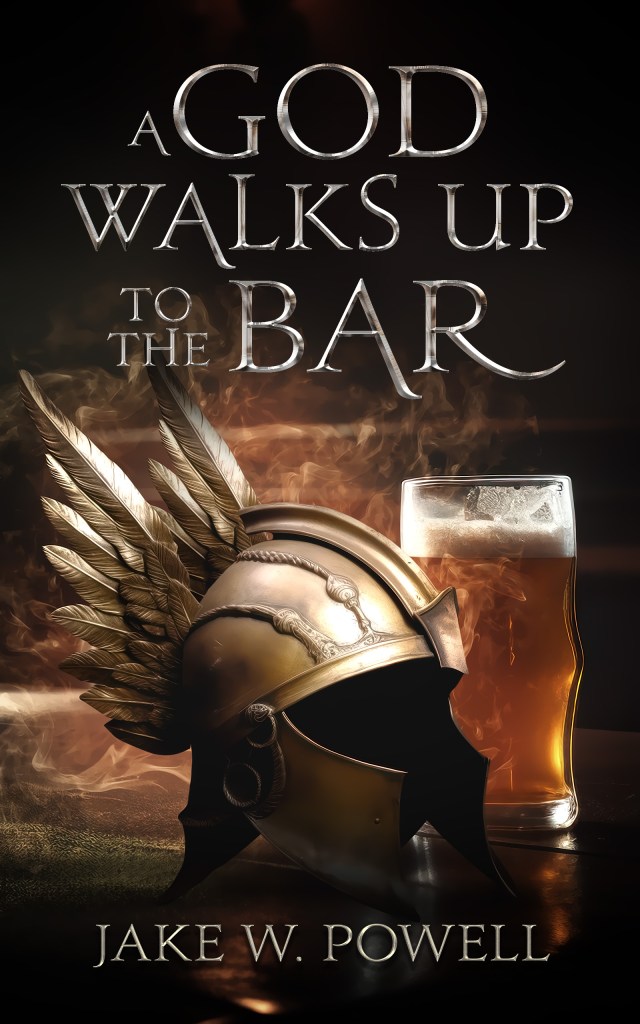
My first book, A God Walks up to the Bar, is available on Amazon.com. Witness the modern day adventures of the Greek god Hermes in a world much like our own – and with demigods, vampires, nymphs, ogres, and magic. The myths never went away, they just learned to move on with the times. It’s a tough job, being a god!
Image: “Dave Checking out the Perseid Meteor Shower at 10,000 feet“; Dave Dugdale; Licensed under CC BY-SA 2.0.
 Jake W. Powell