We engage in dialogue every day. We talk with people face-to-face. We type emails, send letters, conduct Zoom meetings, send messages via social media. We even talk with ourselves. Any conversation we hold is a dialogue, and wherever there are two or more people (or you and the voice in your head) there is conversation.
Since dialogue is such a vital part of real life, it is reasonable to assume that it is also important to writing. And this is true. Characters talk to each other, and the manner in which they speak and communicate is important. Everyone has their own voice, their own mannerisms, accents, affectations, slang, tone, rhythm, and personality. Most stories are going to have dialogue of some sort. They tell the reader who the characters are, how the world works, provide information about the plot, and so forth.
But unlike the real world, where two people can keep a conversation about absolutely nothing going for four hours, writers need to be choosier about what their characters say. Every piece of dialogue carries weight. And it can serve several purposes that can improve and flesh out your story.
So, what does dialogue do for a story? What point does it have? Well, I respectfully submit three here for your consideration.
Characterization
We know what people are like through the way they speak. The things they talk about, how they talk about them, and what they don’t talk about all tell us who they are. People reveal their personalities and values through their words. Actions may speak louder than words, but words still count for something.
Is a character brooding and moody? Witty and optimistic? Intelligent and thoughtful? Brash and shortsighted? The narrative can describe a character as such, but their dialogue should carry through on that description. Different people talk differently. Just consider all the people you know. Do they all talk the same? Do they all respond identically to any given situation or topic? How do their background and experiences influence their words?
Furthermore, characters change over the course of a story. Consequently, their dialogue changes. Perhaps a rude character becomes kinder, and his words are sprinkled with more empathy and compassion. Someone may become obsessed, and her dialogue slowly becomes fixated on a single focus.
Or a character surprises. The stoic deadpan warrior cracks a joke at a key moment, demonstrating he’s not as humorless as he appears. The comic relief offers heartfelt insight that inspires others to action.
Worldbuilding
“You’ve never heard of the Millennium Falcon?” “Should I have?” “It made the Kessel Run in less than twelve parsecs.” – Star Wars: Episode IV
“The Dauntless is the power in these waters, true enough, but there’s no ship as can match the Interceptor for speed.” “I’ve heard of one. Supposed to be very fast, nigh uncatchable. The Black Pearl.” “There’s no real ship as can match the Interceptor.” Pirates of the Caribbean: The Curse of the Black Pearl
What is the Kessel Run, anyway? If you’ve only seen the movie, you’ll never know. But it’s a challenge for space pilots to navigate, apparently. And there’s the subtle implication that the speaker is a no-name making empty boasts.
The Black Pearl apparently is a fairy tale among sailors, setting up the supernatural overtones of the Pirates of the Caribbean film franchise. Also, the British Navy has some really nice ships and isn’t to be taken lightly in this setting.
Do people explain everything when they talk to each other? Do they launch into a five-minute expositional speech whenever they mention something the reader or viewer doesn’t know about? No, they generally don’t, unless it’s in an appropriate context. People in real life make offhand references to stuff all the time with the assumption that their conversation partner understands. Sometimes they do, sometimes not. But that kind of dialogue in a fictional world makes the setting feel more real. There are things that characters take for granted, for instance, and there are legends and folklore that have seeped into the culture.
Explanations aren’t always necessary. Characters talking about this or that thing that’s never followed up on is more like a real conversation than prefacing every explanatory statement with, “As you know…”
We may not know, but the characters do. And as long as it isn’t vital for us to understand, it makes for a fun bit of worldbuilding.
Story Progression
Amazingly enough, characters tend to take action when someone tells them something. Shocking, isn’t it? The king commanding his loyal knight, the messenger arriving with bad news, the lovers making plans to escape to a new life, the villain announcing his diabolical scheme to his archnemesis … Dialogue moves the story along.
Character motivations shift and change as people learn more about each other. Alliances are made and broken. Riddles are solved and treasure maps deciphered. The plan to take down the evil empire is concocted. Plot revelations are, well, revealed.
A story can’t move along without communication. Dialogue is a bit like a meandering river. Each interaction is a journey downstream from one point to another. It can take a while, and there are plenty of sharp turns, and the destination can be radically different from the start.
Sometimes, all a story needs to get going is a quick and innocuous chat. Things have a tendency to snowball from there.
And these are just three ways in which dialogue is vital to telling a good story. There’s plenty more out there. Feel free to share any that come to mind in the comments. After all, what is the comments section, if not another way to have a conversation?
If you just so happen to be enjoying my blog, feel free to subscribe. I post updates on my writing career, I muse over storytelling and fiction, and I reflect on the curious and wonderful things in life.
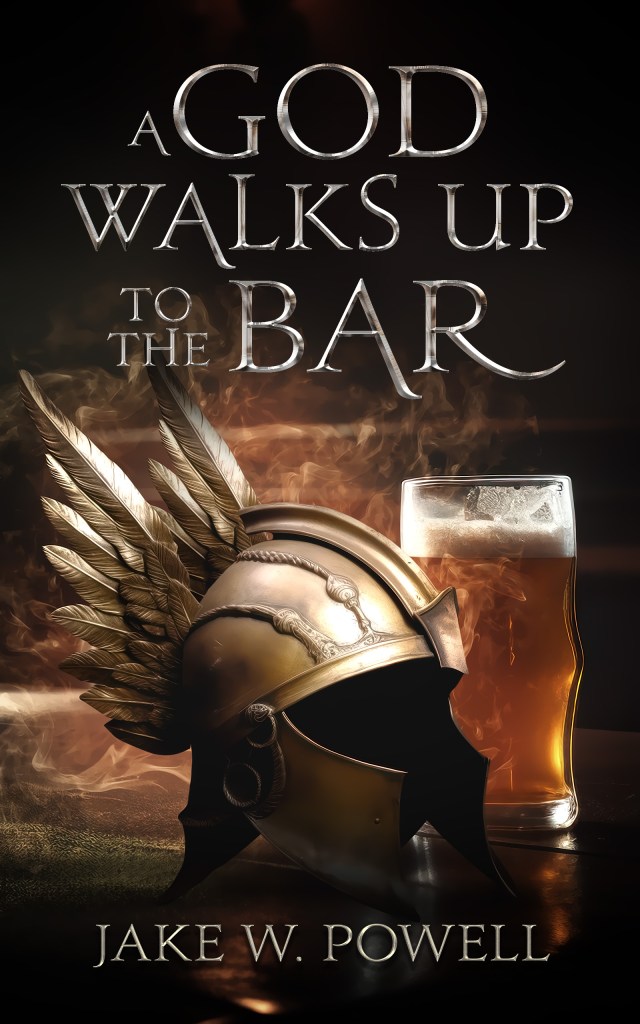
My first book, A God Walks up to the Bar, is available on Amazon.com. Witness the modern day adventures of the Greek god Hermes in a world much like our own – and with demigods, vampires, nymphs, ogres, and magic. The myths never went away, they just learned to move on with the times. It’s a tough job, being a god!
It’s the most wonderful feeling in the world. You start writing, and you’re off to a rough start. You struggle, you groan, you’re on the verge of calling it a day. Then the words start to flow, one after the other. Bam. Bam. Bam. The prose is smooth, the dialogue is superb, and your story just falls into place like a well-made jigsaw puzzle. Everything suddenly fits.
You get into your groove. The wheels turn without a hitch. You are rocking your writing session and just loving being along for the ride while your fingers type away and your subconscious pulls surprises out of the depths of your mind.
I’m in my editing phase at the moment, working on the second draft of my second book. It doesn’t have a name, yet. I’m still working on that. Mostly, I’m trying to make what I originally wrote into something coherent and readable. Sometimes, I think to myself, “I’m not much up for writing today, maybe just a paragraph or two.” Once I get started, I then think, “Well, a little bit more,” and again, “Huh, this isn’t so bad. I can work with this.” And an hour slides by without me noticing. Or two hours. It’s such a great sensation to be pulled into your writing, to let everything else fade.
A bit scary, too! I lose track of time. I start in the morning, I wrap up and look at the clock and – What! It’s already the middle of the afternoon!?
If I was a fish, then writing would be bait on a hook. I can’t resist. We all have that, don’t we? Our hook. Our favorite activity. The thing that gets us in the groove.
It really is a feeling that’s hard to beat.
If you just so happen to be enjoying my blog, feel free to subscribe. I post updates on my writing career, I muse over storytelling and fiction, and I reflect on the curious and wonderful things in life.
My first book, A God Walks up to the Bar, is available on Amazon.com. Witness the modern day adventures of the Greek god Hermes in a world much like our own – and with demigods, vampires, nymphs, ogres, and magic. The myths never went away, they just learned to move on with the times. It’s a tough job, being a god!
Tricksters are fascinating to read about and to write about. They’re the weirdos who exist on the fringes of polite society. They’re the ones who can get away with what other people can’t. They’re stick their tongues out at the world and make the rules work for them, rather than working according to the rules.
Tricksters are fun. They’re fun because, deep down, don’t we all enjoy seeing someone willing to say what we’re all thinking and doing what we wish we could? Tricksters are escapist characters. They pay back the jerks and the bullies, outwit the corrupt authority figures, and flout senseless and silly rules. We all enjoy our Robin Hoods and B’rer Rabbits.
Writing tricksters is fun, too. Writing the character of Hermes for my books has let me see the world from a different point of view. I suppose writing any character gives you such insights, but seeing the world through a trickster’s eyes …
They’re a surprisingly philosophical bunch. As characters whose primary role is to push boundaries and alter the status quo, they are naturally prone to questioning the point of things. Why are things the way they are? Why should (or shouldn’t) they change? Tricksters are the ones who can call out others for their actions and make the rest of the cast pause and think. And that makes for interesting writing. The archetype can fill all sorts of niches, whether the villainous anarchist, the secret mentor, the voice of reason, or the snarky smart aleck who gets all the best lines.
And then, of course, there’s the trickster as protagonist. Tricksters can carry a story all by themselves. By their very nature, they’re proactive. They get things done. The can save the day (or ruin it – protagonist doesn’t mean hero). Since the archetype is almost always transgressive in some way, he or she gets to give society a kick in the pants, usually by acting so outrageously or cunningly that nobody knows what to expect next.
Speaking of cunning, writing tricksters has also taught me a bit about plotting out, well, plots. I sometimes feel like we live in an age of fiction where schemes and trickery must be excessively complex. Writers like to create grand conspiracies, when a trickster is just as likely to tap you on one shoulder while standing on the opposite side. Committing a trickster like Hermes to the page has shown me that deception can be much simpler. Tricking people doesn’t really seem to be that hard. Often, it’s just a matter of reading people and playing up to expectations. Or remembering that most people just want today to be the same as yesterday and aren’t expecting to be hoodwinked. Then again, written characters also behave according to how the author has plotted them to behave, so maybe I’m just blowing smoke.
So, tricksters upend the social order. They slip into different roles with ease. They’re many things to many people. What they aren’t is moral, upstanding role models.
But …
What if a trickster tries to be moral? Is such a thing possible? Trickery is lying, and lying is immoral. Can you reconcile the trickster archetype with the hero archetype? Transgressing social values and upholding them? Can the two be melded? A liar with a moral compass? Can a trickster follow right and reject wrong? Can anything truly good come from trickery?
Very interesting philosophical musings, indeed. I’m still messing about with such notions in my writing. My version of Hermes is developing as I go, revealing new facets of his personality as my works progress. Tricksters aren’t simple characters, after all.
If you just so happen to be enjoying my blog, feel free to subscribe. I post updates on my writing career, I muse over storytelling and fiction, and I reflect on the curious and wonderful things in life.
My first book, A God Walks up to the Bar, is available on Amazon.com. Witness the modern day adventures of the Greek god Hermes in a world much like our own – and with demigods, vampires, nymphs, ogres, and magic. The myths never went away, they just learned to move on with the times. It’s a tough job, being a god!
This is the second half of my short story excerpt from A God Walks Up to the Bar. Go here to view the first half.
—
I walked into a scene right out of a 1930s gangster movie. Five men sat around a table playing cards, cigarette smoke hovering over them like angry clouds. The scent of alcohol wafted from half-empty liquor bottles to mingle with the smoke. Five faces looked up as I entered and stared daggers into me.
It was quite the diverse crew Stauffer had. Sitting closest to the door was a squat, grey-skinned goblin. To his right was a great hulk of a man whose tree-trunk arms cordoned off a quarter of the table as he guarded his cards. Another half-ogre. Across from him sat a man whose face was entirely covered in a bristly black beard save for his red eyes. To his left was a slender, fragile-looking man with ash-colored hair who exuded magical power.
And then there was Arnold Stauffer, seated in his armchair on the far side of the table facing the door. He had a cigar in his mouth and a hand of cards in his thick fingers.
We Immortals are a funny lot. As our kind drifts along time’s currents, watching civilizations rise, rule, and fall, many of us beach ourselves along the way. Some are just too stubborn and irked by keeping pace with changing times. They lose track of the eras and fixate on one specific point. It may be a particular century, decade, or even one notable year. They cling to that time’s fashions for so long that they become walking anachronisms, lodged in attitudes and styles long since abandoned.
Not easy individuals to deal with. It’s hard to negotiate with someone who not only dresses like they’re in the Elizabethan era but talks and acts like it. You want to laugh, but then you remember how easily they can strike you with lightning and plague if you offend their obsolete sensibilities.
Stauffer had started his rise to power in 1920, so the period had sentimental value to him. His aesthetic clung to “Prohibition-era gangster,” suits, Tommy guns and all. It was a style that really didn’t fit him. The sharp-cut suit clung awkwardly to his hulking frame so that he looked like an angry boulder wearing a necktie. His pencil mustache clashed with a jagged nose broken in three different places. His slicked black hair was a hilariously tiny patch on top of a craggy, oversized skull.
Stauffer wanted to look a gentleman, but that’s hard to do when you’re a primal incarnation of nature’s fury.
He was a half-jötunn — a descendant of the giants of the north. They were sovereigns of nature’s wrathful aspects. Their kings had shaped mountains, unleashed fire and magma from the earth, stirred up hurricanes, and rained down hail and thunder. And here was Arnold Stauffer, the blood of King Thrym running in his veins and eyes swirling like a storm, trying to conceal that heritage with a side-combed haircut and bespoke suit. Seeing a manifestation of cataclysm dressed up like Al Capone and playing poker? It was surreal. Absurd.
Stauffer leaned back in his chair and took a long drag from his cigar. Smoke billowed out of his mouth as he spoke.
“Mister, I hope for your sake that you’re someone very important.”
I bowed. “Lord Hermes of Olympus, Herald of the Dodekatheon, who speaks with the voice of Lord Zeus to Arnold Stauffer of the bloodline of Thrym.”
Stauffer put down his cards. “Proof?”
I sighed inwardly. There had been a time when this was easy. When those words made people snap to attention. I took off my ring and tossed it to him. He caught it and inspected it for a moment, then he threw it back.
“Lord Hermes himself. What an honor. What a privilege.” He spat the words out like curses. “So, what does the old fart on the mountain have to say? What horrible punishment will he rain down on this old sinner?”
He laughed. His minions half-heartedly joined him but kept their heads down. Only Stauffer dared look me in the eye.
“Punishment?” I raised an eyebrow. “This isn’t about punishment. We’re civilized folk in a civilized age. Lord Zeus recognizes your authority and your bloodline and so is willing to show leniency. We can resolve this matter quickly and painlessly.”
Stauffer said nothing but waved at me with his cigar to go on.
“The message, to wit, is this: For the past six months, you have been expanding your operations in this city. You approached a man named Zachary Jensen, owner of real estate that you desired. This man is a scion of Lord Zeus. You knew this.”
Stauffer watched me with an indifferent expression. His minions shuffled a little in their seats. Their bodies were tense.
“Five days ago, you invited Mr. Jensen to a restaurant under your ownership and offered him money in exchange for his property. He declined. It is understood by Olympus that he refused … harshly, replying with insults against you and your lineage. The following night, when he arrived home, he was attacked by four men and beaten almost to death. Olympus knows it was at your order. Do not deny it.”
“I never did.”
“In harming a child of the Olympians, you displayed gross disrespect towards Lord Zeus. However, he is willing to show mercy as long as proper compensation is made. Namely—”
“I don’t kowtow to old gods!” Stauffer shouted. “I won’t—”
“Firstly,” I carried on resolutely, “you will affirm here and now your intent to abide by the rules of the Contract. Our law forbids Lord Zeus from taking direct retribution against you and your own within New York, a recognized Free City. So, too, does it forbid your organization from laying hands on any recognized demigod.”
Stauffer bared his teeth in an ugly smile. “I was within my rights. He insulted me and so I —”
“Secondly, you will provide compensation for the injuries done to Jensen. This compensation will consist of two million dollars taken out of your organization’s profits.”
At this, the table rumbled with angry mutterings. Stauffer’s defiant grin grew larger.
“In one week’s time, representatives from Olympus will arrive here to collect the money. And finally, the restaurant at which you met Jensen will, freely and by your own hand, be gifted to Lord Zeus. You will hand over the deed and all other necessary documentation to the Olympian representatives, and Olympus will take up management of the premises. In so doing, you will have displayed proper atonement for your crime.”
I saw the anger in Stauffer boil hotter with every word. As I finished, he shot up from his chair and slammed his hands on the table.
“I refuse,” he said. “I will give Olympus nothing. I don’t jump when you bark. I don’t roll over and show my belly. You and your kin, all you so-called ‘gods,’ have no power over me. Over anyone in this city.”
He exhaled a heavy breath, and the smoke billowed out like from a dragon’s den. “Look around you. Look anywhere in this city. Humans, goblins, trolls, satyrs, djinn, jötunn, all of us, we go about our lives without a thought given to you. You’re nothing now but curiosities in museums, characters in comic books. You’re just fantasies. Nobody really remembers you. We’ve moved beyond you.”
He stretched out his arms, inviting me to challenge him. “The god Thor killed my ancestor Thrym, but his successors watched Thor die at Ragnarök and spat on his corpse. They watched all you Immortals bicker and slaughter each other. You destroyed your own empires, and the mortals hated you for it. You thought making your Contract could help you rebuild. But what happened next? Science came and explained you away. Philosophy killed any faith left in your kind. Technology made you obsolete. And what did you mighty gods do when the prayers stopped? What happened when the temples were left to crumble? Nothing.”
I scratched my neck idly as I listened to his rant. I might as well let him get this off his chest.
“You don’t have any power. You’re just tired old dogs bound by your precious rules. Because without the Contract, you’d tear yourselves apart again, wouldn’t you? And you, Hermes, you’re just an over-glorified errand boy.” Alright, that made me perk up. “You lay a finger on me, and you violate your laws. So, all you can do is spout empty threats. Get out.”
He finished and glared at me triumphantly. I nodded as if acceding to what he said, and strolled past the table. I noticed a ratty-looking couch in the corner and sprawled out on it.
“You know,” I said, “I think there’s a fundamental misunderstanding going on here. Olympus isn’t threatening you. I’m not threatening you. I’m stating facts. You made a mistake, and now you have a chance to make it right. Because, you see”— I held up a hand to cut off another interjection— “this isn’t about the rules. This isn’t about intimidation. This is about the balance of power. You can appreciate that, right? Someone pushes you, you push back. Someone rocks the boat, you tie him down to keep it from capsizing. You can’t get away with mauling demigods without some sort of consequence. What sort of bad precedent would that set?”
Stauffer snorted. “New York is a Free City. The Immortals have no jurisdiction here. We aren’t under any pantheon’s authority.”
“You willing to test that theory? True, no pantheon has direct control over a Free City. It’s neutral ground. But neutral doesn’t mean safe. The Contract is fabulously complex. All sorts of loopholes. Oh, and chew on this: If you walk away from this scot-free, then everyone and their mother who hears about it will figure they can, too. Who’s stopping the supernatural community from settling old grudges and maybe starting a few wars? Maybe even come gunning for you. Who’s going to step in and put a stop to it?” I thumped my chest. “Us. The Immortals. Because we keep the balance.”
Stauffer’s eyes wavered for a moment, but his sneer reasserted itself, and he shook his head.
“I know,” I said coolly, “you’re the big boss. You call the shots. Who can touch you? But let’s think back, shall we? Why are you the big boss? Because you got lucky. Your forefathers are still hiding in Scandinavia, ragged and forgotten, because Ragnarök screwed them over just as badly as it did Thor’s family. So here comes a young man, full of ambition, newly arrived in America, with nothing but brawn, a tangled family tree, and a desire to prove his people still matter. And New York had just come out of a nasty gang war among the supernaturals. I remember. I was there. The war left a power vacuum. Lucky you. You put that brawn to good work and filled the hole.”
“Because I was strong enough,” Stauffer replied. “I took what I wanted and I kept it.”
“Spare me, Arnie. If they were still around, the old families wouldn’t even have noticed you. You’ve never known until now what it’s like to compete in the big leagues. But you’re finding out, aren’t you? The Aristocracy is breathing down your neck. You’ve angered Olympus. Suddenly, the dog is facing the wolves, and what does he do? He hides in a backroom playing poker. Where’s that jötunn pride? Where’s the bravado of the people who watched gods die? Let’s see some strength, Arnie, not big talk.”
This had exactly the effect I knew it would. Wounded pride overcame Stauffer’s self-control. Shaking all over, he walked towards me, fists clenched and breaths coming out in ragged gasps. He stood over me, and I knew from the look in his eye he wasn’t going to let me walk away now.
“Say it,” he whispered. “Just say it.”
I frowned. “Say what?”
“Tell me what you think I am. Say it to my face.”
“Arnie Stauffer? Crime lord of East New York?” I counted on my fingers. “Defier of the gods? Descendant of Thrym, who got his head bashed in by Thor like a chump? Tall, angry man looming over me with murderous rage in his eyes?” My face lit up. “Oh! Do you mean back-stabbing, opportunistic, cowardly piece of meat?”
His hands shot out and grabbed me. He wrenched me off the couch and threw me across the room. I landed on the table. Its occupants backed away as I rolled across and onto the floor, taking beer bottles, cards, and poker chips with me.
I wasn’t down for long. I jumped to my feet, fists at the ready, my mind bandying various strategies on how to win. Because I knew I was going to win.
“Kill him,” Stauffer barked.
I sighed inwardly. Thousands of years of hard-learned lessons, yet folks never really learn.
The slender pale man began muttering under his breath and made a sign with his hands. As the spell manifested, his skin turned white as milk and blue runic symbols shone on his skin. A troll.
I didn’t have time to take him out, though, because I felt a sudden searing pain in my left arm. I turned to see the bearded man gripping me with hands glowing red-hot. He opened his mouth, revealing four rows of razor teeth. I chided myself for not recognizing a ghūl when I saw one.
I twisted my body away from his grip as he tried to bite my arm. With my free hand, I drove a right hook into his head, hitting him hard enough to spin him around. He released my arm, which I promptly used for a jab between the shoulder blades that knocked the wind out of him.
As the ghūl fell to his knees, I felt a constriction around my whole body. The troll was working his magic, weaving cerulean strands of light around me like a rope. I grunted and made towards him, but the bands of light were strong enough to halt my movement. Alright, I admitted to myself, this may be a tad more difficult than I had anticipated.
Then the half-ogre joined the fun.
He rushed past the troll and head-butted me. His skull connected with my jaw and propelled me into the wall with a loud crack of cheap plaster. Still trapped by the troll’s magic, the best I could do in response was an upward kick that looked more like an impression of a flopping fish. The thug threw me to the floor and stomped his foot down — he actually stepped on me! — and drove it as hard as he could into my chest. I think he was surprised that my ribcage didn’t give in.
Enough was enough. The troll was tripping me up with petty magic, the ghūl was regaining enough of his senses to make another go at a taste test, and a half-ogre was literally walking all over me. Time to get serious.
I channeled my own power into breaking the spell. The troll was competent enough but only competent. I envisioned the entangling bands breaking apart. Reality responded to my demand, and the spell swiftly disintegrated into motes of fast-fading light. Several of the motes caught the half-ogre in the eyes. He grunted in pain and backed away as he covered his blinded eyes with his hands.
Able to move freely again, I flipped to my feet in time to catch a bite in the shoulder from that freaking ghūl. I gritted my teeth and elbowed him hard. His head snapped back, taking a nice chunk of my shoulder and jacket with him.
I laid into the half-ogre. A flurry of punches to the stomach softened him up, and a left hook to the hip cracked bone and made the brute double over. I delivered an uppercut that put him back into a standing position before I wrapped a hand around his waist, put my other hand beneath his arm, and lifted him over my head. A flawlessly executed vertical suplex slammed him into the table, splintering it and leaving the half-ogre groaning on the floor.
Incidentally, not many people do their homework on me. They’re so hung up on the “Messenger of the Gods” title that they fail to appreciate my many other admirable attributes. Such as my divine mastery of boxing and wrestling. No man or woman, mortal or otherwise, can beat me in a boxing match. Play fair or cheat, you aren’t going to win.
The troll saw his comrade go down and tried to run. I grabbed him and spun him around to face me. His mouth and eyes formed perfect “O”s when I drove my fist into his chest. He flew across the room into the door. It didn’t break, and he fell down face-forward. He didn’t get back up.
The ghūl was having troubles of his own. He choked and stumbled around as his eyes glazed over. The liquid dribbling from his mouth hadn’t agreed with him. He was quickly learning that the blood of gods was poisonous to mortals. I took him down with an offhand punch.
Stauffer hadn’t budged an inch from where he stood. He was transfixed on me with a mixture of rage, amazement, and stark fear. I turned to the goblin, who hadn’t joined in the fight at all. I lifted an eyebrow. Stauffer also looked at his minion and jerked his head at me.
“You serious, boss?” the goblin scoffed. He jumped over the prostrate troll and bolted out the door.
Stauffer growled a sharp curse.
“You’ll pay for this. You’ve assaulted me on my own property. You’ve violated the Contract, and heads will roll. Mark my words.”
I cracked my knuckles and laughed. “Mark my words, Stauffer, you started this fight. The only head that would roll is yours.”
“You provoked me!” Realization dawned in his eyes. “You wanted this fight to happen!”
“Maybe, maybe not. But it happened. And you started it. You think I’ve breached the Contract, take it up with the High Court. It’s your word against mine.”
“Maybe I will.”
“You do that. Olympus is part of the High Court. My father sits on it. The god you offended.”
His eyes practically bulged out of his head.
“And, I hate to say it, but you are part jötunn. The gods haven’t forgotten what your kind did to Asgard. Take a case to the Court, see what happens.”
“You …You …” He was too angry to form words. Finally, he snapped and charged me.
I was ready. I sidestepped his haymaker, drove my fist into the soft flesh below his ribs, and stuck my foot in front of his leg. He tilted forward ponderously and hit the floor with a heavy thud. He rolled himself over onto his back. He looked up at me, gasping for breath.
“You piece of … You little son of a—”
“Ah-ah!” I wagged my finger. “Blasphemy! Don’t want to add that to your list of offenses.”
I took stock of the scene. The room was trashed, four men were lying on the floor in varying states of consciousness, and I was standing there with my favorite jacket ruined and a piece of my shoulder missing. All in all, things had gone fairly well.
“One week, Stauffer,” I said as I walked away. “You have one week to come up with two million dollars. Olympus’ representatives will be here.” I paused at the door. “They won’t be as polite as me.”
At the sight of my torn clothes and blood — and the sight of my ripped flesh knitting itself back together even as I walked along — the tavern’s occupants looked away from me and became very focused on their drinks. I noticed that Mark was absent. The old man who’d been sitting with him caught my eye and nodded to me with a noncommittal expression.
I walked up to the bar and demanded a shot of whiskey. The bartender obliged me with all due haste. I downed it, put the glass down, and walked out of the bar. The bartender wouldn’t have expected me to pay, anyway.
I was back in the awful drizzle, a little the worse for wear, but in high spirits. I strolled down the sidewalk, happy to be done with that chore and ready for a night of relaxation and enjoyable company. A night at The Vine sounded like just the thing for me.
It had been an exciting errand, certainly, but not anything particularly special. In the grand scheme of life, of all the things I had done and seen and said, this was a minor event. A petty task. Just another message successfully delivered.
If you just so happen to be enjoying my blog, feel free to subscribe. I post updates on my writing career, I muse over storytelling and fiction, and I reflect on the curious and wonderful things in life.
My first book, A God Walks up to the Bar, is available on Amazon.com. Witness the modern day adventures of the Greek god Hermes in a world much like our own – and with demigods, vampires, nymphs, ogres, and magic. The myths never went away, they just learned to move on with the times. It’s a tough job, being a god!
Well, I’ve talked a lot about writing on this blog, but I’ve never actually posted any of my work yet. I thought today that I would post an excerpt from my first-ever published book, A God Walks Up to the Bar. It’s an anthology of five short stories, connected by a framing story, that details the adventures of the Greek god Hermes in modern day. Read and enjoy!
—
The night was gloomy in that part of New York. There was no glamor here, no joyous nightlife. There was just rain drizzling down half-heartedly, covering the sidewalk in a dirty wet sheen that reflected the glare of the streetlights. It reminded me of how long I’d been putting off that vacation to Aruba, and how nice it would be to lounge in the jacuzzi in my apartment. But, alas, no such luxuries tonight. I was on business. The messenger had gotten his assignment, and like the intrepid mail pilots of old, he must get through.
I tromped through the puddles and arrived at my destination. It was a real hole-in-the-wall bar. Its owner had spared no expense in stripping it of the slightest feature that would impress itself in memory. There was no sign, the windows were darkened glass, and the entrance was a blank gray door at the bottom of a flight of concrete steps. I descended and walked inside.
It wasn’t much more cheerful inside the tavern than out. Battered hanging lamps cast everything in a dim reddish-orange tint. The floor was slick with grease, and the air was sour with the scent of cheap beer. It was well into happy hour, but the clientele was sparse. I counted six men hunched over their drinks and making small talk. A couple of them glanced up and appraised me with cold eyes.
This wasn’t a place where people gathered for a good time. This was where you came when you had to conduct business that was frowned upon by civil society. An unfamiliar face like mine wasn’t welcome here. Still, they did little more than scowl at me as I approached the bar.
The bartender had just stepped out of a backroom lugging an icebox when he saw me. He set down the box and fixed his eyes on me. His voice was brusque.
“What’ll it be?”
“Nothing, tonight,” I replied. “I’m here to see your boss.”
The bartender frowned and tilted his head.
“I’m here to see Stauffer,” I clarified.
The man’s eyes narrowed.
“Who wants to see him?”
I set both my hands on the bar counter. I immediately regretted it — the wood was sticky with spilled alcohol — but I wasn’t about to show squeamishness. I pushed my right hand forward and curled my knuckles, displaying the ring I wore.
A gold ring with a seal displaying two serpents wrapped around a winged staff. The Caduceus. My personal symbol.
The bartender’s frown deepened. He recognized it.
“You’re an Olympian,” he said slowly.
“That I am,” I replied with a friendly smile. “Hermes of Olympus, Swift-runner and Wayfarer, Herald of the Dodekatheon, et cetera, et cetera. I’m here to see Arnold Stauffer with a message straight from Lord Zeus. And I fear it must be delivered face-to-face.”
He scratched his chin thoughtfully. “Sorry, my lord, but I can’t say I’ve—”
I held up my hand. “Tell you what. Let’s skip the part where you pretend that he conveniently stepped out a few hours ago and you don’t know when he’ll be back. I know he’s here. Does that sound good to you? Good, that’s settled. Now, just point me to his room, and I’ll be out of your hair faster than a Valkyrie can chug mead.”
The bartender gave a short, ugly chuckle. “He won’t see you today, my lord. He’s busy.”
“Oh!” I replied in mock horror. “He’s busy. Olympus forbid.” I leaned farther forward. “If it’s trouble you’re worried about, I’m not here to knock heads and pull ears. It’s a simple message. A communiqué. A heaven-sent singing telegram, if you will. Minus the singing.”
My words didn’t make much of an impression, but as I spoke, I took a moment to throw a casual glance across the tavern. I noted the hallway leading deeper into the building. I turned again to the bartender.
“He in back? Tending to the affairs of his kingdom?”
“He ain’t seeing you. Not my call.”
Stauffer had been expecting someone to show up. No surprise there. He knew what he’d done. And yet, he still thought he could keep me away. Adorable.
I took several meaningful steps toward the hallway. A man sitting at a nearby table slowly got up and stretched in a way that drew attention to his height and formidable musculature. His drinking buddy, a much older fellow than the rest of the barflies, remained seated but watched me carefully.
The standing man looked at me with a face that shone with arrogance.
“Must not have heard the man,” he said in a loud voice. “Arnie doesn’t want to be disturbed. So why don’t you skip out of here, Olympian?”
He gave me a predator’s grin and glanced at his friend who was still watching me. I sized up the gatekeeper. Tall, stocky, thick-skinned, with a greyish tint to him. Ogre blood. Not to be trifled with. Judging from the way his hands were open and held close to his side, I figured he was armed. Knives most likely. His jacket wasn’t thick enough to conceal a gun. He looked down at me, which isn’t hard to do to a god who’s five feet eight inches tall.
I sighed in defeat.
“Well, that’s a shame. It was worth a shot, though, wasn’t it, Mark? But you’re right, we don’t want to make a fuss. It is Mark, isn’t it?”
The man’s right eye twitched slightly at the casual mention of his name.
“Right, Mark Yeager.” I nodded as if I had just remembered. “You do a bit of leg-breaking work for Stauffer. Real smooth operator. A pawn shop here, a diner there. Very efficient, really rising in the ranks. Even got your own thing going, too, I’ve heard. A bit of burgling on the side when not on Stauffer’s payroll?”
Mark tried to laugh it off, but that telltale twitch in his eye didn’t go away. He wouldn’t make much of a poker player. “What are you trying to do, scare me? I’m a plumber.”
“Yeah, yeah.” I laughed. “That was pretty dumb of me, wasn’t it? You do good work, I’m sure.” Mark smiled mirthlessly at me as I took a step back. The tension in his body drained away, just in time for the gut punch.
“You, uh, did a real good job unclogging the pipes at Ezra Connolly’s place, I heard.”
The comment caught him off-guard. His nostrils flared, and his throat tightened. Jackpot.
“Unclogged his cabinets later that night, too. Pretty slick work.” I waved my hand across the tavern. “The guys must have really been impressed. Not easy, breaking into the home of a member of the Aristocracy.”
“What’s he talking about, Mark?” the white-bearded man asked calmly.
Mark shook his head, trying to shrug off the question. “Nothing. He’s just blowing a load of—”
I cut him off. “And is Stauffer having trouble with the Aristocracy?”
They all remained silent, watching me now with undivided attention. They knew the answer. The Aristocracy was controlled by vampires, a world-spanning criminal empire that suffered no insult. Its network in New York had been harassing Stauffer’s operations for a couple weeks now.
“Didn’t Connolly mention something to Stauffer? Something about being disrespected? About his territory being violated? Hey, Mark, you doing alright?”
The other men turned to observe Mark with acute interest. He wasn’t holding up very well under the scrutiny. His eyelid was practically short-circuiting, and his face was turning a violent shade of red.
I took a step closer to him. “You know how vampires are. Once they get it into their head that they’ve been slighted, they’ll go through fire and water to even the score. Man, I’d hate to be the guy who ticked them off. Vampires have a really interesting idea of justice. It involves lots of sharp, jagged objects. If I were Stauffer, I’d be looking for that idiot who messed up and just hand him over. So, anyway, how is the plumbing business nowadays?”
“Alright!” Mark erupted. “I get it. You think you know stuff.” He glared at me. “I’m loyal to Mr. Stauffer. And you ain’t passing through here.”
The white-bearded man whistled in derision. “He’s a god, you idiot. He’s not trying to force you to stand down. He’s proving a point.” He jerked a thumb. “Step aside.”
Mark shot a look at him. “But—”
“Shut up and get out of his way.”
Crestfallen, Mark stepped to the side, letting me pass. The old man raised his glass to me.
“Well played, Lord Hermes.”
As I walked away, I heard his voice growl, “Sit down, Mark. I think we should talk.”
A key rule of bluffing is confidence. Did I know with dead certainty that Mark was a thief? No. But I knew just enough. I had lots of little birds all over the city telling me things, and this was one of the nuggets they’d dropped me. It was all gossip, truths, and half-lies, and who knew which was which. But I had played this game before. Drop a hint, watch the opponent buckle, and then push him a little more. Never falter, never stutter, and always let them believe you already know everything. I’m a god, aren’t I? Everyone knows gods are all-knowing.
Well, I had gotten that roadblock out of the way. Now, it was time to deal with the big man himself.
There was a solid oak door at the end of the hallway. It was a fancy door, far more ornate than anything else in this place. I felt the faint pulse of magic emanating from it.
I put my hand on the doorknob and was immediately stung by a shock of intense cold that coated my palm in frost. An enchantment to ward off intruders. Clever.
But this was low-grade stuff. I focused my thoughts and pushed back against the enchantment. The magic sputtered and dissipated, and I felt the cold fade away. It took another second to take care of the lock. I opened the door and stepped inside.
To be continued …
If you just so happen to be enjoying my blog, feel free to subscribe. I post updates on my writing career, I muse over storytelling and fiction, and I reflect on the curious and wonderful things in life.
My first book, A God Walks up to the Bar, is available on Amazon.com. Witness the modern day adventures of the Greek god Hermes in a world much like our own – and with demigods, vampires, nymphs, ogres, and magic. The myths never went away, they just learned to move on with the times. It’s a tough job, being a god!
What makes a story a story? What’s the fundamental element that every story has in common, regardless of genre, author, era, or medium? What is something that every, absolutely every, story must have in order to be a complete and whole narrative?
The answer: It ends.
“Oh, well done, Jake,” you might be thinking. “Congratulations, you jumped online to state the mind-numbingly obvious.” Well, yes, it is obvious. So obvious, in fact, that it curves back around to becoming easy to forget just how important it is that stories have conclusions. And, in fact, a lot of people nowadays seem to have forgotten that it’s important for the quality of any story, whether a book, a comic, a movie, a video game, or whatever, that it eventually comes to a stop.
Every narrative has a beginning, a middle, and an end. This is the basic structure. So, unless you’re going for something avant-garde, this is the way that every story is written. You start at the beginning, work your way to the end, then stop. Obvious.
Why is this so important? Because a story that never ends ceases to be a story.
Endings are important. Maybe they’re even more important than beginnings. Endings wrap up the plot. They give closure to the characters’ arcs. They tell the audience that that’s all, folks. Whether or not they satisfy us, endings close the loop. They give a story its shape, like how our backbones keeping us humans from being floppy, wiggly things squirming on the ground. A writer works her way toward the ending. And when she gets to the ending, she knows that there’s no more. There’s a boundary there, a limit that gives focus to what she writes, because she knows that she shouldn’t go beyond the finish line. Writers need their stories to end.
One of my favorite pieces of fiction is the newspaper comic Calvin and Hobbes by Bill Watterson. It’s just fun, brilliant writing and art. It was also very successful. So successful, that Watterson could have kept it going for a long time. But you know what he did? He didn’t. When he felt that he had told every story he needed to, he chose to end the comic. Isn’t that something crazy? To end an ongoing serial at the height of its popularity? Not many people have the courage to do something like that. But the final Calvin and Hobbes comic is something special. It sums up the spirit of the work and ends on a high note. Waterson knew that his story needed its conclusion.
He was tapping into something ancient and mythical, believe it or not. All the great sagas of the ancient world have endings. The epic of Gilgamesh ends with the hero’s profound growth as a person. The tales of the Norse gods end with a world-ending bang in the form of Ragnarök. The Trojan War didn’t go on forever – it reached its climax in one final, bloody battle. In more recent times, J. R. R. Tolkien tapped into that same epic tradition with The Lord of the Rings. It’s a doorstopper, but it does have its finale. He understood what the ancients did – a saga isn’t truly a saga until it’s all over. The fates of the heroes and villains are fulfilled, and an era is finished. The world moves on.
If a story goes on forever, eventually it ceases to be a story. It’s just a never-ending spewing of words and scenes that melt into each other and lose all meaning and purpose. The story falls apart. The narrative goes astray, and the characters lose their very nature simply due to existing for too long. There is no tale to tell, just a desire to keep a dying horse trotting forward for as long as possible, and it becomes painful to experience.
Well, now, aren’t I getting melodramatic? Maybe it’s time to end this post. Before I do, here’s one last thought: Consider a franchise or story arc or series that went on too long. I’m sure you can all think of at least one. It had an end … but then it kept going. It’s still going, perhaps, and shows no sign of stopping. But you wonder why. Why doesn’t it just stop? It’s past its glory days, and you recall its height with bittersweet nostalgia. You may not even enjoy it anymore. It’s not the same. It’s lost the spirit and tone that made it fun in the first place. It’s clearly a walking corpse kept going by sheer inertia – and maybe by the creator’s desire to milk as much money out of it as possible. It should end. It needs to. But it didn’t and suffered for it.
The best stories are the ones that know when they’ve reached their stopping point.
What do you think? What are your thoughts on stories and endings? Feel free to share!
If you just so happen to be enjoying my blog, feel free to subscribe. I post updates on my writing career, I muse over storytelling and fiction, and I reflect on the curious and wonderful things in life.
My first book, A God Walks up to the Bar, is available on Amazon.com. Witness the modern day adventures of the Greek god Hermes in a world much like our own – and with demigods, vampires, nymphs, ogres, and magic. The myths never went away, they just learned to move on with the times. It’s a tough job, being a god!
Funny thing, emotions. In the grips of an emotional high, we feel invincibility and never-ending optimism. Any choice we make is a good one and can only yield good things. And then, with a snap of the fingers and a blink of the eye, we plummet into the doldrums. Everything is wrong, and what can we possibly do to make it better?
The truth is, our emotions are in constant flux. We all have off days where we just feel miserable for no good reason. And we have pleasant days when we feel like everything will keep going swell forever.
We talk about our off days, but what about when just an hour feels off? Have you have ever had a really terrific minute? Sounds silly, doesn’t it? But passions can snap back and forth that quickly. Happy warps into angry after an unexpected phone call, then changes back to happy forty minutes later after a tasty dinner. We wake up feeling listless, but after an invigorating workout, we perk up. In point of fact, all of us can jump from sad to happy to sad again to upset to tranquil all in one afternoon … and for no apparent reason at all.
In short, emotions are really weird. Do you want to feel differently from how you’re feeling now? Wait twenty minutes.
Now, when I talk about emotions, I’m not talking about medical depression. That’s an entirely different conversation. A diagnosed case of depression is a far cry from just feeling “bleh” or lacking joy in our lives. But in most everyday situations, irritation and sorrow walk hand-in-hand with joy and happiness, and they all get mixed together into a crazed tapestry that forms our emotional spectrum. They all take turns. Just because we feel a certain way about something at any given time, doesn’t meant that our opinion won’t make a one-eighty at any given moment.
There’s a somewhat unpleasant implication to take away from this: We can’t trust our feelings when making important choices. We can’t ignore them either, but something so changeable doesn’t strike me as a solid foundation on which to build decisions and opinions. I certainly can’t. I’m a moody guy, and I’ve simply learned that if I’m feeling rotten, I need to be patient and wait for it to run its course. Or heck, I’m hungry and just need a snack.
Now, don’t get me wrong. I’m not talking about medical depression. That’s an entirely different conversation. A diagnosed case of depression is something different from everyday emotional turbulence. Our normal emotions are something perfectly natural. To feel is to walk down a road alternatively smooth and bumpy.
When you’re feeling good, you know you can take on the world. So, you make that impulse buy. You dive into building that house. You decide, perhaps, to start writing a book. And you start out strong! Everything is going exactly as planned. Alas, you eventually run into a problem. And the good feeling fades. What’s left? Well, you still made your choice. Do you abandon it until you feel nice again, or do you resolve to keep trucking along regardless?
As a writer, there are days when I’m 100% satisfied with my work, and there are days when I know my book is crap, my writing skill is garbage, and maybe I should just find a new hobby. But, I write anyway. Emotions come and go, but they shouldn’t take our goals and dreams with them. Life is hard. How much harder would it be if employees only went to work when they were happy? Or parents only paid attention to their kids when they were in a good mood? Or doctors only decided to treat their patients when they were riding that emotional high?
People change. Change is the only constant (besides taxes), so maybe we should bear in mind that our current state of mind can flex and bend and not be hasty to make big decisions based on our emotional response. After all, eventually you will calm down, and then your brain will take over and help you make a more rational choice. Or even better, you’ll learned how to disassociate from your emotions and think logically even in the midst of turbulence. It is possible. Hard, but possible.
Emotions are a good thing. They help us get through hard times, and they teach us empathy and compassion. But they aren’t the sole guiding light in our lives. And they shouldn’t be the only director of our choices. After all, who wants a compass that doesn’t always point north?
If you just so happen to be enjoying my blog, feel free to subscribe. I post updates on my writing career, I muse over storytelling and fiction, and I reflect on the curious and wonderful things in life.
My first book, A God Walks up to the Bar, is available on Amazon.com. Witness the modern day adventures of the Greek god Hermes in a world much like our own – and with demigods, vampires, nymphs, ogres, and magic. The myths never went away, they just learned to move on with the times. It’s a tough job, being a god!



 Jake W. Powell