On Writing Unpleasant Characters

Work on my third book is proceeding apace. Slow but steady wins the race, as they say. I’m currently in the third draft and hope to have something ready for editors by the end of summer. Book #3 about the modern day adventures of the Olympian god Hermes is on its way.

I am reminded that it’s been quite some time since I actually talked about my own writing. And as I think over it, especially thinking of those of you who have read my previous work, I ponder over the character of Hermes himself.

He is, I hope, a likeable protagonist. Certainly, I strive to make him interesting. But he is not, I think, a pleasant one.

Why is that? Well, that’s all part of character development. I don’t like to read or write about perfect saints. They have no room to grow. They’re stagnant. But even so, a protagonist who starts out arrogant, presumptuous and selfish can grate on the nerves. We know plenty of people like that in real life, so why read about one?

Thus, I have to make him a little sympathetic. It’s my responsibility to make readers want to read about a fellow with a big ego.

There are plenty of ways to do this. I prefer the method of making my protagonist suffer. Oh, yes, if he is possessed of insufferable character, then make him suffer! We all understand pain and trials. Even if the guy is a jerk, seeing him go through the wringer can squeeze out a few drops of sympathy. Not everyone deserves to go through this and that.

Also, I make his adversaries worse than him. Sure, Hermes can be haughty, but at least he isn’t a bully, a slaver, a callous killer. He still has a conscience deep, deep down. Even if he doesn’t want to acknowledge it.

Speaking of which, my stories are told from a first-person perspective, which offers tons of insight into his thinking process and views. He is a conflicted individual. He feels isolated and uncertain, at times. That’s a human trait. We have all struggled with ourselves, with what to believe, what is right or wrong, our identity, our place in the world, even what to say or not say at any given time. That humanizes him.

It makes an Olympian god a little more bearable if he has flaws. Readers like flaws. It makes for an interesting character to read about. After all, the absolutely worst thing I could do as a writer, far from even writing an unlikeable character, is to write a boring one.

I hope you enjoy reading more about Hermes’ adventures, even if you do want to wring his neck at times.

***

Many thanks for visiting my blog. I post updates on my writing career, I muse over storytelling and fiction, and I reflect on the curious and wonderful things in life.

“Hermes is not having the best time. He walks a fine line, and his duty as messenger of Olympus weighs heavily on him. Being a god in the modern age means living in a world that no longer believes in gods. How much can one deity accomplish when no one respects him anymore? And why do his instincts tell him that he, the son of Zeus, is losing favor with his own family?

Tensions abound. The upstart Young Gods play dangerous games using entire cities as their boards. Formless monsters strike from the nighttime shadows, terrorizing hapless mortals. Agents of rival pantheons scheme to thwart Olympus’ designs. In the thick of it all, Hermes does what he does best: trick, lie, and cheat his way to victory.

What Matters Most: Establishing A Story’s Stakes

In every story, there are stakes. Something may be lost, something may be gained. The story’s conflict means something. Without stakes, without the risk of failure, a story isn’t very interesting. Who cares if the One Ring is destroyed in the fires of Mount Doom if Sauron isn’t a threat? Who cares about the Galactic Empire if they’re a paper tiger who can’t even threaten one planet?

You need to establish the stakes early on. That is to say, you need to establish what will happen if the heroes lose: Sauron conquers Middle Earth and reduces everyone to slavery. The Galactic Empire uses the Death Star to destroy any planet that opposes it. The heroes’ actions must matter.

Of course, not all stories have such a grand scope. To Kill a Mockingbird doesn’t deal with world-rattling threats, but Atticus Finch is struggling to prove an innocent man didn’t commit the crime he is accused of. The Grapes of Wrath centers around a family trying to establish a new life in California and not fall apart in the process. These are more personal stakes, but no less important.

That’s another thing about establishing stakes. They must be appropriate to the story. Personally, I think that, first and foremost, the stakes must be appropriate to the protagonist. We are reading about a character, and what matters to them must matter to us. If the stake is nothing more than Jim trying to get his kite into the air, then, by golly, that’s what the reader should care about, too.

Sometimes the stakes in a story increase. Maybe Jim gets drafted into World War II. Well, that’s a major shift. What’s at stake now? Survival? Capturing the enemy base? Maybe. But what is most appropriate is what directly affects Jim’s personal journey. It’s not just about fighting the enemy, any more than it was about flying the kite. It’s about Jim’s character growth.

It was never about getting the kite into the air. It’s not about fighting the war, not really. Those are the circumstances, but the story is about Jim learning to persevere and attain self-confidence. He never really felt that he was capable of getting that kite in the air. He feels that he can’t contribute to the war. The kite and the war represent the same thing: obstacles to Jim’s goal of becoming a confident, mature adult.

Okay, I’ll leave it up to one of you out there to write that story.

Writers don’t play hopscotch with the stakes. Even when they are raised to something more serious, they still form a core that drives the narrative. Every new stake is connected to the protagonist’s central conflict, each one a facet of his or her inner struggle.

It’s not about building up the biggest, most dire conflict imaginable: “The world will end! The evil empire will rule! The plague will kill us all!” It’s about character. It’s about what matters most to the protagonist.

***

Many thanks for visiting my blog. I post updates on my writing career, I muse over storytelling and fiction, and I reflect on the curious and wonderful things in life.

“Hermes is not having the best time. He walks a fine line, and his duty as messenger of Olympus weighs heavily on him. Being a god in the modern age means living in a world that no longer believes in gods. How much can one deity accomplish when no one respects him anymore? And why do his instincts tell him that he, the son of Zeus, is losing favor with his own family?

Tensions abound. The upstart Young Gods play dangerous games using entire cities as their boards. Formless monsters strike from the nighttime shadows, terrorizing hapless mortals. Agents of rival pantheons scheme to thwart Olympus’ designs. In the thick of it all, Hermes does what he does best: trick, lie, and cheat his way to victory.

Stephen King on Writing

I came across this quote today by Stephen King. It struck a chord with me.

“Description begins in the writer’s imagination, but should finish in the reader’s.”

This is a trap I am still learning how to avoid. The temptation to describe absolutely everything in meticulous and inane detail is something that, while appealing to the writer, can do extensive damage to the story. We as writers should not be tyrants over our reader’s minds. Describe enough to convey the point, but leave some left over for the readers to fill in the blanks.

After all, we all had our fill of obsession with details in high school literature class.

***

Many thanks for visiting my blog. I post updates on my writing career, I muse over storytelling and fiction, and I reflect on the curious and wonderful things in life.

“Hermes is not having the best time. He walks a fine line, and his duty as messenger of Olympus weighs heavily on him. Being a god in the modern age means living in a world that no longer believes in gods. How much can one deity accomplish when no one respects him anymore? And why do his instincts tell him that he, the son of Zeus, is losing favor with his own family?

Tensions abound. The upstart Young Gods play dangerous games using entire cities as their boards. Formless monsters strike from the nighttime shadows, terrorizing hapless mortals. Agents of rival pantheons scheme to thwart Olympus’ designs. In the thick of it all, Hermes does what he does best: trick, lie, and cheat his way to victory.

Writing is a Whitewater Rapid, Writing is a Block of Marble

What do you enjoy most about writing?

Writing is an act of creation. It is the free exercise of imagination and the production of things unseen, undreamt, uncertain until that very moment. It is as dynamic as a mountain river and just as unpredictable. It ebbs and flows. Currents crisscross one another and pull me in this direction, and now in the other. I love it. I plunge into the unknown when I sit down to write. For all the preparations and outlines and forethought, which are important, I still don’t truly know what will happen.

I love the surprise. I love the way that my imagination detaches from my logical mind and soars on its own. And then, after I return to Earth and the giddiness fades, comes the really fun part: editing.

Editing is taking the uncouth block of marble that is my first draft and refining it into something I can show in public. I am an editor at heart. The initial draft, that whitewater rafting down the river of raw imagination, must be balanced against the delicate chiseling of the editing process. Careful carving, doing away with what isn’t needed, making my work into something better. I love the careful precision and attention to detail.

Truth be told, I just love making up stories. Good stories, bad stories, stories that teach, stories that entertain. Like rivers and stone, riding the rapids and nicking away at the marble, are stories made.

***

Many thanks for visiting my blog. I post updates on my writing career, I muse over storytelling and fiction, and I reflect on the curious and wonderful things in life.

“Hermes is not having the best time. He walks a fine line, and his duty as messenger of Olympus weighs heavily on him. Being a god in the modern age means living in a world that no longer believes in gods. How much can one deity accomplish when no one respects him anymore? And why do his instincts tell him that he, the son of Zeus, is losing favor with his own family?

Tensions abound. The upstart Young Gods play dangerous games using entire cities as their boards. Formless monsters strike from the nighttime shadows, terrorizing hapless mortals. Agents of rival pantheons scheme to thwart Olympus’ designs. In the thick of it all, Hermes does what he does best: trick, lie, and cheat his way to victory.

Literature Adds to Reality …

Literature adds to reality, it does not simply describe it. It enriches the necessary competencies that daily life requires and provides; and in this respect, it irrigates the deserts that our lives have already become.

C . S. Lewis

***

Many thanks for visiting my blog. I post updates on my writing career, I muse over storytelling and fiction, and I sometimes post cool quotes by writers.

Charles Dickens on Writing

Charles Dickens knew what it is like to be a writer …

Prowling about the rooms, sitting down, getting up, stirring the fire, looking out the window, teasing my hair, sitting down to write, writing nothing, writing something and tearing it up…

***

Many thanks for visiting my blog. I post updates on my writing career, I muse over storytelling and fiction, and I reflect on the curious and wonderful things in life.

“Hermes is not having the best time. He walks a fine line, and his duty as messenger of Olympus weighs heavily on him. Being a god in the modern age means living in a world that no longer believes in gods. How much can one deity accomplish when no one respects him anymore? And why do his instincts tell him that he, the son of Zeus, is losing favor with his own family?

Tensions abound. The upstart Young Gods play dangerous games using entire cities as their boards. Formless monsters strike from the nighttime shadows, terrorizing hapless mortals. Agents of rival pantheons scheme to thwart Olympus’ designs. In the thick of it all, Hermes does what he does best: trick, lie, and cheat his way to victory.

Tolkien on Escapism

I was ranging the Internet tonight and came across this quote by J.R.R. Tolkien. Food for thought for writers, poets, and all other storytellers.

Fantasy is escapist, and that is its glory. If a soldier is imprisoned by the enemy, don’t we consider it his duty to escape?. . .If we value the freedom of mind and soul, if we’re partisans of liberty, then it’s our plain duty to escape, and to take as many people with us as we can!

J.R.R. Tolkien

***

Many thanks for visiting my blog. I post updates on my writing career, I muse over storytelling and fiction, and I reflect on the curious and wonderful things in life.

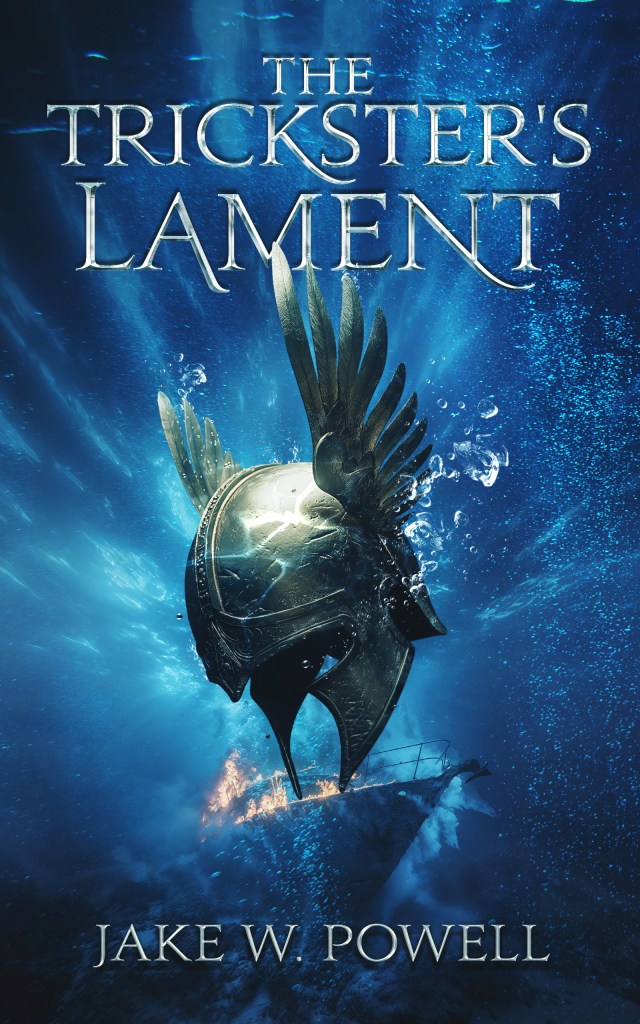
My latest book, The Trickster’s Lament, is currently available on Amazon in both Kindle and paperback format.

“Hermes is not having the best time. He walks a fine line, and his duty as messenger of Olympus weighs heavily on him. Being a god in the modern age means living in a world that no longer believes in gods. How much can one deity accomplish when no one respects him anymore? And why do his instincts tell him that he, the son of Zeus, is losing favor with his own family?

Tensions abound. The upstart Young Gods play dangerous games using entire cities as their boards. Formless monsters strike from the nighttime shadows, terrorizing hapless mortals. Agents of rival pantheons scheme to thwart Olympus’ designs. In the thick of it all, Hermes does what he does best: trick, lie, and cheat his way to victory.

A Thought on the Horror Genre

I don’t have any long discussion on life, writing and the universe planned today. Just a brief thought on the topic of story genres:

The difference between the horror genre and the action genre is whether or not the protagonist has a shotgun.

Cheers.

***

My latest book, The Trickster’s Lament, is currently available on Amazon in both Kindle and paperback format.

“Hermes is not having the best time. He walks a fine line, and his duty as messenger of Olympus weighs heavily on him. Being a god in the modern age means living in a world that no longer believes in gods. How much can one deity accomplish when no one respects him anymore? And why do his instincts tell him that he, the son of Zeus, is losing favor with his own family?

Tensions abound. The upstart Young Gods play dangerous games using entire cities as their boards. Formless monsters strike from the nighttime shadows, terrorizing hapless mortals. Agents of rival pantheons scheme to thwart Olympus’ designs. In the thick of it all, Hermes does what he does best: trick, lie, and cheat his way to victory.

Many thanks for visiting my blog. I post updates on my writing career, I muse over storytelling and fiction, and I reflect on the curious and wonderful things in life.

Dreams in Life

We all have dreams. We have desires and goals we want to achieve. It might be something small or something grand, something that encompasses a single week or a whole lifetime. But we all have something we dream about.

How far do you go to achieve your dream? What are you willing to do? And what are you willing to sacrifice? Do you think about it all day long, but do nothing? Or do you work a little bit towards it every day?

How much do you dedicate to your dream? How much do you sacrifice? And when is the sacrifice too great? When does the dream become a tyrant that destroy your life rather than enrich it?

What place do dreams have in our lives? Do we seek them out at all costs? Or do we know when there are things even more important? Sometimes, we must not sacrifice for the dream, but sacrifice the dream itself. Life goes on. We go on.

But we never stop dreaming.

***

My new book, The Trickster’s Lament, is currently available on Amazon in both Kindle and paperback format.

“Hermes is not having the best time. He walks a fine line, and his duty as messenger of Olympus weighs heavily on him. Being a god in the modern age means living in a world that no longer believes in gods. How much can one deity accomplish when no one respects him anymore? And why do his instincts tell him that he, the son of Zeus, is losing favor with his own family?

Tensions abound. The upstart Young Gods play dangerous games using entire cities as their boards. Formless monsters strike from the nighttime shadows, terrorizing hapless mortals. Agents of rival pantheons scheme to thwart Olympus’ designs. In the thick of it all, Hermes does what he does best: trick, lie, and cheat his way to victory.

He may be disrespected. He may be kicked about. He may even be falling out with his pantheon. But Hermes is a trickster. He knows how to play dirty in a world that doesn’t play fair. But though he can best man, beast, and god, he isn’t prepared for his wiliest opponent yet: his own conscience.”

Many thanks for visiting my blog. I post updates on my writing career, I muse over storytelling and fiction, and I reflect on the curious and wonderful things in life.

My New Book is Out on Amazon!

I am very excited to announce that my new book, The Trickster’s Lament, is now available on Amazon for both Kindle and paperback. This is my second ever published book and a sequel to my first, A God Walks Up to the Bar. I hope that my readers enjoy the further modern day adventures of the Greek god Hermes.

Synopsis:

“Hermes is not having the best time. He walks a fine line, and his duty as messenger of Olympus weighs heavily on him. Being a god in the modern age means living in a world that no longer believes in gods. How much can one deity accomplish when no one respects him anymore? And why do his instincts tell him that he, the son of Zeus, is losing favor with his own family?

Tensions abound. The upstart Young Gods play dangerous games using entire cities as their boards. Formless monsters strike from the nighttime shadows, terrorizing hapless mortals. Agents of rival pantheons scheme to thwart Olympus’ designs. In the thick of it all, Hermes does what he does best: trick, lie, and cheat his way to victory.

He may be disrespected. He may be kicked about. He may even be falling out with his pantheon. But Hermes is a trickster. He knows how to play dirty in a world that doesn’t play fair. But though he can best man, beast, and god, he isn’t prepared for his wiliest opponent yet: his own conscience.”

And for those who missed it the first time …

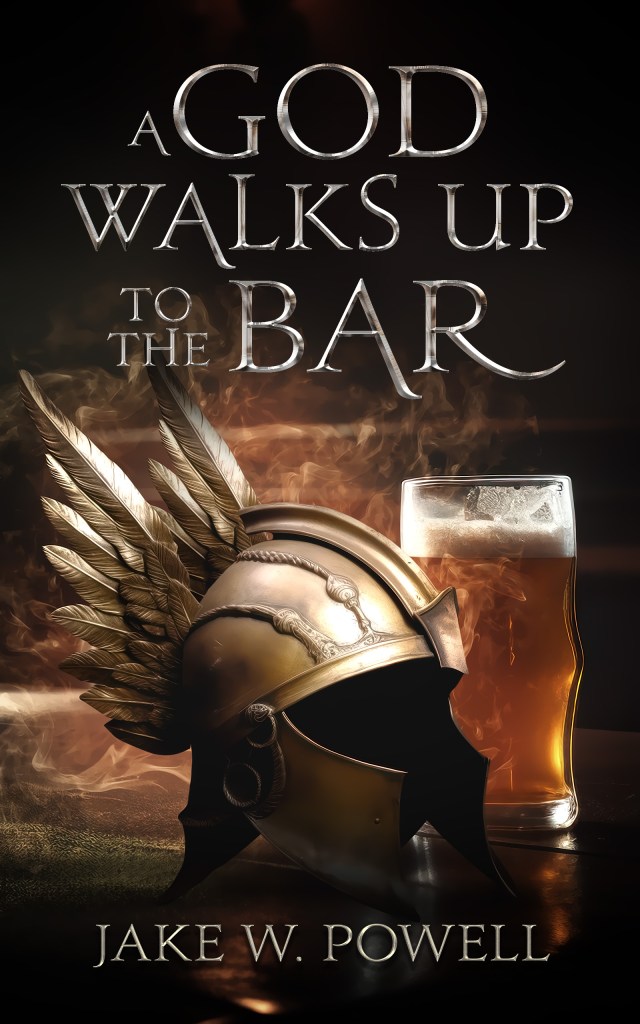
A God Walks Up to the Bar, my first foray into publishing, is also on Amazon.com. Interested in Hermes’s first recorded adventures battling half giants, skinwalkers, vampires, and other foes? Check it out!

As always, thanks for simply visiting my blog and sharing in my writing career and my various musings on life, the universe, and everything. Whether you click that subscribe button or not, I truly appreciate your taking the time to read my ramblings. Cheers.