Open a Book

Open a book, go on an adventure. You don’t leave home, you don’t walk a road. But you go on a journey just the same, to places near and far, betwixt and between.

The past and future, earth and space, ruins and utopias, worlds both alien and familiar. The lives of great kings and scientists and heroes stretch out before you. Hear their words, see inside their minds.

Indeed, you go everywhere, do everything, see everyone. A universe of words is revealed to you. Travel here and there, hither and thither, as much as you can stand.

And at the end of the journey, you come back home, and realize you never left your chair.

Such is the wonder of opening a book.

Many thanks for visiting my blog. I post updates on my writing career, I muse over storytelling and fiction, and I reflect on the curious and wonderful things in life.
Deep Questions about Deep Literature

Do you remember literature classes in high school? How you would spend hours every day discussing the symbolic value of the billboard in The Great Gatsby and analyzing what each character represented in The Lord of the Flies? A spade is never just a spade in lit class. There is always a deeper meaning.

So can anyone explain to me why all the books students have to read are so dang depressing?

Looking back, this is what I feel that we were doing: Taking a beautiful flower and plucking its petals and cutting the stem and digging up the roots to see why it was a beautiful flower. And we very scientifically removed everything beautiful about it.

But darn it, we got educated about great literature. We knew what metaphor was. And allegory. And the subtle social critiques and genre deconstructions that mark all literary classics. We obtained knowledge! We justified our tuition!

There are people who make their living by reading stories and telling other people whether they are good or not. And their word is law, because there is no such thing as an opinion they understand the rules that govern quality writing. Where they obtain this arcane knowledge is unknown. Presumably, they dissected enough flowers.

Good stories seem to be a case of majority rules. If enough people say it’s good, it must be good. Maybe. But I didn’t like The Great Gatsby, so does that mean it’s not a good book or I’m not a good writer? Or perhaps if I had read it on my own time instead of being forced to analyze that darn stupid billboard I would have liked it.

What does it matter what color the curtains are or what suit the one character is wearing in each scene? It matters because somebody important says it matters, but what if it’s not the author saying it? Are we seeing what the writer put there, or what we think is there? Are we seeing meaning where there is none, or is the meaning not what we think it means? Does it mean what people say it means, or does it mean something else, which means that what I want it to mean means that it means the wrong thing from what everyone else thinks it means? Because that’s just mean.

Or maybe we’re just really good at gaslighting ourselves into thinking a book somebody wrote to pay their bills is a magnum opus. The writer wings it, hears what critics say, nods sagely and says, “Yes, that’s exactly what it means.”

Many thanks for visiting my blog. I post updates on my writing career, I muse over storytelling and fiction, and I reflect on the curious and wonderful things in life.

Putting Stories into the World and Learning to Let Them Go

Stories are precious things, especially to those who write them.

We write stories for all sorts of reasons: to tell a message, to work through a grief or hardship, as a gift for friends and family, or simply for the sake of doing so. Regardless of why, stories are very personal things.

And we all have a vision for our stories. We see it for what we want it to be. We see it all – or so we think. And then the moment of truth comes: time to publish. It’s out there, others are reading it, and they don’t see what we saw.

That’s applicability for you. We plan and plan, but readers make the story into something else, because they see themselves in the story. We all see ourselves, and so the narrative comes into focus through the lenses of our own lives.

It’s hard to let go of what we create, and even harder to hear others’ opinions of our work. They claim to understand and comprehend the deep analogies and whatnot, and we tell ourselves, “That’s not what I meant at all!”

It’s life, I suppose. And it’s something all writers will have to deal with sooner or later. But it’s not all bad. The words of readers reveal other lenses, other views and new possibilities. To be a writer is to spend so much time locked up inside yourself. Letting your story go out into the world allows you to see beyond your own mind.

Many thanks for visiting my blog. I post updates on my writing career, I muse over storytelling and fiction, and I reflect on the curious and wonderful things in life.

The Curious Art of NOT Writing the Story

I’m always thinking about writing and how to describe it to people who don’t write. It’s something that is both simple and complex to describe, because like most kinds of art, writing refuses to be boxed into simple definitions. Putting words on paper is what writing involves, but it is not what writing is.

One thing that writing is is the art of cutting away the unnecessary. Putting in too many or too few words is easy; adding just enough is hard. Authors spend their whole lives perfecting that technique.

And then my brain shifts gears and starts thinking: Can the same be said of stories in general? Everyone has at least one good story in them, but then there are those who have dozens, even hundreds of stories. Which ones do we tell, and which do we leave unsaid? In other words, which are the ones worth telling the world?

There are stories published that perhaps should not have been. On the other hand, there are also books written that will never see the light of day, maybe first attempts that authors are content to let sit in their drawer undisturbed (I’m not one of them. I published my first book, for better or for worse. You be the judge).

Some stories are complete in themselves, but get sequels that no one asked for. And some … This may be a strange thing to say, but I think that some stories can stay cozily confined within our own thoughts or just typed out on our computers and taken no further. Not every story needs to be told. But writers do need to write. It’s a hobby as well as a career.

Shifting through all the possibilities, the tons of tales that we think up, and deciding which we will commit our time to writing and which we must pass up on. That’s an art unto itself.

Many thanks for visiting my blog. I post updates on my writing career, I muse over storytelling and fiction, and I reflect on the curious and wonderful things in life.

Stories and Lies

Interesting thought for the day: All storytellers are liars.

Authors, poets, filmmakers, artists … We make things up. We show things to audiences that aren’t real.

But we’re liars who admit we’re liars. The things we tell in our stories are acknowledged as fiction. That’s why it’s called “fiction” and not “deception.”

There is an unspoken agreement between storyteller and audience: I will tell you something untrue, and you will treat it as something true until the story is ended. Audiences know that they are witnessing a fabrication, and so it is acceptable.

But stories do discuss real things – people, events, feelings, ideas, places – although the story itself isn’t true. Even if it is retelling a piece of history, it’s prefaced by the words “Based on a true story.”

Yet if it presents itself as real history, but isn’t, then it’s an actual lie.

Stories are lies that know they are lies and willingly admit it. And so they aren’t true lies, because they don’t pretend to be anything else.

Many thanks for visiting my blog. I post updates on my writing career, I muse over storytelling and fiction, and I reflect on the curious and wonderful things in life.

A Story’s Skin: Setting Limits for Yourself as a Writer

We as human beings don’t like to hear about “limits.” We want to do our own thing without anything holding us back. But consider the breadth of human imagination and all the choices you have as a writer and ask yourself, “How do I even know where to start with my story? Where do I go with it? How do I keep it organized?”

The truth is, stories need boundaries. That’s the difference between a story and rambling. Stories have a point, and they stick to that point. Telling a story about shopping at the grocery store is not going to include what your kids did at school that day. And a story about grocery shopping isn’t going to take as long to tell as, say, the history of Great Britain. Different stories have different limits. But they do need limits.

Some of us like to meander. We have so many ideas and we want to shove them all in. It’s fun to type away at your computer and watch the words flow. But knowing when to stop – ah, there’s the rub.

Here’s a metaphor for you: Imagine your story is like the human body. It’s made of many different complex parts. But all those parts are able to stay together and function properly because of the skin. Skin covers the body and keeps it in place. If we didn’t have skin, we’d just sort of … ooze all over. And who wants that?

It’s the same with writing. You have an idea, or two or three. Great! Now stop. Organize those ideas, don’t add to them. Stories have a beginning, middle, and end. A triggering event, rising action, climax, and epilogue. In other words, stories have structure. And structure, by its very nature, is defined by boundaries and restrictions. They aren’t bad things. They’re necessary for anything to make sense and have form.

Outlining your story ahead of time is a great way to know what your story is about, to know what to put in and what to hold back. Yes, things will shift and change as you go through drafts. But don’t keep adding and adding and adding. Know when to stop and refine what you already have. Put a skin on your story.

If overwriting is a major problem for you, then put a limit on your word count. Something miraculous occurs when you suddenly have a ceiling you can bump your head on.

When we are deprived of the freedom to do everything, we discover a new well of creativity. We choose our words more carefully. We find focus. Words matter more, so we experiment until we find the right ones. We cut away cumbersome paragraphs and sentences. Knowing there’s a cap on our writing makes us pay extra special attention to dialogue, plotting, pacing, and everything else.

Limits are good. They force us to be better writers.

Many thanks for visiting my blog. I post updates on my writing career, I muse over storytelling and fiction, and I reflect on the curious and wonderful things in life.

Just Like Ping-Pong: Crafting Conflict Between Hero and Villain

Let’s assume for a moment that we’re talking about a story featuring classic good versus evil. There’s a hero and a villain. They struggle with each other for victory.

What makes the story good? Lots of things, but interest is a biggie. We like interesting stories. Inversely, we avoid boring stories. What makes an interesting story? Conflict. The hero has to struggle to reach her goal. She must overcome obstacles great and small, and in so doing display character growth and maturity. At the heart of that struggle is their nemesis, the story’s villain.

Good villains go through their own struggles. Does that surprise you? The hero isn’t the only one who must overcome. After all, the best villains are the heroes of their own stories.

Like heroes, villains have goals. These goals run directly counter to the hero’s, hence why they clash. Now, a villain may be stronger than the hero, or smarter, or generally more intimidating. Which is great! It makes the hero’s victory all the sweeter. But if the villain always wins and succeeds in all their schemes right up until the last hour when the hero finally, conclusively defeats her opponent, well … It’s not a bad thing, per se, but it’s a tad predictable, and rather repetitive.

But what if the conflict becomes a ping-pong match?

The hero wins one round. The villain wins the next. They trade blows and barbs; they’re evenly matched up until the last. Now that’s a good story! It keeps the audience on their toes. You don’t know what’s going to happen next. You’re dangling in delicious suspense. “What if?” you ask yourself. What if this story doesn’t end happily? What if the bad guy wins? After all, the villain is a match for the hero. It’s just like ping-pong, which can get really intense if both competitors are skilled.

Okay, we know that good overcomes evil 90% of the time, but the illusion of doubt is introduced. Disbelief is suspended. We are caught up in the moment of the story.

Meaningful conflict is driven by a question that any good story should prompt in the audience: What happens next? It doesn’t matter if deep down we know the answer. The question should still be whispered on our lips.

Many thanks for visiting my blog. I post updates on my writing career, I muse over storytelling and fiction, and I reflect on the curious and wonderful things in life.

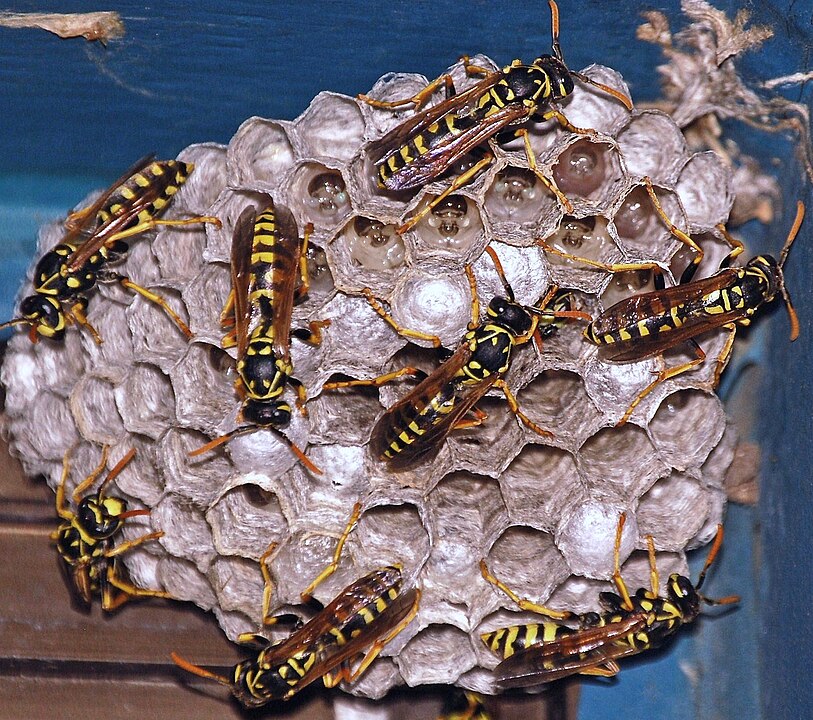
Big Buzzing Bullies

There are bullies under the summer sun. They have no sense of mercy, they inflict harm without cause, and they don’t even have the decency to enjoy it. They buzz around like yellow caution signs of doom. They set up shop exactly where it will worst inconvenience you – butting into your backyard and your homes like they own the place. And if you say anything, they stab you.

I am, of course, talking about wasps. Nature, for all its horrors, is pretty chill all told. Spiders only bother you when you bother them (“It’s not MY fault you walked into the web I set up at eye level”). Tigers and bears and wolves are just hungry, or you got too close to their cubs. Who doesn’t get angry when someone messes with their kids? Sharks are the victims of bad press. Just because someone can’t blink or smile or emote in any way comprehensible to human brains is no reason to discriminate (also, get out of the water). And crocodiles and hippos … okay, they’re pretty bad, but if you keep your distance they’re okay.

Wasps don’t keep their distance. Wasps don’t need a reason. Wasps go out looking for trouble. Those narrow, spindly bodies, those pitch-dark eyes … Just look at the villainous invertebrates!

Look at them! Look at the vile monstrosities!

Not at all like the humble bee. Bees are selfless. Bees are productive. Bees can coexist with mankind. If you rile them up, they’ll sting once and give their lives for the colony. See, even if you’re being swarmed by bees, they’re still quite heroic when you think about it. They give themselves for a greater cause. Not wasps. The only thing a wasp has to give is PAIN.

They don’t produce honey or wax or even jelly. They got nothing (except the aforementioned giving of pain). All animals, no matter how scary, are reasonable enough when you get to know them. Except wasps. They gang up on you because you looked at them funny. They are genocidal, resource-hording invaders. They’re under your feet. They’re in your walls. They want your PB&J sandwich. They’ve claimed your favorite climbing tree and will obliterate you if you get too close. Screw you, wasps.

Wasps are jerks.

Many thanks for visiting my blog. I post updates on my writing career, I muse over storytelling and fiction, and I reflect on the curious and wonderful things in life.

Image courtesy of Wikipedia; License under CC BY-SA 2.5

Committing to First-Person Narratives

When you think of writing a book, “commitment” is a word you might associate with time discipline, writing a certain number of words per day, or setting aside a chunk of your budget for publishing and marketing. You wouldn’t necessarily think of the writing itself. After all, writing is all about making changes. That’s what drafts are for! But there is at least one piece of the puzzle on which you have to make a choice early on, and from which backing out can be painful. That is choosing your narrative point-of-view.

Now, third-person is common and popular, but what if you go for first-person? Ah, then you really have to commit, because first-person narrative has a whole set of pros and cons to it that change the way you tell the story.

The pros? Writing in first-person lets you get inside the head of your POV character, whether they be the protagonist or someone else, and really dig into their psychology and the world they live in. It’s a very personal method of storytelling. You really get to know who this character is as a person. Plus, you get to shape the story and its twists and surprises in a fairly organic way. The reader can only know what the narrator knows (or thinks they know). And the narrator doesn’t have to be honest or reliable.

On the other hand, first-person limits the scope of your storytelling. You can’t describe a distant scene two countries over, you can’t pull back and dedicate a few paragraphs to an unbiased history of the setting, and most importantly, you are restricted to the one character. You can’t jump between multiple peoples’ perspectives.

Ok, that’s not true. Crazy geniuses can write books that feature multiple POV characters told from multiple first-person perspectives, but I’m not brave enough to try it. But if you have written or read such a book, let me know in the comments. I’d be interested in reading it.

Your narrative is narrow in scope. That’s not to say the story itself has to be . It can be a sprawling epic, but you will only see it through the eyes of one person. That’s why you have to be sure of yourself before you start. You’re gonna have to commit.

Many thanks for visiting my blog. I post updates on my writing career, I muse over storytelling and fiction, and I reflect on the curious and wonderful things in life.

It’s Only an Event if It Doesn’t Happen Every Day: My Thoughts on Crossovers

Crossover, crossovers. People from different worlds smashing into each other. Different genres, different styles, different stories. Throw them in a mixer and see what happens.

What’s the appeal? I’d say it comes down to simple curiosity. What would happen if Superman met Captain America? How would Greek myths get on with Chinese myths? Can a pirate really defeat a ninja?

It’s a popular trend these days. Maybe not so much in novel writing, but movies love them, video games really love them, and comics are practically built on them. And they’re fun. But there’s something about these companies’ strategy that is missing the point of a crossover. Every time one occurs (multiple times a year), it’s built up as the MOST INCREDIBLE THING EVER. And people get excited sure. But not like they used to.

Way back in 2008, when Nick Fury stepped out of the shadows at the end of the first Iron Man film to talk about “the Avenger Initiative,” fans squealed with joy and anticipation. Nowadays, the next big Marvel crossover film elicits a non-committal “Eh,” at best.

As a writer, my professional opinion is that crossovers are not easy to pull off anymore, largely because they’ve been done to death.

And that, I think, is the strength and weakness of the concept. Crossovers are big events. They’re something special, something noteworthy. Two completely different worlds colliding is interesting, and fans are curious to see if it can be pulled off. Batman and Elmer Fudd? Yeah, it’s been done, and it won’t be done again because you can’t capture that kind of lightning in a bottle twice. Crossovers are like a fine wine, best in small sips. Overuse just makes you feel overwhelmed. Try imagining a world where the Super Bowl happens every month.

Another example: Back in the 1980s, Mario and Sonic the Hedgehog were the pinnacle of dueling video game mascots. Who was better? Who was cooler? Then, one fateful day, they appeared together in the same game. Awesome! But they’ve done so again and again, and what was something that nobody ever saw coming is now ho-hum, another day in the neighborhood. Video game characters appear in each other’s franchises all the time, now. It’s practically an industry standard.

As it turns out, such “events” are best when served rare. Very rare. Otherwise, they aren’t events. They’re business as usual.

Many thanks for visiting my blog. I post updates on my writing career, I muse over storytelling and fiction, and I reflect on the curious and wonderful things in life.