Blank Spaces of the Mind: How Do You Tell A Story Without Having to Tell Everything?

I like movies. I’m a visual person, and I enjoy seeing things portrayed on the screen. Little details are the most fun. Characters’ tics and interesting events happening in the background. Sometimes, I envy filmmakers. Creating their worlds are a little bit easier, because they can convey in a minute what can take a writer four or five paragraphs to communicate. ESPECIALLY when they are able to tell the story without a single word being said.

We writers, of course, don’t have that luxury. Books are nothing but words, which got me thinking: How do you show the reality of a story, that is, communicate character traits and worldbuilding details, when you can’t really show anything at all?

It’s a different game from simply describing a scene or a character. That’s to be expected. But where to stop? Where’s the line between “This is what Joe looks like and how he acts” and “This is Joe’s personality and character, let me tell you without ever referring to it again and thus making this paragraph pointless.”

So, I’ve thought about it, and here’s what I’ve come up with so far.

Stories are best told when the writer doesn’t need to explain everything. A good story unfurls through action, whether visual or written. Actions define a character, a group of characters, even a location. The way a person carries himself, dresses, talks – these all express relevant elements without the need for a mountain of exposition.

And they can be brief. For example: A wizard appears in the story. He dresses in fancy clothes and has clean, well-groomed hair. He talks formally with a condescending tone. He casually refers to esoteric subjects. He sniffs loudly whenever he disapproves of the other characters’ comments. He kills a wolf with a single, well-timed spell. Short, succinct statements that tell us what we need to know – and give us the freedom to paint a picture of the character in our minds. We don’t always have to go into detail about hair color, eye color, body type, or a detailed analysis of clothing. Heck, just the word “wizard” probably had you paint half the picture from a single word, didn’t it?

But then, another character brings in the Artifact of Doom for the wizard to identify. The wizard immediately panics and backs away, demanding that the object not be brought near him. Well, that tells us immediately that the Artifact of Doom is really bad news. If Mr. High-and-Mighty is scared, it just might be a serious problem for everyone.

So, yeah, books aren’t visual, but they can still tell a story without having to tell us everything. In short, leave some space for the reader. Now, I’m not going to say that I’m necessarily good at this as a writer. I’m still learning, but I’ve learned as much from reading as writing. And I get annoyed when books pause everything to describe the POV character’s emotional state or appearance in long, flowery detail. It just seems … excessive.

Maybe it’s just the mark my journalism classes left on me. I like simple and to-the-point. And I like to think that my readers can be trusted to have a little imagination to fill in the blank spaces of the mind that words can’t reach by themselves.

What are your thoughts? How do you think a story can “show, not tell?”

If you just so happen to be enjoying my blog, feel free to subscribe. I post updates on my writing career, I muse over storytelling and fiction, and I reflect on the curious and wonderful things in life.

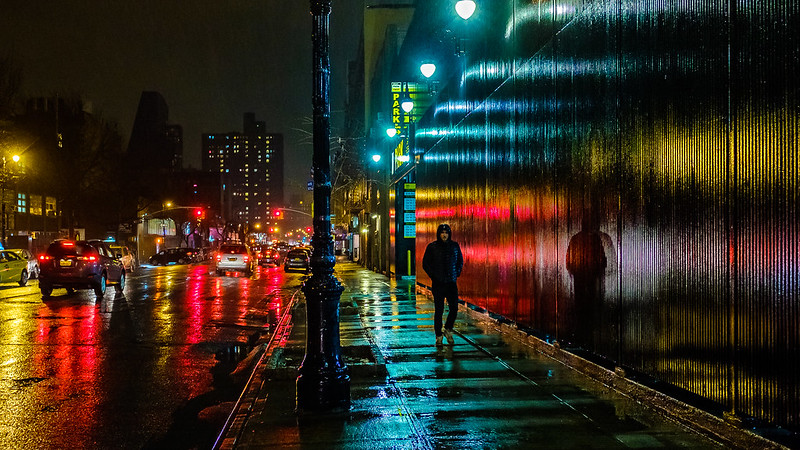
Image: “New York City Street Scenes – Rainy Night on the Lower East Side” by Steven Pisano; Licensed under CC BY 2.0.

Quirks and Tics: Characterization through Minor Details

You ever think about how traits and habits can shape a character? Everyone has their own flavor of mannerisms: body posture, repeating gestures, facial expressions, verbal expressions, nervous habits. For the sake of simplicity, let’s call them “quirks.” They’re the little details that don’t play a part in the unfolding plot, but simply help flesh out the world you’re creating. Being visual cues, for the most part, they also aren’t always the easiest thing to describe in writing. Movies love them, though, and they can definitely help liven up a scene and make characters more relatable.

It’s all about humanizing your characters. Real people have habits and tics. They do or say things on a regular basis that are uniquely a part of them. You – yes, you – have habits and gestures of your own that make you, well, you. The devil is in the details, but so is good writing. Experienced authors can make even a bit character memorable by throwing in a couple of notable traits and letting those emblazon themselves in readers’ minds. Movies have it even easier. Being visual by nature, a film or TV show can display those quirks without pausing to describe them, letting such details blend more seamlessly into the narrative.

Mostly, quirks are all about worldbuilding, aren’t they? Not necessary to the plot, not vital to understanding the hero and supporting cast. They’re like sprinkles on ice cream. They’re a little something extra.

Or are they?

Quirks can be used as plot devices and can even deliver good payoffs. Someone recognizes her long-lost lover because of the specific way in which he twirls his hair. A secret agent’s habit of spinning his knife causes him to drop it and nearly trigger a motion-sensor alarm. A villain always unconsciously taps her fingers at the prospect of playing a game. A protagonist with OCD compulsively touches and counts poles on the sidewalk. He misses one and goes back for it – just in time to miss being run down by an oncoming car.

These are all examples taken from real movies and TV shows. Can you figure out where they come from?

Do you want your story to feel real? Do you want your characters to feel like people you might actually meet on the street? Or maybe you just want to challenge yourself with producing something a little more creative than past works? Consider using quirks to ad spice to your story. How? Well, take a look at the people you already know. Watch them carefully (but don’t be weird about it). Look at how they act and talk and move. Real life is good inspiration. Everyone has quirks.

Are there ways in which you have used quirks in your writing? Please feel free to share!

If you just so happen to be enjoying my blog, feel free to subscribe. I post updates on my writing career, I muse over storytelling and fiction, and I reflect on the curious and wonderful things in life.

Putting Your Best Foot Forward: Thoughts on Confidence

You ever see someone walking down the street with an easy stride, good posture, and a sure expression on their face? You think to yourself, “Man, they’ve got it together. They know they’re going places in life.” You ever question if they actually did know what they were doing and where they’d end up? After all, if they look like they know what they’re doing, they probably do, right?

Well, maybe not.

How often did you ask mom and dad questions about the world when you were a kid? And you took their answers as gospel truth. Parents always know why the sky is blue, and why the moon disappears during the day, and how car engines work, and when Santa is coming down the chimney on Christmas Eve. They were the all-knowing arbiters of wisdom.

Then we grew up and figured out that our parents were barely keeping it together. Blazes if they knew the right answers to a young child’s innocent curiosity. We become parents ourselves and end up playing the same part, only to discover that we can barely manage a coherent sentence in response to our children’s relentless torrent of questions.

But our parents always LOOKED like they knew what they were talking about. And because of that, we never thought to question anything they said. They could have told us the world really was black and white with no color in the 1950s, and our young selves would have believed them.

What about the inverse? An expert – in mathematics, let’s say – lectures in front of an audience. He’s giving one of those TED talks or what have you. He knows exactly what he’s talking about. He’s foremost in his field. But he stutters. He’s nervous being out in public like this. Consequently, he can’t explain the concepts very well. He has a nervous laugh and shuffles his feet. An expert? Sure. But we aren’t inclined to take him seriously. Not like Dad, who has no idea how photosynthesis works, but is able to bluff his three-year-old with a bold smile and a ready answer.

Confidence is a funny thing. It’s no guarantee of truth or accuracy, but it is such a vital component of how others perceive us. We trust confident people. They at least have the decency to look like they know what they’re about. And hey, if they trust their own skill, why shouldn’t we? Well, that way lies potential catastrophe, but that’s the point. We follow those who look like they know where they’re going. Confidence is no substitute for competence, but it is an important ingredient in leadership and successful undertakings.

Writing your book is one thing. Selling it is another. The Internet is full of ways to advertise, but if you don’t believe in the product yourself, why should others? If you don’t have the self-assurance that your story is worth reading, how are you going answer the question, “Why should I care?” If you don’t have any confidence, any trust in your book’s quality, people notice. And who wants to read a book that even the author doesn’t think is very good? Have a little faith in your work!

We live in a superficial world. Sad, but true. People look at our appearance and how we carry ourselves. Before they get to know us, they spot little details –shirt stains, unkempt hair, untied shoelaces. And thus, our self-presentation impresses itself on people’s memories for far longer than a good conversation or a well-informed lecture. Likewise, if any aspiring writers are trying to convince someone to read their book and looks nervous and withdrawn when discussing the thing, that’s what our would-be readers will remember, not that we actually wrote a good story that they’ll enjoy.

Is that fair? Not really. But it’s real. Writing requires skill and practice and patience. But to get people to read that story? That requires the belief that the story you told is worth sharing with others. It requires confidence to say that your story is worth the effort.

If you just so happen to be enjoying my blog, feel free to subscribe. I post updates on my writing career, I muse over storytelling and fiction, and I reflect on the curious and wonderful things in life.

Image: “BASE jump” by santimolina; Licensed under CC BY-NC-ND 2.0.

Writing Your First Draft: The Vomit Draft

Having gotten halfway through the first draft of my second book, I look back on the progress I’ve already made and have mixed feelings about it. On the one hand, I’m fairly confident my skill has improved somewhat since my first book. On the other hand, I see the myriad flaws still there and wish I could write a perfect book straight out of the gate. But writing is a feat where one plays the tortoise more than the hare. Slow and steady wins the race.

Also, the first draft of anything is going to be garbage no matter how hard you try. It’s just the nature of the beast.

In fact, I’ve come up with a nickname for first drafts: the vomit draft.

The first bout of writing isn’t necessarily pretty or neat. In fact, it can be downright ugly as you not only try to type out a coherent story, but also struggle with phrasing, dialogue, vocabulary, writer’s block, and coming to the grim realization that your story’s direction is slowly but surely veering away from your original vision. It’s a beautiful mess.

Knowing this, my goal in the first draft isn’t to write a masterpiece. It’s to just get all the words written. Spewing them out as they come to mind, as it were. Hence, the vomit draft.

We got to start somewhere, right?

Sometimes, I get frustrated and think that the garbage I’m writing is going to stay garbage regardless of rewrites. Sometimes, I go through a brief existential crisis as I wonder if being a writer is even my calling in life and maybe I should just stick to my day job. Sometimes, my mind struggles with even the most basic words. Who will want to read this?

But that’s not what the vomit draft is about. Making your story readable comes later. Right now, just get it all out. No holding back, no second-guessing, no graceful prose. Just write something to fill in the pages. It’s the foundation for what comes later. Every beautiful building is built upon a pool of poured cement. It’s not pretty, and it isn’t supposed to be.

Fortunately, nobody ever has to see our vomit drafts except ourselves. And we get a small consolation in knowing that this sorry state of affairs can and will become something much, much better.

If you just so happen to be enjoying my blog, feel free to subscribe. I post updates on my writing career, I muse over storytelling and fiction, and I reflect on the curious and wonderful things in life.

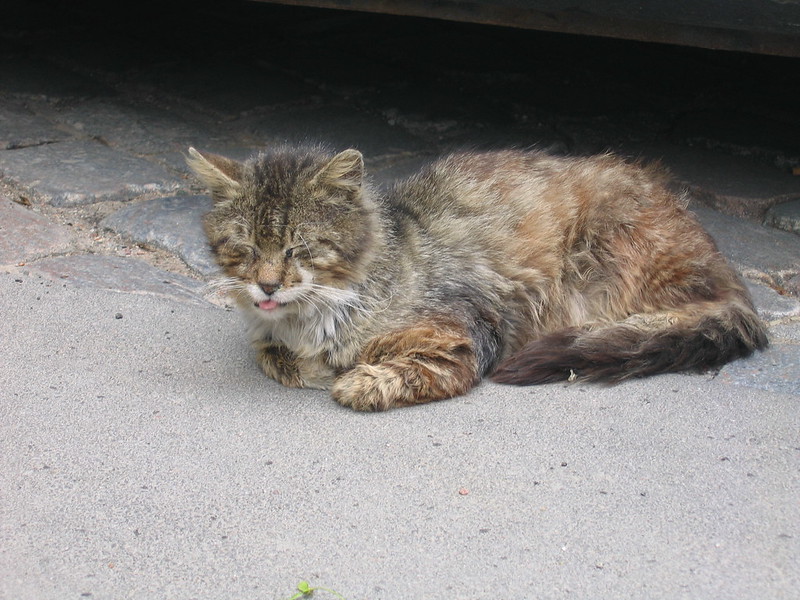
Image: “A sick cat” by wwhyte1968; Licensed under CC BY-SA 2.0.

History: The Greatest Source of Inspiration for Any Writer

Fact is stranger than fiction, they say. And it’s true. But have you ever considered the inverse: Fiction is never stranger than fact.

No matter a writer’s imagination, no matter his ability to craft new worlds out of his own mind and populate it with characters who seem as real and unique as anyone you meet on the street, and no matter how engaging, grandiose, bizarre, or heartfelt the events portrayed in his work, he will never be able to surpass the parade of the unexpected that is world history.

History IS story. It’s right there in the word, isn’t it? And it’s real. Just think about that for a moment. Think about all the things you’ve read in the history books. Adventure. Romance. Mystery. Tragedy. War. Friendship. Triumph. Defeat. Despair. Hope. All of it is there, all of it waiting to be discovered by that one author seeking a mote of inspiration.

Where am I going with this? Just to say this: We writers have so much to draw from just by browsing the history section at our local library or bookstore. Heck, just go online. We live in the age of information. The World Wide Web contains everything. Try a quick surf of your hometown’s newspaper archives. Stories aplenty. Ideas in abundance.

And now I’m starting to think that there are so many tales in history that haven’t been given their due. Forgotten stories that need a time to shine. Eras and events that have been lost in the bustle of modern progress. Martin Scorsese’s Killers of the Flower Moon highlighted a time in Native American history that deserves more recognition. A terrible time, but one that should be known.

What else have we misplaced? What battles and victories waiting for their recognition? Unsung heroes waiting for their song to be written? Tragedies yet to be acknowledged? Villains who thought they got away with it?

Apologies, I’m just waxing poetical now. You get the idea. Writers don’t just write stories. We live at the tail end of the longest story ever written. All we have to do is look back a little ways for new tales from that saga to tell. Isn’t that a teensy bit amazing?

If you just so happen to be enjoying my blog, feel free to subscribe. I post updates on my writing career, I muse over storytelling and fiction, and I reflect on the curious and wonderful things in life.

Image: “Early printed vellum leaf” by Provenance Online Project; Licensed under CC0 1.0.

Why Do You Write?

To all the writers out there.

Why do you write?

Is it a compulsion, a need? Do you wake up each day and not know peace until you write a sentence, a paragraph, a chapter? Do you fear that if you don’t then you will burst?

Do you write for fame and fortune? Do you envision filing whole shelves in the bookstore? Do you see websites devoted to you, adoring fans, #1 on the New York Times bestseller list?

Why do you write?

Is it a profession like any other? A way to pay the bills and keep a roof over your head? A means to put food on the table?

Maybe you’re a dilletante. Writing is self-entertainment, a way to vent your creative impulses in your spare time. Nothing worth publishing, just for fun.

Or maybe you write for friends and family. It’s a way to amuse them with your talents, a bonding experience.

Do you write for strangers? Potential followers? Or maybe for no one in particular?

Why do you write?

Do you have a message to send? A vision to share? A statement to make?

Is it about entertainment and laughter? Or maybe you seek to instill fear, or joy, or curiosity, or dread, or thoughtfulness, or …

Or no reason other than because you can.

Why do you write?

Enjoying my blog? Don’t want to miss a single post? Subscribe for updates on when I post and follow my writing career, musings on fiction and storytelling, and reflections about life in general!

Image: “Pencil” by taylor.a; Licensed under CC BY 2.0.

You Think This is Funny? Reflecting on Film Writing and Humor

Image: “Comedy and Tragedy Masks” by Booyabazooka; Licensed under CC 3.0

Today I’m going to talk about something specifically related to film writing, and a trend that I’ve seen in movies for a while now.

See the picture above? You’ve seen them around. The twin masks of Comedy and Tragedy. The two always go together. Where there’s laughter, there’s sorrow. Where there’s mourning, there’s merriment. They need each other. Every great work has both working hand-in-hand in the jolly spirit of cooperation.

We need to laugh. But, and this is a big but, we also need to cry. And if you have too much of one and none of the other…

What happens if a story is all jokes and funny business? Well, you might call it a comedy, sure, but do you know what a lot of really good comedies have? Moments of seriousness interspersed with the hilarity. And do you know what the best dramas have? Sprinklings of humor to lift the audience’s spirits.

But writing comedy is tricky. Heck, writing in general is tricky, but writing appealing humor is really tricky because you’re trying to appeal to a broad audience. Why do you think broad humor is synonymous with toilet humor? It’s easy to get a quick laugh out of something dirty. It’s the easy way out and requires little skill. Sorry to all of you out there who enjoy such, but it really is the junk food of comedy. And like junk food, you like it at first, but it leaves you sick in the end.

As a wise man once said: “Dying is easy. Comedy is hard.”

Humor is more than just jokes. Humor humanizes. People crack jokes under pressure. Their sense of humor makes the audience able to empathize with them. And yet, humor can also de-humanize, funnily enough. What do I mean by that?

Okay, let’s talk about the current state of Hollywood. Yes, I’m going there.

Blockbusters nowadays – not all of them, but a whole lot – rely on quips and wisecracks to carry their characters through the action. A dramatic scene is undercut by a sudden swerve into corny jokes. Everyone is a kidder. Too much humor spoils the plot. If nobody is taking this seriously, why should I? What are the stakes? When you joke about everything, everything becomes a joke. The characters are just walking punchlines, waltzing from gag to gag. They’re defined by how much funny they can deliver per minute. And they cease to be characters: They’re walking satires, exaggerated stereotypes of human behavior.

Well, Arnold Schwarzenegger could pull it off. True, but 1980’s action movies rarely pretended to be anything more than fluff. Watch bad guys get beat up by a hero delivering one-liners after each kill. What happens when modern blockbusters try to pose as something much more meaningful – and then undercut that meaning with a one-liner perfectly timed to be delivered at the most poignant and emotional moment?

Humor is a very powerful tool. It tells us what to take seriously and what to devalue. We laugh at things we don’t treat as important or respectable. Which can backfire if you set up a story where a situation or character is meant to be treated with dignity, respect, confidence, and even fear, and then undermine that intent with a barrage of cheap quips. Humor is like a gun: You don’t wave it around carelessly.

What’s worse, the audience very quickly becomes desensitized to it. A couple of movies with this type of writing, the audience is whooping and hollering. But by the tenth film, it becomes old-hat. Yeah, yeah, this is about the right place for – yup, he did it. He made a corny joke right when I expected him to. Hey, here’s a quiet drama scene. I bet they’re gonna – yup, another cheap joke to ruin the mood.

Predictable, formulaic, and worst of all, boring. Same old, same old.

So, what to do about it?

Well, learn from it, for one. Why doesn’t it work anymore? Analysis of others’ writing, both good and bad, can be useful for improving one’s own skills. Learning from the mistakes and missteps of others is invaluable. Comedy is a rich and complex genre in and of itself, with so many branches. It serves many purposes, and can truly bring light into hopeless situations, and alleviate tension right when the audience needs it. Just don’t overdo it. No need to beat someone over the head to make sure they “get the joke.”

And the joke itself isn’t the point. Everything, even a witty quip, should be in service of the story. The story should never serve the joke.

Enjoying my blog? Don’t want to miss a single post? Subscribe for updates on when I post and follow my writing career, musings on fiction and storytelling, and reflections about life in general!

Stories for All Time: Universal Themes in Writing

Image: “Lonely Galaxy Lost in Space” by NASA Goddard Photo and Video, Licensed under CC BY 2.0.

Really, this topic is so vast that I could devote an entire week to it. When you consider that stories have been told for as long as humanity has existed, it’s small wonder that certain themes and morals endure the rise and fall of civilizations, and that common threads wind through the evolution of communication technologies.

Quite simply, certain themes in storytelling are universal. I’m sure you’ve thought of some just now. Good versus evil. The hero’s journey. Coming of age. Revenge. Forgiveness. Hope. War and peace. Etc., etc. Why? Because they’re broad. They appeal to everyone, because everyone has, at some point or another, dealt with these issues. They resonate with us, to use a common turn of phrase. Another way of putting it is that they are inherently familiar topics. And it doesn’t matter who you are or where you’re from, everybody has a concept of the hero or wants a story about hope. Everyone is familiar with war, and also with villainy. You don’t need cultural translation to understand that there are good things in the world and also very bad things.

So, some stories have that universal appeal. How do we know which ones? Well, it takes a bit of patience to find out, doesn’t it? When Charles Dickens wrote A Christmas Carol, he didn’t know his novella would be a staple of literature over 150 years later. Neither did the Greek poet Homer know that The Odyssey and The Iliad would still be studied to this very day.

Wait fifty years. Is the story still popular? More importantly, is it still relevant? Do people still care?

For every masterpiece, there must be ten thousand forgotten works. So many stories fade away with time. Sometimes, it’s due to bad luck or happenstance, and some never get a chance to be recognized. And some were a flash in the pan: Their plots were ripped from the headlines, centered around current events. What was hot and fresh that year gave them a brief celebrity. Then the world moved on, and these stories became anachronisms. Their identities were fixed in current events, and without that context they remain curiosities at best.

I won’t give any examples. Maybe you can think of a few yourself.

Universality and timelessness go hand-in-hand. The greatest stories don’t need to be shackled to any one era. They can be retold, again and again, in any age, at any time, because the core of their identity and popularity isn’t the bells and whistles of the current year. It is their basic, broad, foundational themes that reverberate throughout the ages. Sherlock Holmes is Sherlock Holmes, whether he’s in the 19th century or the 21st. Journey to the West has been retold as a post-apocalyptic video game. You can’t count the number of adaptations of Little Red Riding Hood on your hands and feet – you’ll run out of digits.

The very best stories can be told over and over again, and they have something to say to us every time.

Enjoying my blog? Don’t want to miss a single post? Subscribe for updates on when I post and follow my writing career, musings on fiction and storytelling, and reflections about life in general!

Why Writers Must Learn to Kill Their Babies (Less Morbid than It Sounds)

Okay, let me explain…

When I was taking film classes in college, my professor explained a key lesson that every writer must learn. They must learn when it is necessary to kill their babies.

You have an idea. It’s a brilliant, shining idea that came to you in an incandescent flash of inspiration. A magnificent idea that is the beating heart of your story. It is your motivation and driving force. The story would not exist except for this one concept.

It could be anything. A single scene. A character. A set piece. Even a single line of dialogue. Whatever it is, it was amazing enough to make you sit down and write.

It is your precious baby.

You finish the first draft of your story. You’re very pleased with it, especially how you incorporated your idea into the overall work. You send it out to readers for feedback. And the unexpected happens. They’re dubious about your baby. They don’t like it. They say that it doesn’t mesh with the rest of the story. In fact, it’s holding your story back from its full potential. It’s a liability.

Without realizing it, as you wrote and developed your setting, characters, and plot, they outgrew the original idea. That concept you love so much is no longer the plot’s beating heart. It is a tumor that threatens the quality of your narrative. The scene is out of place and unneeded. The character is completely detached from the rest of the cast. The set piece is just a waste of words. The line of dialogue is silly.

For the sake of the story, you must kill your baby.

If that sounds grotesque, it’s only to communicate how strongly writers can feel about their stories, and how painful it can be to remove something that can feel so personal to you. It’s a necessary culling that must be performed for the good of your writing. It is a sacrifice, one that almost every author must make at some point or another. And for those who aren’t willing to make the sacrifice, well, their story suffers for it. The readers might, too.

The lesson here is that something that seems like its working at the beginning of your project can become an utterly awful proposition by the end. A chef likes garlic, so he adds a ton of garlic to his casserole. Then he tastes the final product and gags. It was a good idea at the time, but …

Enjoying my blog? Don’t want to miss a single post? Subscribe for updates on when I post and follow my writing career, musings on fiction and storytelling, and reflections about life in general!

Paperback Version of My Book is Available on Amazon!

Do you like eBooks? I like eBooks. Convenient and affordable. But sometimes I want that tactile sensation of a paperback in my hands and to hear the soft flutter of turning pages. If you like that, too, then I have great news.

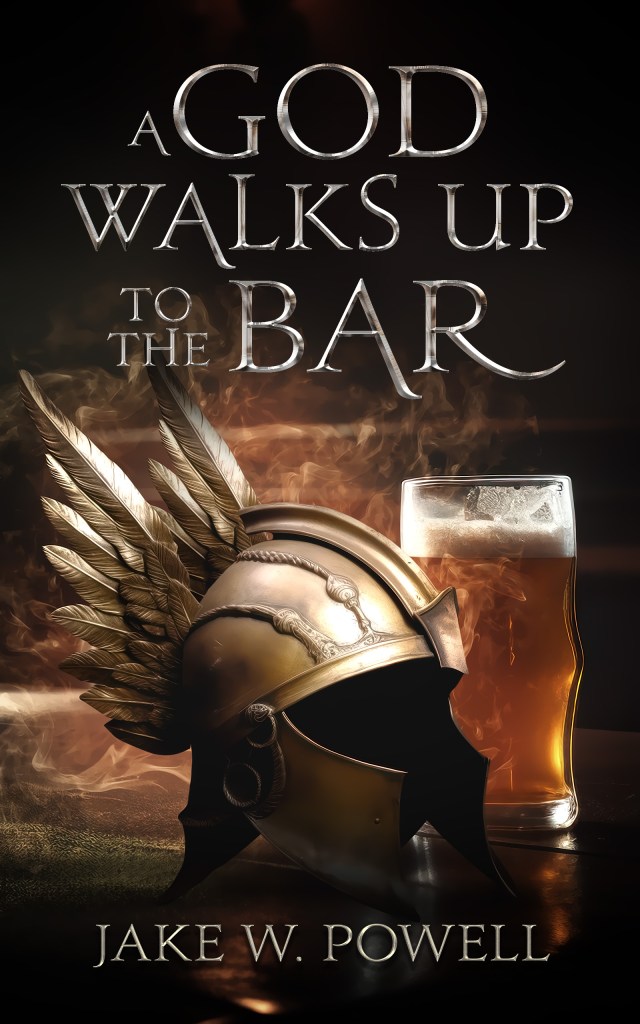
A God Walks Up to the Bar is available in paperback form on Amazon.com! Do you want to add a fun novella to your collection? Do you enjoy fantasy and classical mythology? Thrills? Chills? Humor? Gods beating up monsters? Then hop online and order yourself a copy! Or at the very least, do yourself the favor of admiring the lovely cover art.

And while you’re at it, don’t forget to like and subscribe to this blog. I’m just getting started!