This is the second half of my short story excerpt from A God Walks Up to the Bar. Go here to view the first half.
—
I walked into a scene right out of a 1930s gangster movie. Five men sat around a table playing cards, cigarette smoke hovering over them like angry clouds. The scent of alcohol wafted from half-empty liquor bottles to mingle with the smoke. Five faces looked up as I entered and stared daggers into me.
It was quite the diverse crew Stauffer had. Sitting closest to the door was a squat, grey-skinned goblin. To his right was a great hulk of a man whose tree-trunk arms cordoned off a quarter of the table as he guarded his cards. Another half-ogre. Across from him sat a man whose face was entirely covered in a bristly black beard save for his red eyes. To his left was a slender, fragile-looking man with ash-colored hair who exuded magical power.
And then there was Arnold Stauffer, seated in his armchair on the far side of the table facing the door. He had a cigar in his mouth and a hand of cards in his thick fingers.
We Immortals are a funny lot. As our kind drifts along time’s currents, watching civilizations rise, rule, and fall, many of us beach ourselves along the way. Some are just too stubborn and irked by keeping pace with changing times. They lose track of the eras and fixate on one specific point. It may be a particular century, decade, or even one notable year. They cling to that time’s fashions for so long that they become walking anachronisms, lodged in attitudes and styles long since abandoned.
Not easy individuals to deal with. It’s hard to negotiate with someone who not only dresses like they’re in the Elizabethan era but talks and acts like it. You want to laugh, but then you remember how easily they can strike you with lightning and plague if you offend their obsolete sensibilities.
Stauffer had started his rise to power in 1920, so the period had sentimental value to him. His aesthetic clung to “Prohibition-era gangster,” suits, Tommy guns and all. It was a style that really didn’t fit him. The sharp-cut suit clung awkwardly to his hulking frame so that he looked like an angry boulder wearing a necktie. His pencil mustache clashed with a jagged nose broken in three different places. His slicked black hair was a hilariously tiny patch on top of a craggy, oversized skull.
Stauffer wanted to look a gentleman, but that’s hard to do when you’re a primal incarnation of nature’s fury.
He was a half-jötunn — a descendant of the giants of the north. They were sovereigns of nature’s wrathful aspects. Their kings had shaped mountains, unleashed fire and magma from the earth, stirred up hurricanes, and rained down hail and thunder. And here was Arnold Stauffer, the blood of King Thrym running in his veins and eyes swirling like a storm, trying to conceal that heritage with a side-combed haircut and bespoke suit. Seeing a manifestation of cataclysm dressed up like Al Capone and playing poker? It was surreal. Absurd.
Stauffer leaned back in his chair and took a long drag from his cigar. Smoke billowed out of his mouth as he spoke.
“Mister, I hope for your sake that you’re someone very important.”
I bowed. “Lord Hermes of Olympus, Herald of the Dodekatheon, who speaks with the voice of Lord Zeus to Arnold Stauffer of the bloodline of Thrym.”
Stauffer put down his cards. “Proof?”
I sighed inwardly. There had been a time when this was easy. When those words made people snap to attention. I took off my ring and tossed it to him. He caught it and inspected it for a moment, then he threw it back.
“Lord Hermes himself. What an honor. What a privilege.” He spat the words out like curses. “So, what does the old fart on the mountain have to say? What horrible punishment will he rain down on this old sinner?”
He laughed. His minions half-heartedly joined him but kept their heads down. Only Stauffer dared look me in the eye.
“Punishment?” I raised an eyebrow. “This isn’t about punishment. We’re civilized folk in a civilized age. Lord Zeus recognizes your authority and your bloodline and so is willing to show leniency. We can resolve this matter quickly and painlessly.”
Stauffer said nothing but waved at me with his cigar to go on.
“The message, to wit, is this: For the past six months, you have been expanding your operations in this city. You approached a man named Zachary Jensen, owner of real estate that you desired. This man is a scion of Lord Zeus. You knew this.”
Stauffer watched me with an indifferent expression. His minions shuffled a little in their seats. Their bodies were tense.
“Five days ago, you invited Mr. Jensen to a restaurant under your ownership and offered him money in exchange for his property. He declined. It is understood by Olympus that he refused … harshly, replying with insults against you and your lineage. The following night, when he arrived home, he was attacked by four men and beaten almost to death. Olympus knows it was at your order. Do not deny it.”
“I never did.”
“In harming a child of the Olympians, you displayed gross disrespect towards Lord Zeus. However, he is willing to show mercy as long as proper compensation is made. Namely—”
“I don’t kowtow to old gods!” Stauffer shouted. “I won’t—”
“Firstly,” I carried on resolutely, “you will affirm here and now your intent to abide by the rules of the Contract. Our law forbids Lord Zeus from taking direct retribution against you and your own within New York, a recognized Free City. So, too, does it forbid your organization from laying hands on any recognized demigod.”
Stauffer bared his teeth in an ugly smile. “I was within my rights. He insulted me and so I —”
“Secondly, you will provide compensation for the injuries done to Jensen. This compensation will consist of two million dollars taken out of your organization’s profits.”
At this, the table rumbled with angry mutterings. Stauffer’s defiant grin grew larger.
“In one week’s time, representatives from Olympus will arrive here to collect the money. And finally, the restaurant at which you met Jensen will, freely and by your own hand, be gifted to Lord Zeus. You will hand over the deed and all other necessary documentation to the Olympian representatives, and Olympus will take up management of the premises. In so doing, you will have displayed proper atonement for your crime.”
I saw the anger in Stauffer boil hotter with every word. As I finished, he shot up from his chair and slammed his hands on the table.
“I refuse,” he said. “I will give Olympus nothing. I don’t jump when you bark. I don’t roll over and show my belly. You and your kin, all you so-called ‘gods,’ have no power over me. Over anyone in this city.”
He exhaled a heavy breath, and the smoke billowed out like from a dragon’s den. “Look around you. Look anywhere in this city. Humans, goblins, trolls, satyrs, djinn, jötunn, all of us, we go about our lives without a thought given to you. You’re nothing now but curiosities in museums, characters in comic books. You’re just fantasies. Nobody really remembers you. We’ve moved beyond you.”
He stretched out his arms, inviting me to challenge him. “The god Thor killed my ancestor Thrym, but his successors watched Thor die at Ragnarök and spat on his corpse. They watched all you Immortals bicker and slaughter each other. You destroyed your own empires, and the mortals hated you for it. You thought making your Contract could help you rebuild. But what happened next? Science came and explained you away. Philosophy killed any faith left in your kind. Technology made you obsolete. And what did you mighty gods do when the prayers stopped? What happened when the temples were left to crumble? Nothing.”
I scratched my neck idly as I listened to his rant. I might as well let him get this off his chest.
“You don’t have any power. You’re just tired old dogs bound by your precious rules. Because without the Contract, you’d tear yourselves apart again, wouldn’t you? And you, Hermes, you’re just an over-glorified errand boy.” Alright, that made me perk up. “You lay a finger on me, and you violate your laws. So, all you can do is spout empty threats. Get out.”
He finished and glared at me triumphantly. I nodded as if acceding to what he said, and strolled past the table. I noticed a ratty-looking couch in the corner and sprawled out on it.
“You know,” I said, “I think there’s a fundamental misunderstanding going on here. Olympus isn’t threatening you. I’m not threatening you. I’m stating facts. You made a mistake, and now you have a chance to make it right. Because, you see”— I held up a hand to cut off another interjection— “this isn’t about the rules. This isn’t about intimidation. This is about the balance of power. You can appreciate that, right? Someone pushes you, you push back. Someone rocks the boat, you tie him down to keep it from capsizing. You can’t get away with mauling demigods without some sort of consequence. What sort of bad precedent would that set?”
Stauffer snorted. “New York is a Free City. The Immortals have no jurisdiction here. We aren’t under any pantheon’s authority.”
“You willing to test that theory? True, no pantheon has direct control over a Free City. It’s neutral ground. But neutral doesn’t mean safe. The Contract is fabulously complex. All sorts of loopholes. Oh, and chew on this: If you walk away from this scot-free, then everyone and their mother who hears about it will figure they can, too. Who’s stopping the supernatural community from settling old grudges and maybe starting a few wars? Maybe even come gunning for you. Who’s going to step in and put a stop to it?” I thumped my chest. “Us. The Immortals. Because we keep the balance.”
Stauffer’s eyes wavered for a moment, but his sneer reasserted itself, and he shook his head.
“I know,” I said coolly, “you’re the big boss. You call the shots. Who can touch you? But let’s think back, shall we? Why are you the big boss? Because you got lucky. Your forefathers are still hiding in Scandinavia, ragged and forgotten, because Ragnarök screwed them over just as badly as it did Thor’s family. So here comes a young man, full of ambition, newly arrived in America, with nothing but brawn, a tangled family tree, and a desire to prove his people still matter. And New York had just come out of a nasty gang war among the supernaturals. I remember. I was there. The war left a power vacuum. Lucky you. You put that brawn to good work and filled the hole.”
“Because I was strong enough,” Stauffer replied. “I took what I wanted and I kept it.”
“Spare me, Arnie. If they were still around, the old families wouldn’t even have noticed you. You’ve never known until now what it’s like to compete in the big leagues. But you’re finding out, aren’t you? The Aristocracy is breathing down your neck. You’ve angered Olympus. Suddenly, the dog is facing the wolves, and what does he do? He hides in a backroom playing poker. Where’s that jötunn pride? Where’s the bravado of the people who watched gods die? Let’s see some strength, Arnie, not big talk.”
This had exactly the effect I knew it would. Wounded pride overcame Stauffer’s self-control. Shaking all over, he walked towards me, fists clenched and breaths coming out in ragged gasps. He stood over me, and I knew from the look in his eye he wasn’t going to let me walk away now.
“Say it,” he whispered. “Just say it.”
I frowned. “Say what?”
“Tell me what you think I am. Say it to my face.”
“Arnie Stauffer? Crime lord of East New York?” I counted on my fingers. “Defier of the gods? Descendant of Thrym, who got his head bashed in by Thor like a chump? Tall, angry man looming over me with murderous rage in his eyes?” My face lit up. “Oh! Do you mean back-stabbing, opportunistic, cowardly piece of meat?”
His hands shot out and grabbed me. He wrenched me off the couch and threw me across the room. I landed on the table. Its occupants backed away as I rolled across and onto the floor, taking beer bottles, cards, and poker chips with me.
I wasn’t down for long. I jumped to my feet, fists at the ready, my mind bandying various strategies on how to win. Because I knew I was going to win.
“Kill him,” Stauffer barked.
I sighed inwardly. Thousands of years of hard-learned lessons, yet folks never really learn.
The slender pale man began muttering under his breath and made a sign with his hands. As the spell manifested, his skin turned white as milk and blue runic symbols shone on his skin. A troll.
I didn’t have time to take him out, though, because I felt a sudden searing pain in my left arm. I turned to see the bearded man gripping me with hands glowing red-hot. He opened his mouth, revealing four rows of razor teeth. I chided myself for not recognizing a ghūl when I saw one.
I twisted my body away from his grip as he tried to bite my arm. With my free hand, I drove a right hook into his head, hitting him hard enough to spin him around. He released my arm, which I promptly used for a jab between the shoulder blades that knocked the wind out of him.
As the ghūl fell to his knees, I felt a constriction around my whole body. The troll was working his magic, weaving cerulean strands of light around me like a rope. I grunted and made towards him, but the bands of light were strong enough to halt my movement. Alright, I admitted to myself, this may be a tad more difficult than I had anticipated.
Then the half-ogre joined the fun.
He rushed past the troll and head-butted me. His skull connected with my jaw and propelled me into the wall with a loud crack of cheap plaster. Still trapped by the troll’s magic, the best I could do in response was an upward kick that looked more like an impression of a flopping fish. The thug threw me to the floor and stomped his foot down — he actually stepped on me! — and drove it as hard as he could into my chest. I think he was surprised that my ribcage didn’t give in.
Enough was enough. The troll was tripping me up with petty magic, the ghūl was regaining enough of his senses to make another go at a taste test, and a half-ogre was literally walking all over me. Time to get serious.
I channeled my own power into breaking the spell. The troll was competent enough but only competent. I envisioned the entangling bands breaking apart. Reality responded to my demand, and the spell swiftly disintegrated into motes of fast-fading light. Several of the motes caught the half-ogre in the eyes. He grunted in pain and backed away as he covered his blinded eyes with his hands.
Able to move freely again, I flipped to my feet in time to catch a bite in the shoulder from that freaking ghūl. I gritted my teeth and elbowed him hard. His head snapped back, taking a nice chunk of my shoulder and jacket with him.
I laid into the half-ogre. A flurry of punches to the stomach softened him up, and a left hook to the hip cracked bone and made the brute double over. I delivered an uppercut that put him back into a standing position before I wrapped a hand around his waist, put my other hand beneath his arm, and lifted him over my head. A flawlessly executed vertical suplex slammed him into the table, splintering it and leaving the half-ogre groaning on the floor.
Incidentally, not many people do their homework on me. They’re so hung up on the “Messenger of the Gods” title that they fail to appreciate my many other admirable attributes. Such as my divine mastery of boxing and wrestling. No man or woman, mortal or otherwise, can beat me in a boxing match. Play fair or cheat, you aren’t going to win.
The troll saw his comrade go down and tried to run. I grabbed him and spun him around to face me. His mouth and eyes formed perfect “O”s when I drove my fist into his chest. He flew across the room into the door. It didn’t break, and he fell down face-forward. He didn’t get back up.
The ghūl was having troubles of his own. He choked and stumbled around as his eyes glazed over. The liquid dribbling from his mouth hadn’t agreed with him. He was quickly learning that the blood of gods was poisonous to mortals. I took him down with an offhand punch.
Stauffer hadn’t budged an inch from where he stood. He was transfixed on me with a mixture of rage, amazement, and stark fear. I turned to the goblin, who hadn’t joined in the fight at all. I lifted an eyebrow. Stauffer also looked at his minion and jerked his head at me.
“You serious, boss?” the goblin scoffed. He jumped over the prostrate troll and bolted out the door.
Stauffer growled a sharp curse.
“You’ll pay for this. You’ve assaulted me on my own property. You’ve violated the Contract, and heads will roll. Mark my words.”
I cracked my knuckles and laughed. “Mark my words, Stauffer, you started this fight. The only head that would roll is yours.”
“You provoked me!” Realization dawned in his eyes. “You wanted this fight to happen!”
“Maybe, maybe not. But it happened. And you started it. You think I’ve breached the Contract, take it up with the High Court. It’s your word against mine.”
“Maybe I will.”
“You do that. Olympus is part of the High Court. My father sits on it. The god you offended.”
His eyes practically bulged out of his head.
“And, I hate to say it, but you are part jötunn. The gods haven’t forgotten what your kind did to Asgard. Take a case to the Court, see what happens.”
“You …You …” He was too angry to form words. Finally, he snapped and charged me.
I was ready. I sidestepped his haymaker, drove my fist into the soft flesh below his ribs, and stuck my foot in front of his leg. He tilted forward ponderously and hit the floor with a heavy thud. He rolled himself over onto his back. He looked up at me, gasping for breath.
“You piece of … You little son of a—”
“Ah-ah!” I wagged my finger. “Blasphemy! Don’t want to add that to your list of offenses.”
I took stock of the scene. The room was trashed, four men were lying on the floor in varying states of consciousness, and I was standing there with my favorite jacket ruined and a piece of my shoulder missing. All in all, things had gone fairly well.
“One week, Stauffer,” I said as I walked away. “You have one week to come up with two million dollars. Olympus’ representatives will be here.” I paused at the door. “They won’t be as polite as me.”
At the sight of my torn clothes and blood — and the sight of my ripped flesh knitting itself back together even as I walked along — the tavern’s occupants looked away from me and became very focused on their drinks. I noticed that Mark was absent. The old man who’d been sitting with him caught my eye and nodded to me with a noncommittal expression.
I walked up to the bar and demanded a shot of whiskey. The bartender obliged me with all due haste. I downed it, put the glass down, and walked out of the bar. The bartender wouldn’t have expected me to pay, anyway.
I was back in the awful drizzle, a little the worse for wear, but in high spirits. I strolled down the sidewalk, happy to be done with that chore and ready for a night of relaxation and enjoyable company. A night at The Vine sounded like just the thing for me.
It had been an exciting errand, certainly, but not anything particularly special. In the grand scheme of life, of all the things I had done and seen and said, this was a minor event. A petty task. Just another message successfully delivered.
If you just so happen to be enjoying my blog, feel free to subscribe. I post updates on my writing career, I muse over storytelling and fiction, and I reflect on the curious and wonderful things in life.
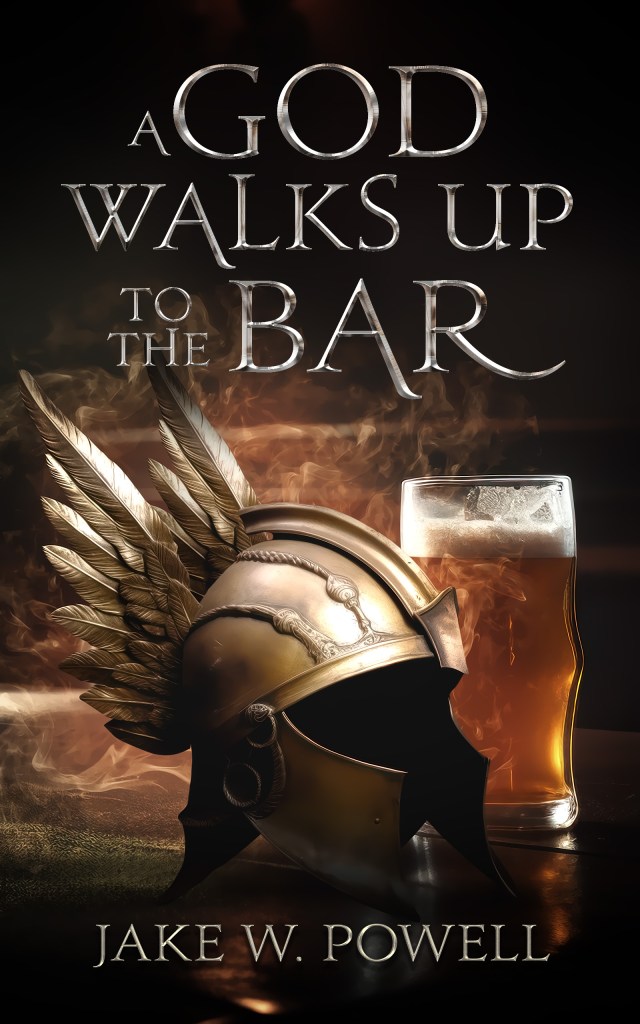
My first book, A God Walks up to the Bar, is available on Amazon.com. Witness the modern day adventures of the Greek god Hermes in a world much like our own – and with demigods, vampires, nymphs, ogres, and magic. The myths never went away, they just learned to move on with the times. It’s a tough job, being a god!



 Jake W. Powell