Lessons I Learned Writing My First Book, Part 1

My first book was quite the educational experience. There’s nothing quite like diving into a new challenge and learning as you go. It’s sink or swim, sometimes, and not knowing quite what you’re doing is as exhilarating as it is terrifying!

So, I’ve made it through, and looking back on the years-long trek, I realize that I actually may have learned a thing or two. Not just the technical aspects of writing, but general takeaways, as well. So, for all you fellow authors out there, and those of you who are thinking of entering the wonderful world of writing, here are my lessons learned from writing my first book.

First and foremost: Discipline. Writing takes effort. More than that, it takes the willingness to sit down and just do the work. It takes a willingness to push yourself beyond your boundaries, to organize a time that’s best for writing, and just do it. Dedication is a big part of being an author, because writing takes time, and time is precious, right? You got to be willing to make that sacrifice.

Writing also taught me perseverance. I felt like I was running a marathon when I was writing my book. It’s not a quick and easy thing when writing a book of any length. This isn’t a blog article or a social media post. I was in it for the long haul, and sometimes I just felt apathetic about what I was doing. I wondered if there was even a point to writing, if it would mean anything in the end. That’s when I had to roll up my sleeves and keep going. You got to be willing to motor on.

Thirdly, I learned patience. Writing takes lots and lots of patience. Whether words come easily to you when you write or not, the process is not necessarily a quick one. Maybe that first draft takes no time at all, but then you got to go back and revise. And revise again. And again. And then you get it read by beta readers. And by editors. And then you go back and write a new draft. You got to be willing to be patient to make your story the best it can be.

And finally, the hardest lesson of all: Humility. To be a published writer means putting your work – and yourself – out there for all to see. That makes you feel quite vulnerable at times. Putting out your book invites criticism and commentary, some positive, some not. When I first gave out drafts of my book to be read by others, I got a heaping helping of flaws and bad habits set down before me. It’s not pleasant, but it’s needed. You got to be willing to admit you’re not perfect and develop a tough skin to take necessary criticism.

That’s the quick summary. Over the next week or so, I’d like to dive deeper into each lesson and go into more detail about how I grew over the course of this book. I hope you all enjoy it!

The gods and beings of ancient myth never went away. They just moved on with the times.

My book, A God Walks up to the Bar, is currently available on Amazon.com. Venture into the world of the Greek god Hermes, a world filled with demigods, vampires, nymphs, ogres, magic, and trickery. It’s a tough job, being a god!

Enjoying my blog? Don’t want to miss a single post? Subscribe for updates on when I post and follow my writing career, musings on fiction and storytelling, and reflections about life in general!

My Book is Now Available!

Hello, all! My first book, A God Walks Up to the Bar, is now available for purchase on Amazon.com! This has been a long time in the making, and I am proud to share it with you all.

Thank you for your continued support of this blog and my writing, and for joining me on my writer’s journey. I hope that this book is but the first of many!

It’s Almost Here!

The gods and beings of ancient myth never went away. They just moved on with the times.

Hermes is a busy god. Messenger of Olympus, trusted agent of Lord Zeus, and irredeemable scamp and trickster. Through wit and cunning, he puts out the fires and conflicts that threaten the fragile stability of the supernatural world. And he does so with style.

Half-giant thugs, vampire crimelords, hot-headed werewolves, freakish chimeras: so many beings slip through the cracks of a world that long stopped believing in legends. And when you look like a pretty-faced youth who stands five foot eight inches tall, not many take you seriously. Sometimes, even a god’s only defense is a sharp tongue and even sharper mind.

If you’re lucky, when the day is over and everyone gathers for a cold drink at the bar, you might run into Hermes and hear tales of his adventures as a myth living in the modern world.

A God Walks Up to the Bar, my first-ever published book, will be available for Kindle on Amazon.com starting Saturday, August 12th!

Book Release Date is Set!

Save the date! My first-ever book, A God Walks Up to the Bar, is due to be published one week from now, on Saturday, August 12th. It will be available as a Kindle eBook on Amazon.com.

This book has been a long time in the making, and I couldn’t have done it without the support of my friends and family and the excellent work of my editor and cover artist.

If you enjoy modern fantasy, Greek mythology, trickster heroes, and general supernatural shenanigans, please check it out!

Learning to Take It: Writing and Criticism

Criticism is a bit of a dirty word, isn’t it? Nobody wants it thrown in their direction. We fear it and worry that we might be its next target. More’s the pity, because criticism is a necessary part of the creative process. Heck, it’s a necessary part of being creative, period.

You learn to grow a thick skin when you’re a writer or artist or filmmaker. Putting your work out there … well, you’re going to get reactions. Some good, some bad, some just plain weird. When I gathered beta readers to read my work in progress, I asked for criticism. Demanded it really, because I need it. Where would we be without second opinions?

But the word has gone through an evolution that’s warped its original meaning. The way I see it, criticism isn’t a bad thing in and of itself. But look at how we use it in everyday conversation: “He criticized my tastes.” “She was critical of the restaurant he picked.” “They learned to ignore criticism of their actions.” It’s always in a bad context, isn’t it?

What criticism actually is is pretty simple: Evaluation of the quality of something. That’s it. Art critics evaluate the quality and merits of an art piece. Literary critics evaluate books. They are judges of whether something is good, based on more or less consistent criteria.

Oh, now there’s a dirty word. Judge. Who wants to be judged?

Well, if you’re writing a book, you’re going to be. People have opinions, and boy howdy are they happy to share them! Which can be a good thing, because otherwise how the blazes am I going to know if my work is any good or not? Or at the very least, if it’s having the effect on readers that I want it to have? And besides, plenty of people have stuff to say that is actually helpful and informative.

But criticism also invites the opportunity to show off one’s own creative side by inventing an endless tirade of elaborate insults that read well on websites and give people something to giggle at. Critics seem to have a knack for channeling their eloquence into spectacular putdowns. Doesn’t really portray the concept of criticism itself as something desirable.

Like I said, you have to grow a thick skin. And you have your own responsibility: Winnow out the kernels of useful feedback from the dross.

There’s positive criticism and there’s negative criticism. There’s evaluation of the failures and triumphs of your work. Listen, consider, and take the steps you need to improve. Criticism isn’t bad. We all need it to get better. Otherwise, we’re just working in isolation, never knowing if what we produce is truly worthwhile. And no writer can afford to be that solitary.  

Enjoy what you’re reading? Subscribe by email for updates on new posts and follow my writing career, musings on fiction and storytelling, and reflections about life in general.

Revision Vs. Obliteration: When to STOP Revising Your Book

Editing is an addictive process for me. I love editing. I love digging into the guts of my story and tinkering with things, fixing typos and grammar, revising dialogue, picking better words to describe action and thought. It’s a huge amount of fun for me. Alas, like most things in life, too much of a good thing can be very bad indeed.

I go through many drafts, and in each draft I find something new that can be improved. And improved again. And again! As soon as I finish, I see something else that needs fixing. Eventually, the quotation marks of irony rear their ugly heads and improve becomes “improve.” Yes, I’m making my story “better” by constantly carving it and nitpicking it until there’s nothing left. I need to remind myself: You must set yourself a stopping point.

But the perfectionist in me screams out: What if you missed something? What if there’s a misspelled word somewhere in there? What if you misplaced a comma? What if there’s an extra space between words? What if, what if, what if!

I’ve gone through my drafts, I’ve had my book edited, and I’m going through my final proofreading. It’s almost done. And I must remind myself that it’s almost done. No last-minute check-ups that turn into another round of revisions. Done is done. Finis. Ready for publication. But am I ready to publish? Is anyone ever truly ready?

What if I missed something? Ah! There it is again! The dreaded “what if!”

In theory, authors could revise their books forever. The process can go on and on until, quite literally, nothing is left. You don’t have a book anymore. You’ve “revised” the living daylights out of it, cutting and cutting, until what made the book great has been destroyed by picky perfectionism.

Maybe that’s part of growing as an author, accepting that you, at any given point in your career, are NOT perfect. That your work is flawed, try as you might, and you must recognize those flaws, learn from them, and apply your lessons to the next project.

But I can’t perfect my craft by obsessing over one work forever. I must set myself a deadline and mark it as DONE, like it or not. Maybe that’s just my quirk. Maybe my fellow authors have struggles that are quite the opposite, or maybe you can relate. Feel free to share in the comments.

Finding the Right Words

Sometimes I wish there was a checklist for writing the perfect story. If I had a step-by-step guide that included everything I needed to put into a book to make it a guaranteed success, it would make life so much easier. All I would have to do is check off each step, and bam, instant bestseller.

Naturally, it’s not that simple. Grammar and spelling are one thing. There are rules for sentence structure that can be looked up easily enough. But what about choosing the right words for the story?

How do I know just the perfect words for a description, or exactly how to phrase a piece of key dialogue? How do I write down something precisely as I want it to be read? I confess, I don’t fully know. I’ve studied creative writing in school and written poems and short stories. I’ve dissected classic literature until I was left with a mess of symbols and metaphors and analogies. As an aspiring author, I’m learning more than ever. But for all that education, writing fiction involves as much instinct and intuition as it does obeying the laws of grammar.

Words have power. I think we can all agree that words can encourage or depress us. There are pieces of writing that really move us, maybe even motivate us to take action. So, I’m like a guy holding a lit match. I have to be careful where I set it. Or maybe I’m more like a guy juggling 50,000 matches who has be verrrrry particular about where each one lands. Words are nothing to be trifled with, but the thing is, a writer really doesn’t know what the damage is until the reviews start coming in. Maybe it’d be useful if my draft spontaneously combusted. Then I’d know if I was doing it right or not.

Finding the right words is a bit of a crapshoot. I’ve only just really developed a feel for what my writing style is, and I’ve gotten beta readers to give me feedback that helps me see my own work more objectively. Even so, sometimes I feel like I’m groping in the dark. How exactly do I convey what I see in my mind’s eye? How do I communicate it? Even harder, what should I leave out to allow readers to fill in the blanks for themselves?

I don’t know if anyone ever gets it right the first time. To paraphrase Ernest Hemingway, the first draft of anything is crap. There’s always another go-around, and another, and another. It’s like a sculptor chipping away at the marble until the proper shape is carved out of the stone. It takes time, thought, and effort to find the right words.

Does that make writing boring and tedious? Not at all! It’s part of the fun for the writer. It’s a game of imagination combined with a jigsaw puzzle. You cook something up out of your own head, look at what ended up on paper, then try to fit the pieces together into something remotely resembling what you originally envisioned. It’s a challenge. I think we writers like challenges. We certainly like tormenting ourselves over finding just that perfect word to use in that one sentence on page 72 that we know only five people on Earth will ever notice.

Will I ever find the right words? The perfect words? Maybe. Maybe not. It’s worth the struggle to try.

Enjoy what you’re reading? Subscribe by email for updates on new posts and follow my writing career, musings on fiction and storytelling, and reflections about life in general.

Pace Yourself! What Can Make or Break a Story

You start reading a book, or watching a movie, and the beginning is a banger. You’re hooked. The characters are great, the story is enthralling, and the action is incredible. The first act is a masterclass in storytelling.

As you continue, though, you feel a nagging sensation that something has gone wrong. You aren’t gripped like you were in the first twenty minutes. Why all this pointless dialogue? Why spend five minutes on a scene that has no impact on the rest of the story? Did someone put the plot on a lifeboat and set it adrift? It’s just … wandering aimlessly.

But wait! You get to the end, and the last ten minutes suddenly pick up. Boom. Bam. Bang. The plot is resolved, the heroes win the day, end of story. It’s satisfying enough, but you’re left wondering why 70% of the story just dragged on and on.

Or maybe you run into a story with the exact opposite problem. You feel out of breath after finishing it, like you were never given a chance to rest. Who’s this person and why are they – never mind! Moving on! More action! More spectacle! Can’t contemplate our navels now!

You’re rushing from set piece to set piece at breakneck speed. Movies especially love to do this. The story is just an excuse to show off the cinematography. Maybe there IS a good story there, but it’s been broken up by a frenetic pace that prevents it from properly unfolding.

Pacing. That’s the keyword. A good story has good pacing. It’s the invisible, unappreciated ingredient that is key to cooking a good meal. Folks know when they dislike the protagonist. They understand bad writing. A poorly constructed setting betrays its flaws just by being experienced. Audiences know these things. But pacing is more subtle. When the pacing’s poor, you don’t always know what’s wrong, but you can sense that something is off.

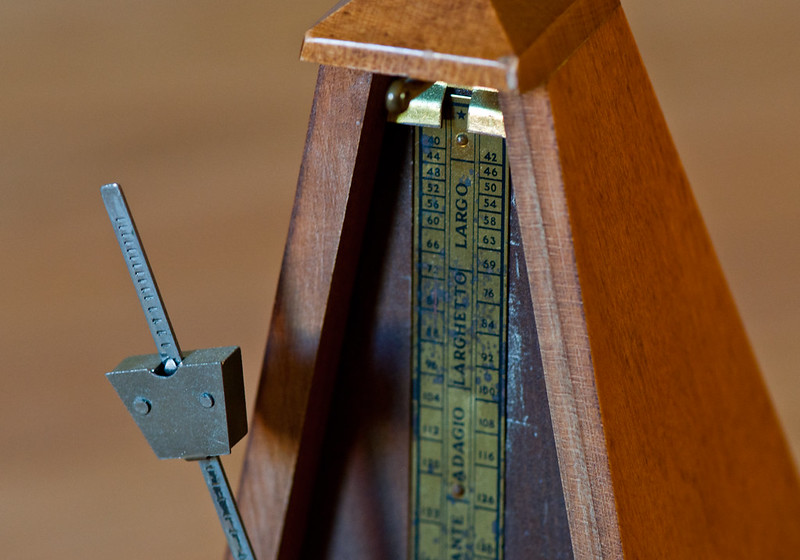
Pacing is the speed at which the story is told, in which everything, everything, you’ve written is unveiled at the times that best serve its progression, its development, the audience’s entertainment, and the impact of key scenes and events. Pacing is to storytelling like a metronome is to music. Go off-beat, and everything goes out of whack.

As the metronome helps the musician keep the proper rhythm, so does a writer keep their story at the proper pace
Metronome” by jronaldlee is licensed under CC BY 2.0.

To continue the earlier food analogy, a story is like a meal. Pacing is the speed at which you eat the meal. Eat too fast, and you barely get to taste the food. Eat too slowly, and the food is so cold and stale by the time you finish that it can hardly be considered tasty anymore. A writer needs to be like Goldilocks and find the pace that is juuuust right.

Naturally, stories being organic things with a knack for growing beyond the writer’s original intention – things that you could swear have minds of their own – there is no magic formula to apply to a story. Each tale is unique. There are so many factors to consider: the genre, the story’s message (if any), the amount of dialogue versus action, the length of the story, et cetera.

Moby Dick is a classic of American literature. It’s also all over the place with its pacing, stopping suddenly to discuss the physiology of whales and the philosophical repercussions of pursuing vengeance against the natural world. But it is as much a philosophical and encyclopedic work as it is a fable of the cost of revenge, and its opening chapter tells you to strap in for a long, introspective ride. There are certain expectations one automatically forms when seeing how much space that monster takes up on the shelf.

On the other hand, a short story is quite the opposite. It’s a short story, and a reader doesn’t go in expecting long, drawn-out retrospectives on life, the universe, and everything. The plot is much more straightforward, and the pacing moves swiftly. If you expect to finish a story in one sitting, you aren’t going to be pleased if nothing worthwhile happens in that time.

I could go on and on about this topic. Its poor execution is one of my biggest pet peeves in writing. But then, a blog post is a short piece of literature, too, isn’t it? Yes, even blogs need good pacing, and though I may complain about it, I’m no master myself. Live and learn, and occasionally complain about things you yourself aren’t very good at. But not too much, that’s just bad form.

Enjoy what you’re reading? Subscribe by email for updates on new posts and follow my writing career, musings on fiction and storytelling, and reflections about life in general.

Tragic Writing Mistakes I Learned Firsthand

They say failure is the best teacher. If that’s true, then I am a very, very good student. I’ve already made some doozies in my nascent writing career. I’m glad I did.

A God Walks Up to the Bar isn’t the first book I’ve ever written. Way back when I was a wee college lad, I wrote another book. I put a lot of effort into it, and I was proud of it at the time. Looking back …

It’s absolute garbage. I’ll never let it see the light of day. So, what went wrong?

Mistake the first: I starting writing without any sort of pre-planning or outline. OOF.

Now, I know that there are some writers who are able to wing it and don’t rely on outlines and plotting out story beats ahead of time. I’m not one of those people. I need something more than nebulous ideas. Good preparation not only organizes my ideas, but I develop new ones and discover the real plot of my story as I outline.

Having done none of that for my first-ever project, the plot, such as it was, was confused and schizophrenic, and the pacing was a jaw-dropping mess. As a naïve beginner, I just figured all writers knew what they were going to write, as if by some magical gift granted to all authors. That belief has since been thoroughly exorcised from my brain.

Mistake the second: Overambition.

Have you ever started a novel thinking it’s going to be a grand six-hundred page epic that will sell thousands of copies, change the literary landscape, and maybe even get audited for a film adaptation? That was what I believed when I first started writing. Again, this was in regards to a book I had not even bothered preparing for. I wrote and expected, oh, it would just be good. Magically.

I crammed about three novels’ worth of material into one book, I was tracking multiple characters across multiple locations at once, I ended with a big epic battle … and I thought all this was setting up more sequels. Again, I had never written a novel before and I didn’t really know what I was doing. Oh, such hubris! Oh, such an education!

Speaking of sequels …

Mistake the third: I wrote for the sequel, not the current story.

When I wrote my horrific-yet-highly-instructive first novel, I wasn’t writing it as a standalone. I was writing for the sequel, and the installments after that. I didn’t give my current project the attention and respect it deserved.

It’s a presumptive way to write a story, treating it merely as the setup for a larger franchise. It isn’t given time to develop its own identity, because you’re too busy teasing at future events and building up to payoffs that may never happen. Thus, the current story is robbed of its own identity.

So, I learned that every story I write, even if part of a bigger universe, should be able to stand on its own merits regardless.

Mistakes aren’t something to fear. They will happen, so I might as well get used to making them. Ah, well, I got some of the worst of my inexperience out of my system, and I like to think I’ve gotten better. I suppose I’ll find out for sure after I get published, eh?

Enjoy what you’re reading? Subscribe by email for updates on new posts and follow my writing career, musings on fiction and storytelling, and reflections about life in general.

Why Even Bother? Thoughts About Motivation

What motivates me? I want to be a published author, but why even bother in the first place? And why stick to it after I’ve started?

Well, going after big questions today, aren’t I? Before I dive headlong into existentialism, I think I better draw the boundary right here: Why am I motivated to write and publish a book?

For me, the impulse to start a task comes in waves. I’ll begin a writing project and when I first start, I’m just thrilled. Think of all the things I’ll get done! Come two days later, I can’t muster up the effort to finish it. The document languishes in the depths of my computer’s files, neglected and lonely. But then, six months later, I’ll come back to it, because suddenly the urge has hit me again.

Truth be told, coming this far with my current novel is a milestone in my life. I started a project and stuck with it, whether I felt like it or not.

What’s the deal? What does it take to stay motivated?

Motivation. How is that word used in conversation? “Be motivated.” “Got to stay motivated.” “Keep yourself motivated.” We make it sound like a state of mind. Remain in that state and only then will you get things done.

You can accomplish a lot when you’re motivated enough …
Climb Ev’ry Mountain“//jermudgeon//CC BY-SA 2.0.

I don’t know about you, but I flip through about three dozen states of mind every day. Maybe it’s just me, but my emotions tend to jump around constantly. It’s kind of annoying, really. But it doesn’t matter. Seriously motivated people aren’t focused on their emotions, they’re looking at the goal. The climber ascending the mountain and the runner approaching the finish line aren’t driven by their feelings, they’re driven by what’s at the end of the struggle.

I’ve worked on my book when I was angry, when I was discouraged, when I was happy, and when I was convinced I was the hottest new thing in the industry. But it didn’t matter how I felt. The book had to get done. No amount of psyching myself up or putting it aside until I was “in the right mood” was going to produce tangible results. I just had to sit down, shut up, and do the work.

Motivation isn’t a state of mind. It’s actively striving. I didn’t just keep myself motivated; my motivation kept me in action.

I’m almost finished with my book. I’ll be releasing in within the next two months. I want people to read it and enjoy it. That’s my goal. That’s the thing that motivates me to finish it. And I believe that’s worth working towards.

Why bother? Because I choose to. And on that last, suitably dramatic note, I wish you a good day and your own goals to motivate you to do something great.

Enjoy what you’re reading? Subscribe by email for updates on new posts and follow my writing career, musings on fiction and storytelling, and reflections about life in general.