A Thought on the Horror Genre

I don’t have any long discussion on life, writing and the universe planned today. Just a brief thought on the topic of story genres:

The difference between the horror genre and the action genre is whether or not the protagonist has a shotgun.

Cheers.

***

My latest book, The Trickster’s Lament, is currently available on Amazon in both Kindle and paperback format.

“Hermes is not having the best time. He walks a fine line, and his duty as messenger of Olympus weighs heavily on him. Being a god in the modern age means living in a world that no longer believes in gods. How much can one deity accomplish when no one respects him anymore? And why do his instincts tell him that he, the son of Zeus, is losing favor with his own family?

Tensions abound. The upstart Young Gods play dangerous games using entire cities as their boards. Formless monsters strike from the nighttime shadows, terrorizing hapless mortals. Agents of rival pantheons scheme to thwart Olympus’ designs. In the thick of it all, Hermes does what he does best: trick, lie, and cheat his way to victory.

Many thanks for visiting my blog. I post updates on my writing career, I muse over storytelling and fiction, and I reflect on the curious and wonderful things in life.

Blank Spaces of the Mind: How Do You Tell A Story Without Having to Tell Everything?

I like movies. I’m a visual person, and I enjoy seeing things portrayed on the screen. Little details are the most fun. Characters’ tics and interesting events happening in the background. Sometimes, I envy filmmakers. Creating their worlds are a little bit easier, because they can convey in a minute what can take a writer four or five paragraphs to communicate. ESPECIALLY when they are able to tell the story without a single word being said.

We writers, of course, don’t have that luxury. Books are nothing but words, which got me thinking: How do you show the reality of a story, that is, communicate character traits and worldbuilding details, when you can’t really show anything at all?

It’s a different game from simply describing a scene or a character. That’s to be expected. But where to stop? Where’s the line between “This is what Joe looks like and how he acts” and “This is Joe’s personality and character, let me tell you without ever referring to it again and thus making this paragraph pointless.”

So, I’ve thought about it, and here’s what I’ve come up with so far.

Stories are best told when the writer doesn’t need to explain everything. A good story unfurls through action, whether visual or written. Actions define a character, a group of characters, even a location. The way a person carries himself, dresses, talks – these all express relevant elements without the need for a mountain of exposition.

And they can be brief. For example: A wizard appears in the story. He dresses in fancy clothes and has clean, well-groomed hair. He talks formally with a condescending tone. He casually refers to esoteric subjects. He sniffs loudly whenever he disapproves of the other characters’ comments. He kills a wolf with a single, well-timed spell. Short, succinct statements that tell us what we need to know – and give us the freedom to paint a picture of the character in our minds. We don’t always have to go into detail about hair color, eye color, body type, or a detailed analysis of clothing. Heck, just the word “wizard” probably had you paint half the picture from a single word, didn’t it?

But then, another character brings in the Artifact of Doom for the wizard to identify. The wizard immediately panics and backs away, demanding that the object not be brought near him. Well, that tells us immediately that the Artifact of Doom is really bad news. If Mr. High-and-Mighty is scared, it just might be a serious problem for everyone.

So, yeah, books aren’t visual, but they can still tell a story without having to tell us everything. In short, leave some space for the reader. Now, I’m not going to say that I’m necessarily good at this as a writer. I’m still learning, but I’ve learned as much from reading as writing. And I get annoyed when books pause everything to describe the POV character’s emotional state or appearance in long, flowery detail. It just seems … excessive.

Maybe it’s just the mark my journalism classes left on me. I like simple and to-the-point. And I like to think that my readers can be trusted to have a little imagination to fill in the blank spaces of the mind that words can’t reach by themselves.

What are your thoughts? How do you think a story can “show, not tell?”

If you just so happen to be enjoying my blog, feel free to subscribe. I post updates on my writing career, I muse over storytelling and fiction, and I reflect on the curious and wonderful things in life.

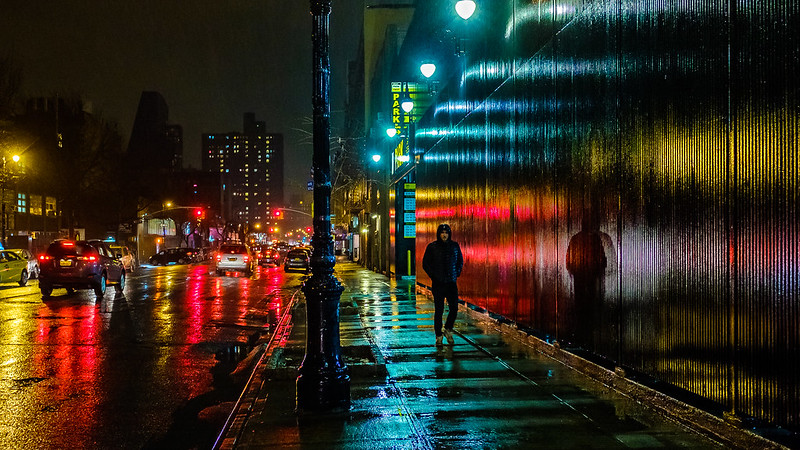
Image: “New York City Street Scenes – Rainy Night on the Lower East Side” by Steven Pisano; Licensed under CC BY 2.0.

Legacy: What We Are Remembered For

As we get older, we start having deep thoughts. Questions run through our minds, questions like, “What will I leave behind when I’m gone?” and “How will people remember me?” With age comes an acute awareness that our time on Earth is finite, and with that come musings on what our legacy will be. What mark will our lives leave on the world? Will we, to get to the heart of things, have done anything that mattered?

Legacy is a loaded word. It’s a word associated with empires and rulers. It invokes monuments that endure for centuries. Legacies are connected to greatness. The greatest men and women of history, whether good or bad, are remembered by all.

And look at what society says to us. We must work hard to leave our own mark. We must strive to improve the world, to improve society, to make positive changes, to “be the change you want to see.” Or even, just to leave the world a little better than when we found it. A burden, one might say. It is something imposed on people from a young age to aspire to greatness.

I say it’s a distraction from what’s truly important. Today’s great accomplishments are tomorrow’s misguided attempts. We simply don’t know how we will be remembered, or by whom, or for what. That guy you accidentally cut off on the freeway is going to remember you very differently than your favorite uncle who loves the sweater you bought him for Christmas. And that piece of litter you picked up in the park without a second thought might inspire some passing child to pursue a career in conservation. The door you held open for an old lady might have given her new hope in life.

Farfetched, you say? What do we truly know about what will affect others the most? Media tells us that big causes and organizations are what change the world. But not everyone is going to make a mark on that scale. What does that tell us? That those who don’t measure up to vaguely defined goals are failures?

Right, right, this is all very deep and philosophical, but maybe you’re wondering what this means for you. Or you’re wondering who this pretentious nit with a blog is, anyhow. Well, the long and short of it is: Your legacy is everything you do, big and small. And the small things, in my experience, tend to matter more than the big.

We’re not all going to be famous when we die. We’re not all going to found a world-spanning charity or find the cure to a terrible disease or invent a new technology. But we are all capable of acts of kindness. Compassion and sympathy go a long, long way. There might not be any prizes or awards, and nobody’s going to erect a monument for a gentle word, so maybe it doesn’t appeal to everyone. At least, until you need a kind word yourself on a bad day.

We can’t control our own legacies. We can maybe dictate what’s written on our tombstone, and will our possessions to others, but how we truly affected the world – for better or ill – is a far more complex thing that can’t be summed up in a few brief achievements.

Legacies shift and change and what we consider our magnum opus might be forgotten within a few years. So, if you ever find yourself getting worried over how people remember you, just relax. Just do your best and be kind. I suspect we’d all be surprised if we were aware of the things we did that truly mattered most to others.

If you just so happen to be enjoying my blog, feel free to subscribe. I post updates on my writing career, I muse over storytelling and fiction, and I reflect on the curious and wonderful things in life.

Image: “The mountains are calling and I must go. John Muir” by blmiers2; Licensed under CC BY-NC-SA 2.0.