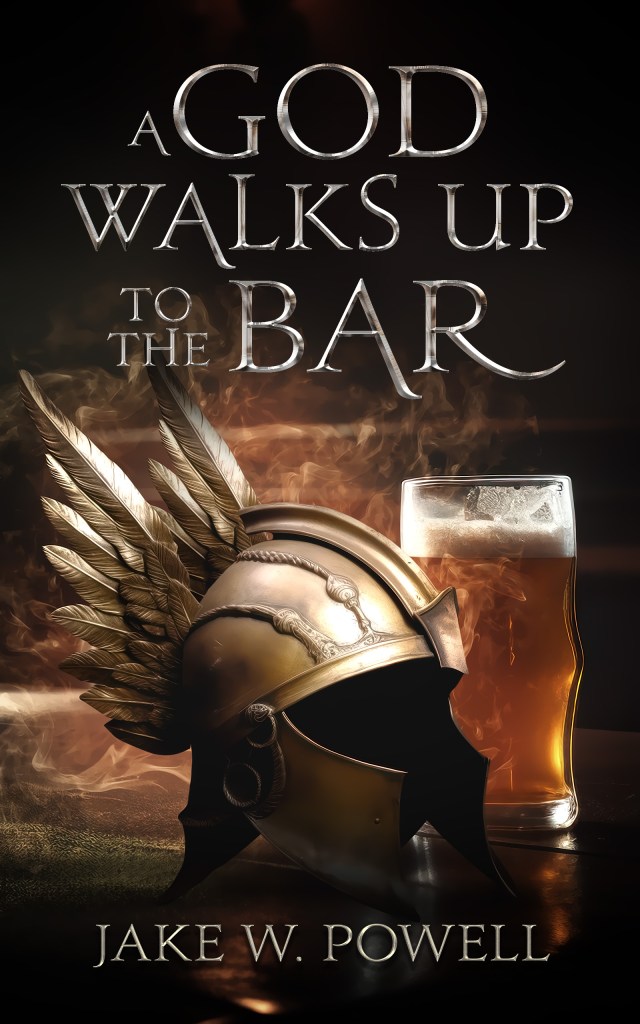
A God Walks up to the Bar – Excerpt

Well, I’ve talked a lot about writing on this blog, but I’ve never actually posted any of my work yet. I thought today that I would post an excerpt from my first-ever published book, A God Walks Up to the Bar. It’s an anthology of five short stories, connected by a framing story, that details the adventures of the Greek god Hermes in modern day. Read and enjoy!

The night was gloomy in that part of New York. There was no glamor here, no joyous nightlife. There was just rain drizzling down half-heartedly, covering the sidewalk in a dirty wet sheen that reflected the glare of the streetlights. It reminded me of how long I’d been putting off that vacation to Aruba, and how nice it would be to lounge in the jacuzzi in my apartment. But, alas, no such luxuries tonight. I was on business. The messenger had gotten his assignment, and like the intrepid mail pilots of old, he must get through.

I tromped through the puddles and arrived at my destination. It was a real hole-in-the-wall bar. Its owner had spared no expense in stripping it of the slightest feature that would impress itself in memory. There was no sign, the windows were darkened glass, and the entrance was a blank gray door at the bottom of a flight of concrete steps. I descended and walked inside.

It wasn’t much more cheerful inside the tavern than out. Battered hanging lamps cast everything in a dim reddish-orange tint. The floor was slick with grease, and the air was sour with the scent of cheap beer. It was well into happy hour, but the clientele was sparse. I counted six men hunched over their drinks and making small talk. A couple of them glanced up and appraised me with cold eyes.

This wasn’t a place where people gathered for a good time. This was where you came when you had to conduct business that was frowned upon by civil society. An unfamiliar face like mine wasn’t welcome here. Still, they did little more than scowl at me as I approached the bar.

The bartender had just stepped out of a backroom lugging an icebox when he saw me. He set down the box and fixed his eyes on me. His voice was brusque.

“What’ll it be?”

“Nothing, tonight,” I replied. “I’m here to see your boss.”

The bartender frowned and tilted his head.

“I’m here to see Stauffer,” I clarified.

The man’s eyes narrowed.

“Who wants to see him?”

I set both my hands on the bar counter. I immediately regretted it — the wood was sticky with spilled alcohol — but I wasn’t about to show squeamishness. I pushed my right hand forward and curled my knuckles, displaying the ring I wore.

A gold ring with a seal displaying two serpents wrapped around a winged staff. The Caduceus. My personal symbol.

The bartender’s frown deepened. He recognized it.

“You’re an Olympian,” he said slowly.

“That I am,” I replied with a friendly smile. “Hermes of Olympus, Swift-runner and Wayfarer, Herald of the Dodekatheon, et cetera, et cetera. I’m here to see Arnold Stauffer with a message straight from Lord Zeus. And I fear it must be delivered face-to-face.”

He scratched his chin thoughtfully. “Sorry, my lord, but I can’t say I’ve—”

I held up my hand. “Tell you what. Let’s skip the part where you pretend that he conveniently stepped out a few hours ago and you don’t know when he’ll be back. I know he’s here. Does that sound good to you? Good, that’s settled. Now, just point me to his room, and I’ll be out of your hair faster than a Valkyrie can chug mead.”

The bartender gave a short, ugly chuckle. “He won’t see you today, my lord. He’s busy.”

“Oh!” I replied in mock horror. “He’s busy. Olympus forbid.” I leaned farther forward. “If it’s trouble you’re worried about, I’m not here to knock heads and pull ears. It’s a simple message. A communiqué. A heaven-sent singing telegram, if you will. Minus the singing.”

My words didn’t make much of an impression, but as I spoke, I took a moment to throw a casual glance across the tavern. I noted the hallway leading deeper into the building. I turned again to the bartender.

“He in back? Tending to the affairs of his kingdom?”

“He ain’t seeing you. Not my call.”

Stauffer had been expecting someone to show up. No surprise there. He knew what he’d done. And yet, he still thought he could keep me away. Adorable.

I took several meaningful steps toward the hallway. A man sitting at a nearby table slowly got up and stretched in a way that drew attention to his height and formidable musculature. His drinking buddy, a much older fellow than the rest of the barflies, remained seated but watched me carefully.

The standing man looked at me with a face that shone with arrogance.

“Must not have heard the man,” he said in a loud voice. “Arnie doesn’t want to be disturbed. So why don’t you skip out of here, Olympian?”

He gave me a predator’s grin and glanced at his friend who was still watching me. I sized up the gatekeeper. Tall, stocky, thick-skinned, with a greyish tint to him. Ogre blood. Not to be trifled with. Judging from the way his hands were open and held close to his side, I figured he was armed. Knives most likely. His jacket wasn’t thick enough to conceal a gun. He looked down at me, which isn’t hard to do to a god who’s five feet eight inches tall.

I sighed in defeat.

“Well, that’s a shame. It was worth a shot, though, wasn’t it, Mark? But you’re right, we don’t want to make a fuss. It is Mark, isn’t it?”

The man’s right eye twitched slightly at the casual mention of his name.

“Right, Mark Yeager.” I nodded as if I had just remembered. “You do a bit of leg-breaking work for Stauffer. Real smooth operator. A pawn shop here, a diner there. Very efficient, really rising in the ranks. Even got your own thing going, too, I’ve heard. A bit of burgling on the side when not on Stauffer’s payroll?”

Mark tried to laugh it off, but that telltale twitch in his eye didn’t go away. He wouldn’t make much of a poker player. “What are you trying to do, scare me? I’m a plumber.”

“Yeah, yeah.” I laughed. “That was pretty dumb of me, wasn’t it? You do good work, I’m sure.” Mark smiled mirthlessly at me as I took a step back. The tension in his body drained away, just in time for the gut punch.

“You, uh, did a real good job unclogging the pipes at Ezra Connolly’s place, I heard.”

The comment caught him off-guard. His nostrils flared, and his throat tightened. Jackpot.

“Unclogged his cabinets later that night, too. Pretty slick work.” I waved my hand across the tavern. “The guys must have really been impressed. Not easy, breaking into the home of a member of the Aristocracy.”

“What’s he talking about, Mark?” the white-bearded man asked calmly.

Mark shook his head, trying to shrug off the question. “Nothing. He’s just blowing a load of—”

I cut him off. “And is Stauffer having trouble with the Aristocracy?”

They all remained silent, watching me now with undivided attention. They knew the answer. The Aristocracy was controlled by vampires, a world-spanning criminal empire that suffered no insult. Its network in New York had been harassing Stauffer’s operations for a couple weeks now.

“Didn’t Connolly mention something to Stauffer? Something about being disrespected? About his territory being violated? Hey, Mark, you doing alright?”

The other men turned to observe Mark with acute interest. He wasn’t holding up very well under the scrutiny. His eyelid was practically short-circuiting, and his face was turning a violent shade of red.

I took a step closer to him. “You know how vampires are. Once they get it into their head that they’ve been slighted, they’ll go through fire and water to even the score. Man, I’d hate to be the guy who ticked them off. Vampires have a really interesting idea of justice. It involves lots of sharp, jagged objects. If I were Stauffer, I’d be looking for that idiot who messed up and just hand him over. So, anyway, how is the plumbing business nowadays?”

“Alright!” Mark erupted. “I get it. You think you know stuff.” He glared at me. “I’m loyal to Mr. Stauffer. And you ain’t passing through here.”

The white-bearded man whistled in derision. “He’s a god, you idiot. He’s not trying to force you to stand down. He’s proving a point.” He jerked a thumb. “Step aside.”

Mark shot a look at him. “But—”

“Shut up and get out of his way.”

Crestfallen, Mark stepped to the side, letting me pass. The old man raised his glass to me.

“Well played, Lord Hermes.”

As I walked away, I heard his voice growl, “Sit down, Mark. I think we should talk.”

A key rule of bluffing is confidence. Did I know with dead certainty that Mark was a thief? No. But I knew just enough. I had lots of little birds all over the city telling me things, and this was one of the nuggets they’d dropped me. It was all gossip, truths, and half-lies, and who knew which was which. But I had played this game before. Drop a hint, watch the opponent buckle, and then push him a little more. Never falter, never stutter, and always let them believe you already know everything. I’m a god, aren’t I? Everyone knows gods are all-knowing.

Well, I had gotten that roadblock out of the way. Now, it was time to deal with the big man himself.

There was a solid oak door at the end of the hallway. It was a fancy door, far more ornate than anything else in this place. I felt the faint pulse of magic emanating from it.

I put my hand on the doorknob and was immediately stung by a shock of intense cold that coated my palm in frost. An enchantment to ward off intruders. Clever.

But this was low-grade stuff. I focused my thoughts and pushed back against the enchantment. The magic sputtered and dissipated, and I felt the cold fade away. It took another second to take care of the lock. I opened the door and stepped inside.

To be continued …

If you just so happen to be enjoying my blog, feel free to subscribe. I post updates on my writing career, I muse over storytelling and fiction, and I reflect on the curious and wonderful things in life.

My first book, A God Walks up to the Bar, is available on Amazon.com. Witness the modern day adventures of the Greek god Hermes in a world much like our own – and with demigods, vampires, nymphs, ogres, and magic. The myths never went away, they just learned to move on with the times. It’s a tough job, being a god!
Confessions of a Skipper

I must confess to a strange reading habit, one that might shock and horrify you. Do not judge me too harshly, for I shall explain myself.

When I start a fiction book, I like to skip to read the last couple of pages first.

“What?” I hear you cry out. “What is this blasphemy? Why ruin the story for yourself?” Calm yourself, please. Let me clear things up.

It’s true that I’m not sensitive to spoilers. I really don’t mind when plot twists are brought up in casual conversation. But this habit is more than just wanting to know how things end. Really, without context, knowledge of a story’s ending doesn’t have a terribly great impact on me as a reader. I have no grasp of the import of the scenes and dialogue. What I’m really interested in is catching a glimpse of the finished jigsaw puzzle, then going back to the beginning to see how the pieces fit together.

Rather than starting a book with no idea of how things end up, I know exactly how it ends. And so, the fun of the read shifts from the “what?” to the “why?” Why is this the ending? And how will my initial impression of it change as I get more pieces of the bigger picture?

I suppose I’m interested in perceiving the author’s mind. How do they assemble the various elements of the narrative into its final shape at story’s end? How are these characters and events inserted into the story? In short, how did we end up here?

Pieces click into place as I read on, and the ending’s significance becomes clearer. Sometimes, I feel like a detective solving a case in reverse. I already know whodunnit, but the howdunnit isn’t so obvious.

And I do it because I’m quirky and it’s kind of a fun exercise to try out. I neither recommend it nor warn against it. Reading style is a matter of personal preference. It’s up to you.

And there you have it. The true confessions of a skipper.

If you just so happen to be enjoying my blog, feel free to subscribe. I post updates on my writing career, I muse over storytelling and fiction, and I reflect on the curious and wonderful things in life.

Quirks and Tics: Characterization through Minor Details

You ever think about how traits and habits can shape a character? Everyone has their own flavor of mannerisms: body posture, repeating gestures, facial expressions, verbal expressions, nervous habits. For the sake of simplicity, let’s call them “quirks.” They’re the little details that don’t play a part in the unfolding plot, but simply help flesh out the world you’re creating. Being visual cues, for the most part, they also aren’t always the easiest thing to describe in writing. Movies love them, though, and they can definitely help liven up a scene and make characters more relatable.

It’s all about humanizing your characters. Real people have habits and tics. They do or say things on a regular basis that are uniquely a part of them. You – yes, you – have habits and gestures of your own that make you, well, you. The devil is in the details, but so is good writing. Experienced authors can make even a bit character memorable by throwing in a couple of notable traits and letting those emblazon themselves in readers’ minds. Movies have it even easier. Being visual by nature, a film or TV show can display those quirks without pausing to describe them, letting such details blend more seamlessly into the narrative.

Mostly, quirks are all about worldbuilding, aren’t they? Not necessary to the plot, not vital to understanding the hero and supporting cast. They’re like sprinkles on ice cream. They’re a little something extra.

Or are they?

Quirks can be used as plot devices and can even deliver good payoffs. Someone recognizes her long-lost lover because of the specific way in which he twirls his hair. A secret agent’s habit of spinning his knife causes him to drop it and nearly trigger a motion-sensor alarm. A villain always unconsciously taps her fingers at the prospect of playing a game. A protagonist with OCD compulsively touches and counts poles on the sidewalk. He misses one and goes back for it – just in time to miss being run down by an oncoming car.

These are all examples taken from real movies and TV shows. Can you figure out where they come from?

Do you want your story to feel real? Do you want your characters to feel like people you might actually meet on the street? Or maybe you just want to challenge yourself with producing something a little more creative than past works? Consider using quirks to ad spice to your story. How? Well, take a look at the people you already know. Watch them carefully (but don’t be weird about it). Look at how they act and talk and move. Real life is good inspiration. Everyone has quirks.

Are there ways in which you have used quirks in your writing? Please feel free to share!

If you just so happen to be enjoying my blog, feel free to subscribe. I post updates on my writing career, I muse over storytelling and fiction, and I reflect on the curious and wonderful things in life.

Writing Your First Draft: The Vomit Draft

Having gotten halfway through the first draft of my second book, I look back on the progress I’ve already made and have mixed feelings about it. On the one hand, I’m fairly confident my skill has improved somewhat since my first book. On the other hand, I see the myriad flaws still there and wish I could write a perfect book straight out of the gate. But writing is a feat where one plays the tortoise more than the hare. Slow and steady wins the race.

Also, the first draft of anything is going to be garbage no matter how hard you try. It’s just the nature of the beast.

In fact, I’ve come up with a nickname for first drafts: the vomit draft.

The first bout of writing isn’t necessarily pretty or neat. In fact, it can be downright ugly as you not only try to type out a coherent story, but also struggle with phrasing, dialogue, vocabulary, writer’s block, and coming to the grim realization that your story’s direction is slowly but surely veering away from your original vision. It’s a beautiful mess.

Knowing this, my goal in the first draft isn’t to write a masterpiece. It’s to just get all the words written. Spewing them out as they come to mind, as it were. Hence, the vomit draft.

We got to start somewhere, right?

Sometimes, I get frustrated and think that the garbage I’m writing is going to stay garbage regardless of rewrites. Sometimes, I go through a brief existential crisis as I wonder if being a writer is even my calling in life and maybe I should just stick to my day job. Sometimes, my mind struggles with even the most basic words. Who will want to read this?

But that’s not what the vomit draft is about. Making your story readable comes later. Right now, just get it all out. No holding back, no second-guessing, no graceful prose. Just write something to fill in the pages. It’s the foundation for what comes later. Every beautiful building is built upon a pool of poured cement. It’s not pretty, and it isn’t supposed to be.

Fortunately, nobody ever has to see our vomit drafts except ourselves. And we get a small consolation in knowing that this sorry state of affairs can and will become something much, much better.

If you just so happen to be enjoying my blog, feel free to subscribe. I post updates on my writing career, I muse over storytelling and fiction, and I reflect on the curious and wonderful things in life.

Image: “A sick cat” by wwhyte1968; Licensed under CC BY-SA 2.0.

History: The Greatest Source of Inspiration for Any Writer

Fact is stranger than fiction, they say. And it’s true. But have you ever considered the inverse: Fiction is never stranger than fact.

No matter a writer’s imagination, no matter his ability to craft new worlds out of his own mind and populate it with characters who seem as real and unique as anyone you meet on the street, and no matter how engaging, grandiose, bizarre, or heartfelt the events portrayed in his work, he will never be able to surpass the parade of the unexpected that is world history.

History IS story. It’s right there in the word, isn’t it? And it’s real. Just think about that for a moment. Think about all the things you’ve read in the history books. Adventure. Romance. Mystery. Tragedy. War. Friendship. Triumph. Defeat. Despair. Hope. All of it is there, all of it waiting to be discovered by that one author seeking a mote of inspiration.

Where am I going with this? Just to say this: We writers have so much to draw from just by browsing the history section at our local library or bookstore. Heck, just go online. We live in the age of information. The World Wide Web contains everything. Try a quick surf of your hometown’s newspaper archives. Stories aplenty. Ideas in abundance.

And now I’m starting to think that there are so many tales in history that haven’t been given their due. Forgotten stories that need a time to shine. Eras and events that have been lost in the bustle of modern progress. Martin Scorsese’s Killers of the Flower Moon highlighted a time in Native American history that deserves more recognition. A terrible time, but one that should be known.

What else have we misplaced? What battles and victories waiting for their recognition? Unsung heroes waiting for their song to be written? Tragedies yet to be acknowledged? Villains who thought they got away with it?

Apologies, I’m just waxing poetical now. You get the idea. Writers don’t just write stories. We live at the tail end of the longest story ever written. All we have to do is look back a little ways for new tales from that saga to tell. Isn’t that a teensy bit amazing?

If you just so happen to be enjoying my blog, feel free to subscribe. I post updates on my writing career, I muse over storytelling and fiction, and I reflect on the curious and wonderful things in life.

Image: “Early printed vellum leaf” by Provenance Online Project; Licensed under CC0 1.0.

Lessons I Learned Writing My First Book, Part 5: Humility

What’s the greatest challenge you face as a writer? The hours of hard work spent crafting your story? Pushing back against writer’s block? Trying to research a key piece of your book that you can’t quite get right? Finding a publisher? Finding the money to publish independently?

After all the effort you put into your book, there comes a point where you crave vindication of your efforts. After everything is said and done, you put it out onto the market and …

Where’s the jubilee? Where’s the praise? It’s MY book, it’s MY effort. Don’t I deserve it?

And here comes a hard truth: No, you actually don’t.       

We should all dream big, because big dreams encourage us to strive for excellence. But dreams alone are not the key to any sort of success. Hard work, diligence, and consistency are far greater allies in that regard. It’s easy to look at examples of literary success and think that somehow, through the mere act of wanting, we not only are able to join them, we deserve to join them. To stand up there with Hugh Howey, Brandon Sanderson, Dan Abnett, Jim Butcher, Ursula K. Le Guin, Terry Pratchett, et al.

Or, going even further, to see ourselves as the next William Faulkner or Charles Dickens or F. Scott Fitzgerald. And then we complete our book, we’re proud of it, and we put in on the market and … it’s another book.

A good book, maybe, but there are no laurels or songs or movie deals. It’s a book. One among hundreds of thousands. Roll up your sleeves if you want to get more notice, because it won’t get noticed by itself. You’re an author. Not THE author, not the greatest author. An author.

Harsh? Maybe. But eating humble pie is a bittersweet affair. Reflecting on my journey to where I am now, I’m darn proud of what I’ve done. I enjoyed writing my book, and I’m enjoying starting my second one. If I wanted glory, I’d pursue a different profession.

It still stings a little, though.

Humility comes in many different forms. Sometimes it whirls in and knocks us off our haughty high ground. Sometimes it’s a series of events that remind us we’re not as self-important as we thought. Sometimes, it’s doing something that others look down on as unimportant. It’s not something that’s enjoyable to learn (a running theme with my past few articles, I’m noticing) but, as I’ve already said before, it’s necessary. Pride and egotism can take a good job and hard-earned goodwill built up with your audience and turn it to ash. We’ve all seen it. Maybe you’ve even been there before.

Keeping ourselves in perspective can, I hope, help us to understand our place in the very big and crowded world of publishing and, rather than discourage us with delusions of insignificance, drive us to work harder toward a successful and fulfilling career. Humility helps us see ourselves clearly and to see the things we can do to make ourselves the best people we can be.

The gods and beings of ancient myth never went away. They just moved on with the times.

My book, A God Walks up to the Bar, is currently available on Amazon.com. Venture into the world of the Greek god Hermes, a world filled with demigods, vampires, nymphs, ogres, magic, and trickery. It’s a tough job, being a god!

Enjoying my blog? Don’t want to miss a single post? Subscribe for updates on when I post and follow my writing career, musings on fiction and storytelling, and reflections about life in general!