Writing Characters You Don’t Agree With

Writing characters require us to dive into their heads and figure out their backstories, beliefs, and personalities. It’s a fun diversion in and of itself to discover a character, much less to incorporate those discoveries into a greater narrative. Learning more about our protagonists can make us as attached to them as we hope our readers will be.

But what about writing people who are … less than agreeable? Or worse, who don’t share our values and principles? What about writing those whose motivations and beliefs are diametrically opposed to our own? What is it like to dig around in the head of someone who we don’t agree with?

It can feel almost like a betrayal of ourselves. He can’t say that, I don’t believe in it! She can’t do this, it’s not part of who I am! But putting yourself into your writing doesn’t necessarily mean you are your writing. You are creating a world with words, and that world will be filled with a motley mix of individuals who all possess their own strong personalities.

This can apply to antagonists and villains, but really, it includes any character you write. They play roles in a story, and sometimes those roles require them to be someone drastically different from yourself. Can that be awkward? Sure. Maybe there’s the nagging feeling in the back of your head that writing a character who deviates from your own worldview is somehow condoning things you don’t agree with. But if the story demands it and it develops your world, then it must be done. It’s not betrayal, it’s the mark of a maturing writer. I write people who do and say things I don’t personally find tasteful, but which do fit their own personality. I’m not that person. They’re a work of fiction, after all.

Besides, characters who disagree with you are likely to disagree with other characters, and that creates conflict. And conflict is how you keep a story going.

Even if you don’t agree with a character, they’re still yours and serve a purpose in the story. So, roll up your sleeves and figure out what to do with them. The first thing is to put yourself into their shoes. Think like them for a bit, practice seeing the world through different eyes. How do they feel about this thing or that other individual? How do they feel about your protagonist? Why?

Learning a bit of empathy and a bit about other worldviews certainly helps, as does reading good literature and learning from example how other authors write. It’s valuable to learn how to write characters whose voice and opinions don’t echo your own. Why? Because it is too easy to put yourself into every character and have everyone essentially act and believe as you do. And that makes a story boring and predictable.

And besides, for all that characters have a habit of taking on a life of their own, you are ultimately the final authority here. Like a director herding meddlesome actors, you learn to work with your cast and guide them toward your vision.

Ultimately, story is king. It comes first, and we do what we must to tell it. It’s all part of growing as writers.

If you just so happen to be enjoying my blog, feel free to subscribe. I post updates on my writing career, I muse over storytelling and fiction, and I reflect on the curious and wonderful things in life.

Why Writers Must Learn to Kill Their Babies (Less Morbid than It Sounds)

Okay, let me explain…

When I was taking film classes in college, my professor explained a key lesson that every writer must learn. They must learn when it is necessary to kill their babies.

You have an idea. It’s a brilliant, shining idea that came to you in an incandescent flash of inspiration. A magnificent idea that is the beating heart of your story. It is your motivation and driving force. The story would not exist except for this one concept.

It could be anything. A single scene. A character. A set piece. Even a single line of dialogue. Whatever it is, it was amazing enough to make you sit down and write.

It is your precious baby.

You finish the first draft of your story. You’re very pleased with it, especially how you incorporated your idea into the overall work. You send it out to readers for feedback. And the unexpected happens. They’re dubious about your baby. They don’t like it. They say that it doesn’t mesh with the rest of the story. In fact, it’s holding your story back from its full potential. It’s a liability.

Without realizing it, as you wrote and developed your setting, characters, and plot, they outgrew the original idea. That concept you love so much is no longer the plot’s beating heart. It is a tumor that threatens the quality of your narrative. The scene is out of place and unneeded. The character is completely detached from the rest of the cast. The set piece is just a waste of words. The line of dialogue is silly.

For the sake of the story, you must kill your baby.

If that sounds grotesque, it’s only to communicate how strongly writers can feel about their stories, and how painful it can be to remove something that can feel so personal to you. It’s a necessary culling that must be performed for the good of your writing. It is a sacrifice, one that almost every author must make at some point or another. And for those who aren’t willing to make the sacrifice, well, their story suffers for it. The readers might, too.

The lesson here is that something that seems like its working at the beginning of your project can become an utterly awful proposition by the end. A chef likes garlic, so he adds a ton of garlic to his casserole. Then he tastes the final product and gags. It was a good idea at the time, but …

Enjoying my blog? Don’t want to miss a single post? Subscribe for updates on when I post and follow my writing career, musings on fiction and storytelling, and reflections about life in general!

Measure Your Writing: Fewer Words are More than Enough

Image: “Stack of Copy Paper” by Jonathan Joseph Bondhus; licensed under CC BY-SA 3.0.

So, you’re writing your book. You feel pretty good about it. You got your first draft done, you send it to your beta readers, and the feedback starts trickling in. You take in the criticism and start your second draft. And you notice something odd. Many of your changes entail removing words, cutting out extra sentences, and shortening descriptions. Your word count is growing smaller. What gives?

Writing involves a lot of things. One thing I’ve discovered it needs is measurement. I don’t mean whipping out the tape measure to guess how thick your paperback will be. I mean making sure that every word matters. If your sentences go on and on and on then you’re going to bore your audience to tears, if you don’t just outright confuse them. On the other hand, using too few words can lead to your readers scratching their heads if you leave out important information. A writer is like a sculptor. He carves out the unnecessary material and leaves behind exactly what is needed to make the piece complete.

My first draft is the phase that I like to call “vomiting words.” Because that’s what I do. I get all my words out, regardless of whether they are good or not. First drafts are always garbage. There’s no helping that. But too many is better than not enough. There’s always plenty of time to parse things down later.

So, how do you make the most of fewer words? Here is what I’ve learned.

  1. Be simple. Don’t try to write fancy. Purple prose is like nitroglycerin. It blows up in your face at the slightest mistake. Don’t write “his face stretched into a wide, dour grimace.” Just write, “he grimaced.”
  2. Synonyms are your friend. There are single words out there that mean the same as three put together. Why waste space? Rather than “ran very fast,” you can use “sprinted” instead.
  3. Details matter to the plot. Readers expect the descriptions and conversations you include to have significance. So make sure everything you include in your final draft has a point! Don’t waste time on things that are irrelevant.
  4. Last, and certainly not least, don’t underestimate your readers’ intelligence. Unless you’re writing for three-year-old’s (and even then…), don’t treat your readers like idiots. They can fill in blanks for themselves, especially regarding mundane things. You don’t need to explain how someone puts on a shirt, or go into gross detail over the interior of an office building. Chances are, people already know. Let them exercise their imagination a little!

Of course, there are exceptions to these. There are always exceptions. And some stories are going to be longer than others, regardless. The point is not to trim everything out until only barebones, dry description remains. The point is to make your writing readable and coherent. Sometimes, you will have a very long and colorful description of a character or scene. If it’s appropriate for the story’s tone, or describes something that isn’t common knowledge, or the details will become important later on, have at it. But don’t overdo it. The point isn’t writing a lot of words. It’s writing just enough words.

The gods and beings of ancient myth never went away. They just moved on with the times.

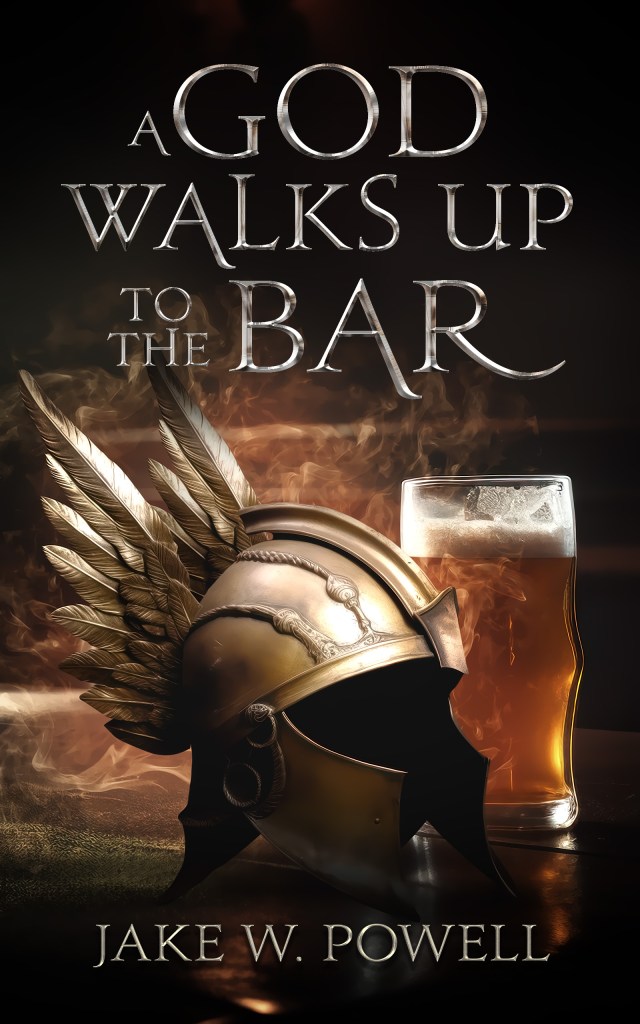
My book, A God Walks up to the Bar, is currently available on Amazon.com. Venture into the world of the Greek god Hermes, a world filled with demigods, vampires, nymphs, ogres, magic, and trickery. It’s a tough job, being a god!

Enjoying my blog? Don’t want to miss a single post? Subscribe for updates on when I post and follow my writing career, musings on fiction and storytelling, and reflections about life in general!

Lessons I Learned Writing My First Book, Part 3: Perseverance

Seventy-eight, seventy-nine, eighty …

Do you like doing pushups? What about arm curls? Or squats?

Eighty-five, eighty-six, eighty … eighty-seven …

They can take a lot out of you. How often have you been tempted to stop halfway through your exercise routine?

Ninety … ninety … ninety-FIVE … Ninety … SIX.

Or have you only gone as far as you could before the burn set in?

Ninety-NINE … ONE … HUNDRED.

Perseverance is when you keep going even when your body and mind don’t want to.

There’s an element of stubbornness in persistent people. They refuse to give up or go home when things are looking down, when the weather is cruddy, when they just want to curl up and sleep the afternoon away. Perseverance is the tenacious insistence on never leaving a task half-done.

Writers need to persevere. We need to never give up no matter the circumstances. How many books have been left half-finished, never to be read by others? How many books have never been written at all?

The most important thing, I’ve found, is to focus on the end goal. It’s easier (not easy, mind you, but certainly more bearable) to stick with it when you know how close you are to the end. And as I look back, I see how quickly that work time passed. Rather than focusing on present difficulties with drafting my book or stumbling over writer’s block, I quietly focused on the goal of finishing and publishing. It really does help.

Sometimes, I felt like I had nothing worthwhile to say, or that nothing I did say could measure up to other authors. What do you do during such times? You motor on. Perseverance is, quite simply, never giving up.

There’s a lot of books that will never be written. I take satisfaction in putting one more out into the world.

The gods and beings of ancient myth never went away. They just moved on with the times.

My book, A God Walks up to the Bar, is currently available on Amazon.com. Venture into the world of the Greek god Hermes, a world filled with demigods, vampires, nymphs, ogres, magic, and trickery. It’s a tough job, being a god!

Enjoying my blog? Don’t want to miss a single post? Subscribe for updates on when I post and follow my writing career, musings on fiction and storytelling, and reflections about life in general!

Lessons I Learned Writing My First Book, Part 2: Discipline

You’re running at a steady pace. You’ve been running for the past thirty minutes. Sweat streams down your back and drips from your brow onto your nose and neck. The marathon is halfway done. Only halfway. Your thoughts stray. You think of a cold glass of water. You think of resting – just for a moment – and catching your breath. Or maybe longer than a moment. You ran half a marathon. That’s good enough.

But you don’t stop. You keep running. You stumble and nearly trip. You regain your balance. You find your rhythm again and keep running. You feel out of breath. Now, the temptation to stop feels more like a necessity. Can’t finish the marathon if you can’t breathe. You feel like you’ll faint from exhaustion.

You remember your breathing exercises. You’ve trained for this. And you find your second wind. A burst of new energy propels you forward. You keep running. At last, you reach the end.

Marathons are a discipline. They take training, practice, and the determination to finish what you started. Writing is the same way. Crafting a book isn’t a quick sprint. It’s not a pole vault or long jump where you throw all of your strength into a few seconds of exertion. Writers must pace themselves and must be willing to get up every day, sit down at their computer, avoid the temptation to get hooked on Youtube or Facebook, and write their word count for the day.

For all that we exalt discipline and admire it in people, it’s not exactly the most well-practiced quality. We like people who accomplish great things: maybe build a skyscraper, or paint a masterpiece, or simply make a million bucks. We look at those people and we think how much patience and hard work must have gone into their achievements. We see the results of discipline, and think we should give it a go, but so many of us just can’t push ourselves. Why? Because discipline sucks.

It’s a slow-burning candle. It isn’t fancy and it isn’t glamorous. The results of discipline are glamorous. That fancy skyscraper, that painting, those million dollars. Wowee! I want that! But putting in the work is a pain.

Writing isn’t exactly a glamorous, exciting process either. Silently typing away at a computer doesn’t make for a great show. It’s not something you show off to others. “Look, Bob, watch me write my story! Isn’t it so cool?” Yeah, nobody’s going to care about the process. They want to see the end product.

Do you want to write? I mean really write, as a lifelong hobby or career? Do you envision yourself as a published author? That vision is the end result of discipline. You must train yourself to write on a schedule that works for you. Every day, every couple days, whatever you find works best. And then you must train yourself to be consistent about it. It’s not always pleasant, especially starting out, but it does get easier over time.

I have a day job. I had to find the time to write. Frequently, coming home from work, I didn’t want to. But I did it anyway. And the end result is, I wrote a book! I published it! I accomplished what I set out to do!

I don’t meant to scare away any of you potential writers out there. But writing can feel like a chore at times. Even so, when we set our minds to doing the things we love, we’ll make the time and effort to do them. But it does take dedication. Dreams are all well and good, but they’re nothing without action, and discipline demands action. Even a dream job has its drudgery, right?

And it’s sweeter in the end, to run toward your goal and finally reach it after a long, tiring run.

The gods and beings of ancient myth never went away. They just moved on with the times.

My book, A God Walks up to the Bar, is currently available on Amazon.com. Venture into the world of the Greek god Hermes, a world filled with demigods, vampires, nymphs, ogres, magic, and trickery. It’s a tough job, being a god!

Enjoying my blog? Don’t want to miss a single post? Subscribe for updates on when I post and follow my writing career, musings on fiction and storytelling, and reflections about life in general!

Lessons I Learned Writing My First Book, Part 1

My first book was quite the educational experience. There’s nothing quite like diving into a new challenge and learning as you go. It’s sink or swim, sometimes, and not knowing quite what you’re doing is as exhilarating as it is terrifying!

So, I’ve made it through, and looking back on the years-long trek, I realize that I actually may have learned a thing or two. Not just the technical aspects of writing, but general takeaways, as well. So, for all you fellow authors out there, and those of you who are thinking of entering the wonderful world of writing, here are my lessons learned from writing my first book.

First and foremost: Discipline. Writing takes effort. More than that, it takes the willingness to sit down and just do the work. It takes a willingness to push yourself beyond your boundaries, to organize a time that’s best for writing, and just do it. Dedication is a big part of being an author, because writing takes time, and time is precious, right? You got to be willing to make that sacrifice.

Writing also taught me perseverance. I felt like I was running a marathon when I was writing my book. It’s not a quick and easy thing when writing a book of any length. This isn’t a blog article or a social media post. I was in it for the long haul, and sometimes I just felt apathetic about what I was doing. I wondered if there was even a point to writing, if it would mean anything in the end. That’s when I had to roll up my sleeves and keep going. You got to be willing to motor on.

Thirdly, I learned patience. Writing takes lots and lots of patience. Whether words come easily to you when you write or not, the process is not necessarily a quick one. Maybe that first draft takes no time at all, but then you got to go back and revise. And revise again. And again. And then you get it read by beta readers. And by editors. And then you go back and write a new draft. You got to be willing to be patient to make your story the best it can be.

And finally, the hardest lesson of all: Humility. To be a published writer means putting your work – and yourself – out there for all to see. That makes you feel quite vulnerable at times. Putting out your book invites criticism and commentary, some positive, some not. When I first gave out drafts of my book to be read by others, I got a heaping helping of flaws and bad habits set down before me. It’s not pleasant, but it’s needed. You got to be willing to admit you’re not perfect and develop a tough skin to take necessary criticism.

That’s the quick summary. Over the next week or so, I’d like to dive deeper into each lesson and go into more detail about how I grew over the course of this book. I hope you all enjoy it!

The gods and beings of ancient myth never went away. They just moved on with the times.

My book, A God Walks up to the Bar, is currently available on Amazon.com. Venture into the world of the Greek god Hermes, a world filled with demigods, vampires, nymphs, ogres, magic, and trickery. It’s a tough job, being a god!

Enjoying my blog? Don’t want to miss a single post? Subscribe for updates on when I post and follow my writing career, musings on fiction and storytelling, and reflections about life in general!

Finding the Right Words

Sometimes I wish there was a checklist for writing the perfect story. If I had a step-by-step guide that included everything I needed to put into a book to make it a guaranteed success, it would make life so much easier. All I would have to do is check off each step, and bam, instant bestseller.

Naturally, it’s not that simple. Grammar and spelling are one thing. There are rules for sentence structure that can be looked up easily enough. But what about choosing the right words for the story?

How do I know just the perfect words for a description, or exactly how to phrase a piece of key dialogue? How do I write down something precisely as I want it to be read? I confess, I don’t fully know. I’ve studied creative writing in school and written poems and short stories. I’ve dissected classic literature until I was left with a mess of symbols and metaphors and analogies. As an aspiring author, I’m learning more than ever. But for all that education, writing fiction involves as much instinct and intuition as it does obeying the laws of grammar.

Words have power. I think we can all agree that words can encourage or depress us. There are pieces of writing that really move us, maybe even motivate us to take action. So, I’m like a guy holding a lit match. I have to be careful where I set it. Or maybe I’m more like a guy juggling 50,000 matches who has be verrrrry particular about where each one lands. Words are nothing to be trifled with, but the thing is, a writer really doesn’t know what the damage is until the reviews start coming in. Maybe it’d be useful if my draft spontaneously combusted. Then I’d know if I was doing it right or not.

Finding the right words is a bit of a crapshoot. I’ve only just really developed a feel for what my writing style is, and I’ve gotten beta readers to give me feedback that helps me see my own work more objectively. Even so, sometimes I feel like I’m groping in the dark. How exactly do I convey what I see in my mind’s eye? How do I communicate it? Even harder, what should I leave out to allow readers to fill in the blanks for themselves?

I don’t know if anyone ever gets it right the first time. To paraphrase Ernest Hemingway, the first draft of anything is crap. There’s always another go-around, and another, and another. It’s like a sculptor chipping away at the marble until the proper shape is carved out of the stone. It takes time, thought, and effort to find the right words.

Does that make writing boring and tedious? Not at all! It’s part of the fun for the writer. It’s a game of imagination combined with a jigsaw puzzle. You cook something up out of your own head, look at what ended up on paper, then try to fit the pieces together into something remotely resembling what you originally envisioned. It’s a challenge. I think we writers like challenges. We certainly like tormenting ourselves over finding just that perfect word to use in that one sentence on page 72 that we know only five people on Earth will ever notice.

Will I ever find the right words? The perfect words? Maybe. Maybe not. It’s worth the struggle to try.

Enjoy what you’re reading? Subscribe by email for updates on new posts and follow my writing career, musings on fiction and storytelling, and reflections about life in general.

Pace Yourself! What Can Make or Break a Story

You start reading a book, or watching a movie, and the beginning is a banger. You’re hooked. The characters are great, the story is enthralling, and the action is incredible. The first act is a masterclass in storytelling.

As you continue, though, you feel a nagging sensation that something has gone wrong. You aren’t gripped like you were in the first twenty minutes. Why all this pointless dialogue? Why spend five minutes on a scene that has no impact on the rest of the story? Did someone put the plot on a lifeboat and set it adrift? It’s just … wandering aimlessly.

But wait! You get to the end, and the last ten minutes suddenly pick up. Boom. Bam. Bang. The plot is resolved, the heroes win the day, end of story. It’s satisfying enough, but you’re left wondering why 70% of the story just dragged on and on.

Or maybe you run into a story with the exact opposite problem. You feel out of breath after finishing it, like you were never given a chance to rest. Who’s this person and why are they – never mind! Moving on! More action! More spectacle! Can’t contemplate our navels now!

You’re rushing from set piece to set piece at breakneck speed. Movies especially love to do this. The story is just an excuse to show off the cinematography. Maybe there IS a good story there, but it’s been broken up by a frenetic pace that prevents it from properly unfolding.

Pacing. That’s the keyword. A good story has good pacing. It’s the invisible, unappreciated ingredient that is key to cooking a good meal. Folks know when they dislike the protagonist. They understand bad writing. A poorly constructed setting betrays its flaws just by being experienced. Audiences know these things. But pacing is more subtle. When the pacing’s poor, you don’t always know what’s wrong, but you can sense that something is off.

Pacing is the speed at which the story is told, in which everything, everything, you’ve written is unveiled at the times that best serve its progression, its development, the audience’s entertainment, and the impact of key scenes and events. Pacing is to storytelling like a metronome is to music. Go off-beat, and everything goes out of whack.

As the metronome helps the musician keep the proper rhythm, so does a writer keep their story at the proper pace
Metronome” by jronaldlee is licensed under CC BY 2.0.

To continue the earlier food analogy, a story is like a meal. Pacing is the speed at which you eat the meal. Eat too fast, and you barely get to taste the food. Eat too slowly, and the food is so cold and stale by the time you finish that it can hardly be considered tasty anymore. A writer needs to be like Goldilocks and find the pace that is juuuust right.

Naturally, stories being organic things with a knack for growing beyond the writer’s original intention – things that you could swear have minds of their own – there is no magic formula to apply to a story. Each tale is unique. There are so many factors to consider: the genre, the story’s message (if any), the amount of dialogue versus action, the length of the story, et cetera.

Moby Dick is a classic of American literature. It’s also all over the place with its pacing, stopping suddenly to discuss the physiology of whales and the philosophical repercussions of pursuing vengeance against the natural world. But it is as much a philosophical and encyclopedic work as it is a fable of the cost of revenge, and its opening chapter tells you to strap in for a long, introspective ride. There are certain expectations one automatically forms when seeing how much space that monster takes up on the shelf.

On the other hand, a short story is quite the opposite. It’s a short story, and a reader doesn’t go in expecting long, drawn-out retrospectives on life, the universe, and everything. The plot is much more straightforward, and the pacing moves swiftly. If you expect to finish a story in one sitting, you aren’t going to be pleased if nothing worthwhile happens in that time.

I could go on and on about this topic. Its poor execution is one of my biggest pet peeves in writing. But then, a blog post is a short piece of literature, too, isn’t it? Yes, even blogs need good pacing, and though I may complain about it, I’m no master myself. Live and learn, and occasionally complain about things you yourself aren’t very good at. But not too much, that’s just bad form.

Enjoy what you’re reading? Subscribe by email for updates on new posts and follow my writing career, musings on fiction and storytelling, and reflections about life in general.