Stop Being Bad: The Redemption Arc in Storytelling

The story of the redeemed villain is a common and provocative trope in storytelling. It’s always fascinating to witness how a thoroughly evil and vile figure can turn around and repent of their ways. We like to see these tales play out and watch what happens next. It appeals to us.

Maybe the villain is likeable enough that we don’t want to see them die, or maybe we even see a little bit of ourselves in there, and hope that their redemption means there’s hope for us, too. Whatever the reason, a villain’s redemption is a major story beat, and should be treated as such. Which, in turn, means that writers should seriously consider it before going through with it. Is it the right move for the story? Is the villain truly redeemable, that is to say, is it a logical and fitting step in their growth as a character? Are they willing to seek redemption? Most importantly, can they be redeemed in a way that the audience finds natural and believable?

It’s easy to fall in love with a good villain and not want them to die. So, some writers just … give them an out. The villain evades consequences, sobs a few tears, gives a dramatic monologue, and skips on over to the side of good. And are welcomed with open arms. But is that how it would actually play out in the context of the world you’ve written? How bad is your bad guy? Did they blow up a planet, or just steal a few pies? If it’s the former, do you really expect them to be immediately welcomed and trusted by the heroes?

Don’t get me wrong, I’m not talking about a villain-hero team-up. Sometimes, good guy and bad guy have to work together, usually against a worse bad guy, but the villain remains clearly villainous, just currently motivated by shared interest. To be redeemed, a villain must be penitent. And to be penitent, a villain must truly feel remorse. And in feeling remorse, a villain must show a change in action and motivation.

A redemption arc is character development. The character will not be the same person at the end of it. Indeed, we writers should seriously consider this fact. If the villain was likeable because of their villainy, then redeeming them may in fact hurt them as a character. They’re no longer a villain. Will that take away what made them interesting and engaging?

On the other hand, you could have the villain redeemed through the classic act of self-sacrifice. It worked for Darth Vader, didn’t it? But, and hear me out, I think this is a bit of a cheat. Imagine how different things would have been for this classic movie villain if he had survived and had to stand trial before the people whose friends and family he had slaughtered. He would have to face his daughter Leia over the destruction of Alderaan. He would deliver himself into the hands of the Rebel Alliance he had hunted down for the whole trilogy. He’d have to live with the memories of his crimes. He’d have to do more than gasp a few words to his son as he lay dying to convince us he was truly changed. He would have to make his redemption stick. An interesting thought, no?

Redemption arcs are fascinating. They offer an incredible opportunity to explore facets of a character that usually aren’t. How and why does the villain do what they do? What would make them stop doing it? Can they stop? Do they have doubts? Do they value something greater than their current goals that they would give up their desires for? These are the sorts of questions that can help you figure out if your villain is a candidate for a moral turnaround.

The most important question to ask is: Does it serve the story? We are talking about fictional characters, after all. They’re not real people, they’re figures in a narrative that we as writers have the responsibility and privilege to manage and direct. Redemption and repentance in real life is quite another thing entirely, even if they do inspire our work. Real life is fuzzy. We can’t truly know other people’s motivations. But we can know exactly what motivates the characters we write, and so we can answer this question with confidence: Can my villain stop being bad?

If you just so happen to be enjoying my blog, feel free to subscribe. I post updates on my writing career, I muse over storytelling and fiction, and I reflect on the curious and wonderful things in life.
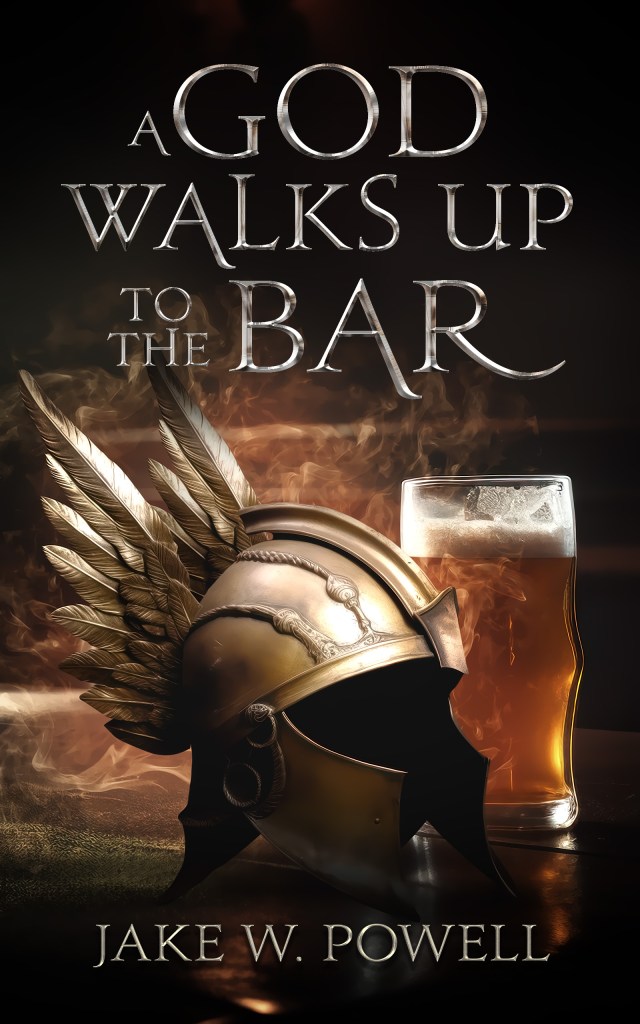
My first book, A God Walks up to the Bar, is available on Amazon.com. Witness the modern day adventures of the Greek god Hermes in a world much like our own – and with demigods, vampires, nymphs, ogres, and magic. The myths never went away, they just learned to move on with the times. It’s a tough job, being a god!

Image Source: “THE Supervillain’s Lair” by nicknormal; Licensed under CC BY-NC-ND 2.0.

Stories Talk: Why Dialogue is Important

We engage in dialogue every day. We talk with people face-to-face. We type emails, send letters, conduct Zoom meetings, send messages via social media. We even talk with ourselves. Any conversation we hold is a dialogue, and wherever there are two or more people (or you and the voice in your head) there is conversation.

Since dialogue is such a vital part of real life, it is reasonable to assume that it is also important to writing. And this is true. Characters talk to each other, and the manner in which they speak and communicate is important. Everyone has their own voice, their own mannerisms, accents, affectations, slang, tone, rhythm, and personality. Most stories are going to have dialogue of some sort. They tell the reader who the characters are, how the world works, provide information about the plot, and so forth.

But unlike the real world, where two people can keep a conversation about absolutely nothing going for four hours, writers need to be choosier about what their characters say. Every piece of dialogue carries weight. And it can serve several purposes that can improve and flesh out your story.

So, what does dialogue do for a story? What point does it have? Well, I respectfully submit three here for your consideration.

Characterization

    We know what people are like through the way they speak. The things they talk about, how they talk about them, and what they don’t talk about all tell us who they are. People reveal their personalities and values through their words. Actions may speak louder than words, but words still count for something.

    Is a character brooding and moody? Witty and optimistic? Intelligent and thoughtful? Brash and shortsighted? The narrative can describe a character as such, but their dialogue should carry through on that description. Different people talk differently. Just consider all the people you know. Do they all talk the same? Do they all respond identically to any given situation or topic? How do their background and experiences influence their words?

    Furthermore, characters change over the course of a story. Consequently, their dialogue changes. Perhaps a rude character becomes kinder, and his words are sprinkled with more empathy and compassion. Someone may become obsessed, and her dialogue slowly becomes fixated on a single focus.

    Or a character surprises. The stoic deadpan warrior cracks a joke at a key moment, demonstrating he’s not as humorless as he appears. The comic relief offers heartfelt insight that inspires others to action.

    Worldbuilding

    “You’ve never heard of the Millennium Falcon?” “Should I have?” “It made the Kessel Run in less than twelve parsecs.” – Star Wars: Episode IV

    “The Dauntless is the power in these waters, true enough, but there’s no ship as can match the Interceptor for speed.” “I’ve heard of one. Supposed to be very fast, nigh uncatchable. The Black Pearl.” “There’s no real ship as can match the Interceptor.” Pirates of the Caribbean: The Curse of the Black Pearl

    What is the Kessel Run, anyway? If you’ve only seen the movie, you’ll never know. But it’s a challenge for space pilots to navigate, apparently. And there’s the subtle implication that the speaker is a no-name making empty boasts.

    The Black Pearl apparently is a fairy tale among sailors, setting up the supernatural overtones of the Pirates of the Caribbean film franchise. Also, the British Navy has some really nice ships and isn’t to be taken lightly in this setting.

    Do people explain everything when they talk to each other? Do they launch into a five-minute expositional speech whenever they mention something the reader or viewer doesn’t know about? No, they generally don’t, unless it’s in an appropriate context. People in real life make offhand references to stuff all the time with the assumption that their conversation partner understands. Sometimes they do, sometimes not. But that kind of dialogue in a fictional world makes the setting feel more real. There are things that characters take for granted, for instance, and there are legends and folklore that have seeped into the culture.

    Explanations aren’t always necessary. Characters talking about this or that thing that’s never followed up on is more like a real conversation than prefacing every explanatory statement with, “As you know…”

    We may not know, but the characters do. And as long as it isn’t vital for us to understand, it makes for a fun bit of worldbuilding.

    Story Progression

    Amazingly enough, characters tend to take action when someone tells them something. Shocking, isn’t it? The king commanding his loyal knight, the messenger arriving with bad news, the lovers making plans to escape to a new life, the villain announcing his diabolical scheme to his archnemesis … Dialogue moves the story along.

    Character motivations shift and change as people learn more about each other. Alliances are made and broken. Riddles are solved and treasure maps deciphered. The plan to take down the evil empire is concocted. Plot revelations are, well, revealed.

    A story can’t move along without communication. Dialogue is a bit like a meandering river. Each interaction is a journey downstream from one point to another. It can take a while, and there are plenty of sharp turns, and the destination can be radically different from the start.

    Sometimes, all a story needs to get going is a quick and innocuous chat. Things have a tendency to snowball from there.

    And these are just three ways in which dialogue is vital to telling a good story. There’s plenty more out there. Feel free to share any that come to mind in the comments. After all, what is the comments section, if not another way to have a conversation?

    If you just so happen to be enjoying my blog, feel free to subscribe. I post updates on my writing career, I muse over storytelling and fiction, and I reflect on the curious and wonderful things in life.

    My first book, A God Walks up to the Bar, is available on Amazon.com. Witness the modern day adventures of the Greek god Hermes in a world much like our own – and with demigods, vampires, nymphs, ogres, and magic. The myths never went away, they just learned to move on with the times. It’s a tough job, being a god!

    Give and Take: Developing Characters with Banter

    So, in my last post I went on a bit of a rant about how I dislike how much quip humor is overused in today’s media. So, maybe you’re wondering what kind of comedic writing I do like. Well, lucky you! That’s what I’m here to talk about today.

    In all seriousness, comedy is a great way to develop and humanize characters. We use humor in all situations, including dangerous ones. It relieves stress, it helps us relate to each other, and it can lighten a grim situation. Most everyone has a sense of humor. And you know what? Nobody’s is exactly the same. So what happens when two people pit their humor against each other? Well, sometimes a black eye, but in most situations you get the normal, casual banter that marks so many conversations in real life. And as in real life, writing banter can reveal a lot about what people are really like.

    Banter is defined by Dictionary.com as “an exchange of light, playful, teasing remarks; good-natured raillery.” While I doubt anyone uses the word “raillery” in casual conversation anymore, this definition gets the point across: Banter is a two-way (or more) street. It is dialogue, and it is reliant on character interaction. Where two characters interact, you get development and characterization. You also get exposition explained in a palatable way. You can get plot progression, foreshadowing, romance, conflict, and all sorts of other things. Why? Because it is dialogue. Because it is character interaction. Because, unlike quipping, banter relies on sharing the spotlight with someone else.

    Good-natured ribbing is a form of camaraderie the world over. Inside jokes and bad puns and the playful critique thereof illustrate the history of a relationship more succinctly and beautifully than a full paragraph detailing the backstory. Verbal sparring is fun to read or watch and can be laden with subtext that delivers multiple messages in a single conversation. Just check out movies and books with great dialogue. Well-written banter makes characters feel like real people.

    And quips … well, people do quip in real life, but it’s a lonely game to play. It’s a one-trick pony. What happens when people get tired of one-liners? Banter is more flexible. People throw different types of funny at each other. To quip is to play golf: You hit the ball and off it goes. One and done. Banter is tennis. You hit the ball back and forth, leaping and twisting around to catch it and keep up the rhythm.

    I promise my blog won’t turn into a campaign against types of writing I don’t like. I don’t despise quipping. But I do prefer variety and versatility in writing. Banter simply offers more options and has more applicability. Not everyone talks in one-liners. But everyone enjoys a spot of teasing and ribbing. Want to flesh out your cast? Add some banter.

    If you just so happen to be enjoying my blog, feel free to subscribe. I post updates on my writing career, I muse over storytelling and fiction, and I reflect on the curious and wonderful things in life.

    My first book, A God Walks up to the Bar, is available on Amazon.com. Witness the modern day adventures of the Greek god Hermes in a world much like our own – and with demigods, vampires, nymphs, ogres, and magic. The myths never went away, they just learned to move on with the times. It’s a tough job, being a god!

    Writing Jerks

    Why do jerks seem worse than villains? Villains are grand and powerful and fierce and evil. They deserve our disdain. But jerks are just plain petty. What’s worse? A dictator bent on conquering a nation, or a man who keys your car because you bumped him in the parking lot? Well, the former, obviously, but the latter certainly seems to steam people a heck of a lot more.

    But I’m not here today to talk about “why’s,” but rather “how’s.” Namely: How do you write a jerk protagonist so that he’s likeable?

    Think about it for a moment, writers. There are plenty of villains that people like. I’ve even written about it in a previous post. Mass murderers? Evil tyrants? Amoral thieves? They’ve all got fans. They’ve all got that special something called charisma. People will forgive a lot if you have charisma.

    But jerks? They’re personal to the audience. We may never have met a murderer or a dictator (hopefully), but we all know a few knuckleheads with attitudes who stoop to the lowliest of cheap shots. Spend a week in customer service and you’ll meet jerks on the regular. They come in all flavors, but they all have something in common.

    THEY AREN’T LIKEABLE.

    Thus, going back to my first question, is there a way to write a protagonist who is unpleasant, rude, and otherwise just plain mean, and still make that character someone the audience can enjoy? Well, yes and no. The main thing about writing jerks is that if you keep them that way from start to finish, chances are you’re shooting yourself in the foot.

    Consider a classic example of jerkdom in literature: A Christmas Carol’s Ebenezer Scrooge. A miserly, heartless, soulless businessman who has no mercy or pity for the poor. He’s on the up-and-up – he’s an honest man in the original story, believe it or not – but he has no redeeming traits. At first. The entire story is about Scrooge’s character development into a better person. And that’s the key to writing jerks: They shouldn’t still be jerks by the end of the story.

    Side characters can stay jerks. Antagonists, of course, can remain jerks. But the protagonist should not remain static at the best of times. They evolve and mature. And if they start out as jerks and bullies, then they should show some sort of marked improvement by story’s end. Less of a jerk, kinder, more patient. Like Scrooge, they should learn something. There is nothing stopping you from writing a protagonist who remains the same come the conclusion, but if they were nasty and unlikeable to begin with, you risk leaving your audience with a sour last impression.

    On the other hand, maybe the jerk not changing is the point. Maybe this is a more cynical piece, an introspective look into what makes a meanie tick – or maybe it’s just a comedy. Well, there is a way to make the audience side with the jerk, and that’s to introduce an even bigger jerk to square off against. Have a protagonist who’s belligerent and petty? Bring in someone else who’s even more so. It worked for British sitcom Fawlty Towers. Basil Fawlty is a Class-A Jerk through and through, but he frequently dances with people even worse than he is. See for yourself.

    We like someone to root for, you see. If we’re given two flavors of unpleasantness, we’re naturally going to compare them. And if one is slightly less bad than the other, we’ll favor that one and despise the other. The lesser of two jerks, if you will.

    There are those rare occasions where your story doesn’t require that the protagonist change for the better, or circumstances dictate that there isn’t a worse character to compare against. So, what to do? Well, you can make the jerk empathetic. That’s not saying you give the protagonist the capacity for empathy, but rather that you give them traits the audience can relate to. Humanize them a bit, just a little, so that they’re a tad more understandable. Maybe they are the way they are because of a bad childhood, or ill health, or they’re just plain unlucky.

    Let us consider the case of Disney’s Donald Duck. He’s … not the most pleasant individual, especially in his 1930s and 1940s cartoon shorts. But oh, boy, does he have bad luck at every turn. Nothing turns out right for him. No wonder he has such a chip on his shoulder. If we had the rotten fortune that Donald does, we’d be short-tempered, irritable scoundrels, too.

    So, there you have it. My two cents on writing jerk protagonists. It can be done. It has been done. You can do it, too.

    If you just so happen to be enjoying my blog, feel free to subscribe. I post updates on my writing career, I muse over storytelling and fiction, and I reflect on the curious and wonderful things in life.

    Why Writers Should Make Their Character Suffer

    It is my duty as an author to make my characters suffer. I must put them through the wringer, submit them to the lash, and force them to endure severe physical and psychological torment. Nothing must come easy to them. My characters must endure doubts, confrontations, and existential crises. They must be tested to their utmost, then pushed even further.

    Why? Because authors are sadistic monsters Because the testing of a character forces them to grow, and the pleasure of reading a story is to see its heroes overcome the challenges they face. The greater the challenge and the greater the suffering they endure in conquering that challenge, the greater the catharsis of victory for both hero and reader. And there’s also no small amount of pleasure in giving my characters that final victory. I personally like happy endings.

    Suffering can bring out the best and worst in people, whether they be real or they be fictional. It’s an interesting experiment to put a written character to the test and see how they react. What happens if I put the protagonist into THIS terrible situation? Or make them confront THAT unpleasant truth? Struggles let us see what makes people tick. Test your mettle and see how strong you are … and grow stronger.

    All that being said, it boils down to this: a story is only as interesting as its characters and the situations they find themselves in. If the characters are flawed and have to work through their problems, then great! The readers share in their triumphs and failures, empathize with their foibles, and root for their success. Characters who never struggle and always succeed perfectly in everything they do can have a place in a story, but you might want to think twice about making them the protagonist. In a word: Boring. Invincibility is fine against bullets and blades, but even Superman is weak against kryptonite.

    Authors should toss their characters into the furnace every now and again. Let them work for what they want. It’s what readers are paying for after all, and we got to fill those pages somehow.

    The gods and beings of ancient myth never went away. They just moved on with the times.

    My book, A God Walks up to the Bar, is currently available on Amazon.com. Venture into the world of the Greek god Hermes, a world filled with demigods, vampires, nymphs, ogres, magic, and trickery. It’s a tough job, being a god!

    Enjoying my blog? Don’t want to miss a single post? Subscribe for updates on when I post and follow my writing career, musings on fiction and storytelling, and reflections about life in general!