The Trickster’s Lament preview #2

Another glimpse of my novel-in-progress.

Don’t you just hate it when a plan falls apart? A simple museum heist has gone completely off the rails for Hermes. The trickster god better think fast.

I didn’t wait for more gunfire and sprinted out of their line of sight into a nearby gift shop. I vaulted the cashier’s desk and winded through the shelves of merchandise. As I did so, I felt a sudden and intense accumulation of magic behind me, a growing pressure that was followed by a violent rush of wind. The sensation swiftly changed from that of a strong gust to the feeling of barbed-wire digging into me. I dropped to the floor.

The clamor of the spell demolished the shop. Books, toys, mugs, and pens were caught up and eviscerated by a wind storm condensed into a narrow room-wide blade of fast-moving air. Metal shrieked as the spell sliced apart shelving. It traveled to the end of the room before it dissipated, leaving a deep gash in the wall.

Wind magic is hard. Controlling it with any degree of precision, let alone focusing it into a cutting edge, is notorious among mages for its difficulty. Most would-be practitioners either give up or lose limbs. These mercenaries were no amateurs. They also obviously had no interest in witnesses.

After the spell ran its course, I pushed myself to my feet and leapt up and over the pile of shredded debris. My foot caught on a piece of ripped cardboard, and I tripped. Four pops of a gun sounded behind me. One of the bullets caught me in the shin. As I regained my footing, centuries of discipline helped me to force the shock of pain to the fringes of my awareness. Another bullet did the proverbial whistle past my ear and kicked up a bit of plaster a few feet away.

Exiting the shop, I reached the second-floor rotunda overlooking the lobby. Speed was essential, so, without stopping, I rolled forward, defying the pain in my leg. I shapeshifted as I came out of the roll, landing as a tortoise whose inertia and smooth underside skidded me along the tile floor like a misshapen hockey puck. Shots aimed at human head height whizzed over me.

I came to a rest and peeked out of my shell. Three men exited the gift shop and proceeded cautiously, two of them with guns raised. Before they could spot me, I changed into a fly and circled behind them. Strong hands swiftly grabbed the pair of gunmen by the napes of their neck and slammed their heads together.

The mage spun around at the sound of my attack. He was dressed like the others – black body armor and balaclava, night vision goggles – but he carried no gun except a sidearm at his hip. His hands were stretched out with palms forward. He was furiously chanting to focus his magic. Not fast enough.

I swung one of the unconscious mercs into a wide arc. At the apex of the throw, I let go. The merc flew gracelessly into the mage. The man saw it and nimbly hopped aside, dodging entirely.

But I followed through the toss and kept spinning. I gripped the second merc with both hands and hurled him as hard as I could. It was a beautiful hit. Both bodies were lifted off the floor and traveled a perfectly horizontal trajectory into a wall.

With luck and medical attention, they would keep all their ribs intact.

More footsteps echoed in the museum’s open space. This was becoming annoying. I didn’t have the inclination to play soldier, and I was running out of time. I had to find Bast. She was still somewhere in the museum, and she had my prize in her hands. Catching up with her was my one and only priority. These thugs were a distraction, at best.

I gritted my teeth. She had better still be here.

Many thanks for visiting my blog. I post updates on my writing career, I muse over storytelling and fiction, and I reflect on the curious and wonderful things in life.
The Trickster’s Lament preview

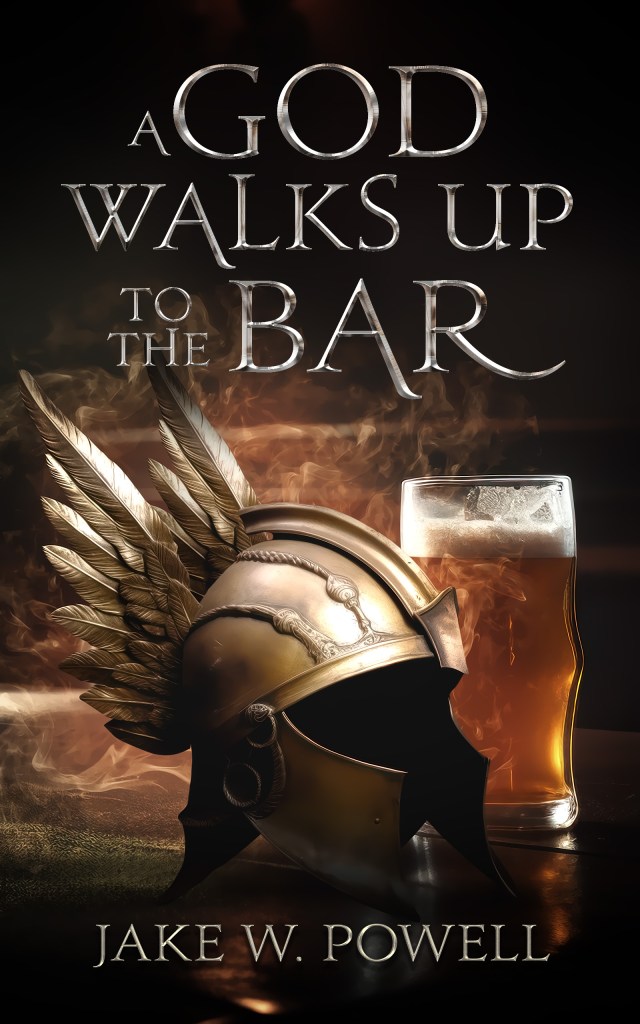
Yes, indeed, I have been working on my second book all this time! And now that it is nearing completion, I’m happy to share a sneak peak of The Trickster’s Lament, continuation of the Greek god Hermes’ adventures in the modern world and sequel to A God Walks Up to the Bar.

In my long life, I’ve awakened to many unpleasant sensations. The awareness that I was drowning swiftly found its place as among the worst.

Consciousness returned slowly. My muddled mind tried to take stock of my surroundings, but failed to comprehend. And so, I obeyed my body’s first instinct, which was to open my mouth and take a deep breath. For that, I received a mouthful of water straight down my windpipe. I choked. The spasm triggered another reflexive breath and more water filled my lungs.

My eyelids snapped open, and I looked around in pain and mounting panic. I rotated my body down to look at the murky blackness beneath my feet, then upward toward the white sun splintered into fragments by the water’s rippling surface. I made frantically for that light, swinging my arms in wide strokes that strained my half-drowned body. Black dots skewered my vision, and every movement was agony. I was dying.

I couldn’t actually die from drowning, of course. One would think that would be an advantage. But my body wasn’t immune to harm, merely to death. I could feel the water in my lungs cutting off the flow of oxygen to my brain. I could feel my heartbeat slow as vital organs succumbed. I could feel every second of my body’s suffering. No, I wouldn’t die. I’d just be reduced to a limbo state, a piece of litter drifting along the currents.

I retched and vomited. A current pushed the warm mess back into my face. A painful twitch in my throat forced me to take another breath. The same water I’d ejected was sucked back in.

I felt a tinge of envy for mortals. Such a uniquely morbid sensation, dying but not being able to die. Feeling the blood in your veins pool and thicken into sludge, and your clogged respiratory system desperately tried to pump out water faster than it was taking it in. My skull felt like it was cracking apart as my brain functions collapsed. Pure animal instinct was all that kept me moving.

Dying, but unable to die. Lucky me.

Eyes bulging out of my head and white-hot pain searing every cell in my body, I broke the surface. Water and vomit erupted from my mouth in a geyser. For the next few moments, I just floated on the waves. My body needed time to heal itself and return to proper working order. My vision gradually cleared of fluttering black flecks, and my thoughts readjusted into more complex patterns than “Oh, dear Hera, I need to breathe.” While I waited for my strength to return, I looked about and saw only rolling waves and a pale sun winking from a cloud-streaked sky. No land was visible. I was alone in the Atlantic.

Many thanks for visiting my blog. I post updates on my writing career, I muse over storytelling and fiction, and I reflect on the curious and wonderful things in life.

Delving into the Unreal: How Fantasy Helps Us Deal with Real Life

Real life is hard. Can we all agree on that? Real life is really hard to deal with. If it’s not the troubles and calamities of real life intruding on our status quo, it’s the dreary monotony of everyday activities. Going to work, washing the dishes, walking the dog. Sometimes, we just hit a rut. What to do?

People are imaginative, and there’s nothing better at firing up the creative juices then boredom.

There are people out there prone to daydreaming. They come up with whole worlds in their heads. The really ambitious ones commit those worlds to paper. Voila! A new fantasy story is created.

Fantasy helps us cope with the real world. It is a form of escapism that gives us a few precious moments away from humdrum reality, a chance to catch our breath and maybe let out a couple screams, then return to the grind. A little fantasizing is good for our mental health. Relaxation and rest is a good thing, and fantasy is a form of that. A jaunt into a made-up world where heroes always win, good triumphs over evil, magic can make food and water out of nothing, and we can fly on winged horses is just … fun. That’s the point of fantasy. Just like some people like car racing or hiking or painting or math (such people do exist), so do some enjoy fantasy because it’s just plain fun.

To deny ourselves recreation is to trap ourselves inside a metal box at the bottom of the ocean. We can’t move, can’t escape, can’t even see the light. We suffocate under the inability to exert ourselves. Our minds along with our bodies atrophy from the lack of exercise. And from the lack of challenge. Fantasy is a challenge. Fairy tales and epics challenge us to see the world in a new way and ponder how these stories match up against our own experiences. And they let us see something new, period. Don’t we humans crave novelty? Why go on vacation, if not to “get away from it all?” And what are we getting away from? The ordinary and the familiar.

Fantasy is all that writ large. It is the unfamiliar and the extraordinary. A chance to wonder: What if?

And at an even more fundamental level, fantasy taps into that all-consuming human urge to create. We all want to create something. We tinker, we write, we draw, we brainstorm, we organize, we build, we muck about. We like to make things, whether things concrete or things abstract. Fantasy is creation. It’s a powerful impulse, the urge to create, and making fantastical worlds is the perfect outlet for what, I believe, is a basic human need.

Does fantasy matter? Absolutely. We can’t resist it’s siren call. To get away from mundanity, to satisfy our basic natures, to keep ourselves sane. Fantasy is very, very important.

If you just so happen to be enjoying my blog, feel free to subscribe. I post updates on my writing career, I muse over storytelling and fiction, and I reflect on the curious and wonderful things in life.

My first book, A God Walks up to the Bar, is available on Amazon.com. Witness the modern day adventures of the Greek god Hermes in a world much like our own – and with demigods, vampires, nymphs, ogres, and magic. The myths never went away, they just learned to move on with the times. It’s a tough job, being a god!

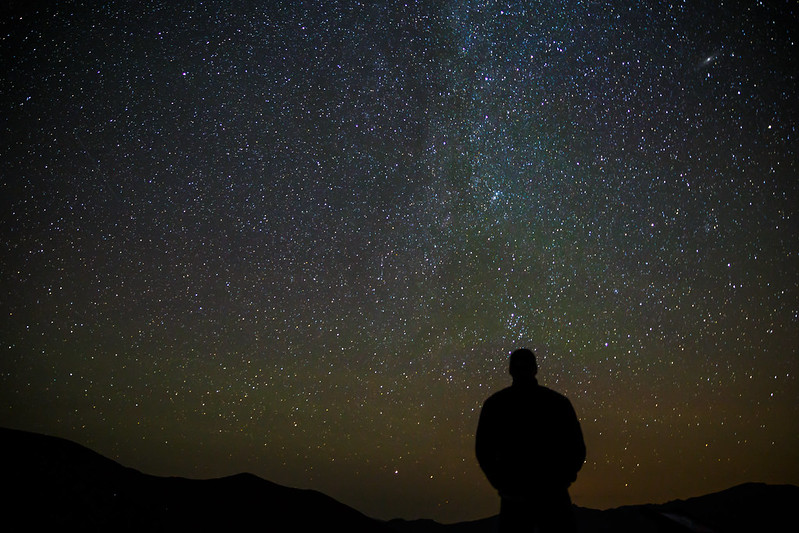
Image: “Dave Checking out the Perseid Meteor Shower at 10,000 feet“; Dave Dugdale; Licensed under CC BY-SA 2.0.

Delving into the Unreal: Taking Fantasy Seriously

Does the fantasy genre matter?

Let’s be honest. With a question like that, and the fact that my blog is subtitled “Writer of Modern Day Fantasy,” you can pretty easily guess that the answer is, “Yes.” But, hey, did I catch your attention? I did? Good. Let’s dive into it, then.

Fantasy is an important genre. Myths and legends have existed for almost as long as humankind has. There is an almost natural urge in people to invent and make up lands, species, events, and other such things that don’t exist in nature. The urge to create things that defy natural law: flying carpets, giants, dragons, dryads, genies, wishing stars, talking puppets, elves, hobbits, fairies, people the size of your thumb, people as tall as a mountain, alien worlds, life on the moon, and so on and so on. The earliest myths probably were meant to explain phenomena that man couldn’t yet fully understand, like the weather or earthquakes. But even after science has offered its explanations, the fantasies endure. Do old habits die hard? Or maybe we need fantasy in our lives.

Consequently, fantasy is a versatile thing. At its heart, it is the telling of things that not only don’t exist, but can’t exist. There are no elves in the forest. There are no genies trapped in bottles. There is no Fountain of Youth or cities at the bottom of the ocean. But the stories are still told.

For a long time, though, there was a problem.

For the last century or so, fantasy got a bad rap. It was viewed as this sort of nerdish subject that is impractical and of no relevance to “real life.” Dungeons & Dragons was the epitome of loser geek culture for decades. It was a “loser” subject because, in part, it was something that wasn’t real – but people took it so seriously! Why make such a big fuss over the unreal? Why obsess over the rules for a game about fighting made-up creatures? If you’re going to obsess over statistics, at least apply that obsession to football and baseball, not orcs and hobgoblins!

For many people, deriving so much enjoyment from something made-up is just plain childish. Oh, when we are children, it’s fine to enjoy stories of knights versus dragons. Fairy tales are quaint little things that amuse us when we’re young. Then we grow up and enter the serious real world where we need to be interested in grown-up things. Like cars and sports and art and the latest celebrity gossip. You know, important stuff.

That association with the immature has been a stain on fantasy’s reputation for a long time, as well as its sister genre, science fiction. The dominions of nerds and other people who can’t handle reality. There were exceptions, of course. Star Wars, for example, was a major blockbuster in 1977. But by and large, fantasy movies and books and games were strictly niche. There was an audience, but a highly specific one.

Then things changed.

I think the Lord of the Rings film trilogy in the early 2000s was the big turning point. Here was a fantasy series with major, respected stars that took itself seriously. It had a big budget, it was being produced by a major studio, it had marketing and advertising out the wazoo. The critics liked it. It was art.

Suddenly, fantasy lost its stigma. It wasn’t so bad to admit you liked the genre.

Others followed. Game of Thrones was a biggie. And there was Stranger Things, which proudly wore its 1980s nostalgia on its sleeve. And what was big in the 1980s? Yup, Dungeons & Dragons. Speaking of which, a Dungeons and Dragons movie released last year was warmly received. Oh, how the tables had turned!

The fact is, there are lots of people who like the unreal. They like to step away from reality for a few hours. It is called escapism. Personally, I think part of fantasy’s bad reputation is that escapism is confused with retreat. One is the willingness to step away from your problems or worries for a little while to refresh yourself. The other is an ultimately selfish choice to ignore one’s real-life obligations in favor of never leaving the fantasy. But many non-fantasy fans view the genre strictly through the latter lens. A bunch of guys and gals without jobs living in their parents’ basements reading silly books about silly people in silly lands. Fantasy is for the weak, for people can’t handle their own responsibilities.

It’s not fair, really. J. R. R. Tolkien wrote fantasy, after all. You know, the highly respected scholar and linguist? A man with a very productive and well-balanced life? And it gets more unfair.

So, fantasy has hit it big, as I just mentioned. And why did it hit it big? Well, a few successful movies certainly helped. But also, you know, the average person finds out that people like Henry Cavill and Joe Manganiello play stuff like D&D and Warhammer 40,000. Hey, they’re not nerds! Fantasy must be cool!

Sometimes, the best way to get people to take something seriously is to find the right spokesperson. All this time, fantasy just needed better PR.

It worked. Fantasy is widely accepted now. People aren’t ashamed to say that they like it. Nerds aren’t social pariahs. Heck, most of them are running major corporations. And the people writing those hit fantasy movies? They’re nerds, too. That’s the other big shift in the fantasy genre in mainstream culture. Four, five decades ago, fantasy films and TV shows were mainly being written by people who saw it as harmless, inconsequential fun. But the people who grew up with those shows and films, the people who fell in love with them, are the ones calling the shots now. And their beloved childhood is anything but inconsequential. Fans tend to pour their hearts into their work, and the quality of the product (hopefully) goes up. The bigger budgets certainly help.

By and large, fantasy has found public acceptance. Fairy tales aren’t just for kids anymore.

But the question posed at the beginning of this article is only half-answered. Does fantasy matter? Yes, yes it does. Financially, socially, culturally, it matters very much. But why does it matter? And in what other ways does it affect us besides providing something to do on a Saturday night?

Stay tuned …

If you just so happen to be enjoying my blog, feel free to subscribe. I post updates on my writing career, I muse over storytelling and fiction, and I reflect on the curious and wonderful things in life.

My first book, A God Walks up to the Bar, is available on Amazon.com. Witness the modern day adventures of the Greek god Hermes in a world much like our own – and with demigods, vampires, nymphs, ogres, and magic. The myths never went away, they just learned to move on with the times. It’s a tough job, being a god!

Image: “Dave Checking out the Perseid Meteor Shower at 10,000 feet“; Dave Dugdale; Licensed under CC BY-SA 2.0.