TV and Nostalgia

What TV shows did you watch as a kid?

Nostalgia gets a bad rap for being a blindfold that prevents us from perceiving hard truths about our childhoods. That can be true, but let’s not throw the baby out with the bathwater. I have very fond memories of my childhood that nostalgia helps keep alive, and that includes the TV shows I watched. Particularly the animated ones.

I spent many evenings with my dad watching some of our favorite cartoons: Justice League, X-Men Evolution, Samurai Jack, Teen Titans. And also one Transformers show that I can’t remember the name of (and wasn’t really all that good, but it was in the same time block, so we watched it anyway).

It was very cozy, watching TV with my dad. Television is great entertainment, but it’s somehow more meaningful when enjoyed with others. I recall those days with no small amount of wistfulness. Simpler times, for him and for me.

It’s strange how as children we take things for granted that we yearn to have back now. Saturday morning cartoons were just part of the routine. They weren’t a golden age of our lives, a precious memory to hold near and dear to our hearts. They were just … there. Fun, sure, but not precious. Not yet, anyway.

And if that’s the case, nostalgia possesses at least one positive quality: It preserves our best memories.

***

Many thanks for visiting my blog. I post updates on my writing career, I muse over storytelling and fiction, and I reflect on the curious and wonderful things in life.

“Hermes is not having the best time. He walks a fine line, and his duty as messenger of Olympus weighs heavily on him. Being a god in the modern age means living in a world that no longer believes in gods. How much can one deity accomplish when no one respects him anymore? And why do his instincts tell him that he, the son of Zeus, is losing favor with his own family?

Tensions abound. The upstart Young Gods play dangerous games using entire cities as their boards. Formless monsters strike from the nighttime shadows, terrorizing hapless mortals. Agents of rival pantheons scheme to thwart Olympus’ designs. In the thick of it all, Hermes does what he does best: trick, lie, and cheat his way to victory.

As I Grow Older, These Grow in Value

What do you think gets better with age?

Aging is not a curse nor a tragedy. It is a fact of life, and like all things in life, brings both good and bad. Indeed, age brings many good things with it. Many things grow in joy and fulfillment as we grow older. Here are just a few:

  1. Friendship. As I grow older, I value my friends all the more. A fresh, new friendship is like an apple that hasn’t quite ripened. It may be a little sweet and hold promise, but it hasn’t yet reached full maturity. A friend who has been at your side for years is more precious than a brother or sister, and you can have full confidence they will stick with you through thick and thin, as they have for so many years already.
  2. Health. As we get older, our health can get a little rickety. I am grateful that I can get out of bed unassisted, that I can walk from one side of town to the other, and that I can take a breath without pain. Does that sound a little morbid? But I value every moment of good health, and strive to make the most of it. A child takes his good health for granted. With age comes an awareness of mortality, and with it, a deeply held joy in a robust life.
  3. Memories. The longer we live, the more memories we are given. Memories can be like old friends – or prodding critics – and reflecting on them helps us discover how full our lives truly are. Even if we think we lived a dull, uneventful life, looking back on our memories reminds us that nobody is uninteresting or boring. We all have memories that span the gamut from comedy to triumph to tragedy to drama to wonder. We all live, and we all remember.
  4. Time. Ah, time. The great equalizer. It bows to no one’s will or demands, no one’s wishful thinking or logical arguments. Time is an unceasing gear, turning with heedless inevitability. In other words, you can’t get more of it. I value time now more than I did as a ten-year-old, because I have less of it. Time is a nonrenewable resource. Make the most of it! I treasure moments that can never come again, for their fleeting nature makes them precious.

What about you? What do you think gets better as you age? What do you value more as you get older?

***

Many thanks for visiting my blog. I post updates on my writing career, I muse over storytelling and fiction, and I reflect on the curious and wonderful things in life.

“Hermes is not having the best time. He walks a fine line, and his duty as messenger of Olympus weighs heavily on him. Being a god in the modern age means living in a world that no longer believes in gods. How much can one deity accomplish when no one respects him anymore? And why do his instincts tell him that he, the son of Zeus, is losing favor with his own family?

Tensions abound. The upstart Young Gods play dangerous games using entire cities as their boards. Formless monsters strike from the nighttime shadows, terrorizing hapless mortals. Agents of rival pantheons scheme to thwart Olympus’ designs. In the thick of it all, Hermes does what he does best: trick, lie, and cheat his way to victory.

The Memories of Childhood

I remember the smell of freshly baked peanut butter cookies in the kitchen wafting like a warm summer breeze. I remember how they crumbled in my hand as I ate them, little bits of delicious debris, and how there were always enough to last a week or more. I plucked them out of the Tupperware container one by one, day by day, a child’s guilty pleasure.

I remember the sound of my father mowing the lawn, a sawing roar yet somehow comforting. I remember the pungent odor of freshly cut grass coming through my open window, and I remember him manhandling the lawnmower up the steep hill in our backyard.

I remember walking through the forest park, the pine needles blanketing the ground like slivers of gold. I remember the tall trees that shaded me, and the baseball diamond at the park’s edge, where my parents and I used to buy hot dogs before returning home.

I remember the day after I had my wisdom teeth removed. My mind was a drowsy blur from anesthetics. I remember how my numb jaw felt like a lump of dead meat that didn’t hurt even when I pinched hard. I held a bag of frozen peas against it when the feeling and the pain started coming back.

I remember when I first became a writer. My parents owned a word processor, and I used it to write stories about my action figures. I printed them out and hung them on my wall, so proud of my work. I started my first novel, and never got past the fifth page. I remember getting my first computer, a great, gray blocky thing, and using it to write new stories. A child’s fancies that watered a ripe imagination.

I remember much, much more. More than could ever be committed to blog or paper. My childhood is over. The memories endure.

***

“Hermes is not having the best time. He walks a fine line, and his duty as messenger of Olympus weighs heavily on him. Being a god in the modern age means living in a world that no longer believes in gods. How much can one deity accomplish when no one respects him anymore? And why do his instincts tell him that he, the son of Zeus, is losing favor with his own family?

Tensions abound. The upstart Young Gods play dangerous games using entire cities as their boards. Formless monsters strike from the nighttime shadows, terrorizing hapless mortals. Agents of rival pantheons scheme to thwart Olympus’ designs. In the thick of it all, Hermes does what he does best: trick, lie, and cheat his way to victory.

Ye Olden Internet Days

Do you remember life before the Internet?

I certainly remember life with less Internet, though I’m not quite old enough to remember a time predating it. I grew up in the days of dial-up when going online meant not being able to use landline phones (I remember those, too) and television had no online connection. In fact, quite a few things weren’t online. Phones weren’t, cars weren’t, watches weren’t, heck, even there wasn’t even Wifi.

Streaming certainly a thing. Once upon a time, watching Netflix meant having a physical copy mailed to you to rent and return. Speaking of TV and movies, you watched them on a channel, stuck a cassette into a VCR, or went to a movie theater. This was the days before YouTube, Instagram, Facebook, and Twitter. There was MySpace, but I never used that so I can’t say much about it.

I do remember early Internet sites fondly, for some reason. Wikis didn’t exist, so people made websites more or less from scratch. Fewer templates, though there was AngelFire and similar tools. No Wix or WordPress yet. Fan sites looked unique. Silly, too, at times, especially compared to today’s sleek designs. Graphics weren’t a big thing, so a web page was mostly a bunch of text and a few pictures. And we were happy with what we got, you young whippersnappers!

Anyway, I’m not that old, but technology has a habit of making you think you are. It moves very fast, and in another thirty years, we’ll probably look at today’s Internet as something akin to the abacus. Or maybe we’ll go back to using the abacus because our calculators keep spitting out ads after every sum.

Yeah, we didn’t get many ads back then, either. Heh.

***

Many thanks for visiting my blog. I post updates on my writing career, I muse over storytelling and fiction, and I reflect on the curious and wonderful things in life.

“Hermes is not having the best time. He walks a fine line, and his duty as messenger of Olympus weighs heavily on him. Being a god in the modern age means living in a world that no longer believes in gods. How much can one deity accomplish when no one respects him anymore? And why do his instincts tell him that he, the son of Zeus, is losing favor with his own family?

Tensions abound. The upstart Young Gods play dangerous games using entire cities as their boards. Formless monsters strike from the nighttime shadows, terrorizing hapless mortals. Agents of rival pantheons scheme to thwart Olympus’ designs. In the thick of it all, Hermes does what he does best: trick, lie, and cheat his way to victory.

Nostalgia Courtesy of a Snickers Bar

What is your favorite candy?

Food is such a nostalgic thing. Memories of my favorites conjure up childhood memories of family outings and fun with friends. I get warm fuzzies thinking of my mother’s old cooking, or a particularly memorable birthday party, or that one time I was allowed to have a pizza when my parents left me home alone one night. And, of course, the memory of favorite candies.

Mine are Snickers. Nuts and caramel covered in chocolate. Not airy fluff like 3 Musketeers and with more texture than a Kit Kat, Snickers bars are the perfect blend of dense, crunchy, tasty and buttery smooth.

I don’t eat them much anymore, but I remember when I was young that every time I went with my parents on our monthly shopping trip to the navy exchange I would get a Snickers from the candy kiosk before check out. I had to finish it before getting back in the car, or I’d get chocolate stains all over the seat.

Snickers isn’t just a favorite candy. It’s a catalyst for fond memories. I can recall nearly every part of that store: the maze of grocery aisles; the home and garden section with kitchen supplies and clothes and magazines and knick knacks; the garden greenhouse, which had a fun corner where they kept the action figures and other toys; the tiny food court where we occasionally grabbed McDonald’s (and where I confirmed that McDonald’s will never be as good as Burger King).

I haven’t thought about any of this in a long time. Food really is a key to nostalgia’s lock. Good days long gone, but readily remembered with a little gastronomic prompting. I miss them.

***

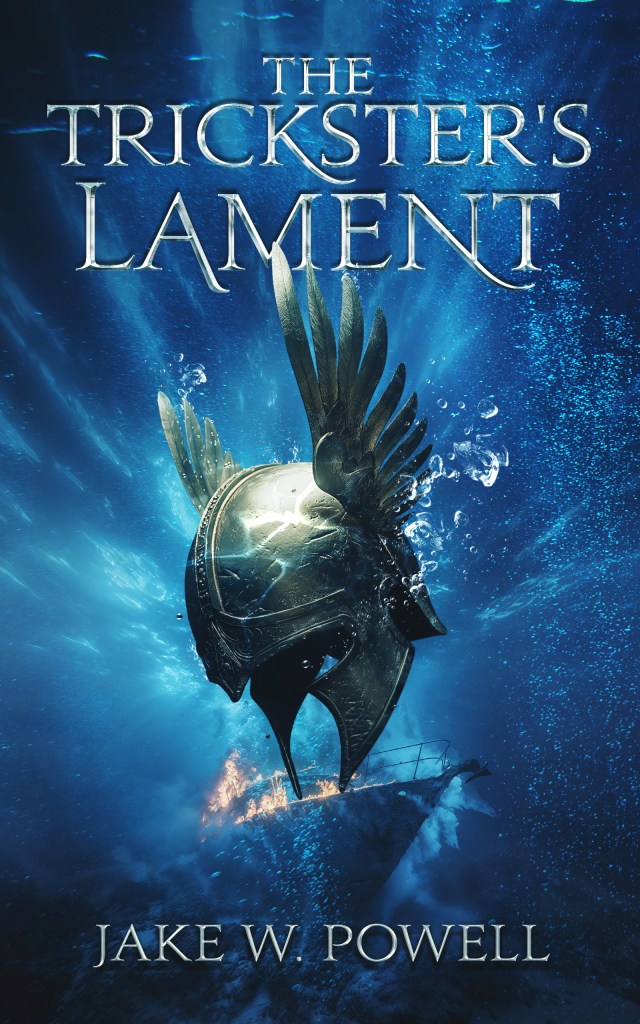
My latest book, The Trickster’s Lament, is currently available on Amazon in both Kindle and paperback format.

“Hermes is not having the best time. He walks a fine line, and his duty as messenger of Olympus weighs heavily on him. Being a god in the modern age means living in a world that no longer believes in gods. How much can one deity accomplish when no one respects him anymore? And why do his instincts tell him that he, the son of Zeus, is losing favor with his own family?

Tensions abound. The upstart Young Gods play dangerous games using entire cities as their boards. Formless monsters strike from the nighttime shadows, terrorizing hapless mortals. Agents of rival pantheons scheme to thwart Olympus’ designs. In the thick of it all, Hermes does what he does best: trick, lie, and cheat his way to victory.

Many thanks for visiting my blog. I post updates on my writing career, I muse over storytelling and fiction, and I reflect on the curious and wonderful things in life.

Remembering Dinotopia

Do you remember your favorite book from your childhood?

In truth, there are so many books I loved as a child that I can’t remember them all. I just remember the hours spent in my room, lost in words and pictures. But there is one that does stick out in my memory.

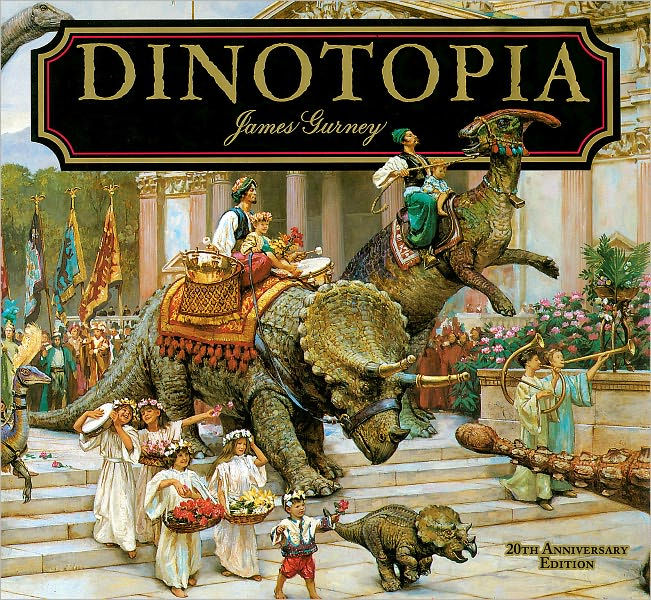
I have very fond memories of an illustrated book called Dinotopia: A Land Apart from Time. It has beautiful imagery, wonderful worldbuilding, and is a tour de force of creating a fully-realized fictional world, courtesy of National Geographic artist James Gurney.

Dinotopia is about an island hidden from the rest of the world where dinosaurs and humans live in peace and harmony. It is presented through the eyes of a 19th-century explorer and his son who are shipwrecked on the island and gradually become a part of its strange, beautiful, and intricate society. Gurney put a lot of thought into how such a world would function, not just the cities and the clothing and the festivals and the government, but such mundane things as bedding, waste disposal, and timekeeping.

And it’s gorgeous.

Remember what it was like to be a kid? When there were no strange grown-up responsibilities and nagging worries? Remember when nobody could take away your joy because you clung to it so fiercely? Dinotopia reminds me of those days, and it reminds me that we are still able to keep that joy throughout our lives.

Most of all, it reminds me how fun it is to curl up with a good book.

Many thanks for visiting my blog. I post updates on my writing career, I muse over storytelling and fiction, and I reflect on the curious and wonderful things in life.

Image: Cover of Dinotopia by James Gurney; Fair use

Legacy: What We Are Remembered For

As we get older, we start having deep thoughts. Questions run through our minds, questions like, “What will I leave behind when I’m gone?” and “How will people remember me?” With age comes an acute awareness that our time on Earth is finite, and with that come musings on what our legacy will be. What mark will our lives leave on the world? Will we, to get to the heart of things, have done anything that mattered?

Legacy is a loaded word. It’s a word associated with empires and rulers. It invokes monuments that endure for centuries. Legacies are connected to greatness. The greatest men and women of history, whether good or bad, are remembered by all.

And look at what society says to us. We must work hard to leave our own mark. We must strive to improve the world, to improve society, to make positive changes, to “be the change you want to see.” Or even, just to leave the world a little better than when we found it. A burden, one might say. It is something imposed on people from a young age to aspire to greatness.

I say it’s a distraction from what’s truly important. Today’s great accomplishments are tomorrow’s misguided attempts. We simply don’t know how we will be remembered, or by whom, or for what. That guy you accidentally cut off on the freeway is going to remember you very differently than your favorite uncle who loves the sweater you bought him for Christmas. And that piece of litter you picked up in the park without a second thought might inspire some passing child to pursue a career in conservation. The door you held open for an old lady might have given her new hope in life.

Farfetched, you say? What do we truly know about what will affect others the most? Media tells us that big causes and organizations are what change the world. But not everyone is going to make a mark on that scale. What does that tell us? That those who don’t measure up to vaguely defined goals are failures?

Right, right, this is all very deep and philosophical, but maybe you’re wondering what this means for you. Or you’re wondering who this pretentious nit with a blog is, anyhow. Well, the long and short of it is: Your legacy is everything you do, big and small. And the small things, in my experience, tend to matter more than the big.

We’re not all going to be famous when we die. We’re not all going to found a world-spanning charity or find the cure to a terrible disease or invent a new technology. But we are all capable of acts of kindness. Compassion and sympathy go a long, long way. There might not be any prizes or awards, and nobody’s going to erect a monument for a gentle word, so maybe it doesn’t appeal to everyone. At least, until you need a kind word yourself on a bad day.

We can’t control our own legacies. We can maybe dictate what’s written on our tombstone, and will our possessions to others, but how we truly affected the world – for better or ill – is a far more complex thing that can’t be summed up in a few brief achievements.

Legacies shift and change and what we consider our magnum opus might be forgotten within a few years. So, if you ever find yourself getting worried over how people remember you, just relax. Just do your best and be kind. I suspect we’d all be surprised if we were aware of the things we did that truly mattered most to others.

If you just so happen to be enjoying my blog, feel free to subscribe. I post updates on my writing career, I muse over storytelling and fiction, and I reflect on the curious and wonderful things in life.

Image: “The mountains are calling and I must go. John Muir” by blmiers2; Licensed under CC BY-NC-SA 2.0.