State of Gaming in 20 Years

What’s a piece of technology you’re convinced will exist in 20 years?

Gaming hardware has entered a bit of a lull in the last ten years or so. Since the 1980s, video game technology was engaged in a race toward realism – realistic graphics, realistic physics, realistic lighting, etc. Now that that has been achieved, what is the next big leap?

Companies have been dabbling in virtual reality for a couple decades now, but I think they’re still in the kiddie pool. Advances in VR will be the next big thing in gaming. And the next big thing in VR? Haptic technology.

What is haptic technology? It is any technology that simulates the sense of touch. VR can simulate visuals pretty darn well. Even motion and balance, to an extent. But replicating the feeling of touch, of being within the artificial world, is a feat that engineers are in the process of developing into something astounding.

Imagine wearing gloves that simulate the sensation of putting your hand around a doorknob that isn’t there, or driving a car that doesn’t exist. Imagine a helmet that induces vibrations to simulate wind and air pressure. Imagine a whole suit that makes you feel like you are running through a field or climbing a mountain.

Can such things exist in 20 years? Yes, I think so. Whether they cost less than a new house, I’m more iffy on, but I do believe they will become more compact, less clunky and widely available. Haptics is the next step in immersion that gaming strives for.

***

Many thanks for visiting my blog. I post updates on my writing career, I muse over storytelling and fiction, and I reflect on the curious and wonderful things in life.

No, A.I. Robots Don’t Herald the End of the Human Race.

Are we all going to be replaced by robots?

When discussing the possibility of a dystopian future where humans are subject to synthetic overlords, we have to remember something about robots and A.I.: They are dumb. Really, really dumb.

The question is rather broad. Will humanity in general be replaced by robots? Or perhaps all workers are going to have their jobs replaced by thinking machines? I personally doubt either will happen.

The question is one that mankind has brooded over for several decades now. It prompts feelings of existential dread that are quite fashionable at the moment, and pop media has taught us that robots exist for no other reason than to take over the world and to exterminate/enslave/assimilate the human race. But no, no, I don’t think it’s going to happen.

Sure, A.I. appears extremely intelligent, able to perform tasks and calculations faster than the human mind, but it is input-output. Garbage in, garbage out. A.I. doesn’t possess the capacity for intuition and introspective learning that humans do.

Robots may be stronger and more resilient than humans, but they are machines. Machines wear out and break down, faster than human bodies, in fact, and need to be fixed regularly. Can an A.I. driven system do that? Probably. But what happens when that system itself glitches out? Who repairs the repairer?

The fear is nothing new. Laborers of the Industrial Revolution feared that mills and machines would replace the need for them entirely. Then came computers, and if anything, they need even more careful attention to work properly. A.I. is the next in a long line of newfangled technological innovations that freak people out because they’re new and nobody knows their full capabilities yet. So, people think, “Hey, maybe this time we really will be replaced!”

Again, pop media has conditioned us to expect as much.

People are still needed to operate technology. Technology is dimwitted. It can’t react to sudden surprises. It needs a human touch to function correctly. In fact, the more we rely on technology, the busier we become in managing it. Automation breaks down the moment a single step falls out of place.

A.I. can think fast, act fast and evolve fast, but it can’t adapt to the weirdness of real life like humans can. A.I. and robots both need people to continue working, not the other way around.

As for the big companies who are jamming A.I. into everything they can? They are in the honeymoon phase when it comes to A.I. and its applications. The possibilities seem endless! But the giddy pipe dreams will end, and stern reality will reassert itself. Executives will grow bored and move on to the next big thing. A.I. will become a fact of life, along with interesting new types of robots, and like the once-strange technologies of the steam engine, the computer and the automatically flushing toilet, it will fade into the mundanity of everyday life.

***

Many thanks for visiting my blog. I post updates on my writing career, I muse over storytelling and fiction, and I reflect on the curious and wonderful things in life.

“Hermes is not having the best time. He walks a fine line, and his duty as messenger of Olympus weighs heavily on him. Being a god in the modern age means living in a world that no longer believes in gods. How much can one deity accomplish when no one respects him anymore? And why do his instincts tell him that he, the son of Zeus, is losing favor with his own family?

Tensions abound. The upstart Young Gods play dangerous games using entire cities as their boards. Formless monsters strike from the nighttime shadows, terrorizing hapless mortals. Agents of rival pantheons scheme to thwart Olympus’ designs. In the thick of it all, Hermes does what he does best: trick, lie, and cheat his way to victory.

Smartphones

The most important invention in your lifetime is…

The smartphone. Not the cellular phone in general, but specifically the smartphone with its advanced computing capabilities, online access and instant information retrieval.

Cell phones have been around a long time, before I was born, but the smartphone came into its own during my lifetime. Funny how science fiction seems to predict these things. Star Trek had those little handheld doodads that could scan anything and tell you if somebody was sick or healthy or mindmelded by Vulcans or whatever, and nowadays we have near-identical gadgets that can scan, measure distances, forecast the weather, monitor health, take pictures, and far too many other things.

Smartphones are interesting devices because few of their features are truly new, but they are devices that can do everything at once. That’s their significance – the number of features contained within one item. All that plus instant communication via phone call, text or email. That sort of versatility and the speed with which one can look up info and immediately apply it to the situation at hand make smartphones into what I consider the most important invention developed during my lifetime.

***

Many thanks for visiting my blog. I post updates on my writing career, I muse over storytelling and fiction, and I reflect on the curious and wonderful things in life.

“Hermes is not having the best time. He walks a fine line, and his duty as messenger of Olympus weighs heavily on him. Being a god in the modern age means living in a world that no longer believes in gods. How much can one deity accomplish when no one respects him anymore? And why do his instincts tell him that he, the son of Zeus, is losing favor with his own family?

Tensions abound. The upstart Young Gods play dangerous games using entire cities as their boards. Formless monsters strike from the nighttime shadows, terrorizing hapless mortals. Agents of rival pantheons scheme to thwart Olympus’ designs. In the thick of it all, Hermes does what he does best: trick, lie, and cheat his way to victory.

The Computers of Yesteryear

Write about your first computer.

The first time I ever used a computer was back in the ancient days of dial-up, GeoCities and flip phones. My parents owned a word processor. No, not a computer. A word processor. As in, an electronic box with a blank, black screen on which you could type sentences and do nothing else. No programs, no Internet, no background wallpaper. This was a simpler time.

So, there I was, a kid not even in the double digits who thought he was going to write his first novel. Never got past the second page, of course. Or I was writing backstories for my action figures and posting them on my bedroom corkboard. Either way, those were the days when I first began cutting my teeth as a writer.

My first personal computer, as in the first I actually owned, was a bigtime birthday gift from my parents. I was in sixth grade, I think. It was a ponderous contraption. Computers weren’t flat back then. Like the word processor, it was a large box filled with many arcane electronic secrets. More importantly, it came with a tower, which was the actual device doing all the processing, because these were the days when the average PC couldn’t contain all that delicious data in just one piece. It needed a second box to actually run the data, and mine needed a whole desk cabinet to be kept in.

And then there were floppy discs and compact discs. Old PCs used to have slots into which you slid the CD or floppy in order to access them. Do computers even still have slots anymore? I have no idea. What with streaming and online gaming and the Internet in general, I doubt they’re needed anymore.

Those were the days. I’m not sure what kind of days, exactly, but those were them. Just turning on a computer felt like an amazing feat accomplished. Before digital phones and instant online access, personal computers were lighthouses of knowledge and wonder. Nowadays, computers are rather mundane and even old-fashioned. But I remember.

***

Many thanks for visiting my blog. I post updates on my writing career, I muse over storytelling and fiction, and I reflect on the curious and wonderful things in life.

“Hermes is not having the best time. He walks a fine line, and his duty as messenger of Olympus weighs heavily on him. Being a god in the modern age means living in a world that no longer believes in gods. How much can one deity accomplish when no one respects him anymore? And why do his instincts tell him that he, the son of Zeus, is losing favor with his own family?

Tensions abound. The upstart Young Gods play dangerous games using entire cities as their boards. Formless monsters strike from the nighttime shadows, terrorizing hapless mortals. Agents of rival pantheons scheme to thwart Olympus’ designs. In the thick of it all, Hermes does what he does best: trick, lie, and cheat his way to victory.

Ranting about Planned Obsolescence

If you could un-invent something, what would it be?

I must warn you, today is something of a rant. Take it as you will.

Planned obsolescence. Machines nowadays, especially electronics, are designed to last only a certain number of years before needing to be replaced. If I could go back in time and unmake this form of technological “innovation,” I would.

I mean, having to buy a new computer or mobile phone every few years is a hassle of money and time. I try to keep mine as long as possible, defying their gradual decline. I like things to be permanent. I like technology to be supportive, not a safety net with a big hole cut in the middle.

What happens if the phone factory collapses into rubble or all the schematics needed to make the hottest new model are lost? Then we’re stuck with old phones that will eventually no longer receive updates and stop working properly, and we won’t have a way to replace them with the new, fancy-schmancy versions. Then society collapses, and we’re all back to the Stone Age because our technology is no longer built to last. This is how Mad Max really starts, people!

… All joking aside, I really don’t like planned obsolescence. I believe it to be detrimental to technological progress and a real pain in the neck for ordinary folks. You could say that I hope it one day … becomes obsolete.

***

Many thanks for visiting my blog. I post updates on my writing career, I muse over storytelling and fiction, and I reflect on the curious and wonderful things in life.

“Hermes is not having the best time. He walks a fine line, and his duty as messenger of Olympus weighs heavily on him. Being a god in the modern age means living in a world that no longer believes in gods. How much can one deity accomplish when no one respects him anymore? And why do his instincts tell him that he, the son of Zeus, is losing favor with his own family?

Tensions abound. The upstart Young Gods play dangerous games using entire cities as their boards. Formless monsters strike from the nighttime shadows, terrorizing hapless mortals. Agents of rival pantheons scheme to thwart Olympus’ designs. In the thick of it all, Hermes does what he does best: trick, lie, and cheat his way to victory.

When AI Slop Presents a Cunning Opportunity…

Here’s a business idea for the modern age.

AI looms over us all like a brooding shadow. Fears of AI replacing human-created novels, magazines, photography, illustrations and more have wormed their way into people’s minds.

“Human-created.” That gives me an idea. I bet I could do something with that.

The surge of AI content isn’t new. In fact, it is very similar to the rise of factory-made goods during and immediately after the Industrial Revolution. Mass-produced furniture, mass-produced clothing, mass-produced vehicles, mass-produced toys … The list goes on.

And now, in this present age, we have the advent of mass-produced media. AI-generated books by the hundreds. Essays written by a computer trained on patterns and Internet-scouring. Art produced in seconds by an artificial mind.

Horrific? Maybe. But if history told us something about mass production, it is that the value of bespoke goods subsequently became much, much higher.

AI slop is all the same. It blends together, united by bland, tedious styles that bear little semblance to the elaborate creativity of the human mind. That makes human-made art and writing valuable. And if AI slop becomes the norm, if large businesses make extensive use of it, than a new niche market opens up.

Bespoke entertainment. Non-AI media. The personal touch of a living person. Stories and art pieces created by human minds for human minds.

It’s not a new business. People have been publishing books for centuries. People have been drawing pictures for millennia. They have charged money for both.

But if AI content becomes the norm, then human-made content becomes rarer. Skilled employees are being laid off by big businesses in favor of replacing their skills with cheaper AI. If I was a small to medium-sized business owner, I’d be snapping up as many of those people as possible. The value of their skills is going to increase.

A suit custom-made for an individual, crafted by the hands of skilled labor, demands a higher price than a generic suit made in a factory. A custom car is more expensive than a basic model.

Imagine then, the value of a book, a magazine, a comic, a painting, a textbook that, in an age where AI-generation is the norm, has been created personally by a living, breathing person.

That’s not a fear. That’s an opportunity.

***

Many thanks for visiting my blog. I post updates on my writing career, I muse over storytelling and fiction, and I reflect on the curious and wonderful things in life.

“Hermes is not having the best time. He walks a fine line, and his duty as messenger of Olympus weighs heavily on him. Being a god in the modern age means living in a world that no longer believes in gods. How much can one deity accomplish when no one respects him anymore? And why do his instincts tell him that he, the son of Zeus, is losing favor with his own family?

Tensions abound. The upstart Young Gods play dangerous games using entire cities as their boards. Formless monsters strike from the nighttime shadows, terrorizing hapless mortals. Agents of rival pantheons scheme to thwart Olympus’ designs. In the thick of it all, Hermes does what he does best: trick, lie, and cheat his way to victory.

No Jetpacks, No Teleporters, No Space Colonies … Keep Pushing Back the Date, Writers!

You ever notice how writers underestimate the rate of technology’s advance? They never quite get it right.

In the 1950s, writers predicted that families would be getting lost in space in the year 1997 A.D. They didn’t. In the 1960s, some small-time director thought that 2001 would a true odyssey in space. It wasn’t. Manned spaceflight hasn’t even gotten past the moon.

In the 1980s, a certain movie about time travel had the audacity to suggest we’d have hoverboards by 2015. That one still hurts. I want a hoverboard!

But no, we don’t have any. We have electric unmanned cars that come to a dead halt in the middle of intersections if the power grid goes out, but no hoverboards.

But we writers have a simple solution for irritants like reality and historical fact. We ignore them.

Just keep pushing back the date. By 2040 we’ll have colonies on Mars, I’m sure. No? By 2070. No? By 2100. Repeat as needed.

Oh, but don’t go thinking writers are completely lacking in self-awareness. There was an overt change in tactics around the 2000s when space colonies were proving to not be coming any time soon.

Writers started cheating.

In the year -insert random year around two decades from now- mankind discovers alien technology on the moon or Mars or what have you and reverse engineers it. Or a benevolent alien race arrives and welcomes us into the greater galactic community. Huzzah!

The year doesn’t even matter anymore! Marvelous literary freedom unbound by the constraints of science and logic! Be it 2027 or 2227, humanity will eventually discover those long-lost alien ruins that will unlock the secrets of faster-than-light travel, teleportation, artificial gravity and hoverboards.

What? Impossible, you say? Excuse me, but how do you know there isn’t an alien vault on the moon? You have proof?

Besides, writers don’t need proof. We type it down, and it is so. Just like this: In 2036 we will have flying cars. See? That was easy.

Science fiction is easy. All you have to do is keep moving the goalposts. And pretend that you never believed we’d all have hoverboards in the 2010s.

***

Many thanks for visiting my blog. I post updates on my writing career, I muse over storytelling and fiction, and I reflect on the curious and wonderful things in life.

“Hermes is not having the best time. He walks a fine line, and his duty as messenger of Olympus weighs heavily on him. Being a god in the modern age means living in a world that no longer believes in gods. How much can one deity accomplish when no one respects him anymore? And why do his instincts tell him that he, the son of Zeus, is losing favor with his own family?

Tensions abound. The upstart Young Gods play dangerous games using entire cities as their boards. Formless monsters strike from the nighttime shadows, terrorizing hapless mortals. Agents of rival pantheons scheme to thwart Olympus’ designs. In the thick of it all, Hermes does what he does best: trick, lie, and cheat his way to victory.

Dinner with History’s Nameless

If you could host a dinner and anyone you invite was sure to come, who would you invite?

If I could invite anyone … I wouldn’t let a thing like time get in the way.

I would invite people long dead to learn their stories and the shape of history. Not famous people or those mentioned in the history books. The nameless, the common people, those whose names never made it into a textbook.

  1. A laborer who worked on the Great Pyramid of Giza. I would ask him how the pyramids were built, and what it was like to build one of them. I would ask what life was like for the common man in the ancient times of Egypt.
  2. A Viking from the 10th century. What were the raids like? What was your culture like? How do you see yourself, and how do you want others to see you?
  3. A peasant from 15th century Japan. What was it like to live during the Warring States period? I would ask him about daily life in Japan and how peasants related to samurai and other higher-ranking castes.
  4. Nez Perce, Comanche, Pueblo, Inuit, and Mohawk tribal members from before the first Europeans arrived in North America. I would ask them what their cultures were like, how they got on with their neighbors, and what North America was like before written history.
  5. One of Thomas Edison’s employees. Not the man himself, but someone who worked under him. What was it like? What was he like? And how did you contribute to his company?
  6. One of the first theater-goers to see Walt Disney’s Snow White and the Seven Dwarfs in 1937. I would want to know what the first audience’s impressions of the film was. And I would want to know what they thought Disney would do next.
  7. One of Microsoft’s first ever employees. I would love to know what his or her vision for the company was, what working under Bill Gates was like, and what it was like to build the first home computers.

And that would just be my first dinner party …

***

Many thanks for visiting my blog. I post updates on my writing career, I muse over storytelling and fiction, and I reflect on the curious and wonderful things in life.

“Hermes is not having the best time. He walks a fine line, and his duty as messenger of Olympus weighs heavily on him. Being a god in the modern age means living in a world that no longer believes in gods. How much can one deity accomplish when no one respects him anymore? And why do his instincts tell him that he, the son of Zeus, is losing favor with his own family?

Tensions abound. The upstart Young Gods play dangerous games using entire cities as their boards. Formless monsters strike from the nighttime shadows, terrorizing hapless mortals. Agents of rival pantheons scheme to thwart Olympus’ designs. In the thick of it all, Hermes does what he does best: trick, lie, and cheat his way to victory.

Ye Olden Internet Days

Do you remember life before the Internet?

I certainly remember life with less Internet, though I’m not quite old enough to remember a time predating it. I grew up in the days of dial-up when going online meant not being able to use landline phones (I remember those, too) and television had no online connection. In fact, quite a few things weren’t online. Phones weren’t, cars weren’t, watches weren’t, heck, even there wasn’t even Wifi.

Streaming certainly a thing. Once upon a time, watching Netflix meant having a physical copy mailed to you to rent and return. Speaking of TV and movies, you watched them on a channel, stuck a cassette into a VCR, or went to a movie theater. This was the days before YouTube, Instagram, Facebook, and Twitter. There was MySpace, but I never used that so I can’t say much about it.

I do remember early Internet sites fondly, for some reason. Wikis didn’t exist, so people made websites more or less from scratch. Fewer templates, though there was AngelFire and similar tools. No Wix or WordPress yet. Fan sites looked unique. Silly, too, at times, especially compared to today’s sleek designs. Graphics weren’t a big thing, so a web page was mostly a bunch of text and a few pictures. And we were happy with what we got, you young whippersnappers!

Anyway, I’m not that old, but technology has a habit of making you think you are. It moves very fast, and in another thirty years, we’ll probably look at today’s Internet as something akin to the abacus. Or maybe we’ll go back to using the abacus because our calculators keep spitting out ads after every sum.

Yeah, we didn’t get many ads back then, either. Heh.

***

Many thanks for visiting my blog. I post updates on my writing career, I muse over storytelling and fiction, and I reflect on the curious and wonderful things in life.

“Hermes is not having the best time. He walks a fine line, and his duty as messenger of Olympus weighs heavily on him. Being a god in the modern age means living in a world that no longer believes in gods. How much can one deity accomplish when no one respects him anymore? And why do his instincts tell him that he, the son of Zeus, is losing favor with his own family?

Tensions abound. The upstart Young Gods play dangerous games using entire cities as their boards. Formless monsters strike from the nighttime shadows, terrorizing hapless mortals. Agents of rival pantheons scheme to thwart Olympus’ designs. In the thick of it all, Hermes does what he does best: trick, lie, and cheat his way to victory.

The Ancient Age of Computers

Write about your first computer.

It was a big deal in my life owning a computer for the first time. Oh, I grew up using my parent’s, but having my own was almost a rite of passage into adulthood.

As many of you already know, I’m a writer, and I’ve been writing for most of my life. My first typed ramblings were done on a word processor, the grandaddy of modern computers where the only thing you could do was type and print. No fonts, no editing, no formatting. The missing link between the typewriter and the computer.

My first proper computer, though, was a birthday gift. It was a big deal, as you might imagine, especially since I was in, what? Fifth or sixth grade? A long time ago, in the days of yore when computers were big solid blocks, the mouse and keyboard were wired, the monitor was tiny, and it was the really big towers tucked away behind the desk that held all the processing power. These were the days of floppy discs that could hold maybe a single magazine issue’s worth of information before filling up and needing you to buy another one. No memory sticks here.

Before touch screens. Before iPhones. Before Bluetooth. Yes, the time when there was only – shudder – dial-up.

Some of you reading this remember dial-up. Using a landline phone connection to hook up to the Internet. When I wanted to go online, I had to tell my parents, because we couldn’t use the phone and be online at the same time. And then there was the sound. All I can really say is, if you know, you know. The sinister symphony of beeps, honks and screaming static. The sound of an age before instant convenience. Back in my day, we waited minutes to get online.

I liked that computer. Well, it was my only one, so I had better like it, but it was fun. Surfing the old version of the web, playing computer games that required actual discs (sometimes more than one for a single game!) and using the old Microsoft Word that came in an actual package rather than be an online service.

But that computer is gone now. It died, as computers tend to do. A moment of silence for the Ancient Age of Computers. But not for dial-up. Dial-up will not be missed.

***

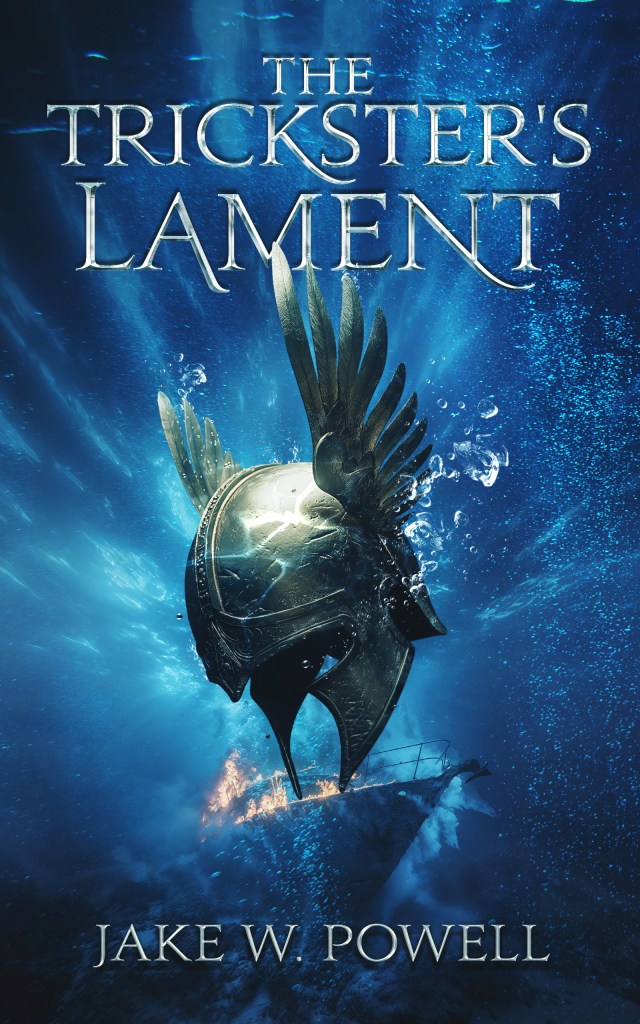
My new book, The Trickster’s Lament, is currently available on Amazon in both Kindle and paperback format.

“Hermes is not having the best time. He walks a fine line, and his duty as messenger of Olympus weighs heavily on him. Being a god in the modern age means living in a world that no longer believes in gods. How much can one deity accomplish when no one respects him anymore? And why do his instincts tell him that he, the son of Zeus, is losing favor with his own family?

Tensions abound. The upstart Young Gods play dangerous games using entire cities as their boards. Formless monsters strike from the nighttime shadows, terrorizing hapless mortals. Agents of rival pantheons scheme to thwart Olympus’ designs. In the thick of it all, Hermes does what he does best: trick, lie, and cheat his way to victory.

He may be disrespected. He may be kicked about. He may even be falling out with his pantheon. But Hermes is a trickster. He knows how to play dirty in a world that doesn’t play fair. But though he can best man, beast, and god, he isn’t prepared for his wiliest opponent yet: his own conscience.”

Many thanks for visiting my blog. I post updates on my writing career, I muse over storytelling and fiction, and I reflect on the curious and wonderful things in life.