What Matters Most: Establishing A Story’s Stakes

In every story, there are stakes. Something may be lost, something may be gained. The story’s conflict means something. Without stakes, without the risk of failure, a story isn’t very interesting. Who cares if the One Ring is destroyed in the fires of Mount Doom if Sauron isn’t a threat? Who cares about the Galactic Empire if they’re a paper tiger who can’t even threaten one planet?

You need to establish the stakes early on. That is to say, you need to establish what will happen if the heroes lose: Sauron conquers Middle Earth and reduces everyone to slavery. The Galactic Empire uses the Death Star to destroy any planet that opposes it. The heroes’ actions must matter.

Of course, not all stories have such a grand scope. To Kill a Mockingbird doesn’t deal with world-rattling threats, but Atticus Finch is struggling to prove an innocent man didn’t commit the crime he is accused of. The Grapes of Wrath centers around a family trying to establish a new life in California and not fall apart in the process. These are more personal stakes, but no less important.

That’s another thing about establishing stakes. They must be appropriate to the story. Personally, I think that, first and foremost, the stakes must be appropriate to the protagonist. We are reading about a character, and what matters to them must matter to us. If the stake is nothing more than Jim trying to get his kite into the air, then, by golly, that’s what the reader should care about, too.

Sometimes the stakes in a story increase. Maybe Jim gets drafted into World War II. Well, that’s a major shift. What’s at stake now? Survival? Capturing the enemy base? Maybe. But what is most appropriate is what directly affects Jim’s personal journey. It’s not just about fighting the enemy, any more than it was about flying the kite. It’s about Jim’s character growth.

It was never about getting the kite into the air. It’s not about fighting the war, not really. Those are the circumstances, but the story is about Jim learning to persevere and attain self-confidence. He never really felt that he was capable of getting that kite in the air. He feels that he can’t contribute to the war. The kite and the war represent the same thing: obstacles to Jim’s goal of becoming a confident, mature adult.

Okay, I’ll leave it up to one of you out there to write that story.

Writers don’t play hopscotch with the stakes. Even when they are raised to something more serious, they still form a core that drives the narrative. Every new stake is connected to the protagonist’s central conflict, each one a facet of his or her inner struggle.

It’s not about building up the biggest, most dire conflict imaginable: “The world will end! The evil empire will rule! The plague will kill us all!” It’s about character. It’s about what matters most to the protagonist.

***

Many thanks for visiting my blog. I post updates on my writing career, I muse over storytelling and fiction, and I reflect on the curious and wonderful things in life.
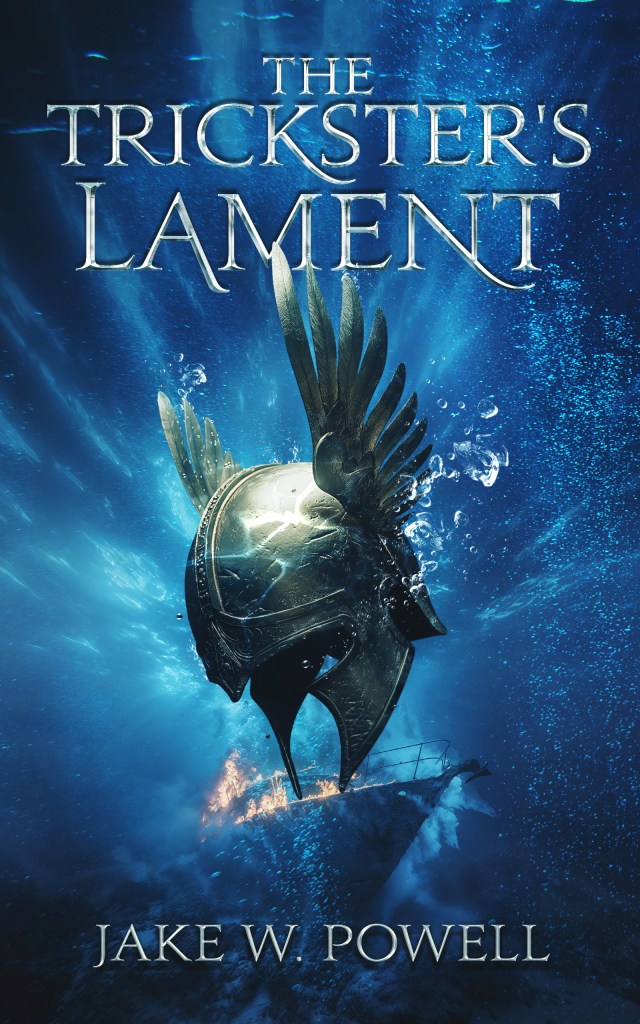
“Hermes is not having the best time. He walks a fine line, and his duty as messenger of Olympus weighs heavily on him. Being a god in the modern age means living in a world that no longer believes in gods. How much can one deity accomplish when no one respects him anymore? And why do his instincts tell him that he, the son of Zeus, is losing favor with his own family?

Tensions abound. The upstart Young Gods play dangerous games using entire cities as their boards. Formless monsters strike from the nighttime shadows, terrorizing hapless mortals. Agents of rival pantheons scheme to thwart Olympus’ designs. In the thick of it all, Hermes does what he does best: trick, lie, and cheat his way to victory.

Putting Stories into the World and Learning to Let Them Go

Stories are precious things, especially to those who write them.

We write stories for all sorts of reasons: to tell a message, to work through a grief or hardship, as a gift for friends and family, or simply for the sake of doing so. Regardless of why, stories are very personal things.

And we all have a vision for our stories. We see it for what we want it to be. We see it all – or so we think. And then the moment of truth comes: time to publish. It’s out there, others are reading it, and they don’t see what we saw.

That’s applicability for you. We plan and plan, but readers make the story into something else, because they see themselves in the story. We all see ourselves, and so the narrative comes into focus through the lenses of our own lives.

It’s hard to let go of what we create, and even harder to hear others’ opinions of our work. They claim to understand and comprehend the deep analogies and whatnot, and we tell ourselves, “That’s not what I meant at all!”

It’s life, I suppose. And it’s something all writers will have to deal with sooner or later. But it’s not all bad. The words of readers reveal other lenses, other views and new possibilities. To be a writer is to spend so much time locked up inside yourself. Letting your story go out into the world allows you to see beyond your own mind.

Many thanks for visiting my blog. I post updates on my writing career, I muse over storytelling and fiction, and I reflect on the curious and wonderful things in life.

Committing to First-Person Narratives

When you think of writing a book, “commitment” is a word you might associate with time discipline, writing a certain number of words per day, or setting aside a chunk of your budget for publishing and marketing. You wouldn’t necessarily think of the writing itself. After all, writing is all about making changes. That’s what drafts are for! But there is at least one piece of the puzzle on which you have to make a choice early on, and from which backing out can be painful. That is choosing your narrative point-of-view.

Now, third-person is common and popular, but what if you go for first-person? Ah, then you really have to commit, because first-person narrative has a whole set of pros and cons to it that change the way you tell the story.

The pros? Writing in first-person lets you get inside the head of your POV character, whether they be the protagonist or someone else, and really dig into their psychology and the world they live in. It’s a very personal method of storytelling. You really get to know who this character is as a person. Plus, you get to shape the story and its twists and surprises in a fairly organic way. The reader can only know what the narrator knows (or thinks they know). And the narrator doesn’t have to be honest or reliable.

On the other hand, first-person limits the scope of your storytelling. You can’t describe a distant scene two countries over, you can’t pull back and dedicate a few paragraphs to an unbiased history of the setting, and most importantly, you are restricted to the one character. You can’t jump between multiple peoples’ perspectives.

Ok, that’s not true. Crazy geniuses can write books that feature multiple POV characters told from multiple first-person perspectives, but I’m not brave enough to try it. But if you have written or read such a book, let me know in the comments. I’d be interested in reading it.

Your narrative is narrow in scope. That’s not to say the story itself has to be . It can be a sprawling epic, but you will only see it through the eyes of one person. That’s why you have to be sure of yourself before you start. You’re gonna have to commit.

Many thanks for visiting my blog. I post updates on my writing career, I muse over storytelling and fiction, and I reflect on the curious and wonderful things in life.

Confessions of a Skipper

I must confess to a strange reading habit, one that might shock and horrify you. Do not judge me too harshly, for I shall explain myself.

When I start a fiction book, I like to skip to read the last couple of pages first.

“What?” I hear you cry out. “What is this blasphemy? Why ruin the story for yourself?” Calm yourself, please. Let me clear things up.

It’s true that I’m not sensitive to spoilers. I really don’t mind when plot twists are brought up in casual conversation. But this habit is more than just wanting to know how things end. Really, without context, knowledge of a story’s ending doesn’t have a terribly great impact on me as a reader. I have no grasp of the import of the scenes and dialogue. What I’m really interested in is catching a glimpse of the finished jigsaw puzzle, then going back to the beginning to see how the pieces fit together.

Rather than starting a book with no idea of how things end up, I know exactly how it ends. And so, the fun of the read shifts from the “what?” to the “why?” Why is this the ending? And how will my initial impression of it change as I get more pieces of the bigger picture?

I suppose I’m interested in perceiving the author’s mind. How do they assemble the various elements of the narrative into its final shape at story’s end? How are these characters and events inserted into the story? In short, how did we end up here?

Pieces click into place as I read on, and the ending’s significance becomes clearer. Sometimes, I feel like a detective solving a case in reverse. I already know whodunnit, but the howdunnit isn’t so obvious.

And I do it because I’m quirky and it’s kind of a fun exercise to try out. I neither recommend it nor warn against it. Reading style is a matter of personal preference. It’s up to you.

And there you have it. The true confessions of a skipper.

If you just so happen to be enjoying my blog, feel free to subscribe. I post updates on my writing career, I muse over storytelling and fiction, and I reflect on the curious and wonderful things in life.