Truth be told, I’ve never considered myself an authority on anything. Oh, sure, I write a blog and share my thoughts and insights on life, writing, and sundry subjects, but I don’t consider myself an expert on any of them. I certainly wouldn’t call myself an authority on writing, and I probably never will. I’m just sharing my experiences, for better or for worse.
To achieve mastery in an artistic pursuit is something I pursue, but it is not a goal I expect to ever achieve. I don’t think it is obtainable. The journey and the gradual improvement of skill over time is what makes such a thing worthwhile.
I’m just a guy with things to say who started a blog. Thanks for reading it, by the way!
That being said, there are things I know about more than others. You know, the kinds of intellectual scree that are useful for a game of Trivial Pursuit, to rekindle the embers of a dying conversation, or perhaps to insert into a livestream chat. I have an unhealthy knowledge of pop culture, for example, particularly video games and tabletop gaming.
I also have an interest in animation history. I have a keen interest in modern Japanese history – enough that I took a master’s degree in Japanese Studies. Actually, reading what I just wrote, I can conclude that I like history in general. The hard sciences scare me, but I’m always up for a discussion about the liberal arts. Go figure.
Jack of all trades, master of none? Yes, yes, I am.
What about you? Are there any subjects you consider yourself an authority on or have a wide range of knowledge about?
***
Many thanks for visiting my blog. I post updates on my writing career, I muse over storytelling and fiction, and I reflect on the curious and wonderful things in life.
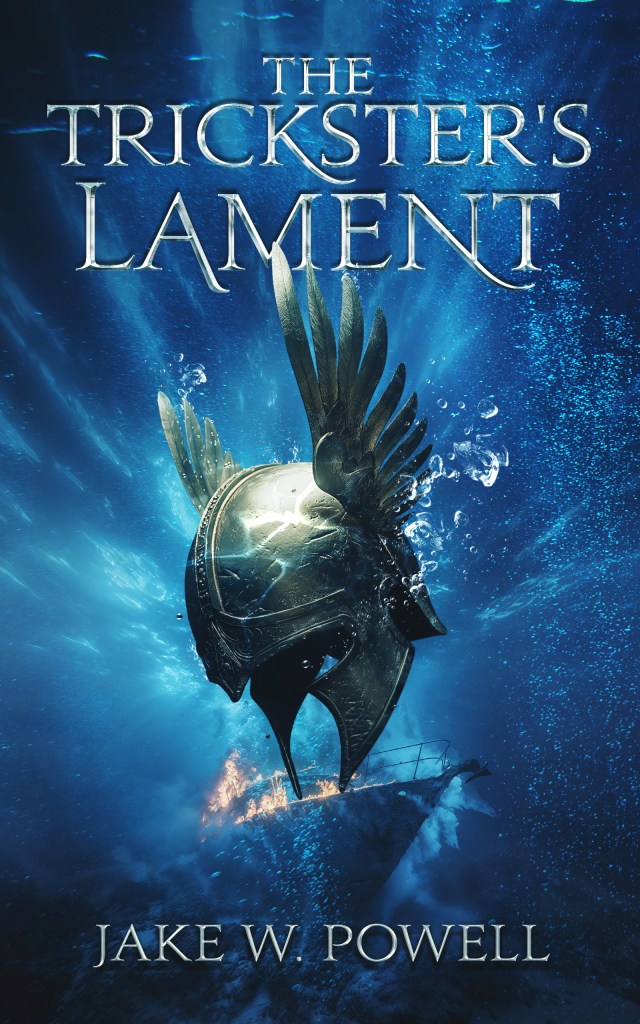
“Hermes is not having the best time. He walks a fine line, and his duty as messenger of Olympus weighs heavily on him. Being a god in the modern age means living in a world that no longer believes in gods. How much can one deity accomplish when no one respects him anymore? And why do his instincts tell him that he, the son of Zeus, is losing favor with his own family?
Tensions abound. The upstart Young Gods play dangerous games using entire cities as their boards. Formless monsters strike from the nighttime shadows, terrorizing hapless mortals. Agents of rival pantheons scheme to thwart Olympus’ designs. In the thick of it all, Hermes does what he does best: trick, lie, and cheat his way to victory.“
I have … several … words that I believe have seeped into the social fabric as overused and overrated vocabulary. Words used so often they don’t have any meaning left except as placeholders or hollow props to push a point. But one word I, as a storyteller and writer, really, really, really, really tire of seeing used at the drop of a hat is this:
Genius.
I see it everywhere online.
“Look at that camera shot! Genius!”
“Did you read this cool one-liner in this comic book? It’s awesome! Genius!”
“Look at what she’s wearing! I love it! The designer is a genius!”
“This music pumps me up! It must be genius!”
No, it’s not. It’s not genius. It’s likeable and memorable and probably technically very skillful. But it’s not genius just because you personally like it.
If I’m coming on strong with this, it’s because I don’t like it when people’s vocabulary is reduced to a handful of expressions and words to communicate a vast and varied array of feelings and situations. It cheapens words. Wait, what am I saying? Words are expensive. They must be, because so many people can’t seem to afford to learn any more.
Genius is a word with a history. The ancient Romans believed the genius was a type of spirit. Genii watched over people and resided in objects and locations. They were entities that guided and assisted people. They were an abstract, animistic concept with concrete benefits.
Genius evolved to mean an individual possessing remarkable and unique creative or intellectual ability. Geniuses are singular in their talents. They are rare, and often leave a significant impact on the world beyond that of simple aesthetic or crowd pleasing. Their minds are quantifiably beyond that of others.
Note that I said “rare.” Geniuses, true geniuses, don’t sprout up like dandelions. And yet, somewhere down the road, society lost the plot. It loves to attach the word to anything. And, I suspect, not because one truly believes the person or the work has intellectual or creative worth, but because of personal gratification. Genius is whatever you want it to be. Genius has become relative.
Maybe it always was? Maybe. But were Einstein or Turing or Leonardo da Vinci merely relatively smarter than the average joe? Or were they actually making remarkable and unprecedented achievements in their fields through learned and innate skill that is extremely hard to match? There’s nothing relative about genius. It is either present, or it isn’t.
This is not to tread over the achievements of others. Not everyone is a genius, but there are many, many skilled people in the arts and sciences who have produced amazing things for people to enjoy and benefit from. They should not be put down. And geniuses work hard, too. It’s the hard-working ones that we know about. But for the love of apple pie, please stop throwing the word around like confetti! Let it hold some meaning.
On the other hand, linguistic drift is a thing. Tragically, “genius” may very well go the way of so many other words with rich histories and meanings and become just another toy in pop culture’s box.
But not for us bloggers, right? Right?
Many thanks for visiting my blog. I post updates on my writing career, I muse over storytelling and fiction, and I reflect on the curious and wonderful things in life.
Let’s be honest. With a question like that, and the fact that my blog is subtitled “Writer of Modern Day Fantasy,” you can pretty easily guess that the answer is, “Yes.” But, hey, did I catch your attention? I did? Good. Let’s dive into it, then.
Fantasy is an important genre. Myths and legends have existed for almost as long as humankind has. There is an almost natural urge in people to invent and make up lands, species, events, and other such things that don’t exist in nature. The urge to create things that defy natural law: flying carpets, giants, dragons, dryads, genies, wishing stars, talking puppets, elves, hobbits, fairies, people the size of your thumb, people as tall as a mountain, alien worlds, life on the moon, and so on and so on. The earliest myths probably were meant to explain phenomena that man couldn’t yet fully understand, like the weather or earthquakes. But even after science has offered its explanations, the fantasies endure. Do old habits die hard? Or maybe we need fantasy in our lives.
Consequently, fantasy is a versatile thing. At its heart, it is the telling of things that not only don’t exist, but can’t exist. There are no elves in the forest. There are no genies trapped in bottles. There is no Fountain of Youth or cities at the bottom of the ocean. But the stories are still told.
For a long time, though, there was a problem.
For the last century or so, fantasy got a bad rap. It was viewed as this sort of nerdish subject that is impractical and of no relevance to “real life.” Dungeons & Dragons was the epitome of loser geek culture for decades. It was a “loser” subject because, in part, it was something that wasn’t real – but people took it so seriously! Why make such a big fuss over the unreal? Why obsess over the rules for a game about fighting made-up creatures? If you’re going to obsess over statistics, at least apply that obsession to football and baseball, not orcs and hobgoblins!
For many people, deriving so much enjoyment from something made-up is just plain childish. Oh, when we are children, it’s fine to enjoy stories of knights versus dragons. Fairy tales are quaint little things that amuse us when we’re young. Then we grow up and enter the serious real world where we need to be interested in grown-up things. Like cars and sports and art and the latest celebrity gossip. You know, important stuff.
That association with the immature has been a stain on fantasy’s reputation for a long time, as well as its sister genre, science fiction. The dominions of nerds and other people who can’t handle reality. There were exceptions, of course. Star Wars, for example, was a major blockbuster in 1977. But by and large, fantasy movies and books and games were strictly niche. There was an audience, but a highly specific one.
Then things changed.
I think the Lord of the Rings film trilogy in the early 2000s was the big turning point. Here was a fantasy series with major, respected stars that took itself seriously. It had a big budget, it was being produced by a major studio, it had marketing and advertising out the wazoo. The critics liked it. It was art.
Suddenly, fantasy lost its stigma. It wasn’t so bad to admit you liked the genre.
Others followed. Game of Thrones was a biggie. And there was Stranger Things, which proudly wore its 1980s nostalgia on its sleeve. And what was big in the 1980s? Yup, Dungeons & Dragons. Speaking of which, a Dungeons and Dragons movie released last year was warmly received. Oh, how the tables had turned!
The fact is, there are lots of people who like the unreal. They like to step away from reality for a few hours. It is called escapism. Personally, I think part of fantasy’s bad reputation is that escapism is confused with retreat. One is the willingness to step away from your problems or worries for a little while to refresh yourself. The other is an ultimately selfish choice to ignore one’s real-life obligations in favor of never leaving the fantasy. But many non-fantasy fans view the genre strictly through the latter lens. A bunch of guys and gals without jobs living in their parents’ basements reading silly books about silly people in silly lands. Fantasy is for the weak, for people can’t handle their own responsibilities.
It’s not fair, really. J. R. R. Tolkien wrote fantasy, after all. You know, the highly respected scholar and linguist? A man with a very productive and well-balanced life? And it gets more unfair.
So, fantasy has hit it big, as I just mentioned. And why did it hit it big? Well, a few successful movies certainly helped. But also, you know, the average person finds out that people like Henry Cavill and Joe Manganiello play stuff like D&D and Warhammer 40,000. Hey, they’re not nerds! Fantasy must be cool!
Sometimes, the best way to get people to take something seriously is to find the right spokesperson. All this time, fantasy just needed better PR.
It worked. Fantasy is widely accepted now. People aren’t ashamed to say that they like it. Nerds aren’t social pariahs. Heck, most of them are running major corporations. And the people writing those hit fantasy movies? They’re nerds, too. That’s the other big shift in the fantasy genre in mainstream culture. Four, five decades ago, fantasy films and TV shows were mainly being written by people who saw it as harmless, inconsequential fun. But the people who grew up with those shows and films, the people who fell in love with them, are the ones calling the shots now. And their beloved childhood is anything but inconsequential. Fans tend to pour their hearts into their work, and the quality of the product (hopefully) goes up. The bigger budgets certainly help.
By and large, fantasy has found public acceptance. Fairy tales aren’t just for kids anymore.
But the question posed at the beginning of this article is only half-answered. Does fantasy matter? Yes, yes it does. Financially, socially, culturally, it matters very much. But why does it matter? And in what other ways does it affect us besides providing something to do on a Saturday night?
Stay tuned …
If you just so happen to be enjoying my blog, feel free to subscribe. I post updates on my writing career, I muse over storytelling and fiction, and I reflect on the curious and wonderful things in life.
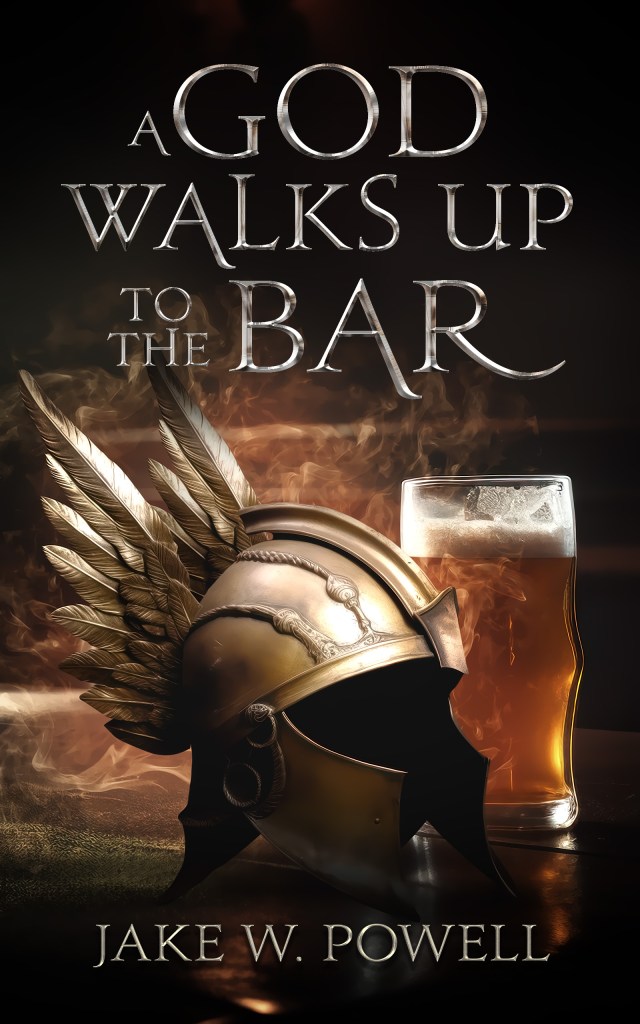
My first book, A God Walks up to the Bar, is available on Amazon.com. Witness the modern day adventures of the Greek god Hermes in a world much like our own – and with demigods, vampires, nymphs, ogres, and magic. The myths never went away, they just learned to move on with the times. It’s a tough job, being a god!
 Jake W. Powell