Groucho Marx on Reading

Outside of a dog, a book is a man’s best friend. Inside of a dog it’s too dark to read.

I find television very educating. Every time somebody turns on the set, I go into the other room and read a book.

Groucho Marx

Very important and enlightening commentary on reading by the great Groucho Marx. Good advice and to be followed. Reading is healthy. Being inside animals is not.

***

Many thanks for visiting my blog. I post updates on my writing career, I muse over storytelling and fiction, and I reflect on the curious and wonderful things in life.

“Hermes is not having the best time. He walks a fine line, and his duty as messenger of Olympus weighs heavily on him. Being a god in the modern age means living in a world that no longer believes in gods. How much can one deity accomplish when no one respects him anymore? And why do his instincts tell him that he, the son of Zeus, is losing favor with his own family?

Tensions abound. The upstart Young Gods play dangerous games using entire cities as their boards. Formless monsters strike from the nighttime shadows, terrorizing hapless mortals. Agents of rival pantheons scheme to thwart Olympus’ designs. In the thick of it all, Hermes does what he does best: trick, lie, and cheat his way to victory.

Open a Book

Open a book, go on an adventure. You don’t leave home, you don’t walk a road. But you go on a journey just the same, to places near and far, betwixt and between.

The past and future, earth and space, ruins and utopias, worlds both alien and familiar. The lives of great kings and scientists and heroes stretch out before you. Hear their words, see inside their minds.

Indeed, you go everywhere, do everything, see everyone. A universe of words is revealed to you. Travel here and there, hither and thither, as much as you can stand.

And at the end of the journey, you come back home, and realize you never left your chair.

Such is the wonder of opening a book.

Many thanks for visiting my blog. I post updates on my writing career, I muse over storytelling and fiction, and I reflect on the curious and wonderful things in life.
Deep Questions about Deep Literature

Do you remember literature classes in high school? How you would spend hours every day discussing the symbolic value of the billboard in The Great Gatsby and analyzing what each character represented in The Lord of the Flies? A spade is never just a spade in lit class. There is always a deeper meaning.

So can anyone explain to me why all the books students have to read are so dang depressing?

Looking back, this is what I feel that we were doing: Taking a beautiful flower and plucking its petals and cutting the stem and digging up the roots to see why it was a beautiful flower. And we very scientifically removed everything beautiful about it.

But darn it, we got educated about great literature. We knew what metaphor was. And allegory. And the subtle social critiques and genre deconstructions that mark all literary classics. We obtained knowledge! We justified our tuition!

There are people who make their living by reading stories and telling other people whether they are good or not. And their word is law, because there is no such thing as an opinion they understand the rules that govern quality writing. Where they obtain this arcane knowledge is unknown. Presumably, they dissected enough flowers.

Good stories seem to be a case of majority rules. If enough people say it’s good, it must be good. Maybe. But I didn’t like The Great Gatsby, so does that mean it’s not a good book or I’m not a good writer? Or perhaps if I had read it on my own time instead of being forced to analyze that darn stupid billboard I would have liked it.

What does it matter what color the curtains are or what suit the one character is wearing in each scene? It matters because somebody important says it matters, but what if it’s not the author saying it? Are we seeing what the writer put there, or what we think is there? Are we seeing meaning where there is none, or is the meaning not what we think it means? Does it mean what people say it means, or does it mean something else, which means that what I want it to mean means that it means the wrong thing from what everyone else thinks it means? Because that’s just mean.

Or maybe we’re just really good at gaslighting ourselves into thinking a book somebody wrote to pay their bills is a magnum opus. The writer wings it, hears what critics say, nods sagely and says, “Yes, that’s exactly what it means.”

Many thanks for visiting my blog. I post updates on my writing career, I muse over storytelling and fiction, and I reflect on the curious and wonderful things in life.

Confessions of a Skipper

I must confess to a strange reading habit, one that might shock and horrify you. Do not judge me too harshly, for I shall explain myself.

When I start a fiction book, I like to skip to read the last couple of pages first.

“What?” I hear you cry out. “What is this blasphemy? Why ruin the story for yourself?” Calm yourself, please. Let me clear things up.

It’s true that I’m not sensitive to spoilers. I really don’t mind when plot twists are brought up in casual conversation. But this habit is more than just wanting to know how things end. Really, without context, knowledge of a story’s ending doesn’t have a terribly great impact on me as a reader. I have no grasp of the import of the scenes and dialogue. What I’m really interested in is catching a glimpse of the finished jigsaw puzzle, then going back to the beginning to see how the pieces fit together.

Rather than starting a book with no idea of how things end up, I know exactly how it ends. And so, the fun of the read shifts from the “what?” to the “why?” Why is this the ending? And how will my initial impression of it change as I get more pieces of the bigger picture?

I suppose I’m interested in perceiving the author’s mind. How do they assemble the various elements of the narrative into its final shape at story’s end? How are these characters and events inserted into the story? In short, how did we end up here?

Pieces click into place as I read on, and the ending’s significance becomes clearer. Sometimes, I feel like a detective solving a case in reverse. I already know whodunnit, but the howdunnit isn’t so obvious.

And I do it because I’m quirky and it’s kind of a fun exercise to try out. I neither recommend it nor warn against it. Reading style is a matter of personal preference. It’s up to you.

And there you have it. The true confessions of a skipper.

If you just so happen to be enjoying my blog, feel free to subscribe. I post updates on my writing career, I muse over storytelling and fiction, and I reflect on the curious and wonderful things in life.

History: The Greatest Source of Inspiration for Any Writer

Fact is stranger than fiction, they say. And it’s true. But have you ever considered the inverse: Fiction is never stranger than fact.

No matter a writer’s imagination, no matter his ability to craft new worlds out of his own mind and populate it with characters who seem as real and unique as anyone you meet on the street, and no matter how engaging, grandiose, bizarre, or heartfelt the events portrayed in his work, he will never be able to surpass the parade of the unexpected that is world history.

History IS story. It’s right there in the word, isn’t it? And it’s real. Just think about that for a moment. Think about all the things you’ve read in the history books. Adventure. Romance. Mystery. Tragedy. War. Friendship. Triumph. Defeat. Despair. Hope. All of it is there, all of it waiting to be discovered by that one author seeking a mote of inspiration.

Where am I going with this? Just to say this: We writers have so much to draw from just by browsing the history section at our local library or bookstore. Heck, just go online. We live in the age of information. The World Wide Web contains everything. Try a quick surf of your hometown’s newspaper archives. Stories aplenty. Ideas in abundance.

And now I’m starting to think that there are so many tales in history that haven’t been given their due. Forgotten stories that need a time to shine. Eras and events that have been lost in the bustle of modern progress. Martin Scorsese’s Killers of the Flower Moon highlighted a time in Native American history that deserves more recognition. A terrible time, but one that should be known.

What else have we misplaced? What battles and victories waiting for their recognition? Unsung heroes waiting for their song to be written? Tragedies yet to be acknowledged? Villains who thought they got away with it?

Apologies, I’m just waxing poetical now. You get the idea. Writers don’t just write stories. We live at the tail end of the longest story ever written. All we have to do is look back a little ways for new tales from that saga to tell. Isn’t that a teensy bit amazing?

If you just so happen to be enjoying my blog, feel free to subscribe. I post updates on my writing career, I muse over storytelling and fiction, and I reflect on the curious and wonderful things in life.

Image: “Early printed vellum leaf” by Provenance Online Project; Licensed under CC0 1.0.

Climbing Out of Your Burrow: Read New Things!

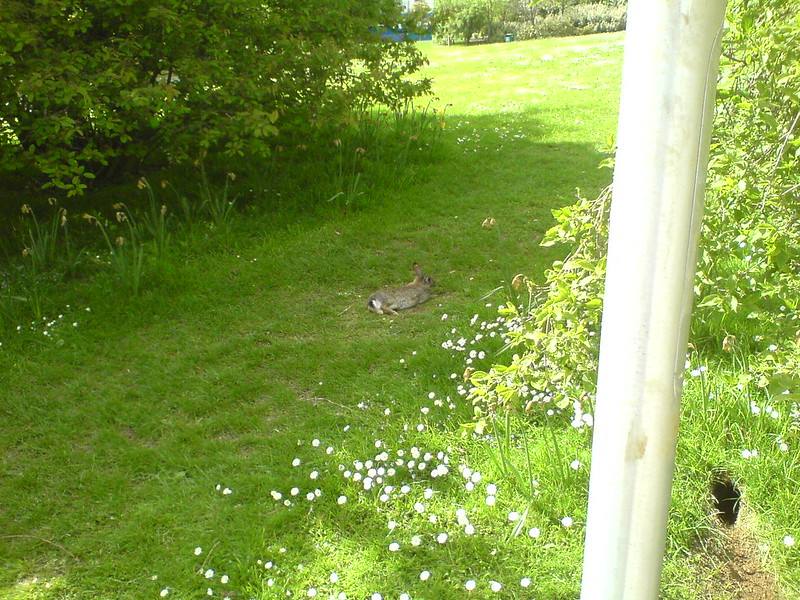
Image: “Rabbit and Burrow” by Stephen.G; Licensed under CC BY-NC 2.0.

“Cuddling up with a good book” is a phrase that invites images of coziness and comfort. It’s like being a rabbit holed up in your burrow, safe and secure. And we do like being comfortable. The same predictable genre or series over and over is a safe choice for when we get the itch to read something. But we are not rabbits. We humans benefit greatly from trying new things. Sometimes, we need to climb out of our burrows and take a close look at the landscape. A new book, a new genre, a new experience.

It’s not easy to do something we’ve never tried before, even with something as seemingly trivial as trying a new book. But it’s not trivial, is it? For some of us (myself included), it can be very daunting indeed. Reading is a time investment. Sinking time into something we might not even enjoy is time forever lost to us. Dare we take the risk?

I say we should. Life is short enough without limiting ourselves to a narrow view of it. Stories grow us and expand our perspective on the world. And who knows? You just might discover something new to love in literature. Trying new things is its own reward, and challenging ourselves to grow is always beneficial.

Rabbits are nervous, wary creatures. But rabbits can’t read and know the joy of encountering a new tale, of being lost in a new world of words. There are so many worlds out there, contained in the pages of a book or imprinted in the code of an eBook, and they’re all there for us to visit whenever we want. Why shouldn’t we try to explore as much as we can?

Alright, I’ll be honest. I’ve read books I didn’t enjoy. I’ve tried things recommended to me that I didn’t get much of a thrill doing. But, as they say, you never know until you try. On the other hand, I discovered some of my favorite franchises thanks to a friend or family member. And sometimes just from idle curiosity.

Whether you’re a writer or not, if you love literature, than never stop exploring its many corners. Leave your burrow and go out and see what there is to see!

Enjoying my blog? Don’t want to miss a single post? Subscribe for updates on when I post and follow my writing career, musings on fiction and storytelling, and reflections about life in general!