Writing About Tricksters

I’ve talked about tricksters before, and nine months later, I realize I have more to say.

Tricksters are fascinating to read about and to write about. They’re the weirdos who exist on the fringes of polite society. They’re the ones who can get away with what other people can’t. They’re stick their tongues out at the world and make the rules work for them, rather than working according to the rules.

Tricksters are fun. They’re fun because, deep down, don’t we all enjoy seeing someone willing to say what we’re all thinking and doing what we wish we could? Tricksters are escapist characters. They pay back the jerks and the bullies, outwit the corrupt authority figures, and flout senseless and silly rules. We all enjoy our Robin Hoods and B’rer Rabbits.

Writing tricksters is fun, too. Writing the character of Hermes for my books has let me see the world from a different point of view. I suppose writing any character gives you such insights, but seeing the world through a trickster’s eyes …

They’re a surprisingly philosophical bunch. As characters whose primary role is to push boundaries and alter the status quo, they are naturally prone to questioning the point of things. Why are things the way they are? Why should (or shouldn’t) they change? Tricksters are the ones who can call out others for their actions and make the rest of the cast pause and think. And that makes for interesting writing. The archetype can fill all sorts of niches, whether the villainous anarchist, the secret mentor, the voice of reason, or the snarky smart aleck who gets all the best lines.

And then, of course, there’s the trickster as protagonist. Tricksters can carry a story all by themselves. By their very nature, they’re proactive. They get things done. The can save the day (or ruin it – protagonist doesn’t mean hero). Since the archetype is almost always transgressive in some way, he or she gets to give society a kick in the pants, usually by acting so outrageously or cunningly that nobody knows what to expect next.

Speaking of cunning, writing tricksters has also taught me a bit about plotting out, well, plots. I sometimes feel like we live in an age of fiction where schemes and trickery must be excessively complex. Writers like to create grand conspiracies, when a trickster is just as likely to tap you on one shoulder while standing on the opposite side. Committing a trickster like Hermes to the page has shown me that deception can be much simpler. Tricking people doesn’t really seem to be that hard. Often, it’s just a matter of reading people and playing up to expectations. Or remembering that most people just want today to be the same as yesterday and aren’t expecting to be hoodwinked. Then again, written characters also behave according to how the author has plotted them to behave, so maybe I’m just blowing smoke.

So, tricksters upend the social order. They slip into different roles with ease. They’re many things to many people. What they aren’t is moral, upstanding role models.

But …

What if a trickster tries to be moral? Is such a thing possible? Trickery is lying, and lying is immoral. Can you reconcile the trickster archetype with the hero archetype? Transgressing social values and upholding them? Can the two be melded? A liar with a moral compass? Can a trickster follow right and reject wrong? Can anything truly good come from trickery?

Very interesting philosophical musings, indeed. I’m still messing about with such notions in my writing. My version of Hermes is developing as I go, revealing new facets of his personality as my works progress. Tricksters aren’t simple characters, after all.

If you just so happen to be enjoying my blog, feel free to subscribe. I post updates on my writing career, I muse over storytelling and fiction, and I reflect on the curious and wonderful things in life.

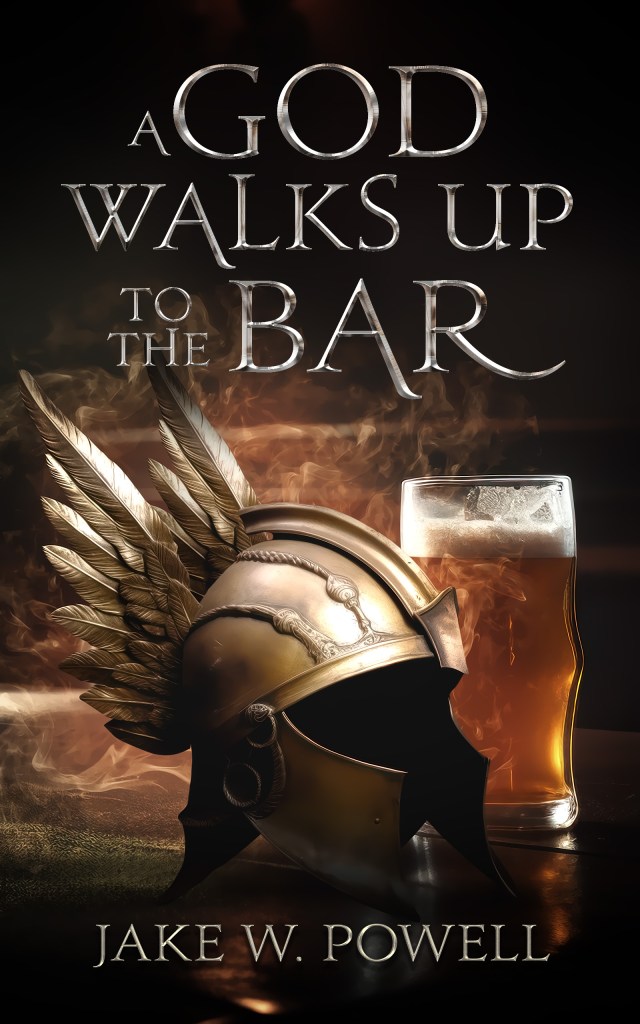
My first book, A God Walks up to the Bar, is available on Amazon.com. Witness the modern day adventures of the Greek god Hermes in a world much like our own – and with demigods, vampires, nymphs, ogres, and magic. The myths never went away, they just learned to move on with the times. It’s a tough job, being a god!

Delving into the Unreal: Fantasy and Social Commentary … or Lack Thereof

Don’t let the title scare you away. I’m not talking about specific politics or social issues. Rather, this is about how fantasy can be a tool for analyzing society undercover. That is to say, the fantasy genre gives authors a knack for talking about real life without actually talking about real life.

Now, the fantasy genre isn’t real, obviously. That’s kind of the point. However, fantasy’s detachment from reality can give it a very unique perspective on the world we do live in.

This comes, I think, from the fact that the fantasy genre can be used to observe elements of our world by substituting real groups, issues, events, or locations with fictional analogues. These same analogues allow readers to perceive them more objectively than if they were the real thing. Real-life issues tend to get our defenses up, consciously or not, and we let our own biases color our lenses. Fantasy equivalents are, well, fantasy, so we don’t view them in the same way, even if they are equivalent to the same social issues that otherwise get our hackles up. It’s a bit of a literary trick, really.

Whether or not a writer gets their message across to the audience depends on two things: One, whether the readers recognize the subtext, and two, whether they connect the subtext with the correct issue. Yes, we must trust our readers to infer what we want them to infer. And sometimes, alas, they don’t. All writers reach a point where their authority dies, and their readership draws its own conclusions independent of the author’s intent. So, you might very well have been writing a hard-hitting social critique using elves and pixies, but the audience comes away thinking it was about the virtues of natural conservation rather than the consequences of war.

On the other hand, maybe your story has no message. You just wanted to write something fun and light. Yet, for some reason, readers are convinced there’s a hidden meaning buried in your writing. Tell me, dear reader, what is the message of Little Red Riding Hood? Is it just a story about a girl and her grandma who are eaten by a wolf, then saved by a woodsman, end of story? Or is it about:

The dangers of nature

Man’s triumph over nature

Listen to your parents

Pay attention to the task at hand

Don’t trust strangers

Rebirth from death into a better person

A metaphor for puberty

A metaphor for sexual predators

A metaphor for rape

A metaphor for how people read sex into everything

Axes are useful for killing animals

If you think a wolf looks like your grandmother, you really should buy glasses

And so forth.

Maybe we don’t really know for sure? Maybe there is no analogy, but there is applicability. Applicability is a very different animal. It is the reader’s independence of the writer and ability to view the story through their own lives and beliefs. In short, they see the story as matching their own notions.

Or maybe, we’re just thinking too hard about it all.

If you just so happen to be enjoying my blog, feel free to subscribe. I post updates on my writing career, I muse over storytelling and fiction, and I reflect on the curious and wonderful things in life.

My first book, A God Walks up to the Bar, is available on Amazon.com. Witness the modern day adventures of the Greek god Hermes in a world much like our own – and with demigods, vampires, nymphs, ogres, and magic. The myths never went away, they just learned to move on with the times. It’s a tough job, being a god!

Image: “Dave Checking out the Perseid Meteor Shower at 10,000 feet“; Dave Dugdale; Licensed under CC BY-SA 2.0.

Legacy: What We Are Remembered For

As we get older, we start having deep thoughts. Questions run through our minds, questions like, “What will I leave behind when I’m gone?” and “How will people remember me?” With age comes an acute awareness that our time on Earth is finite, and with that come musings on what our legacy will be. What mark will our lives leave on the world? Will we, to get to the heart of things, have done anything that mattered?

Legacy is a loaded word. It’s a word associated with empires and rulers. It invokes monuments that endure for centuries. Legacies are connected to greatness. The greatest men and women of history, whether good or bad, are remembered by all.

And look at what society says to us. We must work hard to leave our own mark. We must strive to improve the world, to improve society, to make positive changes, to “be the change you want to see.” Or even, just to leave the world a little better than when we found it. A burden, one might say. It is something imposed on people from a young age to aspire to greatness.

I say it’s a distraction from what’s truly important. Today’s great accomplishments are tomorrow’s misguided attempts. We simply don’t know how we will be remembered, or by whom, or for what. That guy you accidentally cut off on the freeway is going to remember you very differently than your favorite uncle who loves the sweater you bought him for Christmas. And that piece of litter you picked up in the park without a second thought might inspire some passing child to pursue a career in conservation. The door you held open for an old lady might have given her new hope in life.

Farfetched, you say? What do we truly know about what will affect others the most? Media tells us that big causes and organizations are what change the world. But not everyone is going to make a mark on that scale. What does that tell us? That those who don’t measure up to vaguely defined goals are failures?

Right, right, this is all very deep and philosophical, but maybe you’re wondering what this means for you. Or you’re wondering who this pretentious nit with a blog is, anyhow. Well, the long and short of it is: Your legacy is everything you do, big and small. And the small things, in my experience, tend to matter more than the big.

We’re not all going to be famous when we die. We’re not all going to found a world-spanning charity or find the cure to a terrible disease or invent a new technology. But we are all capable of acts of kindness. Compassion and sympathy go a long, long way. There might not be any prizes or awards, and nobody’s going to erect a monument for a gentle word, so maybe it doesn’t appeal to everyone. At least, until you need a kind word yourself on a bad day.

We can’t control our own legacies. We can maybe dictate what’s written on our tombstone, and will our possessions to others, but how we truly affected the world – for better or ill – is a far more complex thing that can’t be summed up in a few brief achievements.

Legacies shift and change and what we consider our magnum opus might be forgotten within a few years. So, if you ever find yourself getting worried over how people remember you, just relax. Just do your best and be kind. I suspect we’d all be surprised if we were aware of the things we did that truly mattered most to others.

If you just so happen to be enjoying my blog, feel free to subscribe. I post updates on my writing career, I muse over storytelling and fiction, and I reflect on the curious and wonderful things in life.

Image: “The mountains are calling and I must go. John Muir” by blmiers2; Licensed under CC BY-NC-SA 2.0.