Writers, Mix It Up

I’ve started on the third installment in my urban fantasy series. Everyone writes at different speeds, and I’m somewhere in the middle of the pack, I think. I published my first book in August 2023 and published my second in January of this year. I hope to finish this third installment by the end of next year.

Maybe I am a slow writer, after all, but when you have a job and other commitments, you can’t be a writer 24/7, unfortunately.

Anyway, I’m happy with my work, but after finishing this current project, I think I’ll take a break from Hermes’ adventures. I’m in the mood to try something new. And that’s healthy, I’m finding. Writing about the same thing is kind of like exercising. If you keep exercising the same muscle group over and over, you end up hurting yourself rather than strengthening yourself.

So, I want to mix it up. I want to write different stories after finishing book #3 and stretch my talents. Broaden my horizons and various other cliches. It’ll be fun, and it’s good practice to try something new.

***

My book, The Trickster’s Lament, is currently available on Amazon in both Kindle and paperback format.

“Hermes is not having the best time. He walks a fine line, and his duty as messenger of Olympus weighs heavily on him. Being a god in the modern age means living in a world that no longer believes in gods. How much can one deity accomplish when no one respects him anymore? And why do his instincts tell him that he, the son of Zeus, is losing favor with his own family?

Tensions abound. The upstart Young Gods play dangerous games using entire cities as their boards. Formless monsters strike from the nighttime shadows, terrorizing hapless mortals. Agents of rival pantheons scheme to thwart Olympus’ designs. In the thick of it all, Hermes does what he does best: trick, lie, and cheat his way to victory.

Many thanks for visiting my blog. I post updates on my writing career, I muse over storytelling and fiction, and I reflect on the curious and wonderful things in life.
How to Write the Best Novel Ever

Looking for how to be the greatest author who ever lived? Need some quick and easy advice on the quick and easy way to become rich and famous? Just follow these ten tips without question, and you will become an author that nobody will forget! Absolutely not satire!

  1. Plagiarize other writers. Sharing is caring. Besides, they did the really hard part, so why not be efficient? If they didn’t want people using their stuff, they wouldn’t have made it public, now, would they?
  2. Use the most complicated, flowery language you can. Pull words from the dictionary with at least four syllables. Use really big words never used in casual conversation and sprinkle them liberally throughout your story. That way, everybody knows how smart you are.
  3. Don’t use consistent characterization. People aren’t consistent in real life, so why should they be in fiction? Don’t worry if your protagonist acts contradictory to established personality and goals. Just have them do whatever with no real rhyme or reason. It’s not like readers actually care about that sort of thing.
  4. Write maybe once or twice a month. Why stress yourself out? Write whenever you feel like. After all, you can only write well if you’re “in the zone.” Writing every day regardless of how you feel is just plain silly and definitely bad for your skin.
  5. Editing is a waste of time. Reviewing your work for typos, story flow and all that other stuff is dumb. Why compromise your original vision by changing all your hard work? Even worse is submitting your novel to editing by other people. Didn’t your parents teach you to never trust strangers?
  6. Novels are only good if they have lots of symbolism. They taught us that in high school literature class, so it must be true. Symbolism is way more important than storytelling, so make sure everything in your novel is symbolic: the color of people’s clothes, their names, their hairstyle, and especially innocuous, minor details that are otherwise irrelevant to the story. Everything is symbolic and has Deep Meaning™.
  7. Constructive criticism is dumb and bad and should be ignored. If someone doesn’t like something in your book and suggests how to improve it, they’re just jealous and probably want to sabotage you. Surround yourself with people who compliment everything you do and listen to them exclusively. But remember, per tip #5, don’t let them actually touch your book.
  8. Bigger books are better, so write as many words as you can and don’t cut any out. Refer to tip #2. All the hard copy versions of the world’s greatest novels are big enough to be used as doorstoppers. So, obviously, you want to write a huge book with lots of words. NEVER use 3 words when you can use 30.
  9. Draw your own cover art. Why bother letting someone else draw your vision? Save time and money by drawing the art yourself! You know what you want, and it’s guaranteed to be memorable.
  10. Include a gimmick. Everybody writes the same old boring way, so make yourself stick out. Write only in present tense, or make each character’s lines a different color, or write the pages out of order, or write sentences backwards. People like that kind of fun and will definitely appreciate all the extra effort you put in.

Ultimately, it is up to you on whether to make the correct decision and follow this free advice. Remember, this is ABSOLUTELY not satire designed to point out things that can hinder a book’s quality or a humorous article designed to make people laugh. This is absolutely serious stuff and following these steps will make you the best writer in the history of the universe and rich enough to buy a whole nation. Everyone will love and adore you forever as you achieve authorial apotheosis.

I repeat, this is in no way satire, and taking this advice seriously will not lead to you angrily arguing with people over your book’s reviews on Amazon.

And no, I am not crossing my fingers behind my back. My hand is itchy.

***

My new book, The Trickster’s Lament, is currently available on Amazon in both Kindle and paperback format.

“Hermes is not having the best time. He walks a fine line, and his duty as messenger of Olympus weighs heavily on him. Being a god in the modern age means living in a world that no longer believes in gods. How much can one deity accomplish when no one respects him anymore? And why do his instincts tell him that he, the son of Zeus, is losing favor with his own family?

Tensions abound. The upstart Young Gods play dangerous games using entire cities as their boards. Formless monsters strike from the nighttime shadows, terrorizing hapless mortals. Agents of rival pantheons scheme to thwart Olympus’ designs. In the thick of it all, Hermes does what he does best: trick, lie, and cheat his way to victory.

He may be disrespected. He may be kicked about. He may even be falling out with his pantheon. But Hermes is a trickster. He knows how to play dirty in a world that doesn’t play fair. But though he can best man, beast, and god, he isn’t prepared for his wiliest opponent yet: his own conscience.”

Many thanks for visiting my blog. I post updates on my writing career, I muse over storytelling and fiction, and I reflect on the curious and wonderful things in life.

Dreams in Life

We all have dreams. We have desires and goals we want to achieve. It might be something small or something grand, something that encompasses a single week or a whole lifetime. But we all have something we dream about.

How far do you go to achieve your dream? What are you willing to do? And what are you willing to sacrifice? Do you think about it all day long, but do nothing? Or do you work a little bit towards it every day?

How much do you dedicate to your dream? How much do you sacrifice? And when is the sacrifice too great? When does the dream become a tyrant that destroy your life rather than enrich it?

What place do dreams have in our lives? Do we seek them out at all costs? Or do we know when there are things even more important? Sometimes, we must not sacrifice for the dream, but sacrifice the dream itself. Life goes on. We go on.

But we never stop dreaming.

***

My new book, The Trickster’s Lament, is currently available on Amazon in both Kindle and paperback format.

“Hermes is not having the best time. He walks a fine line, and his duty as messenger of Olympus weighs heavily on him. Being a god in the modern age means living in a world that no longer believes in gods. How much can one deity accomplish when no one respects him anymore? And why do his instincts tell him that he, the son of Zeus, is losing favor with his own family?

Tensions abound. The upstart Young Gods play dangerous games using entire cities as their boards. Formless monsters strike from the nighttime shadows, terrorizing hapless mortals. Agents of rival pantheons scheme to thwart Olympus’ designs. In the thick of it all, Hermes does what he does best: trick, lie, and cheat his way to victory.

He may be disrespected. He may be kicked about. He may even be falling out with his pantheon. But Hermes is a trickster. He knows how to play dirty in a world that doesn’t play fair. But though he can best man, beast, and god, he isn’t prepared for his wiliest opponent yet: his own conscience.”

Many thanks for visiting my blog. I post updates on my writing career, I muse over storytelling and fiction, and I reflect on the curious and wonderful things in life.

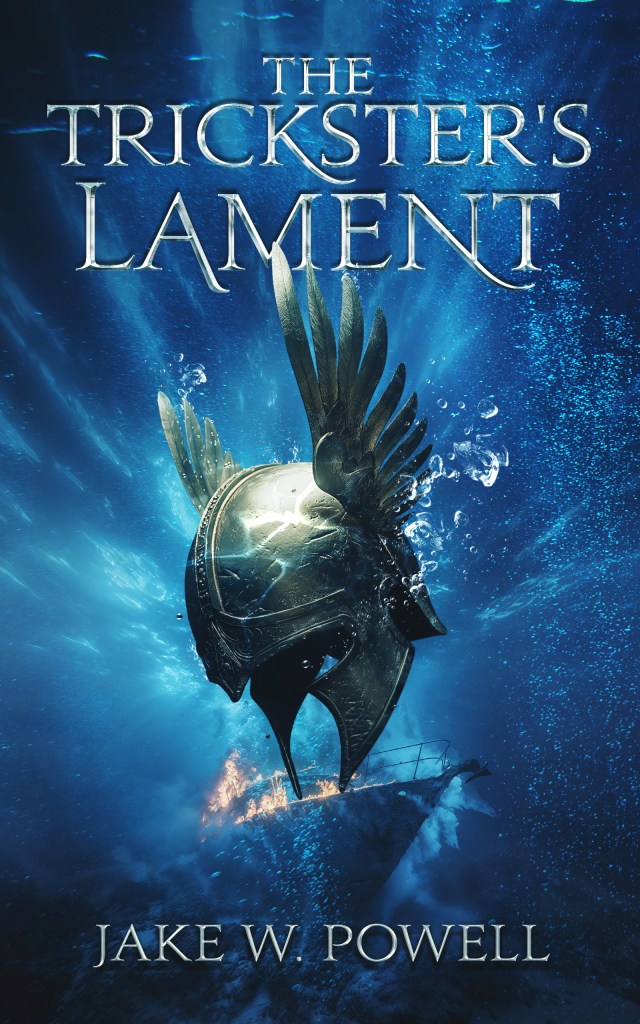
Cover Art for The Trickster’s Lament

It’s my pleasure and privilege to reveal to you the title and cover of my soon to be published second book, The Trickster’s Lament.

Per the synopsis:

“Hermes is not having the best time. He walks a fine line, and his duty as messenger of Olympus weighs heavily on him. Being a god in the modern age means living in a world that no longer believes in gods. How much can one deity accomplish when no one respects him anymore? And why do his instincts tell him that he, the son of Zeus, is losing favor with his own family?

Tensions abound. The upstart Young Gods play dangerous games using entire cities as their boards. Formless monsters strike from the nighttime shadows, terrorizing hapless mortals. Agents of rival pantheons scheme to thwart Olympus’ designs. In the thick of it all, Hermes does what he does best: trick, lie, and cheat his way to victory.

He may be disrespected. He may be kicked about. He may even be falling out with his pantheon. But Hermes is a trickster. He knows how to play dirty in a world that doesn’t play fair. But though he can best man, beast, and god, he isn’t prepared for his wiliest opponent yet: his own conscience.”

Look forward to The Trickster’s Lament release on Amazon.com later this month!

Many thanks for visiting my blog. I post updates on my writing career, I muse over storytelling and fiction, and I reflect on the curious and wonderful things in life.

Open a Book

Open a book, go on an adventure. You don’t leave home, you don’t walk a road. But you go on a journey just the same, to places near and far, betwixt and between.

The past and future, earth and space, ruins and utopias, worlds both alien and familiar. The lives of great kings and scientists and heroes stretch out before you. Hear their words, see inside their minds.

Indeed, you go everywhere, do everything, see everyone. A universe of words is revealed to you. Travel here and there, hither and thither, as much as you can stand.

And at the end of the journey, you come back home, and realize you never left your chair.

Such is the wonder of opening a book.

Many thanks for visiting my blog. I post updates on my writing career, I muse over storytelling and fiction, and I reflect on the curious and wonderful things in life.

Putting Stories into the World and Learning to Let Them Go

Stories are precious things, especially to those who write them.

We write stories for all sorts of reasons: to tell a message, to work through a grief or hardship, as a gift for friends and family, or simply for the sake of doing so. Regardless of why, stories are very personal things.

And we all have a vision for our stories. We see it for what we want it to be. We see it all – or so we think. And then the moment of truth comes: time to publish. It’s out there, others are reading it, and they don’t see what we saw.

That’s applicability for you. We plan and plan, but readers make the story into something else, because they see themselves in the story. We all see ourselves, and so the narrative comes into focus through the lenses of our own lives.

It’s hard to let go of what we create, and even harder to hear others’ opinions of our work. They claim to understand and comprehend the deep analogies and whatnot, and we tell ourselves, “That’s not what I meant at all!”

It’s life, I suppose. And it’s something all writers will have to deal with sooner or later. But it’s not all bad. The words of readers reveal other lenses, other views and new possibilities. To be a writer is to spend so much time locked up inside yourself. Letting your story go out into the world allows you to see beyond your own mind.

Many thanks for visiting my blog. I post updates on my writing career, I muse over storytelling and fiction, and I reflect on the curious and wonderful things in life.

The Curious Art of NOT Writing the Story

I’m always thinking about writing and how to describe it to people who don’t write. It’s something that is both simple and complex to describe, because like most kinds of art, writing refuses to be boxed into simple definitions. Putting words on paper is what writing involves, but it is not what writing is.

One thing that writing is is the art of cutting away the unnecessary. Putting in too many or too few words is easy; adding just enough is hard. Authors spend their whole lives perfecting that technique.

And then my brain shifts gears and starts thinking: Can the same be said of stories in general? Everyone has at least one good story in them, but then there are those who have dozens, even hundreds of stories. Which ones do we tell, and which do we leave unsaid? In other words, which are the ones worth telling the world?

There are stories published that perhaps should not have been. On the other hand, there are also books written that will never see the light of day, maybe first attempts that authors are content to let sit in their drawer undisturbed (I’m not one of them. I published my first book, for better or for worse. You be the judge).

Some stories are complete in themselves, but get sequels that no one asked for. And some … This may be a strange thing to say, but I think that some stories can stay cozily confined within our own thoughts or just typed out on our computers and taken no further. Not every story needs to be told. But writers do need to write. It’s a hobby as well as a career.

Shifting through all the possibilities, the tons of tales that we think up, and deciding which we will commit our time to writing and which we must pass up on. That’s an art unto itself.

Many thanks for visiting my blog. I post updates on my writing career, I muse over storytelling and fiction, and I reflect on the curious and wonderful things in life.

Stories and Lies

Interesting thought for the day: All storytellers are liars.

Authors, poets, filmmakers, artists … We make things up. We show things to audiences that aren’t real.

But we’re liars who admit we’re liars. The things we tell in our stories are acknowledged as fiction. That’s why it’s called “fiction” and not “deception.”

There is an unspoken agreement between storyteller and audience: I will tell you something untrue, and you will treat it as something true until the story is ended. Audiences know that they are witnessing a fabrication, and so it is acceptable.

But stories do discuss real things – people, events, feelings, ideas, places – although the story itself isn’t true. Even if it is retelling a piece of history, it’s prefaced by the words “Based on a true story.”

Yet if it presents itself as real history, but isn’t, then it’s an actual lie.

Stories are lies that know they are lies and willingly admit it. And so they aren’t true lies, because they don’t pretend to be anything else.

Many thanks for visiting my blog. I post updates on my writing career, I muse over storytelling and fiction, and I reflect on the curious and wonderful things in life.

A Story’s Skin: Setting Limits for Yourself as a Writer

We as human beings don’t like to hear about “limits.” We want to do our own thing without anything holding us back. But consider the breadth of human imagination and all the choices you have as a writer and ask yourself, “How do I even know where to start with my story? Where do I go with it? How do I keep it organized?”

The truth is, stories need boundaries. That’s the difference between a story and rambling. Stories have a point, and they stick to that point. Telling a story about shopping at the grocery store is not going to include what your kids did at school that day. And a story about grocery shopping isn’t going to take as long to tell as, say, the history of Great Britain. Different stories have different limits. But they do need limits.

Some of us like to meander. We have so many ideas and we want to shove them all in. It’s fun to type away at your computer and watch the words flow. But knowing when to stop – ah, there’s the rub.

Here’s a metaphor for you: Imagine your story is like the human body. It’s made of many different complex parts. But all those parts are able to stay together and function properly because of the skin. Skin covers the body and keeps it in place. If we didn’t have skin, we’d just sort of … ooze all over. And who wants that?

It’s the same with writing. You have an idea, or two or three. Great! Now stop. Organize those ideas, don’t add to them. Stories have a beginning, middle, and end. A triggering event, rising action, climax, and epilogue. In other words, stories have structure. And structure, by its very nature, is defined by boundaries and restrictions. They aren’t bad things. They’re necessary for anything to make sense and have form.

Outlining your story ahead of time is a great way to know what your story is about, to know what to put in and what to hold back. Yes, things will shift and change as you go through drafts. But don’t keep adding and adding and adding. Know when to stop and refine what you already have. Put a skin on your story.

If overwriting is a major problem for you, then put a limit on your word count. Something miraculous occurs when you suddenly have a ceiling you can bump your head on.

When we are deprived of the freedom to do everything, we discover a new well of creativity. We choose our words more carefully. We find focus. Words matter more, so we experiment until we find the right ones. We cut away cumbersome paragraphs and sentences. Knowing there’s a cap on our writing makes us pay extra special attention to dialogue, plotting, pacing, and everything else.

Limits are good. They force us to be better writers.

Many thanks for visiting my blog. I post updates on my writing career, I muse over storytelling and fiction, and I reflect on the curious and wonderful things in life.

Just Like Ping-Pong: Crafting Conflict Between Hero and Villain

Let’s assume for a moment that we’re talking about a story featuring classic good versus evil. There’s a hero and a villain. They struggle with each other for victory.

What makes the story good? Lots of things, but interest is a biggie. We like interesting stories. Inversely, we avoid boring stories. What makes an interesting story? Conflict. The hero has to struggle to reach her goal. She must overcome obstacles great and small, and in so doing display character growth and maturity. At the heart of that struggle is their nemesis, the story’s villain.

Good villains go through their own struggles. Does that surprise you? The hero isn’t the only one who must overcome. After all, the best villains are the heroes of their own stories.

Like heroes, villains have goals. These goals run directly counter to the hero’s, hence why they clash. Now, a villain may be stronger than the hero, or smarter, or generally more intimidating. Which is great! It makes the hero’s victory all the sweeter. But if the villain always wins and succeeds in all their schemes right up until the last hour when the hero finally, conclusively defeats her opponent, well … It’s not a bad thing, per se, but it’s a tad predictable, and rather repetitive.

But what if the conflict becomes a ping-pong match?

The hero wins one round. The villain wins the next. They trade blows and barbs; they’re evenly matched up until the last. Now that’s a good story! It keeps the audience on their toes. You don’t know what’s going to happen next. You’re dangling in delicious suspense. “What if?” you ask yourself. What if this story doesn’t end happily? What if the bad guy wins? After all, the villain is a match for the hero. It’s just like ping-pong, which can get really intense if both competitors are skilled.

Okay, we know that good overcomes evil 90% of the time, but the illusion of doubt is introduced. Disbelief is suspended. We are caught up in the moment of the story.

Meaningful conflict is driven by a question that any good story should prompt in the audience: What happens next? It doesn’t matter if deep down we know the answer. The question should still be whispered on our lips.

Many thanks for visiting my blog. I post updates on my writing career, I muse over storytelling and fiction, and I reflect on the curious and wonderful things in life.