Just Like Ping-Pong: Crafting Conflict Between Hero and Villain

Let’s assume for a moment that we’re talking about a story featuring classic good versus evil. There’s a hero and a villain. They struggle with each other for victory.

What makes the story good? Lots of things, but interest is a biggie. We like interesting stories. Inversely, we avoid boring stories. What makes an interesting story? Conflict. The hero has to struggle to reach her goal. She must overcome obstacles great and small, and in so doing display character growth and maturity. At the heart of that struggle is their nemesis, the story’s villain.

Good villains go through their own struggles. Does that surprise you? The hero isn’t the only one who must overcome. After all, the best villains are the heroes of their own stories.

Like heroes, villains have goals. These goals run directly counter to the hero’s, hence why they clash. Now, a villain may be stronger than the hero, or smarter, or generally more intimidating. Which is great! It makes the hero’s victory all the sweeter. But if the villain always wins and succeeds in all their schemes right up until the last hour when the hero finally, conclusively defeats her opponent, well … It’s not a bad thing, per se, but it’s a tad predictable, and rather repetitive.

But what if the conflict becomes a ping-pong match?

The hero wins one round. The villain wins the next. They trade blows and barbs; they’re evenly matched up until the last. Now that’s a good story! It keeps the audience on their toes. You don’t know what’s going to happen next. You’re dangling in delicious suspense. “What if?” you ask yourself. What if this story doesn’t end happily? What if the bad guy wins? After all, the villain is a match for the hero. It’s just like ping-pong, which can get really intense if both competitors are skilled.

Okay, we know that good overcomes evil 90% of the time, but the illusion of doubt is introduced. Disbelief is suspended. We are caught up in the moment of the story.

Meaningful conflict is driven by a question that any good story should prompt in the audience: What happens next? It doesn’t matter if deep down we know the answer. The question should still be whispered on our lips.

Many thanks for visiting my blog. I post updates on my writing career, I muse over storytelling and fiction, and I reflect on the curious and wonderful things in life.

Stop Being Bad: The Redemption Arc in Storytelling

The story of the redeemed villain is a common and provocative trope in storytelling. It’s always fascinating to witness how a thoroughly evil and vile figure can turn around and repent of their ways. We like to see these tales play out and watch what happens next. It appeals to us.

Maybe the villain is likeable enough that we don’t want to see them die, or maybe we even see a little bit of ourselves in there, and hope that their redemption means there’s hope for us, too. Whatever the reason, a villain’s redemption is a major story beat, and should be treated as such. Which, in turn, means that writers should seriously consider it before going through with it. Is it the right move for the story? Is the villain truly redeemable, that is to say, is it a logical and fitting step in their growth as a character? Are they willing to seek redemption? Most importantly, can they be redeemed in a way that the audience finds natural and believable?

It’s easy to fall in love with a good villain and not want them to die. So, some writers just … give them an out. The villain evades consequences, sobs a few tears, gives a dramatic monologue, and skips on over to the side of good. And are welcomed with open arms. But is that how it would actually play out in the context of the world you’ve written? How bad is your bad guy? Did they blow up a planet, or just steal a few pies? If it’s the former, do you really expect them to be immediately welcomed and trusted by the heroes?

Don’t get me wrong, I’m not talking about a villain-hero team-up. Sometimes, good guy and bad guy have to work together, usually against a worse bad guy, but the villain remains clearly villainous, just currently motivated by shared interest. To be redeemed, a villain must be penitent. And to be penitent, a villain must truly feel remorse. And in feeling remorse, a villain must show a change in action and motivation.

A redemption arc is character development. The character will not be the same person at the end of it. Indeed, we writers should seriously consider this fact. If the villain was likeable because of their villainy, then redeeming them may in fact hurt them as a character. They’re no longer a villain. Will that take away what made them interesting and engaging?

On the other hand, you could have the villain redeemed through the classic act of self-sacrifice. It worked for Darth Vader, didn’t it? But, and hear me out, I think this is a bit of a cheat. Imagine how different things would have been for this classic movie villain if he had survived and had to stand trial before the people whose friends and family he had slaughtered. He would have to face his daughter Leia over the destruction of Alderaan. He would deliver himself into the hands of the Rebel Alliance he had hunted down for the whole trilogy. He’d have to live with the memories of his crimes. He’d have to do more than gasp a few words to his son as he lay dying to convince us he was truly changed. He would have to make his redemption stick. An interesting thought, no?

Redemption arcs are fascinating. They offer an incredible opportunity to explore facets of a character that usually aren’t. How and why does the villain do what they do? What would make them stop doing it? Can they stop? Do they have doubts? Do they value something greater than their current goals that they would give up their desires for? These are the sorts of questions that can help you figure out if your villain is a candidate for a moral turnaround.

The most important question to ask is: Does it serve the story? We are talking about fictional characters, after all. They’re not real people, they’re figures in a narrative that we as writers have the responsibility and privilege to manage and direct. Redemption and repentance in real life is quite another thing entirely, even if they do inspire our work. Real life is fuzzy. We can’t truly know other people’s motivations. But we can know exactly what motivates the characters we write, and so we can answer this question with confidence: Can my villain stop being bad?

If you just so happen to be enjoying my blog, feel free to subscribe. I post updates on my writing career, I muse over storytelling and fiction, and I reflect on the curious and wonderful things in life.
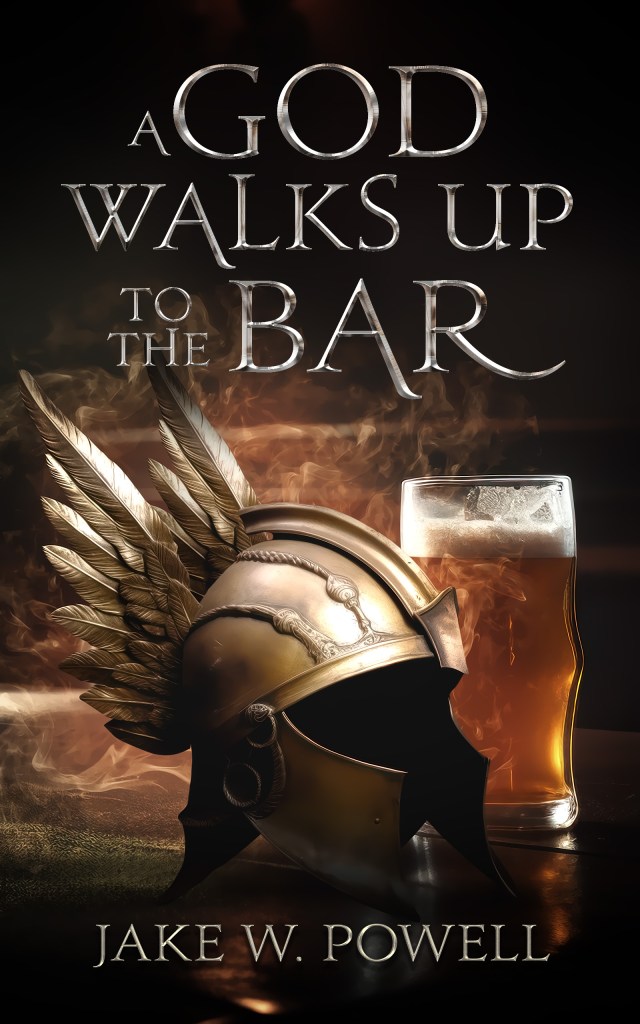
My first book, A God Walks up to the Bar, is available on Amazon.com. Witness the modern day adventures of the Greek god Hermes in a world much like our own – and with demigods, vampires, nymphs, ogres, and magic. The myths never went away, they just learned to move on with the times. It’s a tough job, being a god!

Image Source: “THE Supervillain’s Lair” by nicknormal; Licensed under CC BY-NC-ND 2.0.

Writing Jerks

Why do jerks seem worse than villains? Villains are grand and powerful and fierce and evil. They deserve our disdain. But jerks are just plain petty. What’s worse? A dictator bent on conquering a nation, or a man who keys your car because you bumped him in the parking lot? Well, the former, obviously, but the latter certainly seems to steam people a heck of a lot more.

But I’m not here today to talk about “why’s,” but rather “how’s.” Namely: How do you write a jerk protagonist so that he’s likeable?

Think about it for a moment, writers. There are plenty of villains that people like. I’ve even written about it in a previous post. Mass murderers? Evil tyrants? Amoral thieves? They’ve all got fans. They’ve all got that special something called charisma. People will forgive a lot if you have charisma.

But jerks? They’re personal to the audience. We may never have met a murderer or a dictator (hopefully), but we all know a few knuckleheads with attitudes who stoop to the lowliest of cheap shots. Spend a week in customer service and you’ll meet jerks on the regular. They come in all flavors, but they all have something in common.

THEY AREN’T LIKEABLE.

Thus, going back to my first question, is there a way to write a protagonist who is unpleasant, rude, and otherwise just plain mean, and still make that character someone the audience can enjoy? Well, yes and no. The main thing about writing jerks is that if you keep them that way from start to finish, chances are you’re shooting yourself in the foot.

Consider a classic example of jerkdom in literature: A Christmas Carol’s Ebenezer Scrooge. A miserly, heartless, soulless businessman who has no mercy or pity for the poor. He’s on the up-and-up – he’s an honest man in the original story, believe it or not – but he has no redeeming traits. At first. The entire story is about Scrooge’s character development into a better person. And that’s the key to writing jerks: They shouldn’t still be jerks by the end of the story.

Side characters can stay jerks. Antagonists, of course, can remain jerks. But the protagonist should not remain static at the best of times. They evolve and mature. And if they start out as jerks and bullies, then they should show some sort of marked improvement by story’s end. Less of a jerk, kinder, more patient. Like Scrooge, they should learn something. There is nothing stopping you from writing a protagonist who remains the same come the conclusion, but if they were nasty and unlikeable to begin with, you risk leaving your audience with a sour last impression.

On the other hand, maybe the jerk not changing is the point. Maybe this is a more cynical piece, an introspective look into what makes a meanie tick – or maybe it’s just a comedy. Well, there is a way to make the audience side with the jerk, and that’s to introduce an even bigger jerk to square off against. Have a protagonist who’s belligerent and petty? Bring in someone else who’s even more so. It worked for British sitcom Fawlty Towers. Basil Fawlty is a Class-A Jerk through and through, but he frequently dances with people even worse than he is. See for yourself.

We like someone to root for, you see. If we’re given two flavors of unpleasantness, we’re naturally going to compare them. And if one is slightly less bad than the other, we’ll favor that one and despise the other. The lesser of two jerks, if you will.

There are those rare occasions where your story doesn’t require that the protagonist change for the better, or circumstances dictate that there isn’t a worse character to compare against. So, what to do? Well, you can make the jerk empathetic. That’s not saying you give the protagonist the capacity for empathy, but rather that you give them traits the audience can relate to. Humanize them a bit, just a little, so that they’re a tad more understandable. Maybe they are the way they are because of a bad childhood, or ill health, or they’re just plain unlucky.

Let us consider the case of Disney’s Donald Duck. He’s … not the most pleasant individual, especially in his 1930s and 1940s cartoon shorts. But oh, boy, does he have bad luck at every turn. Nothing turns out right for him. No wonder he has such a chip on his shoulder. If we had the rotten fortune that Donald does, we’d be short-tempered, irritable scoundrels, too.

So, there you have it. My two cents on writing jerk protagonists. It can be done. It has been done. You can do it, too.

If you just so happen to be enjoying my blog, feel free to subscribe. I post updates on my writing career, I muse over storytelling and fiction, and I reflect on the curious and wonderful things in life.

Villains: Why We Love Such Hateful Scoundrels

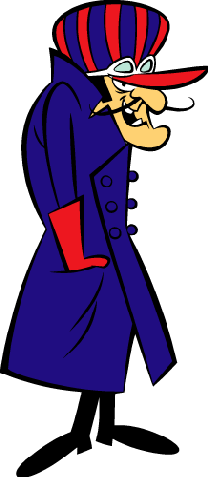
Image: Dick Dastardly, doomed to villainy from the day he was named. Wacky Races promotional material, courtesy of Wikipedia, fair use

Last week, I talked about antagonists and their importance to a good story. If you read it, you may have noted that I said antagonists are not necessarily villains. Antagonists are just a roadblock to the hero’s goal.

Today we are going to talk about villains.

What’s the difference? Simple. Villains are EEEEVVVIIILLL. They’re monstrous, greedy, murderous, and rude. They slaughter villages, rob innocents of all their possessions, conquer nations, and say really mean things. We love to hate them. We love villains. Why do we love villains? Why like something so vile?

That question gave me some food for thought, and here’s what I’ve come up with.

1: Villains are charismatic.

Darth Vader knows how to make an entrance. He strides down a hallway littered with corpses, black cape flourishing behind him. His breath is a low mechanical wheeze, and his face is concealed behind a skull-like mask. He casually strangles a rebel while interrogating him, takes charge of every situation, strangles fellow Imperials from a distance while cracking morbidly dry jokes, and in general is a terrifying threat to everyone he meets.

He’s a monster. But he’s a cool monster. He gets the cool armor, the cool lines, every appearance is accompanied by John Williams’s Imperial March, and if he’s not the mascot of the Star Wars franchise, he’s pretty dang close. Why? Because Vader has charisma. He’s memorable, he has stage presence, he has the physical acting of David Prowse and the rumbling baritone of James Earl Jones. Who doesn’t know who Darth Vader is? And how many little kids dress up as this cold-blooded mass murderer every Halloween? Oh, bitter irony! But such is the effect of a charismatic villain.

2. Villains are interesting.

We like to watch or read about interesting people. Ergo, we like to watch or read about interesting villains. Villains with unusual motives, or memorable quirks, or empathetic traits. We like villains who stick out from the mass of mundanity. We like villains who can keep us invested in the plot.

Take old Norman Bates, for example. He’s a psychotic serial killer. Well, nothing new there, fiction loves its depraved killers. But he’s a hotel owner with a split personality, that of his deceased domineering mother, who takes control and kills any woman that Norman expresses an interest in. Well, that’s certainly one form of interesting. What’s more, half the plot of Alfred Hitchcock’s Psycho follows him as the main character. And we learn that, sick as he is, he is a tad pitiable as well. That makes him, dare I say, quite interesting to watch.

We generally consume fiction for the purpose of being entertained. And a key part of entertainment consists of simply holding our attention. The best villains grab our attention and never let go. We look forward to seeing them onscreen, especially if they end up more endearing than the cardboard heroes.

3. Villains drive the plot.

Maybe, on some unconscious level, we like villains because we recognize how necessary they are. Villains, like all antagonists, drive the story. If they don’t start it, they at the very least keep it going. Conflict is key, and villains by their nature stir up conflict.

Take the Evil Queen from Disney’s Snow White and the Seven Dwarfs, for instance. There would be no story if she hadn’t gone up to her magic mirror and asked “Who is the fairest of them all?” And then tried to kill Snow White when she learned the girl was fairer than her. Then Snow White wouldn’t have ended up in the dwarfs’ cabin, and the Evil Queen wouldn’t have pursued her disguised as an old hag, and we wouldn’t have had the dwarfs’ climactic scene chasing her up the cliff during a thunderstorm.

There would be no movie. And we would not be entertained.

The gods and beings of ancient myth never went away. They just moved on with the times.

My book, A God Walks up to the Bar, is currently available on Amazon.com. Venture into the world of the Greek god Hermes, a world filled with demigods, vampires, nymphs, ogres, magic, and trickery. It’s a tough job, being a god!

Enjoying my blog? Don’t want to miss a single post? Subscribe for updates on when I post and follow my writing career, musings on fiction and storytelling, and reflections about life in general!