The Trickster’s Lament preview

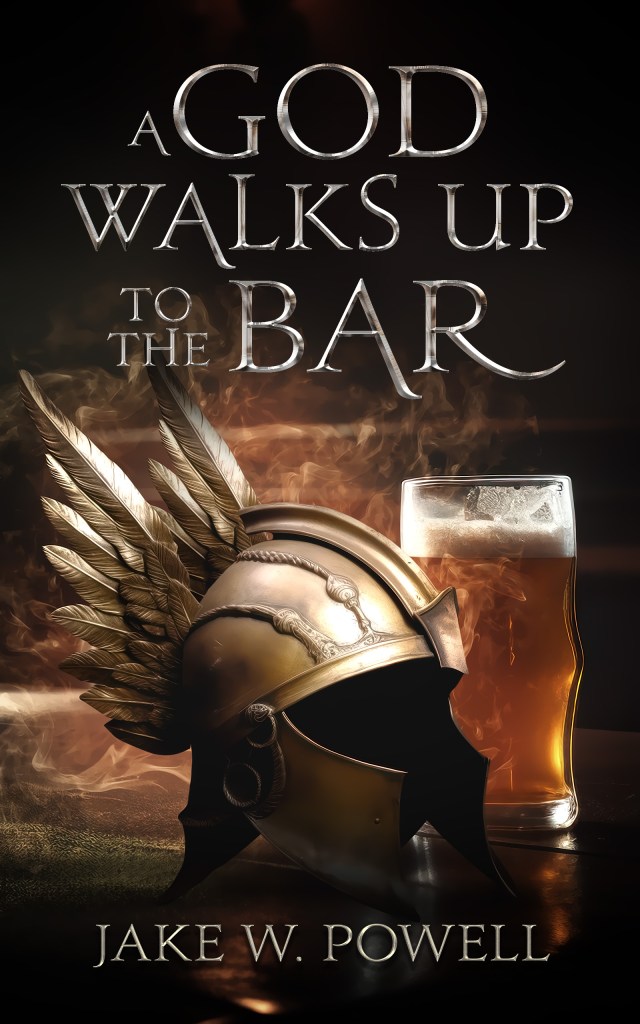
Yes, indeed, I have been working on my second book all this time! And now that it is nearing completion, I’m happy to share a sneak peak of The Trickster’s Lament, continuation of the Greek god Hermes’ adventures in the modern world and sequel to A God Walks Up to the Bar.

In my long life, I’ve awakened to many unpleasant sensations. The awareness that I was drowning swiftly found its place as among the worst.

Consciousness returned slowly. My muddled mind tried to take stock of my surroundings, but failed to comprehend. And so, I obeyed my body’s first instinct, which was to open my mouth and take a deep breath. For that, I received a mouthful of water straight down my windpipe. I choked. The spasm triggered another reflexive breath and more water filled my lungs.

My eyelids snapped open, and I looked around in pain and mounting panic. I rotated my body down to look at the murky blackness beneath my feet, then upward toward the white sun splintered into fragments by the water’s rippling surface. I made frantically for that light, swinging my arms in wide strokes that strained my half-drowned body. Black dots skewered my vision, and every movement was agony. I was dying.

I couldn’t actually die from drowning, of course. One would think that would be an advantage. But my body wasn’t immune to harm, merely to death. I could feel the water in my lungs cutting off the flow of oxygen to my brain. I could feel my heartbeat slow as vital organs succumbed. I could feel every second of my body’s suffering. No, I wouldn’t die. I’d just be reduced to a limbo state, a piece of litter drifting along the currents.

I retched and vomited. A current pushed the warm mess back into my face. A painful twitch in my throat forced me to take another breath. The same water I’d ejected was sucked back in.

I felt a tinge of envy for mortals. Such a uniquely morbid sensation, dying but not being able to die. Feeling the blood in your veins pool and thicken into sludge, and your clogged respiratory system desperately tried to pump out water faster than it was taking it in. My skull felt like it was cracking apart as my brain functions collapsed. Pure animal instinct was all that kept me moving.

Dying, but unable to die. Lucky me.

Eyes bulging out of my head and white-hot pain searing every cell in my body, I broke the surface. Water and vomit erupted from my mouth in a geyser. For the next few moments, I just floated on the waves. My body needed time to heal itself and return to proper working order. My vision gradually cleared of fluttering black flecks, and my thoughts readjusted into more complex patterns than “Oh, dear Hera, I need to breathe.” While I waited for my strength to return, I looked about and saw only rolling waves and a pale sun winking from a cloud-streaked sky. No land was visible. I was alone in the Atlantic.

Many thanks for visiting my blog. I post updates on my writing career, I muse over storytelling and fiction, and I reflect on the curious and wonderful things in life.

Putting Stories into the World and Learning to Let Them Go

Stories are precious things, especially to those who write them.

We write stories for all sorts of reasons: to tell a message, to work through a grief or hardship, as a gift for friends and family, or simply for the sake of doing so. Regardless of why, stories are very personal things.

And we all have a vision for our stories. We see it for what we want it to be. We see it all – or so we think. And then the moment of truth comes: time to publish. It’s out there, others are reading it, and they don’t see what we saw.

That’s applicability for you. We plan and plan, but readers make the story into something else, because they see themselves in the story. We all see ourselves, and so the narrative comes into focus through the lenses of our own lives.

It’s hard to let go of what we create, and even harder to hear others’ opinions of our work. They claim to understand and comprehend the deep analogies and whatnot, and we tell ourselves, “That’s not what I meant at all!”

It’s life, I suppose. And it’s something all writers will have to deal with sooner or later. But it’s not all bad. The words of readers reveal other lenses, other views and new possibilities. To be a writer is to spend so much time locked up inside yourself. Letting your story go out into the world allows you to see beyond your own mind.

Many thanks for visiting my blog. I post updates on my writing career, I muse over storytelling and fiction, and I reflect on the curious and wonderful things in life.

The Curious Art of NOT Writing the Story

I’m always thinking about writing and how to describe it to people who don’t write. It’s something that is both simple and complex to describe, because like most kinds of art, writing refuses to be boxed into simple definitions. Putting words on paper is what writing involves, but it is not what writing is.

One thing that writing is is the art of cutting away the unnecessary. Putting in too many or too few words is easy; adding just enough is hard. Authors spend their whole lives perfecting that technique.

And then my brain shifts gears and starts thinking: Can the same be said of stories in general? Everyone has at least one good story in them, but then there are those who have dozens, even hundreds of stories. Which ones do we tell, and which do we leave unsaid? In other words, which are the ones worth telling the world?

There are stories published that perhaps should not have been. On the other hand, there are also books written that will never see the light of day, maybe first attempts that authors are content to let sit in their drawer undisturbed (I’m not one of them. I published my first book, for better or for worse. You be the judge).

Some stories are complete in themselves, but get sequels that no one asked for. And some … This may be a strange thing to say, but I think that some stories can stay cozily confined within our own thoughts or just typed out on our computers and taken no further. Not every story needs to be told. But writers do need to write. It’s a hobby as well as a career.

Shifting through all the possibilities, the tons of tales that we think up, and deciding which we will commit our time to writing and which we must pass up on. That’s an art unto itself.

Many thanks for visiting my blog. I post updates on my writing career, I muse over storytelling and fiction, and I reflect on the curious and wonderful things in life.

The Sound of Inspiration

What would your life be like without music?

A life without music would be dull, that’s easy enough to say. But for me, it would also be a great deal more difficult to write anything noteworthy.

It is my belief that music is the purest expression of emotions and feelings available to humankind, just as written words are the purest expression of structured ideas. How do we describe good music? Moving, exciting, stirring, heartbreaking, uplifting, thrilling, contemplative. Music makes us feel. Words can, too, of course, but where a written story might give us a good shove now and then, music slaps us in the face – in a good way. Take any scene from a movie or stage play and remove the music. What do you have left? A bunch of people yelling and prancing around, usually. But add the music, and your heart beats to a gallop, or sinks in defeat or halts in anticipation. You no longer see something silly, but an experience of deep sincerity.

So what does this have to do with my writing? Simple. I listen to music for inspiration. Lots of people do, and I’m one of them. If you’re a writer and haven’t tried music as a way to come up with new ideas and work through the details of current ones, then I highly recommend it. Music stirs up emotions into a bubbling well, and from that well I draw my inspiration to fuel my projects.

I suppose that music and words go hand in hand. Two different forms of passion that perfectly compliment each other.

Many thanks for visiting my blog. I post updates on my writing career, I muse over storytelling and fiction, and I reflect on the curious and wonderful things in life.

Stories and Lies

Interesting thought for the day: All storytellers are liars.

Authors, poets, filmmakers, artists … We make things up. We show things to audiences that aren’t real.

But we’re liars who admit we’re liars. The things we tell in our stories are acknowledged as fiction. That’s why it’s called “fiction” and not “deception.”

There is an unspoken agreement between storyteller and audience: I will tell you something untrue, and you will treat it as something true until the story is ended. Audiences know that they are witnessing a fabrication, and so it is acceptable.

But stories do discuss real things – people, events, feelings, ideas, places – although the story itself isn’t true. Even if it is retelling a piece of history, it’s prefaced by the words “Based on a true story.”

Yet if it presents itself as real history, but isn’t, then it’s an actual lie.

Stories are lies that know they are lies and willingly admit it. And so they aren’t true lies, because they don’t pretend to be anything else.

Many thanks for visiting my blog. I post updates on my writing career, I muse over storytelling and fiction, and I reflect on the curious and wonderful things in life.

When You’re Fed Up with Life …

Whenever you are fed up with life, start writing: ink is the great cure for all human ills, as I have found out long ago.

C. S. Lewis

One of my favorite writers and thinkers, providing some advice to all writers out there – and anyone else who needs to work through life’s bullying moments.

Many thanks for visiting my blog. I post updates on my writing career, I muse over storytelling and fiction, and I reflect on the curious and wonderful things in life.

Tips on Draft Writing

Drafts are a vital part of any writing project. Very, very, very rarely is any book released on its first draft. You need to pour over your work many times to make sure it’s ready for publication. But, the question often arises: How many drafts should you write? Three? Four? Eleven? How many is enough?

There’s no hard and fast answer. It depends on the author. Different strokes for different writers.

Even so, I’ve come across a few general tips that can help you decide how long to spend in the drafting stage.

  1. Set yourself goals for each draft. Pick one specific thing to improve for each draft you write. Your first draft -the vomit draft, as I like to call it – is just getting your story onto paper. Your second draft, perhaps, can center around developing story and characterization. For the next one, pay attention to grammar and sentence structure. Whatever you choose, each draft sees definite and specific improvement, and you may find yourself not needing to go through as many as you expected.
  2. Don’t expect perfection. You’ll never get there. Drafting is about improvement, not reaching an ideal but unattainable state of “perfection.” Even the greatest writers make mistakes. Focus on refining and polishing. Every time you go through your story, you’re making it better. Each draft builds on the previous one.
  3. Pace yourself. Sometimes, wrapping up one draft and jumping straight into the next isn’t a good idea. Give yourself a few days to let your subconscious mull over things. A little break can be great for your writing as you begin anew rested and with a fresh perspective. You find yourself more easily spotting errors and opportunities.
  4. You have to publish eventually. If you want to release your book to the public, you will have to stop drafting at some point. You have to tell yourself that your story is ready. Remember: Refining and editing is all well and good, but if you never stop, then you will reach a point where you’re doing more harm than good. You lose sight of the whole and get buried in nitpicks that add nothing. A sculptor who never stops chiseling the marble ends up with nothing but gravel in the end.

Some people love the drafting stage, other people don’t. I find it a useful and interesting process. I not only clean up the chaos of my first draft, but also discover new things about my characters, new storytelling techniques, and just plain mature as a writer. However many you find necessary, remember the most important tip of all: Have fun with it!

Many thanks for visiting my blog. I post updates on my writing career, I muse over storytelling and fiction, and I reflect on the curious and wonderful things in life.

A Story’s Skin: Setting Limits for Yourself as a Writer

We as human beings don’t like to hear about “limits.” We want to do our own thing without anything holding us back. But consider the breadth of human imagination and all the choices you have as a writer and ask yourself, “How do I even know where to start with my story? Where do I go with it? How do I keep it organized?”

The truth is, stories need boundaries. That’s the difference between a story and rambling. Stories have a point, and they stick to that point. Telling a story about shopping at the grocery store is not going to include what your kids did at school that day. And a story about grocery shopping isn’t going to take as long to tell as, say, the history of Great Britain. Different stories have different limits. But they do need limits.

Some of us like to meander. We have so many ideas and we want to shove them all in. It’s fun to type away at your computer and watch the words flow. But knowing when to stop – ah, there’s the rub.

Here’s a metaphor for you: Imagine your story is like the human body. It’s made of many different complex parts. But all those parts are able to stay together and function properly because of the skin. Skin covers the body and keeps it in place. If we didn’t have skin, we’d just sort of … ooze all over. And who wants that?

It’s the same with writing. You have an idea, or two or three. Great! Now stop. Organize those ideas, don’t add to them. Stories have a beginning, middle, and end. A triggering event, rising action, climax, and epilogue. In other words, stories have structure. And structure, by its very nature, is defined by boundaries and restrictions. They aren’t bad things. They’re necessary for anything to make sense and have form.

Outlining your story ahead of time is a great way to know what your story is about, to know what to put in and what to hold back. Yes, things will shift and change as you go through drafts. But don’t keep adding and adding and adding. Know when to stop and refine what you already have. Put a skin on your story.

If overwriting is a major problem for you, then put a limit on your word count. Something miraculous occurs when you suddenly have a ceiling you can bump your head on.

When we are deprived of the freedom to do everything, we discover a new well of creativity. We choose our words more carefully. We find focus. Words matter more, so we experiment until we find the right ones. We cut away cumbersome paragraphs and sentences. Knowing there’s a cap on our writing makes us pay extra special attention to dialogue, plotting, pacing, and everything else.

Limits are good. They force us to be better writers.

Many thanks for visiting my blog. I post updates on my writing career, I muse over storytelling and fiction, and I reflect on the curious and wonderful things in life.

Setting Your Own Pace: The Importance of Not Comparing Your Productivity to Others

It’s so easy to look at the writing community and be amazed at the writers who churn out novels like nobody’s business. A novel per year, two novels, even three! How can anyone hope to compete with that kind of productivity? For those of us just starting out, we may feel a burden being placed on our shoulders. We may feel that we have to “keep up” to be considered good writers.

Well, I say “Phooey” to that. Every writer is different, and we all have different paces at which we write. Some write slow, some fast. And not everyone has a dozen stories to share, or even two. Some people only have one good book in them for their entire lives. My respect to those who publish that one book.

Comparing yourself to other writers, using the accomplishments of others as the measure of your own worth and talent, is a flawed notion. What do you know about the life of those writers? How long have they been writing, and how much time do they have with which to write? And even more importantly, what sacrifices have they made to achieve their output?

I have a day job and other responsibilities. I have friends and a social calendar. As much as a part of me would love to write 8 hours a day every day, the simple truth is that I can’t. I make deadlines, I make an effort to write something every day, but I’m no book-making machine. But I can still be content with my work.

So, if you feel that your worth as a writer is measured by how prolific you are, take a breath and relax. Don’t rush your writing, and don’t seek quantity over quality. A rushed product is messy and rarely 100% of your potential. There is no race, except maybe against the deadlines you set for yourself. Don’t rob yourself of the enjoyment of what you do.

We’re all different. Our writing journeys are different. Figure out what works for you.

Many thanks for visiting my blog. I post updates on my writing career, I muse over storytelling and fiction, and I reflect on the curious and wonderful things in life.

Publishing and Budgeting

As writers, we are doing something that we love. We also know that writing comes with wearisome but necessary tasks, such as budgeting. This is especially true if you’re self-publishing. As annoying as managing your budget can be, it is vital to getting your book onto the market. Here are a few tips I picked up in the course of publishing my first book.

  • Set your maximum budget. First and foremost, how much can you spend on your book? Some of us, like myself, write as a hobby. With writing not a main source of income, I need to pinch pennies. If you’re worried about overspending, do some research online to get an idea for the general cost of publishing. From there, set yourself an upper limit you won’t go over. Keeping within boundaries can not only help you keep a firm hand on your finances, it also narrows the field of available options and prevents overloading your brain with too many choices.

  • Budget in steps. You won’t be spending all your money at once. Getting your book ready requires multiple steps: Editing, cover art, marketing, formatting, and so forth. So, you can create a budget that accounts for each stage. Budget for the editors, and plan for what type of edits you’ll submit your draft for: copyediting, line editing, etc. Plan how much you will spend on cover art, and whether you will have your book formatted as an eBook, hardcopy, or both. How will you market your book, and how much are you able and willing to spend? Dividing up these tasks can make setting the budget much less overwhelming. You put money away for each stage, rather than viewing it all as one big vaguely defined blob.
  • Do research before you pay. The old adage rings true: “You get what you pay for.” As you look into available services, research company reviews online. What do other authors have to say about their experiences with this or that business? And furthermore, if you find someone offering what seems like a bargain, be cautious. Ask yourself: Are they cheap because they can’t keep any customers? Look around, build up a list of potential candidates, and check them out one by one until you find someone you can trust to do a good job. And remember that the quality options are inevitably going to command higher prices.

Money is a pain. It’s not why most of us write. But it’s a necessary evil, and it’s worth it in the end. The light at the end of the tunnel is seeing your book up for sale and available to the world.

Many thanks for visiting my blog. I post updates on my writing career, I muse over storytelling and fiction, and I reflect on the curious and wonderful things in life.