A Game of Riddles

Do you like riddles? I love riddles. I think they’re interesting, fun, and come in infinite variety. They’ve been around for millennia, so someone thought they were worth keeping around.

The book I’m currently working on features a scene where two characters engage in a riddle contest. I used some riddles from history for the scene, but I also took a stab at making up my own. At least, they’re original as far as I know, assuming my subconscious wasn’t inspired by something I read fifteen years ago or some such.

Regardless, here they are. Highlight the space beneath each riddle for the answer. Enjoy!

Teary eyes and stolen breaths

So often found with death and wrath

No teeth to bite nor fists to strike

Yet destruction always marks my path

A single eye, yet I cannot see

A single fang, yet I cannot bite

I have no hands nor feet

Yet many things can I complete

Clad in armor like the turtle, many do I command

Proud and vain like the eagle, on ground I need not stand

Beasts fantastic mark my name and honor,

Yet at day’s end, I die like any man

What are some of your favorite riddles? Maybe you’d like to take a shot at creating a few yourself!

If you just so happen to be enjoying my blog, feel free to subscribe. I post updates on my writing career, I muse over storytelling and fiction, and I reflect on the curious and wonderful things in life.
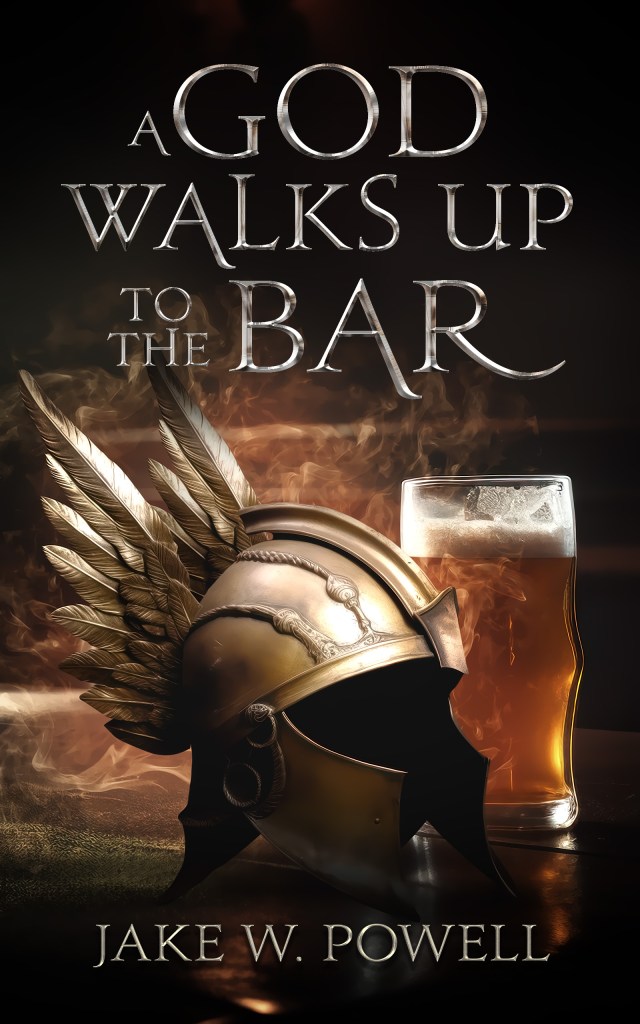
And speaking of my writing …

My first book, A God Walks up to the Bar, is available on Amazon.com. Witness the modern day adventures of the Greek god Hermes in a world much like our own – and with demigods, vampires, nymphs, ogres, and magic. The myths never went away, they just learned to move on with the times. It’s a tough job, being a god!

Confessions of a Skipper

I must confess to a strange reading habit, one that might shock and horrify you. Do not judge me too harshly, for I shall explain myself.

When I start a fiction book, I like to skip to read the last couple of pages first.

“What?” I hear you cry out. “What is this blasphemy? Why ruin the story for yourself?” Calm yourself, please. Let me clear things up.

It’s true that I’m not sensitive to spoilers. I really don’t mind when plot twists are brought up in casual conversation. But this habit is more than just wanting to know how things end. Really, without context, knowledge of a story’s ending doesn’t have a terribly great impact on me as a reader. I have no grasp of the import of the scenes and dialogue. What I’m really interested in is catching a glimpse of the finished jigsaw puzzle, then going back to the beginning to see how the pieces fit together.

Rather than starting a book with no idea of how things end up, I know exactly how it ends. And so, the fun of the read shifts from the “what?” to the “why?” Why is this the ending? And how will my initial impression of it change as I get more pieces of the bigger picture?

I suppose I’m interested in perceiving the author’s mind. How do they assemble the various elements of the narrative into its final shape at story’s end? How are these characters and events inserted into the story? In short, how did we end up here?

Pieces click into place as I read on, and the ending’s significance becomes clearer. Sometimes, I feel like a detective solving a case in reverse. I already know whodunnit, but the howdunnit isn’t so obvious.

And I do it because I’m quirky and it’s kind of a fun exercise to try out. I neither recommend it nor warn against it. Reading style is a matter of personal preference. It’s up to you.

And there you have it. The true confessions of a skipper.

If you just so happen to be enjoying my blog, feel free to subscribe. I post updates on my writing career, I muse over storytelling and fiction, and I reflect on the curious and wonderful things in life.
Over the Next Hill: Tribute to Mankind’s Curiosity

The history of humanity is the history of crossing over the next hill.

Where are we without curiosity? Caves and mud huts. One day, someone steps outside with a mind filled with questions. What is over that next hill? What is in that valley? What is beyond that forest? Anther follows, and another. Further afield we walk, driven not by necessity but because we want to know.

Questions follow questions. Can I eat that? Can I grow it? Why does this reed make a sound when I blow through it? Food and music are discovered. Someone finds a sturdy stick. A walking stick, and soon a weapon. Lines are draw on sandy ground, then painted onto rock and hides. Maps are made to chart the wanderer’s path.

We cross the last hill and find a sea. But now is not the time to stop. Wood floats, this is known. A little later, and mankind sails out on boats across the water to find out what lies on the other side. They learn how to make the stars their guide. Navigation becomes more than simple wandering.

Where people grow tired and rest, they find new fruits and vegetables and animals. The nomad becomes the gardener and herdsman. Someone notices those mangy wolves following the camp for scraps. Someone tames them.

People build huts of straw and wood, of stone and brick. Cities appear. Curiosity turns inwards. How to make life better? Clever hands produce answers: the wheel, the hammer, the nail, the net, the plough, the saddle.

Not all stay in cities. Others keep wandering, looking for the next hill and sea and valley. They wander far afield, planting new cultures wherever they stop awhile. Downriver and up mountain and across desert. Because they can. Because they must know what is there.

The whole earth is charted. Mankind does not rest. The ocean deeps call out. The stars wink at humanity, inviting it to pay them a visit. Steam and electricity are harnessed. Fire no longer warms the camp, but lifts man and woman on ships of steel into the airless void to visit the moon. Other ships carry them beneath the ocean into the lightless abyss to glimpse its moody depths.

It is the never-ending journey. Why? Reasons are given, some long and eloquent, others little more than a careless shrug. Because we must know. Because we are curious creatures. Because we can scarce imagine what new mystery awaits us over the next hill.

If you just so happen to be enjoying my blog, feel free to subscribe. I post updates on my writing career, I muse over storytelling and fiction, and I reflect on the curious and wonderful things in life.

Image: “A view of hills and sky” by World Bank Photo Collection; Licensed under CC BY-NC-ND 2.0.

Writing Characters You Don’t Agree With

Writing characters require us to dive into their heads and figure out their backstories, beliefs, and personalities. It’s a fun diversion in and of itself to discover a character, much less to incorporate those discoveries into a greater narrative. Learning more about our protagonists can make us as attached to them as we hope our readers will be.

But what about writing people who are … less than agreeable? Or worse, who don’t share our values and principles? What about writing those whose motivations and beliefs are diametrically opposed to our own? What is it like to dig around in the head of someone who we don’t agree with?

It can feel almost like a betrayal of ourselves. He can’t say that, I don’t believe in it! She can’t do this, it’s not part of who I am! But putting yourself into your writing doesn’t necessarily mean you are your writing. You are creating a world with words, and that world will be filled with a motley mix of individuals who all possess their own strong personalities.

This can apply to antagonists and villains, but really, it includes any character you write. They play roles in a story, and sometimes those roles require them to be someone drastically different from yourself. Can that be awkward? Sure. Maybe there’s the nagging feeling in the back of your head that writing a character who deviates from your own worldview is somehow condoning things you don’t agree with. But if the story demands it and it develops your world, then it must be done. It’s not betrayal, it’s the mark of a maturing writer. I write people who do and say things I don’t personally find tasteful, but which do fit their own personality. I’m not that person. They’re a work of fiction, after all.

Besides, characters who disagree with you are likely to disagree with other characters, and that creates conflict. And conflict is how you keep a story going.

Even if you don’t agree with a character, they’re still yours and serve a purpose in the story. So, roll up your sleeves and figure out what to do with them. The first thing is to put yourself into their shoes. Think like them for a bit, practice seeing the world through different eyes. How do they feel about this thing or that other individual? How do they feel about your protagonist? Why?

Learning a bit of empathy and a bit about other worldviews certainly helps, as does reading good literature and learning from example how other authors write. It’s valuable to learn how to write characters whose voice and opinions don’t echo your own. Why? Because it is too easy to put yourself into every character and have everyone essentially act and believe as you do. And that makes a story boring and predictable.

And besides, for all that characters have a habit of taking on a life of their own, you are ultimately the final authority here. Like a director herding meddlesome actors, you learn to work with your cast and guide them toward your vision.

Ultimately, story is king. It comes first, and we do what we must to tell it. It’s all part of growing as writers.

If you just so happen to be enjoying my blog, feel free to subscribe. I post updates on my writing career, I muse over storytelling and fiction, and I reflect on the curious and wonderful things in life.

Writing Jerks

Why do jerks seem worse than villains? Villains are grand and powerful and fierce and evil. They deserve our disdain. But jerks are just plain petty. What’s worse? A dictator bent on conquering a nation, or a man who keys your car because you bumped him in the parking lot? Well, the former, obviously, but the latter certainly seems to steam people a heck of a lot more.

But I’m not here today to talk about “why’s,” but rather “how’s.” Namely: How do you write a jerk protagonist so that he’s likeable?

Think about it for a moment, writers. There are plenty of villains that people like. I’ve even written about it in a previous post. Mass murderers? Evil tyrants? Amoral thieves? They’ve all got fans. They’ve all got that special something called charisma. People will forgive a lot if you have charisma.

But jerks? They’re personal to the audience. We may never have met a murderer or a dictator (hopefully), but we all know a few knuckleheads with attitudes who stoop to the lowliest of cheap shots. Spend a week in customer service and you’ll meet jerks on the regular. They come in all flavors, but they all have something in common.

THEY AREN’T LIKEABLE.

Thus, going back to my first question, is there a way to write a protagonist who is unpleasant, rude, and otherwise just plain mean, and still make that character someone the audience can enjoy? Well, yes and no. The main thing about writing jerks is that if you keep them that way from start to finish, chances are you’re shooting yourself in the foot.

Consider a classic example of jerkdom in literature: A Christmas Carol’s Ebenezer Scrooge. A miserly, heartless, soulless businessman who has no mercy or pity for the poor. He’s on the up-and-up – he’s an honest man in the original story, believe it or not – but he has no redeeming traits. At first. The entire story is about Scrooge’s character development into a better person. And that’s the key to writing jerks: They shouldn’t still be jerks by the end of the story.

Side characters can stay jerks. Antagonists, of course, can remain jerks. But the protagonist should not remain static at the best of times. They evolve and mature. And if they start out as jerks and bullies, then they should show some sort of marked improvement by story’s end. Less of a jerk, kinder, more patient. Like Scrooge, they should learn something. There is nothing stopping you from writing a protagonist who remains the same come the conclusion, but if they were nasty and unlikeable to begin with, you risk leaving your audience with a sour last impression.

On the other hand, maybe the jerk not changing is the point. Maybe this is a more cynical piece, an introspective look into what makes a meanie tick – or maybe it’s just a comedy. Well, there is a way to make the audience side with the jerk, and that’s to introduce an even bigger jerk to square off against. Have a protagonist who’s belligerent and petty? Bring in someone else who’s even more so. It worked for British sitcom Fawlty Towers. Basil Fawlty is a Class-A Jerk through and through, but he frequently dances with people even worse than he is. See for yourself.

We like someone to root for, you see. If we’re given two flavors of unpleasantness, we’re naturally going to compare them. And if one is slightly less bad than the other, we’ll favor that one and despise the other. The lesser of two jerks, if you will.

There are those rare occasions where your story doesn’t require that the protagonist change for the better, or circumstances dictate that there isn’t a worse character to compare against. So, what to do? Well, you can make the jerk empathetic. That’s not saying you give the protagonist the capacity for empathy, but rather that you give them traits the audience can relate to. Humanize them a bit, just a little, so that they’re a tad more understandable. Maybe they are the way they are because of a bad childhood, or ill health, or they’re just plain unlucky.

Let us consider the case of Disney’s Donald Duck. He’s … not the most pleasant individual, especially in his 1930s and 1940s cartoon shorts. But oh, boy, does he have bad luck at every turn. Nothing turns out right for him. No wonder he has such a chip on his shoulder. If we had the rotten fortune that Donald does, we’d be short-tempered, irritable scoundrels, too.

So, there you have it. My two cents on writing jerk protagonists. It can be done. It has been done. You can do it, too.

If you just so happen to be enjoying my blog, feel free to subscribe. I post updates on my writing career, I muse over storytelling and fiction, and I reflect on the curious and wonderful things in life.

Blank Spaces of the Mind: How Do You Tell A Story Without Having to Tell Everything?

I like movies. I’m a visual person, and I enjoy seeing things portrayed on the screen. Little details are the most fun. Characters’ tics and interesting events happening in the background. Sometimes, I envy filmmakers. Creating their worlds are a little bit easier, because they can convey in a minute what can take a writer four or five paragraphs to communicate. ESPECIALLY when they are able to tell the story without a single word being said.

We writers, of course, don’t have that luxury. Books are nothing but words, which got me thinking: How do you show the reality of a story, that is, communicate character traits and worldbuilding details, when you can’t really show anything at all?

It’s a different game from simply describing a scene or a character. That’s to be expected. But where to stop? Where’s the line between “This is what Joe looks like and how he acts” and “This is Joe’s personality and character, let me tell you without ever referring to it again and thus making this paragraph pointless.”

So, I’ve thought about it, and here’s what I’ve come up with so far.

Stories are best told when the writer doesn’t need to explain everything. A good story unfurls through action, whether visual or written. Actions define a character, a group of characters, even a location. The way a person carries himself, dresses, talks – these all express relevant elements without the need for a mountain of exposition.

And they can be brief. For example: A wizard appears in the story. He dresses in fancy clothes and has clean, well-groomed hair. He talks formally with a condescending tone. He casually refers to esoteric subjects. He sniffs loudly whenever he disapproves of the other characters’ comments. He kills a wolf with a single, well-timed spell. Short, succinct statements that tell us what we need to know – and give us the freedom to paint a picture of the character in our minds. We don’t always have to go into detail about hair color, eye color, body type, or a detailed analysis of clothing. Heck, just the word “wizard” probably had you paint half the picture from a single word, didn’t it?

But then, another character brings in the Artifact of Doom for the wizard to identify. The wizard immediately panics and backs away, demanding that the object not be brought near him. Well, that tells us immediately that the Artifact of Doom is really bad news. If Mr. High-and-Mighty is scared, it just might be a serious problem for everyone.

So, yeah, books aren’t visual, but they can still tell a story without having to tell us everything. In short, leave some space for the reader. Now, I’m not going to say that I’m necessarily good at this as a writer. I’m still learning, but I’ve learned as much from reading as writing. And I get annoyed when books pause everything to describe the POV character’s emotional state or appearance in long, flowery detail. It just seems … excessive.

Maybe it’s just the mark my journalism classes left on me. I like simple and to-the-point. And I like to think that my readers can be trusted to have a little imagination to fill in the blank spaces of the mind that words can’t reach by themselves.

What are your thoughts? How do you think a story can “show, not tell?”

If you just so happen to be enjoying my blog, feel free to subscribe. I post updates on my writing career, I muse over storytelling and fiction, and I reflect on the curious and wonderful things in life.

Image: “New York City Street Scenes – Rainy Night on the Lower East Side” by Steven Pisano; Licensed under CC BY 2.0.

Keep Soldiering On!

The snow is here. Winter continues its dismal march. I walk through slush and ice in the dark to work every morning, and return home at twilight. I don’t see much of daylight. It’s a dreary time of year. Makes it hard to write and create.

But the days are getting longer! The dismal darkness won’t last forever. I’ll see the sun again on a daily basis, and enjoy the cheer of spring.

No deep reflections today, or musings on storytelling. Just a piece of encouragement to all you creators out there to keep creating. Keep motoring on when things feel gloomy. This, too, shall pass, and tomorrow will be a little bit brighter.

Face-to-Face in an Age of Long-Distance Technology

I’m an introvert by nature. I like being alone. Being isolated holds no real terror for me. Sure, it can be a bit monotonous at times, but I have a knack for finding ways to amuse myself. All in all, I enjoy being by myself. And in today’s word of Zoom meetings and work-from-home job schedules, I have more time to myself then ever. Most of us do. Heck, the Internet has made in-person interaction almost a secondary social trait.

That being said, I will never decry the importance – the essentiality – of physically being with friends.

I recently celebrated New Year’s with a group of close friends. We spent the night playing board games and laughing at each other’s corny jokes. Not being a social butterfly, such events are relatively rare for me, which makes them all the sweeter. Being with people is fun. And if I say that as if it’s some grand discovery, maybe that’s just the millennial in me talking.

We need people. Not just people’s words on social media, or their faces on the web camera. We need to be with people. Humans are social animals.

“Relationship” is a word that’s easy to bandy about. What other words are there to use to illustrate its complexity? Friendship. Camaraderie. Partnership. Sharing. Connecting. Time investment. Yup, relationships demand our time. Maybe a friendship in person is more precious because you sacrifice the time to be there in the flesh, rather than sit on your butt in front of your computer typing from a distance.

That New Year’s party was time well-spent. The spontaneity, the laughter, the jokes, the simple act of being there. It stirred memories of when that was commonplace for me. Maybe for all of us? Before the advent of social distancing. High school and college days where I hung out with friends during lunch and chatted with them throughout the week. Things that I took for granted. Ah, but hindsight is always bittersweet.

So, this New Year has gotten me thinking about the importance of in-person relationships. Writing is a solitary activity, and that means socializing is something I must seek elsewhere. I do have a social life, mind you, but perhaps I was starting to treat it a little too casually and valuing it a little less than I should have. We all need to see a living face every once in a while.

If you just so happen to be enjoying my blog, feel free to subscribe. I post updates on my writing career, I muse over storytelling and fiction, and I reflect on the curious and wonderful things in life.

Image: “Forest” by tim_gorman; Licensed under CC BY-ND 2.0.