Remembering Dinotopia

Do you remember your favorite book from your childhood?

In truth, there are so many books I loved as a child that I can’t remember them all. I just remember the hours spent in my room, lost in words and pictures. But there is one that does stick out in my memory.

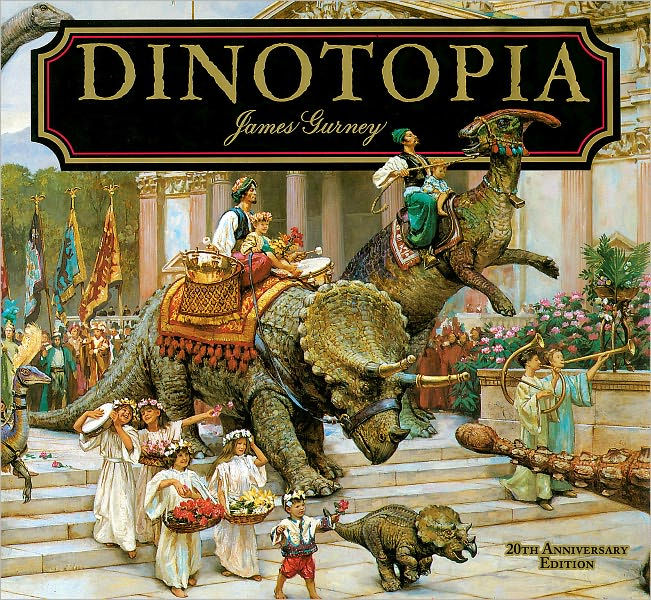
I have very fond memories of an illustrated book called Dinotopia: A Land Apart from Time. It has beautiful imagery, wonderful worldbuilding, and is a tour de force of creating a fully-realized fictional world, courtesy of National Geographic artist James Gurney.

Dinotopia is about an island hidden from the rest of the world where dinosaurs and humans live in peace and harmony. It is presented through the eyes of a 19th-century explorer and his son who are shipwrecked on the island and gradually become a part of its strange, beautiful, and intricate society. Gurney put a lot of thought into how such a world would function, not just the cities and the clothing and the festivals and the government, but such mundane things as bedding, waste disposal, and timekeeping.

And it’s gorgeous.

Remember what it was like to be a kid? When there were no strange grown-up responsibilities and nagging worries? Remember when nobody could take away your joy because you clung to it so fiercely? Dinotopia reminds me of those days, and it reminds me that we are still able to keep that joy throughout our lives.

Most of all, it reminds me how fun it is to curl up with a good book.

Many thanks for visiting my blog. I post updates on my writing career, I muse over storytelling and fiction, and I reflect on the curious and wonderful things in life.

Image: Cover of Dinotopia by James Gurney; Fair use

What is a Masterpiece?

Masterpiece. It’s a word you hear often. So often, I feel that its meaning has been drained out of it. Like “genius” and “magnum opus,” it’s a label we often apply to something that we enjoy on a personal level, regardless of whether it deserves the title.

A little harsh? Probably. There’s nothing wrong with liking something. In fact, I encourage you to like lots of things. Enjoy life. But I like to overthink things and write them down, so why not dig a little deeper?

Masterpiece. It’s actually two words. Master. Piece. A master piece. In ye olden days, guilds and academies required their apprentices and journeymen to submit a masterpiece as part of their application to the status of master. Hence, they presented a piece that marked mastery of their craft, be it carpentry, smithing, jewelry, baking, or what have you. Proof and demonstration that they were worthy of attaining the highest rank, as judged by their superiors.

So, it was something that was measured against quantifiable standards. A masterpiece was actually a lot like today’s college senior capstones: a final paper or project that demonstrates the graduate’s understanding of their degree subject. Or perhaps more appropriately, it is like a doctorate or master’s thesis (and there’s the word “master” again!). That’s not really surprising, considering that guilds, like schools, train people for careers.

But the word’s meaning changed over time, as words are wont to do. Now, a masterpiece has come to hold an even more elevated meaning. It is not simply proof of an individual’s skill, but it is the apex of their skill. Mona Lisa is Leonardo da Vinci’s masterpiece. Not his first work, but widely considered his best. 1984 is George Orwell’s masterpiece, and Star Wars is George Lucas’s.

So what does the word mean nowadays? It means something superlative, something that represents the epitome of the creator’s talent and understanding of the art. It is applied to anything that can be considered great or notable. And in so doing, we have, oddly enough, brought the word down. A masterpiece is declared as such by critics who are not necessarily practitioners of the art. Anyone who favors a particular artist or author and is eager to share that love can declare their favorite work to be a masterpiece, regardless of what merit it actually represents. That happens with all words – their meanings change and are shaped by usage into something quite different, and will again in a hundred years or so – but looking back at a word’s origin can make you look at it a little differently. A little more carefully.

A masterpiece was originally something that proved the apprentice was worthy of the master’s rank as judged by his teachers. It was a stepping stone from a lower tier to a higher one. It was a gateway and a turning point in one’s life. It was something singular and unique. It was the masterpiece of your career. It was something special.

Call me grumpy, but I think we can be more mindful when using words like masterpiece. They are powerful words, and applying them more prudently can in turn make us consider the media we consume more carefully. A bit of critical thinking put into evaluating whether something is truly a master’s piece. And that’s good practice for any artist.

Many thanks for visiting my blog. I post updates on my writing career, I muse over storytelling and fiction, and I reflect on the curious and wonderful things in life.

What is Art?

The eternal pressing question: What is art? What defines it, what is its nature, how is it differentiated from the common dross, and how do we recognize it when we see it? What. Is. Art?

Ask a hundred people, and you’ll get a hundred and one different answers. Nobody can seem to decide, though everyone, from the working joe to the professional critic, seems convinced that they know exactly what art is. The artistic merits of literature, film, paintings, and even video games are debated again and again. Is it art? But can we know, when the definition of art is as fluid as the fresh paint dripping from a canvas?

Maybe we’re asking the wrong question. Maybe we should instead ask what isn’t art.

Can this process of elimination help answer this great question? Consider the humble spoon. Is a spoon art? Well, most people would say it isn’t. You use it to eat soup and cereal. It’s a mundane thing. It has an everyday utility. It isn’t art.

What about a car? Is a car art? Well, it also has a mundane use: transportation from point A to point B. But look at car commercials and car shows. Cars boast aesthetic pleasures and pleasing design. They are promoted based on appearance, performance, improvement, and flashy lights. People collect cars. People analyze cars. Are they art? Or are they merely utilities passed off as art? And how do we know, unless we can define what art is?

This is getting complicated.

Why do Jackson Pollack’s paintings get hung up in museums but a two-year old’s paint smears don’t? What’s the difference? Aren’t they both paintings? And aren’t both paintings art? Well, the latter obviously isn’t art art because nobody cares except the parents. But everyone must care about Sydney Pollack since he gets public exhibits.

Nobody cares about spoons unless they try eating soup with a fork. But everyone cares about cars, one way or another. They’re both a fact of life, but one is just plain more noticeable than the other.

Nobody cared about the pipe until René Magritte put up a picture of one alongside the words, “This is not a pipe.” A pipe is just a pipe until it isn’t.

Maybe that’s all there is to it. Maybe art isn’t art until you decide that it’s art.

Until you care whether or not it’s art.

If enough people say that something is true, does it become true? No. No matter how many people say you can fly by flapping your arms, you can’t. But it sure is easier to think you can.

Is that all that art is? A shared belief? A social construct? Just the idea that if we belief something has merit inherent in its composition, construction, appearance, and intent, it rises above the mundane to become something with social significance?

But what about your two-year-old’s paint splatters? Is that art? What loving parent would say, “No”? To them it’s art. It’s more precious than everything in the Louvre.

Maybe art is more than just innovation, messages, and composition. Maybe it’s something more personal than that. Maybe art lies in how much it is valued by the individual. I happen to think cars all look the same and are basically just glorified boxes on wheels. I don’t see the appeal. Cars aren’t art to me. But to others, they are masterpieces.

Critics say something is art, and so we believe them. They must know what they’re talking about, right? Then, a hundred years later, the great art of the time is depreciated. It’s not as important. And new art replaces it. Tastes and preferences change. The definition of art changes based on what we think is important.

A spoon can be a piece of art. In some ways, it is by default. “Art” is a relative of the word “artifice.” Artificial. Manmade.

Maybe everything is art. But if everything is, than nothing is art.

Oh, to heck with it. Art is whatever you want it to be.

If you just so happen to be enjoying my blog, feel free to subscribe. I post updates on my writing career, I muse over storytelling and fiction, and I reflect on the curious and wonderful things in life.

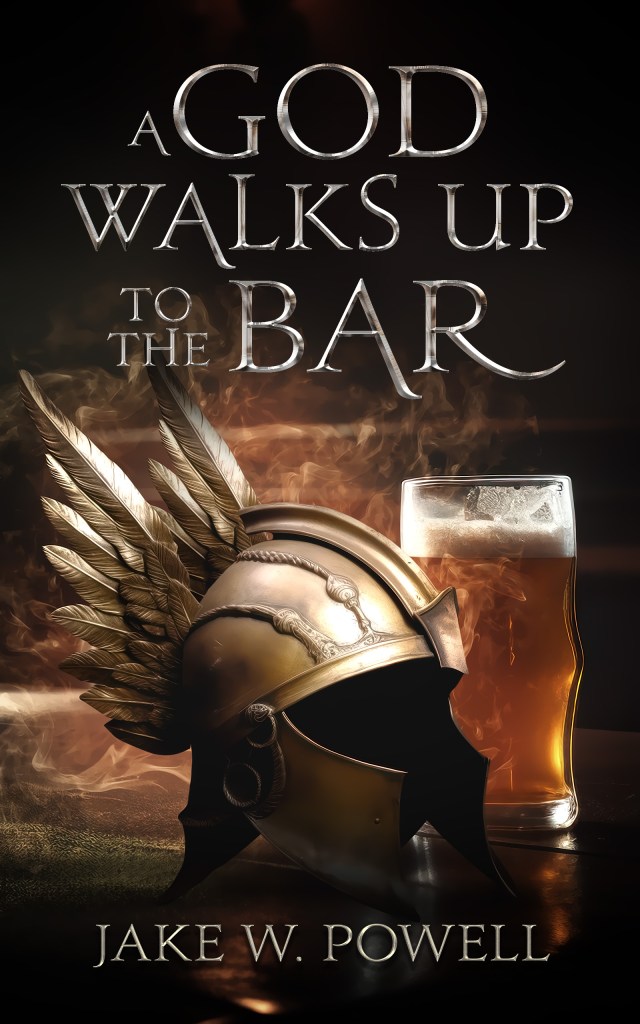
My first book, A God Walks up to the Bar, is available on Amazon.com. Witness the modern day adventures of the Greek god Hermes in a world much like our own – and with demigods, vampires, nymphs, ogres, and magic. The myths never went away, they just learned to move on with the times. It’s a tough job, being a god!

Why Do You Create?

Christmas vacation has given me more time than usual to spend on my writing and passion. That needling desire – that need – to write is stronger than ever within me. With this awareness fresh in mind, I want to ask a question to my readers. No need to answer in the comments if you don’t want to, of course. This is just something to ponder when you have a moment.

Why do you create?

This isn’t just a question for authors, or for artists, sculptors, songwriters, musicians, poets, filmmakers, and those who doodle in their notebooks during class. This is for all who feel the urge to create something, to tinker with something, to take something apart and put it back together again.

This is for those who enjoy the act of producing and modifying and bringing into being a thing that wasn’t there before. The car mechanics, the dance choreographers, the sketchers, the gardeners, the woodcarvers, the fashion designers, the computer programmers, the origami enthusiasts, the crocheters, the embroiderers, and the engravers. The shoemakers, the tailors, the welders, the carpenters, the jewelers, and the chemists. The people who sing in the shower and the people who love decorating for Christmas. The people who color coordinate their clothes and the ones who sew blankets for their friends’ children. This is for all of you.

Why do you create?

What is this burning desire? This all-consuming thought that strikes us out of the blue: I want to make something. Why? What does it do for you? What is this amazing, crazy facet of human nature, this ability and impulse to make something new in the world?

And what happens if we don’t answer the desire? How do you feel if you can’t create, or if you experience a blockage?

Just a thought to ponder as the new year approaches. Whatever the answer, I wish you luck with your creations, and the fervent hope you can share them with others. To create is a gift, and the best gifts are shared with others.

If you just so happen to be enjoying my blog, feel free to subscribe. I post updates on my writing career, I muse over storytelling and fiction, and I reflect on the curious and wonderful things in life.

Image: “Another Bosque Sunrise” by snowpeak; Licensed under CC BY 2.0.

The Myth of the Easy Masterpiece

We’ve all heard the glorious stories of the writer who dashed out a masterpiece over the course of a weekend, solicited it, and made big bucks. Or we hear about someone writing a book for kicks, posting in on Amazon, and suddenly getting offers from film studios to turn their sudden runaway success into a show. It’s a tempting motivation to become an author, or scriptwriter, or whatever. These guys made it. How hard can it be?

Pretty hard, actually. After all, we only hear about the successes. What about those stories written over a weekend that never took off? How many books on Amazon do you think there are that nobody’s ever read?

I don’t know where I first heard the story that the screenplay for Good Will Hunting was written by Matt Damon and Ben Affleck over a weekend. Probably one of those motivational stories my teachers told me as an example of how life doesn’t actually work. It’s not true, by the by. Matt Damon wrote the original 40-page script as a drama class project, then worked with Affleck on revising it into a full Hollywood script. So, no, they didn’t conjure a masterpiece out of thin air in just a couple days. The foundation was already there, and they still had to work hard to translate it from written word to big screen.

Hugh Howey wrote Wool as a one-off short story that he put up for sale on Amazon. And yes, it did become so successful that he ended up writing sequels and selling the film rights and getting a good deal out of the whole thing. But as unusual as the success of Wool is, it was still based on years of writing experience and hard work. Howey had already been a diligent writer long before he published Wool. The story may have been a one-off, but Howey’s efforts weren’t. He goes into detail at length about his writing on his own blog.

All of which is to say, if you hear about a runaway success, that success is probably the result of a lot of hard work, blood, sweat, and tears that rarely make their way into the story told in magazines. The humdrum routine of writing, or scripting, or painting, or sculpting, or whatever medium you can think of doesn’t usually make for a good story, after all. Customers want the end product. The tedious hours of chipping away at marble or revising a fourth draft aren’t what they’re buying. And, quite frankly, do they even need to know about all that sweat and work?

If you’re truly devoted to something, you’ll put in the effort necessary to see it through to completion. Writing isn’t a “get rich quick” scheme. In fact, it may be the worst method possible for getting rich quickly. Sure, there are plenty of authors out there who make a living off their books. Many of them are quite wealthy, even. But only because they work to an almost obsessive degree on their projects. They devote extreme amounts of time to writing to the near-exclusion of all else. That’s not the easy path to wealth.

So, no, there aren’t any “easy masterpieces” in the world. Just a lot of grunt work and diligence that is never seen by the public eye.

Do what you love, not what you think will make you rich. That’s one thing that can make life a bit easier.

The gods and beings of ancient myth never went away. They just moved on with the times.

My book, A God Walks up to the Bar, is currently available on Amazon.com. Venture into the world of the Greek god Hermes, a world filled with demigods, vampires, nymphs, ogres, magic, and trickery. It’s a tough job, being a god!

Enjoying my blog? Don’t want to miss a single post? Subscribe for updates on when I post and follow my writing career, musings on fiction and storytelling, and reflections about life in general!

Cover Art is Here!

The cover art for my upcoming book has arrived! A hearty thanks to Ebook Launch for their great work and professionalism. They were a joy to work with.

A God Walks Up to the Bar, my very first published book, will be available later this year. Stay tuned!