Writing Characters You Don’t Agree With

Writing characters require us to dive into their heads and figure out their backstories, beliefs, and personalities. It’s a fun diversion in and of itself to discover a character, much less to incorporate those discoveries into a greater narrative. Learning more about our protagonists can make us as attached to them as we hope our readers will be.

But what about writing people who are … less than agreeable? Or worse, who don’t share our values and principles? What about writing those whose motivations and beliefs are diametrically opposed to our own? What is it like to dig around in the head of someone who we don’t agree with?

It can feel almost like a betrayal of ourselves. He can’t say that, I don’t believe in it! She can’t do this, it’s not part of who I am! But putting yourself into your writing doesn’t necessarily mean you are your writing. You are creating a world with words, and that world will be filled with a motley mix of individuals who all possess their own strong personalities.

This can apply to antagonists and villains, but really, it includes any character you write. They play roles in a story, and sometimes those roles require them to be someone drastically different from yourself. Can that be awkward? Sure. Maybe there’s the nagging feeling in the back of your head that writing a character who deviates from your own worldview is somehow condoning things you don’t agree with. But if the story demands it and it develops your world, then it must be done. It’s not betrayal, it’s the mark of a maturing writer. I write people who do and say things I don’t personally find tasteful, but which do fit their own personality. I’m not that person. They’re a work of fiction, after all.

Besides, characters who disagree with you are likely to disagree with other characters, and that creates conflict. And conflict is how you keep a story going.

Even if you don’t agree with a character, they’re still yours and serve a purpose in the story. So, roll up your sleeves and figure out what to do with them. The first thing is to put yourself into their shoes. Think like them for a bit, practice seeing the world through different eyes. How do they feel about this thing or that other individual? How do they feel about your protagonist? Why?

Learning a bit of empathy and a bit about other worldviews certainly helps, as does reading good literature and learning from example how other authors write. It’s valuable to learn how to write characters whose voice and opinions don’t echo your own. Why? Because it is too easy to put yourself into every character and have everyone essentially act and believe as you do. And that makes a story boring and predictable.

And besides, for all that characters have a habit of taking on a life of their own, you are ultimately the final authority here. Like a director herding meddlesome actors, you learn to work with your cast and guide them toward your vision.

Ultimately, story is king. It comes first, and we do what we must to tell it. It’s all part of growing as writers.

If you just so happen to be enjoying my blog, feel free to subscribe. I post updates on my writing career, I muse over storytelling and fiction, and I reflect on the curious and wonderful things in life.


Writing Jerks

Why do jerks seem worse than villains? Villains are grand and powerful and fierce and evil. They deserve our disdain. But jerks are just plain petty. What’s worse? A dictator bent on conquering a nation, or a man who keys your car because you bumped him in the parking lot? Well, the former, obviously, but the latter certainly seems to steam people a heck of a lot more.

But I’m not here today to talk about “why’s,” but rather “how’s.” Namely: How do you write a jerk protagonist so that he’s likeable?

Think about it for a moment, writers. There are plenty of villains that people like. I’ve even written about it in a previous post. Mass murderers? Evil tyrants? Amoral thieves? They’ve all got fans. They’ve all got that special something called charisma. People will forgive a lot if you have charisma.

But jerks? They’re personal to the audience. We may never have met a murderer or a dictator (hopefully), but we all know a few knuckleheads with attitudes who stoop to the lowliest of cheap shots. Spend a week in customer service and you’ll meet jerks on the regular. They come in all flavors, but they all have something in common.

THEY AREN’T LIKEABLE.

Thus, going back to my first question, is there a way to write a protagonist who is unpleasant, rude, and otherwise just plain mean, and still make that character someone the audience can enjoy? Well, yes and no. The main thing about writing jerks is that if you keep them that way from start to finish, chances are you’re shooting yourself in the foot.

Consider a classic example of jerkdom in literature: A Christmas Carol’s Ebenezer Scrooge. A miserly, heartless, soulless businessman who has no mercy or pity for the poor. He’s on the up-and-up – he’s an honest man in the original story, believe it or not – but he has no redeeming traits. At first. The entire story is about Scrooge’s character development into a better person. And that’s the key to writing jerks: They shouldn’t still be jerks by the end of the story.

Side characters can stay jerks. Antagonists, of course, can remain jerks. But the protagonist should not remain static at the best of times. They evolve and mature. And if they start out as jerks and bullies, then they should show some sort of marked improvement by story’s end. Less of a jerk, kinder, more patient. Like Scrooge, they should learn something. There is nothing stopping you from writing a protagonist who remains the same come the conclusion, but if they were nasty and unlikeable to begin with, you risk leaving your audience with a sour last impression.

On the other hand, maybe the jerk not changing is the point. Maybe this is a more cynical piece, an introspective look into what makes a meanie tick – or maybe it’s just a comedy. Well, there is a way to make the audience side with the jerk, and that’s to introduce an even bigger jerk to square off against. Have a protagonist who’s belligerent and petty? Bring in someone else who’s even more so. It worked for British sitcom Fawlty Towers. Basil Fawlty is a Class-A Jerk through and through, but he frequently dances with people even worse than he is. See for yourself.

We like someone to root for, you see. If we’re given two flavors of unpleasantness, we’re naturally going to compare them. And if one is slightly less bad than the other, we’ll favor that one and despise the other. The lesser of two jerks, if you will.

There are those rare occasions where your story doesn’t require that the protagonist change for the better, or circumstances dictate that there isn’t a worse character to compare against. So, what to do? Well, you can make the jerk empathetic. That’s not saying you give the protagonist the capacity for empathy, but rather that you give them traits the audience can relate to. Humanize them a bit, just a little, so that they’re a tad more understandable. Maybe they are the way they are because of a bad childhood, or ill health, or they’re just plain unlucky.

Let us consider the case of Disney’s Donald Duck. He’s … not the most pleasant individual, especially in his 1930s and 1940s cartoon shorts. But oh, boy, does he have bad luck at every turn. Nothing turns out right for him. No wonder he has such a chip on his shoulder. If we had the rotten fortune that Donald does, we’d be short-tempered, irritable scoundrels, too.

So, there you have it. My two cents on writing jerk protagonists. It can be done. It has been done. You can do it, too.

If you just so happen to be enjoying my blog, feel free to subscribe. I post updates on my writing career, I muse over storytelling and fiction, and I reflect on the curious and wonderful things in life.
Blank Spaces of the Mind: How Do You Tell A Story Without Having to Tell Everything?

I like movies. I’m a visual person, and I enjoy seeing things portrayed on the screen. Little details are the most fun. Characters’ tics and interesting events happening in the background. Sometimes, I envy filmmakers. Creating their worlds are a little bit easier, because they can convey in a minute what can take a writer four or five paragraphs to communicate. ESPECIALLY when they are able to tell the story without a single word being said.

We writers, of course, don’t have that luxury. Books are nothing but words, which got me thinking: How do you show the reality of a story, that is, communicate character traits and worldbuilding details, when you can’t really show anything at all?

It’s a different game from simply describing a scene or a character. That’s to be expected. But where to stop? Where’s the line between “This is what Joe looks like and how he acts” and “This is Joe’s personality and character, let me tell you without ever referring to it again and thus making this paragraph pointless.”

So, I’ve thought about it, and here’s what I’ve come up with so far.

Stories are best told when the writer doesn’t need to explain everything. A good story unfurls through action, whether visual or written. Actions define a character, a group of characters, even a location. The way a person carries himself, dresses, talks – these all express relevant elements without the need for a mountain of exposition.

And they can be brief. For example: A wizard appears in the story. He dresses in fancy clothes and has clean, well-groomed hair. He talks formally with a condescending tone. He casually refers to esoteric subjects. He sniffs loudly whenever he disapproves of the other characters’ comments. He kills a wolf with a single, well-timed spell. Short, succinct statements that tell us what we need to know – and give us the freedom to paint a picture of the character in our minds. We don’t always have to go into detail about hair color, eye color, body type, or a detailed analysis of clothing. Heck, just the word “wizard” probably had you paint half the picture from a single word, didn’t it?

But then, another character brings in the Artifact of Doom for the wizard to identify. The wizard immediately panics and backs away, demanding that the object not be brought near him. Well, that tells us immediately that the Artifact of Doom is really bad news. If Mr. High-and-Mighty is scared, it just might be a serious problem for everyone.

So, yeah, books aren’t visual, but they can still tell a story without having to tell us everything. In short, leave some space for the reader. Now, I’m not going to say that I’m necessarily good at this as a writer. I’m still learning, but I’ve learned as much from reading as writing. And I get annoyed when books pause everything to describe the POV character’s emotional state or appearance in long, flowery detail. It just seems … excessive.

Maybe it’s just the mark my journalism classes left on me. I like simple and to-the-point. And I like to think that my readers can be trusted to have a little imagination to fill in the blank spaces of the mind that words can’t reach by themselves.

What are your thoughts? How do you think a story can “show, not tell?”

If you just so happen to be enjoying my blog, feel free to subscribe. I post updates on my writing career, I muse over storytelling and fiction, and I reflect on the curious and wonderful things in life.

Image: “New York City Street Scenes – Rainy Night on the Lower East Side” by Steven Pisano; Licensed under CC BY 2.0.

Keep Soldiering On!

The snow is here. Winter continues its dismal march. I walk through slush and ice in the dark to work every morning, and return home at twilight. I don’t see much of daylight. It’s a dreary time of year. Makes it hard to write and create.

But the days are getting longer! The dismal darkness won’t last forever. I’ll see the sun again on a daily basis, and enjoy the cheer of spring.

No deep reflections today, or musings on storytelling. Just a piece of encouragement to all you creators out there to keep creating. Keep motoring on when things feel gloomy. This, too, shall pass, and tomorrow will be a little bit brighter.

New Year’s Resolutions? I Resolve Not To!

New Year’s Day is a day famous for resolutions. The day when people work up the courage to swear to permanent change in their lives. To resolve to start doing this, stop doing that, and make some adjustments to these other things. A time for fresh starts.

Now, let’s be honest with ourselves. How many of you have ever kept a resolution all the way through the entire year? If you have, you have my deep and abiding respect. You are a rare breed.

I don’t believe in New Year’s resolutions. I defy this societal concept. No, I’m not being contrary for contrariness’s sake, I just don’t understand the need for it. Why wait until one day out of 365 (or 366) when you can always decide to change TODAY? That is, if you really want to improve yourself. Maybe it’s just more comfortable to say, as little orphan Annie sings, “There’s always tomorrow.” And tomorrow always seems to be such a long time coming.

That being said, it’s all well and good to come up with new goals on New Year’s Day. It’s tempting to look out across the vastness of the new year, all those blank days ripe with promise, and imagine to oneself how this time you’ll do it differently. You’ll be better this year, just wait and see. You make that silent resolution to yourself. On the same day, of course, when everyone parties hard till midnight and carouses and gets drunk and gets into car accidents. A hangover and a car repair bill. An excellent start to the new year.

Some people take resolutions very seriously. And to those people who can keep them throughout the year, I say more power to you. Like I already said, you are a rare breed. Most people make a few half-hearted mentions of a few things in life they want to be different, then forget all about it in a couple weeks (or a couple drinks).

Which isn’t to say that the idea behind New Year’s resolutions is a bad thing. We should always strive to improve ourselves. But maturity and growth is a gradual process, not something that happens in leaps and spurts. It takes a lot of effort to change something about ourselves. We stubbornly cling to bad habits and thoughts because they’ve stuck with us for so long. A single day of swearing off a habit isn’t going to make much difference. You got to work at it every day. You got to practice. Change is slow.

So, I don’t bother with New Year’s resolutions. Why should I, when I can make that resolution any day of the year? Sometimes, I make the same resolution multiple times in a week or a month, because I stumble. We all stumble, especially after making a big show of the big changes in our lives. Life likes to set us up like that. It’s like setting the cute baby seal free into the ocean with cameras rolling and – oh, there’s the shark waiting to spoil the moment.

I will make resolutions as many days as it takes to improve myself for the better and change my bad habits. No one-and-done deals. One day’s quick and easy promises aren’t enough.

If you just so happen to be enjoying my blog, feel free to subscribe. I post updates on my writing career, I muse over storytelling and fiction, and I reflect on the curious and wonderful things in life.

Image: “Fireworks – Adelaide Skyshow 2010” by anthonycramp; Licensed under CC BY 2.0.

Writing Your First Draft: The Vomit Draft

Having gotten halfway through the first draft of my second book, I look back on the progress I’ve already made and have mixed feelings about it. On the one hand, I’m fairly confident my skill has improved somewhat since my first book. On the other hand, I see the myriad flaws still there and wish I could write a perfect book straight out of the gate. But writing is a feat where one plays the tortoise more than the hare. Slow and steady wins the race.

Also, the first draft of anything is going to be garbage no matter how hard you try. It’s just the nature of the beast.

In fact, I’ve come up with a nickname for first drafts: the vomit draft.

The first bout of writing isn’t necessarily pretty or neat. In fact, it can be downright ugly as you not only try to type out a coherent story, but also struggle with phrasing, dialogue, vocabulary, writer’s block, and coming to the grim realization that your story’s direction is slowly but surely veering away from your original vision. It’s a beautiful mess.

Knowing this, my goal in the first draft isn’t to write a masterpiece. It’s to just get all the words written. Spewing them out as they come to mind, as it were. Hence, the vomit draft.

We got to start somewhere, right?

Sometimes, I get frustrated and think that the garbage I’m writing is going to stay garbage regardless of rewrites. Sometimes, I go through a brief existential crisis as I wonder if being a writer is even my calling in life and maybe I should just stick to my day job. Sometimes, my mind struggles with even the most basic words. Who will want to read this?

But that’s not what the vomit draft is about. Making your story readable comes later. Right now, just get it all out. No holding back, no second-guessing, no graceful prose. Just write something to fill in the pages. It’s the foundation for what comes later. Every beautiful building is built upon a pool of poured cement. It’s not pretty, and it isn’t supposed to be.

Fortunately, nobody ever has to see our vomit drafts except ourselves. And we get a small consolation in knowing that this sorry state of affairs can and will become something much, much better.

If you just so happen to be enjoying my blog, feel free to subscribe. I post updates on my writing career, I muse over storytelling and fiction, and I reflect on the curious and wonderful things in life.
Image: “A sick cat” by wwhyte1968; Licensed under CC BY-SA 2.0.

Why Do You Write?

To all the writers out there.

Why do you write?

Is it a compulsion, a need? Do you wake up each day and not know peace until you write a sentence, a paragraph, a chapter? Do you fear that if you don’t then you will burst?

Do you write for fame and fortune? Do you envision filing whole shelves in the bookstore? Do you see websites devoted to you, adoring fans, #1 on the New York Times bestseller list?

Why do you write?

Is it a profession like any other? A way to pay the bills and keep a roof over your head? A means to put food on the table?

Maybe you’re a dilletante. Writing is self-entertainment, a way to vent your creative impulses in your spare time. Nothing worth publishing, just for fun.

Or maybe you write for friends and family. It’s a way to amuse them with your talents, a bonding experience.

Do you write for strangers? Potential followers? Or maybe for no one in particular?

Why do you write?

Do you have a message to send? A vision to share? A statement to make?

Is it about entertainment and laughter? Or maybe you seek to instill fear, or joy, or curiosity, or dread, or thoughtfulness, or …

Or no reason other than because you can.

Why do you write?

Enjoying my blog? Don’t want to miss a single post? Subscribe for updates on when I post and follow my writing career, musings on fiction and storytelling, and reflections about life in general!

Image: “Pencil” by taylor.a; Licensed under CC BY 2.0.

Why Writers Must Learn to Kill Their Babies (Less Morbid than It Sounds)

Okay, let me explain…

When I was taking film classes in college, my professor explained a key lesson that every writer must learn. They must learn when it is necessary to kill their babies.

You have an idea. It’s a brilliant, shining idea that came to you in an incandescent flash of inspiration. A magnificent idea that is the beating heart of your story. It is your motivation and driving force. The story would not exist except for this one concept.

It could be anything. A single scene. A character. A set piece. Even a single line of dialogue. Whatever it is, it was amazing enough to make you sit down and write.

It is your precious baby.

You finish the first draft of your story. You’re very pleased with it, especially how you incorporated your idea into the overall work. You send it out to readers for feedback. And the unexpected happens. They’re dubious about your baby. They don’t like it. They say that it doesn’t mesh with the rest of the story. In fact, it’s holding your story back from its full potential. It’s a liability.

Without realizing it, as you wrote and developed your setting, characters, and plot, they outgrew the original idea. That concept you love so much is no longer the plot’s beating heart. It is a tumor that threatens the quality of your narrative. The scene is out of place and unneeded. The character is completely detached from the rest of the cast. The set piece is just a waste of words. The line of dialogue is silly.

For the sake of the story, you must kill your baby.

If that sounds grotesque, it’s only to communicate how strongly writers can feel about their stories, and how painful it can be to remove something that can feel so personal to you. It’s a necessary culling that must be performed for the good of your writing. It is a sacrifice, one that almost every author must make at some point or another. And for those who aren’t willing to make the sacrifice, well, their story suffers for it. The readers might, too.

The lesson here is that something that seems like its working at the beginning of your project can become an utterly awful proposition by the end. A chef likes garlic, so he adds a ton of garlic to his casserole. Then he tastes the final product and gags. It was a good idea at the time, but …

Enjoying my blog? Don’t want to miss a single post? Subscribe for updates on when I post and follow my writing career, musings on fiction and storytelling, and reflections about life in general!

Measure Your Writing: Fewer Words are More than Enough

Image: “Stack of Copy Paper” by Jonathan Joseph Bondhus; licensed under CC BY-SA 3.0.

So, you’re writing your book. You feel pretty good about it. You got your first draft done, you send it to your beta readers, and the feedback starts trickling in. You take in the criticism and start your second draft. And you notice something odd. Many of your changes entail removing words, cutting out extra sentences, and shortening descriptions. Your word count is growing smaller. What gives?

Writing involves a lot of things. One thing I’ve discovered it needs is measurement. I don’t mean whipping out the tape measure to guess how thick your paperback will be. I mean making sure that every word matters. If your sentences go on and on and on then you’re going to bore your audience to tears, if you don’t just outright confuse them. On the other hand, using too few words can lead to your readers scratching their heads if you leave out important information. A writer is like a sculptor. He carves out the unnecessary material and leaves behind exactly what is needed to make the piece complete.

My first draft is the phase that I like to call “vomiting words.” Because that’s what I do. I get all my words out, regardless of whether they are good or not. First drafts are always garbage. There’s no helping that. But too many is better than not enough. There’s always plenty of time to parse things down later.

So, how do you make the most of fewer words? Here is what I’ve learned.

  1. Be simple. Don’t try to write fancy. Purple prose is like nitroglycerin. It blows up in your face at the slightest mistake. Don’t write “his face stretched into a wide, dour grimace.” Just write, “he grimaced.”
  2. Synonyms are your friend. There are single words out there that mean the same as three put together. Why waste space? Rather than “ran very fast,” you can use “sprinted” instead.
  3. Details matter to the plot. Readers expect the descriptions and conversations you include to have significance. So make sure everything you include in your final draft has a point! Don’t waste time on things that are irrelevant.
  4. Last, and certainly not least, don’t underestimate your readers’ intelligence. Unless you’re writing for three-year-old’s (and even then…), don’t treat your readers like idiots. They can fill in blanks for themselves, especially regarding mundane things. You don’t need to explain how someone puts on a shirt, or go into gross detail over the interior of an office building. Chances are, people already know. Let them exercise their imagination a little!

Of course, there are exceptions to these. There are always exceptions. And some stories are going to be longer than others, regardless. The point is not to trim everything out until only barebones, dry description remains. The point is to make your writing readable and coherent. Sometimes, you will have a very long and colorful description of a character or scene. If it’s appropriate for the story’s tone, or describes something that isn’t common knowledge, or the details will become important later on, have at it. But don’t overdo it. The point isn’t writing a lot of words. It’s writing just enough words.

The gods and beings of ancient myth never went away. They just moved on with the times.

My book, A God Walks up to the Bar, is currently available on Amazon.com. Venture into the world of the Greek god Hermes, a world filled with demigods, vampires, nymphs, ogres, magic, and trickery. It’s a tough job, being a god!

Enjoying my blog? Don’t want to miss a single post? Subscribe for updates on when I post and follow my writing career, musings on fiction and storytelling, and reflections about life in general!

The Rule of Three: A Strange Ingredient for Storytellers

Image: “Three wise monkeys” by Anderson Mancini, licensed under CC BY 2.0.

What’s the most important number in the world? Let’s count.

One … two … three?

It’s an odd number to be fixated on. But we are. Look around you. Listen. Read. Everything comes in threes. We love things to be presented in trios.

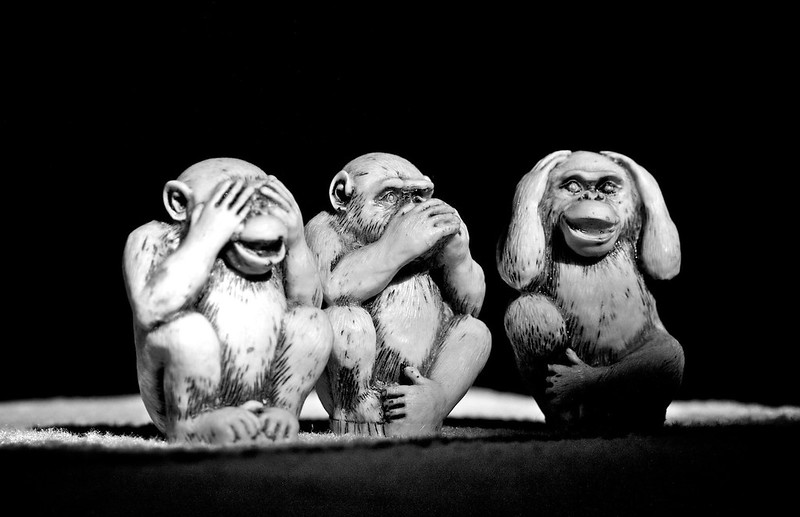
Land, sea, sky. Birth, life, death. Child, adult, elder. Beginning, middle, end. Ready, set, go. Lights, camera, action. I came, I saw, I conquered. See no evil, hear no evil, speak no evil.

It’s a habit of humanity to divvy things up into threes. Maybe because it’s a nice prime number, like 5 or 7. There’s a pleasant sense of completeness in three, a satisfaction that you can’t quite get with two, and going up to four is a step too far. Three is everywhere, and it’s found a home in our collective psyche. Things always feel right when they’re grouped into threes. Stories feel right.

The number three is storytelling’s superstar. Stories rely on patterns, and the number three is the smallest number you can use to set up a pattern and then deviate from it. Take a glance at fairy tales and note how many times the third brother gets the prize, or how many trials the hero must overcome to succeed, or how many times the evil witch tries to stop him. Set up the expectation and then throw in a twist the third time around.

Good stories tend to be efficient with their time and words. Why go through the same pattern four times to set up the fifth’s deviation, when you can cut out two repetitions and get the same result? Maybe early oral storytellers were just lazy and hit on a good tactic to keep listeners engaged without wearing out their throats.

Either way, if you’re going to be a writer, consider the usefulness of the rule of three. Most stories are divided into three acts: The setup, the middle action, and the climax. Want to reinforce that a plot element is important? Mention it three times: Once to introduce it, a second time to remind your audience of its existence, and a third time for the payoff (alternatively, a third time to reinforce it in audience’s minds, and then give them the payoff).

Remember the oath that witnesses make in court? “Tell the truth, the whole truth, and nothing but the truth, so help me, God.” Here we see the principle in action: “Tell the truth” (introducing the concept to speak truthfully), “the whole truth” (reinforce the concept that you will be honest), “and nothing but the truth, so help me, God” (grinding it into your head that you will tell the truth, doggonit!)

As weird as the rule of three is if you think about it too hard, we’ve been raised on it for so long that it’s been hardwired into most societies. We tend to think in terms of threes when writing, when talking with friends, or even when giving a speech. It’s just such a common, reliable, and trustworthy trope. It’s in schools, it’s in media, it’s even in the academic community.

Ha, ha, yes, I’m so very clever. But you get the point. Don’t you? Need me to repeat it again?

In all seriousness, we humans do like patterns, and the rule of three is such a basic pattern that it fits pretty much anywhere. We recognize it, at least on a subconscious level, because we’ve been exposed to it since childhood. I can make that statement with confidence because it’s just. That. Widespread. And yes, I did just use the rule again to prove my point. Really, this whole article could drown in its own metatext.

Being so common, the rule of three is a reliable standby for writers both beginner and veteran. I use. You use it. And – Well, you get the idea.

The gods and beings of ancient myth never went away. They just moved on with the times.

My book, A God Walks up to the Bar, is currently available on Amazon.com. Venture into the world of the Greek god Hermes, a world filled with demigods, vampires, nymphs, ogres, magic, and trickery. It’s a tough job, being a god!

Enjoying my blog? Don’t want to miss a single post? Subscribe for updates on when I post and follow my writing career, musings on fiction and storytelling, and reflections about life in general!