No Jetpacks, No Teleporters, No Space Colonies … Keep Pushing Back the Date, Writers!

You ever notice how writers underestimate the rate of technology’s advance? They never quite get it right.

In the 1950s, writers predicted that families would be getting lost in space in the year 1997 A.D. They didn’t. In the 1960s, some small-time director thought that 2001 would a true odyssey in space. It wasn’t. Manned spaceflight hasn’t even gotten past the moon.

In the 1980s, a certain movie about time travel had the audacity to suggest we’d have hoverboards by 2015. That one still hurts. I want a hoverboard!

But no, we don’t have any. We have electric unmanned cars that come to a dead halt in the middle of intersections if the power grid goes out, but no hoverboards.

But we writers have a simple solution for irritants like reality and historical fact. We ignore them.

Just keep pushing back the date. By 2040 we’ll have colonies on Mars, I’m sure. No? By 2070. No? By 2100. Repeat as needed.

Oh, but don’t go thinking writers are completely lacking in self-awareness. There was an overt change in tactics around the 2000s when space colonies were proving to not be coming any time soon.

Writers started cheating.

In the year -insert random year around two decades from now- mankind discovers alien technology on the moon or Mars or what have you and reverse engineers it. Or a benevolent alien race arrives and welcomes us into the greater galactic community. Huzzah!

The year doesn’t even matter anymore! Marvelous literary freedom unbound by the constraints of science and logic! Be it 2027 or 2227, humanity will eventually discover those long-lost alien ruins that will unlock the secrets of faster-than-light travel, teleportation, artificial gravity and hoverboards.

What? Impossible, you say? Excuse me, but how do you know there isn’t an alien vault on the moon? You have proof?

Besides, writers don’t need proof. We type it down, and it is so. Just like this: In 2036 we will have flying cars. See? That was easy.

Science fiction is easy. All you have to do is keep moving the goalposts. And pretend that you never believed we’d all have hoverboards in the 2010s.

***

Many thanks for visiting my blog. I post updates on my writing career, I muse over storytelling and fiction, and I reflect on the curious and wonderful things in life.
“Hermes is not having the best time. He walks a fine line, and his duty as messenger of Olympus weighs heavily on him. Being a god in the modern age means living in a world that no longer believes in gods. How much can one deity accomplish when no one respects him anymore? And why do his instincts tell him that he, the son of Zeus, is losing favor with his own family?

Tensions abound. The upstart Young Gods play dangerous games using entire cities as their boards. Formless monsters strike from the nighttime shadows, terrorizing hapless mortals. Agents of rival pantheons scheme to thwart Olympus’ designs. In the thick of it all, Hermes does what he does best: trick, lie, and cheat his way to victory.

What Matters Most: Establishing A Story’s Stakes

In every story, there are stakes. Something may be lost, something may be gained. The story’s conflict means something. Without stakes, without the risk of failure, a story isn’t very interesting. Who cares if the One Ring is destroyed in the fires of Mount Doom if Sauron isn’t a threat? Who cares about the Galactic Empire if they’re a paper tiger who can’t even threaten one planet?

You need to establish the stakes early on. That is to say, you need to establish what will happen if the heroes lose: Sauron conquers Middle Earth and reduces everyone to slavery. The Galactic Empire uses the Death Star to destroy any planet that opposes it. The heroes’ actions must matter.

Of course, not all stories have such a grand scope. To Kill a Mockingbird doesn’t deal with world-rattling threats, but Atticus Finch is struggling to prove an innocent man didn’t commit the crime he is accused of. The Grapes of Wrath centers around a family trying to establish a new life in California and not fall apart in the process. These are more personal stakes, but no less important.

That’s another thing about establishing stakes. They must be appropriate to the story. Personally, I think that, first and foremost, the stakes must be appropriate to the protagonist. We are reading about a character, and what matters to them must matter to us. If the stake is nothing more than Jim trying to get his kite into the air, then, by golly, that’s what the reader should care about, too.

Sometimes the stakes in a story increase. Maybe Jim gets drafted into World War II. Well, that’s a major shift. What’s at stake now? Survival? Capturing the enemy base? Maybe. But what is most appropriate is what directly affects Jim’s personal journey. It’s not just about fighting the enemy, any more than it was about flying the kite. It’s about Jim’s character growth.

It was never about getting the kite into the air. It’s not about fighting the war, not really. Those are the circumstances, but the story is about Jim learning to persevere and attain self-confidence. He never really felt that he was capable of getting that kite in the air. He feels that he can’t contribute to the war. The kite and the war represent the same thing: obstacles to Jim’s goal of becoming a confident, mature adult.

Okay, I’ll leave it up to one of you out there to write that story.

Writers don’t play hopscotch with the stakes. Even when they are raised to something more serious, they still form a core that drives the narrative. Every new stake is connected to the protagonist’s central conflict, each one a facet of his or her inner struggle.

It’s not about building up the biggest, most dire conflict imaginable: “The world will end! The evil empire will rule! The plague will kill us all!” It’s about character. It’s about what matters most to the protagonist.

***

Many thanks for visiting my blog. I post updates on my writing career, I muse over storytelling and fiction, and I reflect on the curious and wonderful things in life.

“Hermes is not having the best time. He walks a fine line, and his duty as messenger of Olympus weighs heavily on him. Being a god in the modern age means living in a world that no longer believes in gods. How much can one deity accomplish when no one respects him anymore? And why do his instincts tell him that he, the son of Zeus, is losing favor with his own family?

Tensions abound. The upstart Young Gods play dangerous games using entire cities as their boards. Formless monsters strike from the nighttime shadows, terrorizing hapless mortals. Agents of rival pantheons scheme to thwart Olympus’ designs. In the thick of it all, Hermes does what he does best: trick, lie, and cheat his way to victory.

A Thought on the Horror Genre

I don’t have any long discussion on life, writing and the universe planned today. Just a brief thought on the topic of story genres:

The difference between the horror genre and the action genre is whether or not the protagonist has a shotgun.

Cheers.

***

My latest book, The Trickster’s Lament, is currently available on Amazon in both Kindle and paperback format.

“Hermes is not having the best time. He walks a fine line, and his duty as messenger of Olympus weighs heavily on him. Being a god in the modern age means living in a world that no longer believes in gods. How much can one deity accomplish when no one respects him anymore? And why do his instincts tell him that he, the son of Zeus, is losing favor with his own family?

Tensions abound. The upstart Young Gods play dangerous games using entire cities as their boards. Formless monsters strike from the nighttime shadows, terrorizing hapless mortals. Agents of rival pantheons scheme to thwart Olympus’ designs. In the thick of it all, Hermes does what he does best: trick, lie, and cheat his way to victory.

Many thanks for visiting my blog. I post updates on my writing career, I muse over storytelling and fiction, and I reflect on the curious and wonderful things in life.

Writers, Mix It Up

I’ve started on the third installment in my urban fantasy series. Everyone writes at different speeds, and I’m somewhere in the middle of the pack, I think. I published my first book in August 2023 and published my second in January of this year. I hope to finish this third installment by the end of next year.

Maybe I am a slow writer, after all, but when you have a job and other commitments, you can’t be a writer 24/7, unfortunately.

Anyway, I’m happy with my work, but after finishing this current project, I think I’ll take a break from Hermes’ adventures. I’m in the mood to try something new. And that’s healthy, I’m finding. Writing about the same thing is kind of like exercising. If you keep exercising the same muscle group over and over, you end up hurting yourself rather than strengthening yourself.

So, I want to mix it up. I want to write different stories after finishing book #3 and stretch my talents. Broaden my horizons and various other cliches. It’ll be fun, and it’s good practice to try something new.

***

My book, The Trickster’s Lament, is currently available on Amazon in both Kindle and paperback format.

“Hermes is not having the best time. He walks a fine line, and his duty as messenger of Olympus weighs heavily on him. Being a god in the modern age means living in a world that no longer believes in gods. How much can one deity accomplish when no one respects him anymore? And why do his instincts tell him that he, the son of Zeus, is losing favor with his own family?

Tensions abound. The upstart Young Gods play dangerous games using entire cities as their boards. Formless monsters strike from the nighttime shadows, terrorizing hapless mortals. Agents of rival pantheons scheme to thwart Olympus’ designs. In the thick of it all, Hermes does what he does best: trick, lie, and cheat his way to victory.

Many thanks for visiting my blog. I post updates on my writing career, I muse over storytelling and fiction, and I reflect on the curious and wonderful things in life.

My New Book is Out on Amazon!

I am very excited to announce that my new book, The Trickster’s Lament, is now available on Amazon for both Kindle and paperback. This is my second ever published book and a sequel to my first, A God Walks Up to the Bar. I hope that my readers enjoy the further modern day adventures of the Greek god Hermes.

Synopsis:

“Hermes is not having the best time. He walks a fine line, and his duty as messenger of Olympus weighs heavily on him. Being a god in the modern age means living in a world that no longer believes in gods. How much can one deity accomplish when no one respects him anymore? And why do his instincts tell him that he, the son of Zeus, is losing favor with his own family?

Tensions abound. The upstart Young Gods play dangerous games using entire cities as their boards. Formless monsters strike from the nighttime shadows, terrorizing hapless mortals. Agents of rival pantheons scheme to thwart Olympus’ designs. In the thick of it all, Hermes does what he does best: trick, lie, and cheat his way to victory.

He may be disrespected. He may be kicked about. He may even be falling out with his pantheon. But Hermes is a trickster. He knows how to play dirty in a world that doesn’t play fair. But though he can best man, beast, and god, he isn’t prepared for his wiliest opponent yet: his own conscience.”

And for those who missed it the first time …

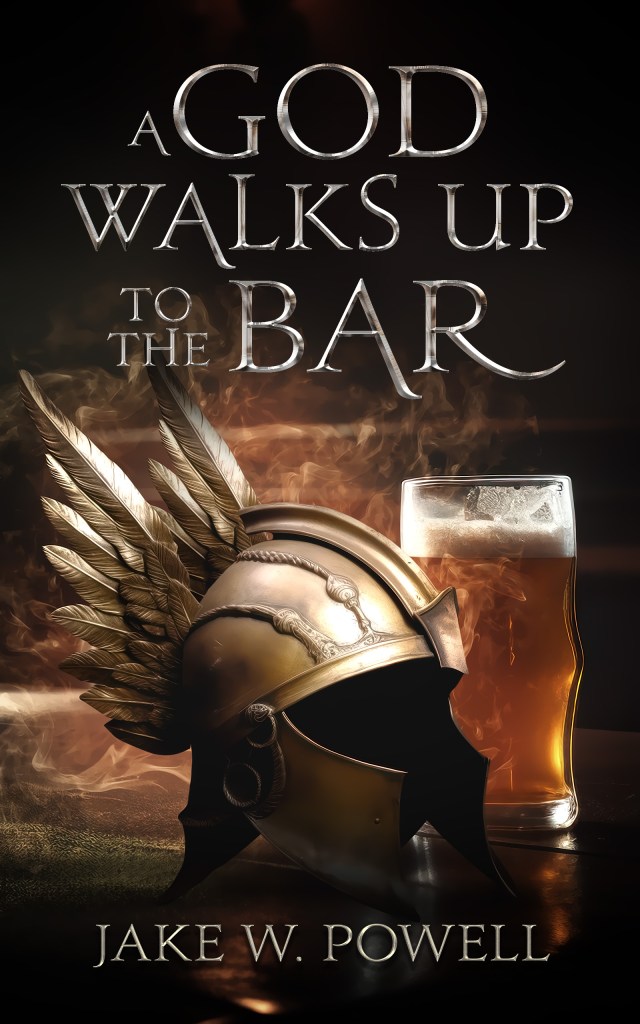
A God Walks Up to the Bar, my first foray into publishing, is also on Amazon.com. Interested in Hermes’s first recorded adventures battling half giants, skinwalkers, vampires, and other foes? Check it out!

As always, thanks for simply visiting my blog and sharing in my writing career and my various musings on life, the universe, and everything. Whether you click that subscribe button or not, I truly appreciate your taking the time to read my ramblings. Cheers.

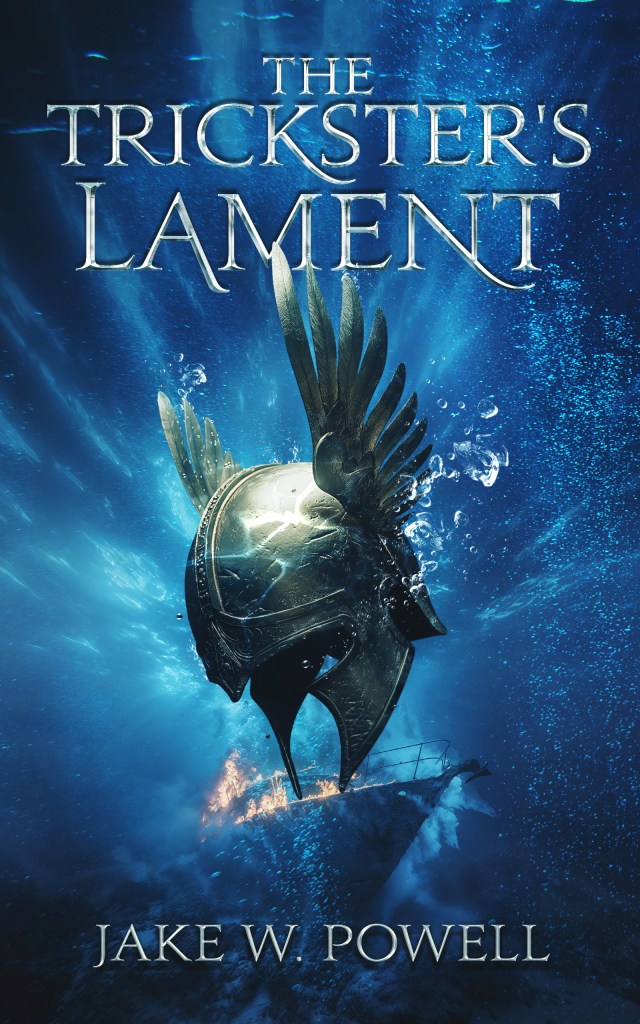
Cover Art for The Trickster’s Lament

It’s my pleasure and privilege to reveal to you the title and cover of my soon to be published second book, The Trickster’s Lament.

Per the synopsis:

“Hermes is not having the best time. He walks a fine line, and his duty as messenger of Olympus weighs heavily on him. Being a god in the modern age means living in a world that no longer believes in gods. How much can one deity accomplish when no one respects him anymore? And why do his instincts tell him that he, the son of Zeus, is losing favor with his own family?

Tensions abound. The upstart Young Gods play dangerous games using entire cities as their boards. Formless monsters strike from the nighttime shadows, terrorizing hapless mortals. Agents of rival pantheons scheme to thwart Olympus’ designs. In the thick of it all, Hermes does what he does best: trick, lie, and cheat his way to victory.

He may be disrespected. He may be kicked about. He may even be falling out with his pantheon. But Hermes is a trickster. He knows how to play dirty in a world that doesn’t play fair. But though he can best man, beast, and god, he isn’t prepared for his wiliest opponent yet: his own conscience.”

Look forward to The Trickster’s Lament release on Amazon.com later this month!

Many thanks for visiting my blog. I post updates on my writing career, I muse over storytelling and fiction, and I reflect on the curious and wonderful things in life.

The Trickster’s Lament preview #2

Another glimpse of my novel-in-progress.

Don’t you just hate it when a plan falls apart? A simple museum heist has gone completely off the rails for Hermes. The trickster god better think fast.

I didn’t wait for more gunfire and sprinted out of their line of sight into a nearby gift shop. I vaulted the cashier’s desk and winded through the shelves of merchandise. As I did so, I felt a sudden and intense accumulation of magic behind me, a growing pressure that was followed by a violent rush of wind. The sensation swiftly changed from that of a strong gust to the feeling of barbed-wire digging into me. I dropped to the floor.

The clamor of the spell demolished the shop. Books, toys, mugs, and pens were caught up and eviscerated by a wind storm condensed into a narrow room-wide blade of fast-moving air. Metal shrieked as the spell sliced apart shelving. It traveled to the end of the room before it dissipated, leaving a deep gash in the wall.

Wind magic is hard. Controlling it with any degree of precision, let alone focusing it into a cutting edge, is notorious among mages for its difficulty. Most would-be practitioners either give up or lose limbs. These mercenaries were no amateurs. They also obviously had no interest in witnesses.

After the spell ran its course, I pushed myself to my feet and leapt up and over the pile of shredded debris. My foot caught on a piece of ripped cardboard, and I tripped. Four pops of a gun sounded behind me. One of the bullets caught me in the shin. As I regained my footing, centuries of discipline helped me to force the shock of pain to the fringes of my awareness. Another bullet did the proverbial whistle past my ear and kicked up a bit of plaster a few feet away.

Exiting the shop, I reached the second-floor rotunda overlooking the lobby. Speed was essential, so, without stopping, I rolled forward, defying the pain in my leg. I shapeshifted as I came out of the roll, landing as a tortoise whose inertia and smooth underside skidded me along the tile floor like a misshapen hockey puck. Shots aimed at human head height whizzed over me.

I came to a rest and peeked out of my shell. Three men exited the gift shop and proceeded cautiously, two of them with guns raised. Before they could spot me, I changed into a fly and circled behind them. Strong hands swiftly grabbed the pair of gunmen by the napes of their neck and slammed their heads together.

The mage spun around at the sound of my attack. He was dressed like the others – black body armor and balaclava, night vision goggles – but he carried no gun except a sidearm at his hip. His hands were stretched out with palms forward. He was furiously chanting to focus his magic. Not fast enough.

I swung one of the unconscious mercs into a wide arc. At the apex of the throw, I let go. The merc flew gracelessly into the mage. The man saw it and nimbly hopped aside, dodging entirely.

But I followed through the toss and kept spinning. I gripped the second merc with both hands and hurled him as hard as I could. It was a beautiful hit. Both bodies were lifted off the floor and traveled a perfectly horizontal trajectory into a wall.

With luck and medical attention, they would keep all their ribs intact.

More footsteps echoed in the museum’s open space. This was becoming annoying. I didn’t have the inclination to play soldier, and I was running out of time. I had to find Bast. She was still somewhere in the museum, and she had my prize in her hands. Catching up with her was my one and only priority. These thugs were a distraction, at best.

I gritted my teeth. She had better still be here.

Many thanks for visiting my blog. I post updates on my writing career, I muse over storytelling and fiction, and I reflect on the curious and wonderful things in life.

The Trickster’s Lament preview

Yes, indeed, I have been working on my second book all this time! And now that it is nearing completion, I’m happy to share a sneak peak of The Trickster’s Lament, continuation of the Greek god Hermes’ adventures in the modern world and sequel to A God Walks Up to the Bar.

In my long life, I’ve awakened to many unpleasant sensations. The awareness that I was drowning swiftly found its place as among the worst.

Consciousness returned slowly. My muddled mind tried to take stock of my surroundings, but failed to comprehend. And so, I obeyed my body’s first instinct, which was to open my mouth and take a deep breath. For that, I received a mouthful of water straight down my windpipe. I choked. The spasm triggered another reflexive breath and more water filled my lungs.

My eyelids snapped open, and I looked around in pain and mounting panic. I rotated my body down to look at the murky blackness beneath my feet, then upward toward the white sun splintered into fragments by the water’s rippling surface. I made frantically for that light, swinging my arms in wide strokes that strained my half-drowned body. Black dots skewered my vision, and every movement was agony. I was dying.

I couldn’t actually die from drowning, of course. One would think that would be an advantage. But my body wasn’t immune to harm, merely to death. I could feel the water in my lungs cutting off the flow of oxygen to my brain. I could feel my heartbeat slow as vital organs succumbed. I could feel every second of my body’s suffering. No, I wouldn’t die. I’d just be reduced to a limbo state, a piece of litter drifting along the currents.

I retched and vomited. A current pushed the warm mess back into my face. A painful twitch in my throat forced me to take another breath. The same water I’d ejected was sucked back in.

I felt a tinge of envy for mortals. Such a uniquely morbid sensation, dying but not being able to die. Feeling the blood in your veins pool and thicken into sludge, and your clogged respiratory system desperately tried to pump out water faster than it was taking it in. My skull felt like it was cracking apart as my brain functions collapsed. Pure animal instinct was all that kept me moving.

Dying, but unable to die. Lucky me.

Eyes bulging out of my head and white-hot pain searing every cell in my body, I broke the surface. Water and vomit erupted from my mouth in a geyser. For the next few moments, I just floated on the waves. My body needed time to heal itself and return to proper working order. My vision gradually cleared of fluttering black flecks, and my thoughts readjusted into more complex patterns than “Oh, dear Hera, I need to breathe.” While I waited for my strength to return, I looked about and saw only rolling waves and a pale sun winking from a cloud-streaked sky. No land was visible. I was alone in the Atlantic.

Many thanks for visiting my blog. I post updates on my writing career, I muse over storytelling and fiction, and I reflect on the curious and wonderful things in life.

Stories and Lies

Interesting thought for the day: All storytellers are liars.

Authors, poets, filmmakers, artists … We make things up. We show things to audiences that aren’t real.

But we’re liars who admit we’re liars. The things we tell in our stories are acknowledged as fiction. That’s why it’s called “fiction” and not “deception.”

There is an unspoken agreement between storyteller and audience: I will tell you something untrue, and you will treat it as something true until the story is ended. Audiences know that they are witnessing a fabrication, and so it is acceptable.

But stories do discuss real things – people, events, feelings, ideas, places – although the story itself isn’t true. Even if it is retelling a piece of history, it’s prefaced by the words “Based on a true story.”

Yet if it presents itself as real history, but isn’t, then it’s an actual lie.

Stories are lies that know they are lies and willingly admit it. And so they aren’t true lies, because they don’t pretend to be anything else.

Many thanks for visiting my blog. I post updates on my writing career, I muse over storytelling and fiction, and I reflect on the curious and wonderful things in life.

Just Like Ping-Pong: Crafting Conflict Between Hero and Villain

Let’s assume for a moment that we’re talking about a story featuring classic good versus evil. There’s a hero and a villain. They struggle with each other for victory.

What makes the story good? Lots of things, but interest is a biggie. We like interesting stories. Inversely, we avoid boring stories. What makes an interesting story? Conflict. The hero has to struggle to reach her goal. She must overcome obstacles great and small, and in so doing display character growth and maturity. At the heart of that struggle is their nemesis, the story’s villain.

Good villains go through their own struggles. Does that surprise you? The hero isn’t the only one who must overcome. After all, the best villains are the heroes of their own stories.

Like heroes, villains have goals. These goals run directly counter to the hero’s, hence why they clash. Now, a villain may be stronger than the hero, or smarter, or generally more intimidating. Which is great! It makes the hero’s victory all the sweeter. But if the villain always wins and succeeds in all their schemes right up until the last hour when the hero finally, conclusively defeats her opponent, well … It’s not a bad thing, per se, but it’s a tad predictable, and rather repetitive.

But what if the conflict becomes a ping-pong match?

The hero wins one round. The villain wins the next. They trade blows and barbs; they’re evenly matched up until the last. Now that’s a good story! It keeps the audience on their toes. You don’t know what’s going to happen next. You’re dangling in delicious suspense. “What if?” you ask yourself. What if this story doesn’t end happily? What if the bad guy wins? After all, the villain is a match for the hero. It’s just like ping-pong, which can get really intense if both competitors are skilled.

Okay, we know that good overcomes evil 90% of the time, but the illusion of doubt is introduced. Disbelief is suspended. We are caught up in the moment of the story.

Meaningful conflict is driven by a question that any good story should prompt in the audience: What happens next? It doesn’t matter if deep down we know the answer. The question should still be whispered on our lips.

Many thanks for visiting my blog. I post updates on my writing career, I muse over storytelling and fiction, and I reflect on the curious and wonderful things in life.