What is the most important thing to carry with you all the time?
What do I carry with me? That question can be a profound one. What abstract qualities do I carry that sustain me through the day? What precious items do I keep with me at all times that show what I truly value?
Well, it could be a profound question. Or it could be remarkably mundane and ordinary. Let’s go in that direction. There’s time for profundity later.
I always carry my glasses. Why? Because I need them. I can’t see well without them. I’d say that’s pretty important, wouldn’t you? My glasses are a part of me, whether I like it or not, and so they are either on my face or close at hand all the time.
It’s not emotional. It’s not soul-stirring. It’s not philosophical. But it’s real. If I didn’t have my glasses, I’d be straining to read these words as I’m writing them. If I couldn’t find them, I’d be tearing apart my room looking for them, crying fruitlessly, “Where are my glasses?”
***
Many thanks for visiting my blog. I post updates on my writing career, I muse over storytelling and fiction, and I reflect on the curious and wonderful things in life.
“Hermes is not having the best time. He walks a fine line, and his duty as messenger of Olympus weighs heavily on him. Being a god in the modern age means living in a world that no longer believes in gods. How much can one deity accomplish when no one respects him anymore? And why do his instincts tell him that he, the son of Zeus, is losing favor with his own family?
Tensions abound. The upstart Young Gods play dangerous games using entire cities as their boards. Formless monsters strike from the nighttime shadows, terrorizing hapless mortals. Agents of rival pantheons scheme to thwart Olympus’ designs. In the thick of it all, Hermes does what he does best: trick, lie, and cheat his way to victory.“
I’m working off of this daily prompt under the assumption that “crazy business idea” means something that no sane, rational person would actually attempt with a serious expectation of success. Something so absurd that only a crazy person would expect it to turn a profit. Something that –
Let’s face it, somebody would try to do this in real life, and scarily enough, it might just work.
My idea is to sell ideas as a service.
No, no, not selling an idea for a type of service, but selling actual ideas. For example, Joe Citizen wakes up one day and wonders, “What should I have for breakfast? I can’t decide.” So, he calls up Ideas, Inc. and asks. Ideas, Inc. tells him to make waffles. What a good idea!
Jane Doe wants to know where her son should go to school. Ideas, Inc. to the rescue! And what should he major in when he enters college? Ideas, Inc. can tell you!
Wondering what car to buy and in what color? A monthly subscription to Ideas, Inc. can give you these answers and more!
Why bother thinking when you can subscribe to a service that thinks for you?
Like I said, silly and nonsensical. But is it really? Hmm…
And if I ever see this service in real-life, I will know somebody stole the idea from me, heh.
***
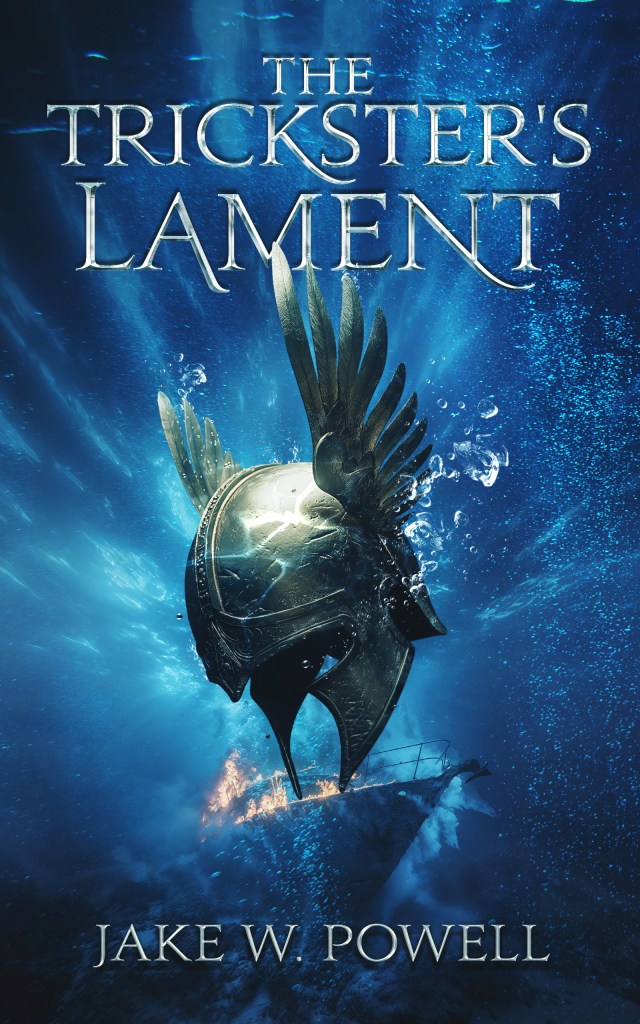
My new book, The Trickster’s Lament, is currently available on Amazon in both Kindle and paperback format.
“Hermes is not having the best time. He walks a fine line, and his duty as messenger of Olympus weighs heavily on him. Being a god in the modern age means living in a world that no longer believes in gods. How much can one deity accomplish when no one respects him anymore? And why do his instincts tell him that he, the son of Zeus, is losing favor with his own family?
Tensions abound. The upstart Young Gods play dangerous games using entire cities as their boards. Formless monsters strike from the nighttime shadows, terrorizing hapless mortals. Agents of rival pantheons scheme to thwart Olympus’ designs. In the thick of it all, Hermes does what he does best: trick, lie, and cheat his way to victory.
He may be disrespected. He may be kicked about. He may even be falling out with his pantheon. But Hermes is a trickster. He knows how to play dirty in a world that doesn’t play fair. But though he can best man, beast, and god, he isn’t prepared for his wiliest opponent yet: his own conscience.”
Many thanks for visiting my blog. I post updates on my writing career, I muse over storytelling and fiction, and I reflect on the curious and wonderful things in life.
If you could live anywhere in the world, where would it be?
I would live in a comfortable cabin in the middle of a sparse but lush forest with no neighbors within shouting distance and located exactly one hour away from the nearest town. I would also have electricity and a hot tub.
Those who read my musings on my city of the future may be aware that when a daily prompt asks me what I want, I go whole hog with exactly what I want. Will I ever get it? Probably not, but my imagination doesn’t have to agree with reality. I want a cozy cabin, I want peace and quiet, and I want to huddle up on my couch and watch my big-screen TV while the birds chirp outside. And when I need to go shopping, I want the store to be an hour’s drive away.
Fantasizing about an idyllic, Arcadian existence is all fun and dandy, but actually living it is a different case entirely. Loafing around on a tropical island is fine until you need to take a shower and have no soap and shampoo. Or towels and washcloths. Or plumbing. Not to mention the bugs and the heat and the storms. Yes, I admit it, I like modern amenities as much as I like nature. So, I would live close to nature, but not too close, thank you very much.
Civilization strove for millennia to invent the modern conveniences we currently enjoy, and some of them were invented for very good reason. Who am I to throw aside all that hard work?
Okay, maybe I could go without the hot tub …
Many thanks for visiting my blog. I post updates on my writing career, I muse over storytelling and fiction, and I reflect on the curious and wonderful things in life.
Well, for starters, I’d figure out what the heck is meant by “city of the future.”
I mean, hypothetical, futuristic cities designed in the 1950s look a lot different from what we 2020ers think they should look like . A lot less art-deco and a lot more Apple aesthetic. Lots of white and curved corners. In fifty more years, the city of the future will probably be imagined as made of recyclable plastic or something.
But this is my city, right? I can do what I want. So, futuristic means pretty, practical, and maybe even a little sustainable.
First thing’s first, its streets are based on a grid system. I want a city that’s easy to navigate with no silly, loopy streets going every which way. If we live in the future, we should be able to make our own cities easy to drive in, a least. Also, wide streets. My city will acknowledge the existence of heavy traffic and anticipate it. Wide streets that can accommodate, oh, let’s say six lanes.
But I’m also going to offer incentives to not drive cars everywhere. Because we’re in the future, right? And cars are a thing of the past. Well, they might be. It’s the future, who knows what’s going to happen?
So, I’ll have elevated rail lines for the train and also lots and lots of rental stations with electric bikes. Just put in a quarter and ride your rental for an hour or so. Also, I’m bringing back trolleys. Trolleys are a great idea, and I’ll fight the gas companies to make my city’s public transportation system the best in the world.
Since my city is on a grid, I’m thinking it’ll be shaped like a big square or rectangle. In the center is where all the skyscrapers will be located; the major businesses and corporate headquarters will have their places in the center, and they aren’t going to be big blocks of glass. I want some curvature to these buildings, something a little softer on the eyes. No hard corners. Also, solar panels. I’ll coat the upper floors of these skyscrapers in solar panels. Fancy, futuristic solar panels that are transparent or something, so you can still see out the windows. Not possible? Well, guess what? It’s the future!
Ah, speaking of power, I’m also going to install revolutionary new generators under the city center sidewalks that convert the kinetic force of footsteps into electrical energy. That’s right, I’m going to design a city that generates power from people walking down the sidewalk. Impossible, you say? Need I remind you? Future!
The most vital part of my city design is trees. Lots and lots of trees. The streets will be lined with trees, and there will be dozens of parks. Big parks, little parks, flower gardens, all scattered throughout the city. The very center of the city, smack dab in the middle, will be the biggest park, with a lake, a sports field, a walking loop through the woods, and more. Trees are important. They provide fresh oxygen and help calm people who otherwise are trapped in an artificial world. My city of the future will have nature in it.
That’s about all I can think of. A nice, pretty city that’s livable. And preferably cheap to live in. It needs lots of incentives for businesses to come in and employ people, but I’m just the designer, not the economist, so I can’t answer that here. But I’m sure my revolutionary sidewalk power generators will cut down on costs somehow.
I took the time to describe my basic idea to AI and got this image spat out in response.
Not bad, actually. I was expecting worse from AI. The buildings aren’t quite what I wanted, but I like the distinct lack of traffic and lots of bicyclists. Also, trees. Yes, that many trees.
There you have it. My city of the future.
Many thanks for visiting my blog. I post updates on my writing career, I muse over storytelling and fiction, and I reflect on the curious and wonderful things in life.
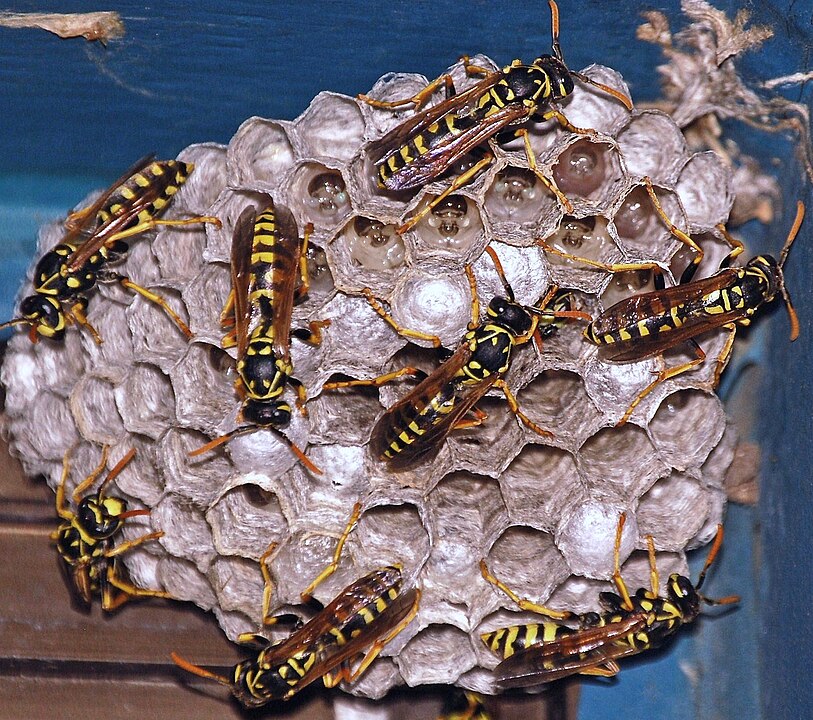
There are bullies under the summer sun. They have no sense of mercy, they inflict harm without cause, and they don’t even have the decency to enjoy it. They buzz around like yellow caution signs of doom. They set up shop exactly where it will worst inconvenience you – butting into your backyard and your homes like they own the place. And if you say anything, they stab you.
I am, of course, talking about wasps. Nature, for all its horrors, is pretty chill all told. Spiders only bother you when you bother them (“It’s not MY fault you walked into the web I set up at eye level”). Tigers and bears and wolves are just hungry, or you got too close to their cubs. Who doesn’t get angry when someone messes with their kids? Sharks are the victims of bad press. Just because someone can’t blink or smile or emote in any way comprehensible to human brains is no reason to discriminate (also, get out of the water). And crocodiles and hippos … okay, they’re pretty bad, but if you keep your distance they’re okay.
Wasps don’t keep their distance. Wasps don’t need a reason. Wasps go out looking for trouble. Those narrow, spindly bodies, those pitch-dark eyes … Just look at the villainous invertebrates!
Look at them! Look at the vile monstrosities!
Not at all like the humble bee. Bees are selfless. Bees are productive. Bees can coexist with mankind. If you rile them up, they’ll sting once and give their lives for the colony. See, even if you’re being swarmed by bees, they’re still quite heroic when you think about it. They give themselves for a greater cause. Not wasps. The only thing a wasp has to give is PAIN.
They don’t produce honey or wax or even jelly. They got nothing (except the aforementioned giving of pain). All animals, no matter how scary, are reasonable enough when you get to know them. Except wasps. They gang up on you because you looked at them funny. They are genocidal, resource-hording invaders. They’re under your feet. They’re in your walls. They want your PB&J sandwich. They’ve claimed your favorite climbing tree and will obliterate you if you get too close. Screw you, wasps.
Wasps are jerks.
Many thanks for visiting my blog. I post updates on my writing career, I muse over storytelling and fiction, and I reflect on the curious and wonderful things in life.
The eternal pressing question: What is art? What defines it, what is its nature, how is it differentiated from the common dross, and how do we recognize it when we see it? What. Is. Art?
Ask a hundred people, and you’ll get a hundred and one different answers. Nobody can seem to decide, though everyone, from the working joe to the professional critic, seems convinced that they know exactly what art is. The artistic merits of literature, film, paintings, and even video games are debated again and again. Is it art? But can we know, when the definition of art is as fluid as the fresh paint dripping from a canvas?
Maybe we’re asking the wrong question. Maybe we should instead ask what isn’t art.
Can this process of elimination help answer this great question? Consider the humble spoon. Is a spoon art? Well, most people would say it isn’t. You use it to eat soup and cereal. It’s a mundane thing. It has an everyday utility. It isn’t art.
What about a car? Is a car art? Well, it also has a mundane use: transportation from point A to point B. But look at car commercials and car shows. Cars boast aesthetic pleasures and pleasing design. They are promoted based on appearance, performance, improvement, and flashy lights. People collect cars. People analyze cars. Are they art? Or are they merely utilities passed off as art? And how do we know, unless we can define what art is?
This is getting complicated.
Why do Jackson Pollack’s paintings get hung up in museums but a two-year old’s paint smears don’t? What’s the difference? Aren’t they both paintings? And aren’t both paintings art? Well, the latter obviously isn’t art art because nobody cares except the parents. But everyone must care about Sydney Pollack since he gets public exhibits.
Nobody cares about spoons unless they try eating soup with a fork. But everyone cares about cars, one way or another. They’re both a fact of life, but one is just plain more noticeable than the other.
Nobody cared about the pipe until René Magritte put up a picture of one alongside the words, “This is not a pipe.” A pipe is just a pipe until it isn’t.
Maybe that’s all there is to it. Maybe art isn’t art until you decide that it’s art.
Until you care whether or not it’s art.
If enough people say that something is true, does it become true? No. No matter how many people say you can fly by flapping your arms, you can’t. But it sure is easier to think you can.
Is that all that art is? A shared belief? A social construct? Just the idea that if we belief something has merit inherent in its composition, construction, appearance, and intent, it rises above the mundane to become something with social significance?
But what about your two-year-old’s paint splatters? Is that art? What loving parent would say, “No”? To them it’s art. It’s more precious than everything in the Louvre.
Maybe art is more than just innovation, messages, and composition. Maybe it’s something more personal than that. Maybe art lies in how much it is valued by the individual. I happen to think cars all look the same and are basically just glorified boxes on wheels. I don’t see the appeal. Cars aren’t art to me. But to others, they are masterpieces.
Critics say something is art, and so we believe them. They must know what they’re talking about, right? Then, a hundred years later, the great art of the time is depreciated. It’s not as important. And new art replaces it. Tastes and preferences change. The definition of art changes based on what we think is important.
A spoon can be a piece of art. In some ways, it is by default. “Art” is a relative of the word “artifice.” Artificial. Manmade.
Maybe everything is art. But if everything is, than nothing is art.
Oh, to heck with it. Art is whatever you want it to be.
If you just so happen to be enjoying my blog, feel free to subscribe. I post updates on my writing career, I muse over storytelling and fiction, and I reflect on the curious and wonderful things in life.
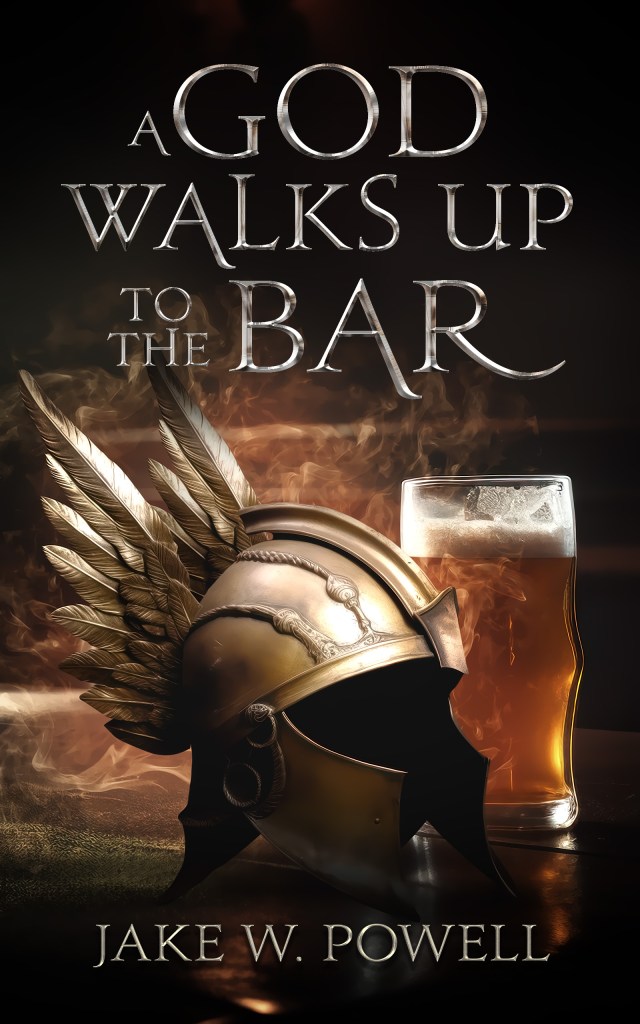
My first book, A God Walks up to the Bar, is available on Amazon.com. Witness the modern day adventures of the Greek god Hermes in a world much like our own – and with demigods, vampires, nymphs, ogres, and magic. The myths never went away, they just learned to move on with the times. It’s a tough job, being a god!
The history of humanity is the history of crossing over the next hill.
Where are we without curiosity? Caves and mud huts. One day, someone steps outside with a mind filled with questions. What is over that next hill? What is in that valley? What is beyond that forest? Anther follows, and another. Further afield we walk, driven not by necessity but because we want to know.
Questions follow questions. Can I eat that? Can I grow it? Why does this reed make a sound when I blow through it? Food and music are discovered. Someone finds a sturdy stick. A walking stick, and soon a weapon. Lines are draw on sandy ground, then painted onto rock and hides. Maps are made to chart the wanderer’s path.
We cross the last hill and find a sea. But now is not the time to stop. Wood floats, this is known. A little later, and mankind sails out on boats across the water to find out what lies on the other side. They learn how to make the stars their guide. Navigation becomes more than simple wandering.
Where people grow tired and rest, they find new fruits and vegetables and animals. The nomad becomes the gardener and herdsman. Someone notices those mangy wolves following the camp for scraps. Someone tames them.
People build huts of straw and wood, of stone and brick. Cities appear. Curiosity turns inwards. How to make life better? Clever hands produce answers: the wheel, the hammer, the nail, the net, the plough, the saddle.
Not all stay in cities. Others keep wandering, looking for the next hill and sea and valley. They wander far afield, planting new cultures wherever they stop awhile. Downriver and up mountain and across desert. Because they can. Because they must know what is there.
The whole earth is charted. Mankind does not rest. The ocean deeps call out. The stars wink at humanity, inviting it to pay them a visit. Steam and electricity are harnessed. Fire no longer warms the camp, but lifts man and woman on ships of steel into the airless void to visit the moon. Other ships carry them beneath the ocean into the lightless abyss to glimpse its moody depths.
It is the never-ending journey. Why? Reasons are given, some long and eloquent, others little more than a careless shrug. Because we must know. Because we are curious creatures. Because we can scarce imagine what new mystery awaits us over the next hill.
If you just so happen to be enjoying my blog, feel free to subscribe. I post updates on my writing career, I muse over storytelling and fiction, and I reflect on the curious and wonderful things in life.



 Jake W. Powell
