Many thanks for visiting my blog. I post updates on my writing career, I muse over storytelling and fiction, and I reflect on the curious and wonderful things in life.
I like dark stories. I like stories that are grim and violent and seemingly hopeless. I like stories where the heroes are battered, bruised, beaten, foiled, and know great loss. I like stories filled with injustice and overwhelming evil trying to smother out the good.
I don’t like the darkness for its own sake. It’s true that I enjoy battle scenes and war stories and am not averse to violence. But I don’t enjoy the blood for its own sake, either. And I’m no masochist who watches bitter stories simply to sit alone later on and feel bad about the state of the world.
I like dark stories because the lights in them shine all the brighter. The sun is easily ignored on a sunny day, but it makes itself known when it breaks through the storm clouds. Moments of compassion and hope are all the more meaningful in a story filled with sorrow and cruelty.
We know what good is when it is juxtaposed against evil. We know what heroes are when they stand in the face of the impossible. We know what hope is when it defies despair.
When a writer understands that a dark story can still be uplifting and not merely a means to rage impotently against the wrongs they have known in life, then that story can be something great. We learn that life can be cruel, but we don’t have to be.
Did you like what you just read? Are you a writer, or just looking for fun content? Do you want more, but are worried about missing new posts? Please subscribe! I post updates on my writing career, I muse over storytelling and fiction, and I reflect on the curious and wonderful things in life.
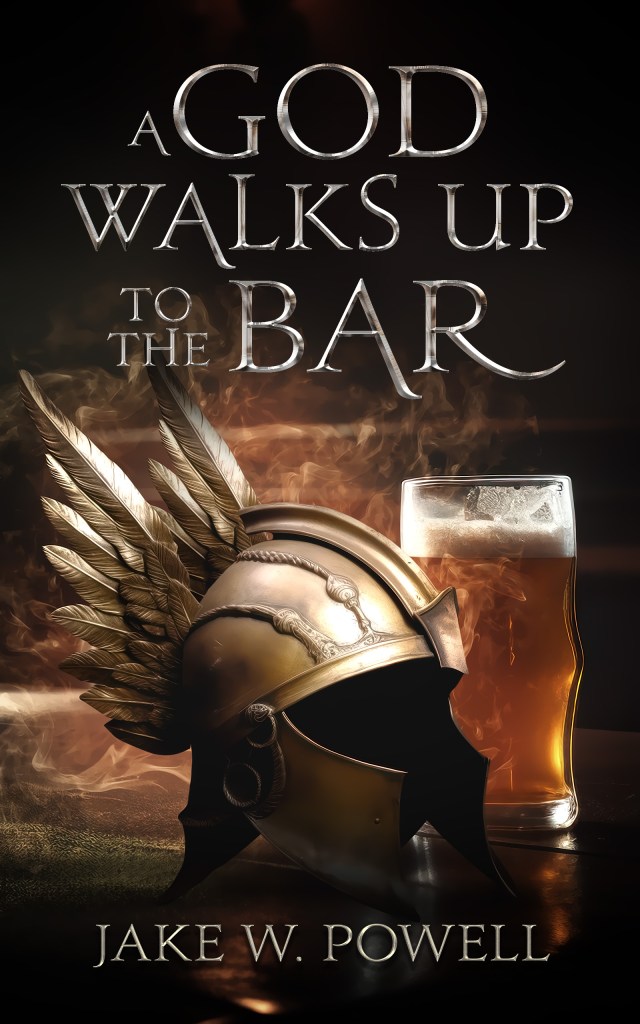
It hasn’t gone anywhere, and it won’t anytime soon! My first book, A God Walks Up to the Bar, is available on Amazon.com. Witness the modern day adventures of the Greek god Hermes in a world much like our own – plus with demigods, vampires, nymphs, ogres, and magic. The myths of old never went away, they just moved on with the times. It’s a tough job, being a god!
It’s the worst insult you can toss at a writer. It’s the deepest cut, the ultimate condemnation.
This reads like bad fan fiction.
Amateurish, incompetent, dubious, self-indulgent, outright moronic – these are the connotations those six words carry. Fan fiction is the respite of those who cannot write, but insist on doing so. Taking what others have already made and twisting it into their personal playground of poorly conceived plots. The refuge of the untalented.
Except it’s not true. Well, mostly.
Stories written by fans about their favorite movies or books or other franchises have garnered a collectively dismal reputation. They’re just a means for disgruntled people to “fix” stories they felt were ruined by the original creators or a way to make up romances between two characters that they happen to like. Now, these types of stories aren’t necessarily poor quality, but they tend to be made purely for the author’s own self-gratification. Consequently, quality isn’t an issue, only that the author gets what they want out of the story without regard for whether others will enjoy it (which beggars the question why it is posted online).
On the other hand, there is fan fiction that is comparable to published works, displaying not only raw talent but an understanding of plot structure, characterization, and reader engagement. Some of them are indeed so-called “fix fics” and romances, but just as many are original ideas, what-if scenarios, unofficial sequels, and other creative content. There’s the bad, the good, and the exceptional.
I wonder how many fan fiction writers could become successful mainstream authors if they so chose.
But what does this matter to you or me? What can aspiring writers who seek to publish, whether independently or through traditional publishers, find of worth in the world of fan fiction?
To put it plainly, writing fan fiction is really good practice for a writer.
I’ve written fan fiction. I wrote fan fiction before I published A God Walks Up to the Bar specifically to cut my teeth on writing for an audience. Fan fiction sites don’t require author names. You can make up any username or web appellation that you want. Anonymity can motivate shy writers, among whom I can be counted. The boldness inspired by a sobriquet can finally push you to take the plunge into getting your work out to the world. Plus, you get your first taste of criticism, good and bad, and develop the thick skin you’ll need and the ability to discern between worthwhile critiques and meaningless heckling.
If you’re a serious writer, fan fiction isn’t an exercise in self-indulgence. You want to tell a good story, and sometimes, building off a preexisting idea can be just the spark you need to flex your storytelling muscles. You can explore freely, experiment with writing styles to see what works for you and what doesn’t, and most importantly, you get to write. Practice, practice, practice. That’s how you improve as a writer.
And just as important, it’s completely free. The barrier of entry is even lower than for an indie publisher. No need for a budget to pay editors, beta readers, and cover artists. No need to maintain an author’s website. No need even for a business license! And the marketing is free, too. Fan fiction, by its nature, is about something already popular and well-known, so your writing can possibly attract more readers than your other, original works. Which is, well, not really fair, I suppose, but let’s try to stay optimistic here. More readers means more criticism means more improvement. Writing fan fiction is a fantastically low-risk method of developing your writing. It’s a great way to discover your own identity as an author without worrying about finances and other aspects of publishing.
All of which is to say, if you’re interested in getting into professional writing and feel you want to practice your skills and test the waters of public reception, fan fiction is a great starting point. And as someone who loves things to come full circle, I’ll just end by saying that someday, you may look back on these early experiments and chuckle … because now people are writing fan fiction about your work.
Did you like what you just read? Are you a writer, or just looking for fun content? Do you want more, but are worried about missing new posts? Please subscribe! I post updates on my writing career, I muse over storytelling and fiction, and I reflect on the curious and wonderful things in life.
It hasn’t gone anywhere, and it won’t anytime soon! My first book, A God Walks Up to the Bar, is available on Amazon.com. Witness the modern day adventures of the Greek god Hermes in a world much like our own – plus with demigods, vampires, nymphs, ogres, and magic. The myths of old never went away, they just moved on with the times. It’s a tough job, being a god!
We all have big dreams, and big dreams involve big projects, lots of planning, blood, sweat and tears. Writers want to be known, and they want to put out their best possible work into the world. That takes time. And as we are all acutely aware, we don’t have all the time in the world.
So, is it possible to embark on a writing project that is too ambitious? Can we overreach ourselves and fall short?
In the end, it depends on each one of us.
Ambition is not in and of itself a bad thing, mind you. The desire to improve and grow is a natural and good thing for a writer. But writing and publishing also require a fair dose of humility. We are not all going to become the next Hugh Howie or Brandon Sanderson. And they only reached the heights they did because they worked really hard for a really long time to get there. So, how hard are you willing to work? Just as important, how hard are you able to work? Time isn’t infinite, and you might genuinely be limited by work schedule, family, and other things that pop up in life. If you try to expend time and focus you don’t actually have to spare, yes, you are being overambitious.
What about experience? How many books have you written before? Planning to write an epic trilogy that will sell a thousand copies when it’s your very first published work? Maybe you want to back off on that plan for a while. Write some smaller books first, find your voice, build up your skill. The story of the one-off novel that becomes a literary masterpiece is very alluring, but let’s not assume it’s going to happen to us.
Yes, you have talent. I have talent. We all have talent, and we can sharpen that talent into something great and memorable. But desire is no substitute for talent. What we want and what we have to work with are very different things. If you don’t have the experience, get it. Then write your magnum opus.
Overambition is overreach. It is to push yourself beyond your capabilities. Writing is like exercise. You flex your storytelling muscles every time you do it. That helps you build bigger muscles that can handle a bigger workload and more complex stories. It’s discipline. Weightlifters don’t start off with 400 pound weights when they begin their training. They work their way up to it.
Is it possible to be too ambitious? Yes. But the measure of that ambition changes over time. What is too ambitious now may be achievable ten years later, because in ten years you’ll be a better author. Keep writing. Keep stretching your limits. Shoot for the moon, but don’t assume you’ll get there on your first shot.
If you just so happen to be enjoying my blog, feel free to subscribe. I post updates on my writing career, I muse over storytelling and fiction, and I reflect on the curious and wonderful things in life.
My first book, A God Walks up to the Bar, is available on Amazon.com. Witness the modern day adventures of the Greek god Hermes in a world much like our own – and with demigods, vampires, nymphs, ogres, and magic. The myths never went away, they just learned to move on with the times. It’s a tough job, being a god!
Feeling down in the dumps? Feeling like nothing you do is right or ever will be? If not, don’t worry, you will.
I’ve detected a pattern to discouragement in my life. It likes to come at certain times. I wonder if that’s true for everyone.
I find that nighttime is the worst for me. A couple of hours before bedtime, when I start to tire and my mind starts shutting down, fear and worry slither into my brain.
I need to start thinking about this. I haven’t done that yet. Do I have enough time to complete my book? Do I have enough money to pay for editing and publishing and marketing? Is it even any good?
It’s inevitable. For the writer, it can be debilitating. We work hard to finish our projects. We march on with stubborn determination to see our dreams through to the end. And we dread … not failure exactly. Inadequacy. Anyone can write, but can we write well? Or is it all just crap that would be better off hidden away in our computer’s hard drive, or better yet, in our own minds?
Even worse, what if it’s a good story, but nobody knows it exists? The unnoticed, inconsequential curiosity of the online store.
The night is a quiet and still time. My brain has time to process all these fears. When the excitement of the actual writing process stops, these nagging thoughts are heard most clearly.
But we don’t have to listen to such fears. They come, they stay a while, and then they leave. Yes, they do leave, if we press on regardless. Discouragement isn’t something we always have control over, but we can control how we act in response to it. Feelings of worry are not eternal. They only have real power to influence our life and work if we give them permission. Emotions run up and down. I look at my work today and feel it’s my best yet, and look at it tomorrow and cringe in disgust.
To continue writing in spite of that hollow feeling, to trudge along, to persevere through grim thoughts, this is is what we must do. Night isn’t forever.
Fear debilitates. Depression paralyzes. Writing is a joy for me, but I don’t feel excited about it all the time. Not 24/7. I have rough spots. I have times where I wonder if I should just leave it all behind. And I wait. I don’t act on those impulses of giving up, because I realize that they don’t last.
Writing is a marathon. Like athletes, we tire. We can feel inadequate and unable to rise up to the challenge. Write anyway. If you feel like crap, write. If you feel like nothing is coming to you, write something. A paragraph, a single sentence, anything so that you can say that you wrote for the day. Persevere. Be stubborn.
After night comes morning.
If you just so happen to be enjoying my blog, feel free to subscribe. I post updates on my writing career, I muse over storytelling and fiction, and I reflect on the curious and wonderful things in life.
My first book, A God Walks up to the Bar, is available on Amazon.com. Witness the modern day adventures of the Greek god Hermes in a world much like our own – and with demigods, vampires, nymphs, ogres, and magic. The myths never went away, they just learned to move on with the times. It’s a tough job, being a god!
It’s the most wonderful feeling in the world. You start writing, and you’re off to a rough start. You struggle, you groan, you’re on the verge of calling it a day. Then the words start to flow, one after the other. Bam. Bam. Bam. The prose is smooth, the dialogue is superb, and your story just falls into place like a well-made jigsaw puzzle. Everything suddenly fits.
You get into your groove. The wheels turn without a hitch. You are rocking your writing session and just loving being along for the ride while your fingers type away and your subconscious pulls surprises out of the depths of your mind.
I’m in my editing phase at the moment, working on the second draft of my second book. It doesn’t have a name, yet. I’m still working on that. Mostly, I’m trying to make what I originally wrote into something coherent and readable. Sometimes, I think to myself, “I’m not much up for writing today, maybe just a paragraph or two.” Once I get started, I then think, “Well, a little bit more,” and again, “Huh, this isn’t so bad. I can work with this.” And an hour slides by without me noticing. Or two hours. It’s such a great sensation to be pulled into your writing, to let everything else fade.
A bit scary, too! I lose track of time. I start in the morning, I wrap up and look at the clock and – What! It’s already the middle of the afternoon!?
If I was a fish, then writing would be bait on a hook. I can’t resist. We all have that, don’t we? Our hook. Our favorite activity. The thing that gets us in the groove.
It really is a feeling that’s hard to beat.
If you just so happen to be enjoying my blog, feel free to subscribe. I post updates on my writing career, I muse over storytelling and fiction, and I reflect on the curious and wonderful things in life.
My first book, A God Walks up to the Bar, is available on Amazon.com. Witness the modern day adventures of the Greek god Hermes in a world much like our own – and with demigods, vampires, nymphs, ogres, and magic. The myths never went away, they just learned to move on with the times. It’s a tough job, being a god!
Tricksters are fascinating to read about and to write about. They’re the weirdos who exist on the fringes of polite society. They’re the ones who can get away with what other people can’t. They’re stick their tongues out at the world and make the rules work for them, rather than working according to the rules.
Tricksters are fun. They’re fun because, deep down, don’t we all enjoy seeing someone willing to say what we’re all thinking and doing what we wish we could? Tricksters are escapist characters. They pay back the jerks and the bullies, outwit the corrupt authority figures, and flout senseless and silly rules. We all enjoy our Robin Hoods and B’rer Rabbits.
Writing tricksters is fun, too. Writing the character of Hermes for my books has let me see the world from a different point of view. I suppose writing any character gives you such insights, but seeing the world through a trickster’s eyes …
They’re a surprisingly philosophical bunch. As characters whose primary role is to push boundaries and alter the status quo, they are naturally prone to questioning the point of things. Why are things the way they are? Why should (or shouldn’t) they change? Tricksters are the ones who can call out others for their actions and make the rest of the cast pause and think. And that makes for interesting writing. The archetype can fill all sorts of niches, whether the villainous anarchist, the secret mentor, the voice of reason, or the snarky smart aleck who gets all the best lines.
And then, of course, there’s the trickster as protagonist. Tricksters can carry a story all by themselves. By their very nature, they’re proactive. They get things done. The can save the day (or ruin it – protagonist doesn’t mean hero). Since the archetype is almost always transgressive in some way, he or she gets to give society a kick in the pants, usually by acting so outrageously or cunningly that nobody knows what to expect next.
Speaking of cunning, writing tricksters has also taught me a bit about plotting out, well, plots. I sometimes feel like we live in an age of fiction where schemes and trickery must be excessively complex. Writers like to create grand conspiracies, when a trickster is just as likely to tap you on one shoulder while standing on the opposite side. Committing a trickster like Hermes to the page has shown me that deception can be much simpler. Tricking people doesn’t really seem to be that hard. Often, it’s just a matter of reading people and playing up to expectations. Or remembering that most people just want today to be the same as yesterday and aren’t expecting to be hoodwinked. Then again, written characters also behave according to how the author has plotted them to behave, so maybe I’m just blowing smoke.
So, tricksters upend the social order. They slip into different roles with ease. They’re many things to many people. What they aren’t is moral, upstanding role models.
But …
What if a trickster tries to be moral? Is such a thing possible? Trickery is lying, and lying is immoral. Can you reconcile the trickster archetype with the hero archetype? Transgressing social values and upholding them? Can the two be melded? A liar with a moral compass? Can a trickster follow right and reject wrong? Can anything truly good come from trickery?
Very interesting philosophical musings, indeed. I’m still messing about with such notions in my writing. My version of Hermes is developing as I go, revealing new facets of his personality as my works progress. Tricksters aren’t simple characters, after all.
If you just so happen to be enjoying my blog, feel free to subscribe. I post updates on my writing career, I muse over storytelling and fiction, and I reflect on the curious and wonderful things in life.
My first book, A God Walks up to the Bar, is available on Amazon.com. Witness the modern day adventures of the Greek god Hermes in a world much like our own – and with demigods, vampires, nymphs, ogres, and magic. The myths never went away, they just learned to move on with the times. It’s a tough job, being a god!
This is the second half of my short story excerpt from A God Walks Up to the Bar. Go here to view the first half.
—
I walked into a scene right out of a 1930s gangster movie. Five men sat around a table playing cards, cigarette smoke hovering over them like angry clouds. The scent of alcohol wafted from half-empty liquor bottles to mingle with the smoke. Five faces looked up as I entered and stared daggers into me.
It was quite the diverse crew Stauffer had. Sitting closest to the door was a squat, grey-skinned goblin. To his right was a great hulk of a man whose tree-trunk arms cordoned off a quarter of the table as he guarded his cards. Another half-ogre. Across from him sat a man whose face was entirely covered in a bristly black beard save for his red eyes. To his left was a slender, fragile-looking man with ash-colored hair who exuded magical power.
And then there was Arnold Stauffer, seated in his armchair on the far side of the table facing the door. He had a cigar in his mouth and a hand of cards in his thick fingers.
We Immortals are a funny lot. As our kind drifts along time’s currents, watching civilizations rise, rule, and fall, many of us beach ourselves along the way. Some are just too stubborn and irked by keeping pace with changing times. They lose track of the eras and fixate on one specific point. It may be a particular century, decade, or even one notable year. They cling to that time’s fashions for so long that they become walking anachronisms, lodged in attitudes and styles long since abandoned.
Not easy individuals to deal with. It’s hard to negotiate with someone who not only dresses like they’re in the Elizabethan era but talks and acts like it. You want to laugh, but then you remember how easily they can strike you with lightning and plague if you offend their obsolete sensibilities.
Stauffer had started his rise to power in 1920, so the period had sentimental value to him. His aesthetic clung to “Prohibition-era gangster,” suits, Tommy guns and all. It was a style that really didn’t fit him. The sharp-cut suit clung awkwardly to his hulking frame so that he looked like an angry boulder wearing a necktie. His pencil mustache clashed with a jagged nose broken in three different places. His slicked black hair was a hilariously tiny patch on top of a craggy, oversized skull.
Stauffer wanted to look a gentleman, but that’s hard to do when you’re a primal incarnation of nature’s fury.
He was a half-jötunn — a descendant of the giants of the north. They were sovereigns of nature’s wrathful aspects. Their kings had shaped mountains, unleashed fire and magma from the earth, stirred up hurricanes, and rained down hail and thunder. And here was Arnold Stauffer, the blood of King Thrym running in his veins and eyes swirling like a storm, trying to conceal that heritage with a side-combed haircut and bespoke suit. Seeing a manifestation of cataclysm dressed up like Al Capone and playing poker? It was surreal. Absurd.
Stauffer leaned back in his chair and took a long drag from his cigar. Smoke billowed out of his mouth as he spoke.
“Mister, I hope for your sake that you’re someone very important.”
I bowed. “Lord Hermes of Olympus, Herald of the Dodekatheon, who speaks with the voice of Lord Zeus to Arnold Stauffer of the bloodline of Thrym.”
Stauffer put down his cards. “Proof?”
I sighed inwardly. There had been a time when this was easy. When those words made people snap to attention. I took off my ring and tossed it to him. He caught it and inspected it for a moment, then he threw it back.
“Lord Hermes himself. What an honor. What a privilege.” He spat the words out like curses. “So, what does the old fart on the mountain have to say? What horrible punishment will he rain down on this old sinner?”
He laughed. His minions half-heartedly joined him but kept their heads down. Only Stauffer dared look me in the eye.
“Punishment?” I raised an eyebrow. “This isn’t about punishment. We’re civilized folk in a civilized age. Lord Zeus recognizes your authority and your bloodline and so is willing to show leniency. We can resolve this matter quickly and painlessly.”
Stauffer said nothing but waved at me with his cigar to go on.
“The message, to wit, is this: For the past six months, you have been expanding your operations in this city. You approached a man named Zachary Jensen, owner of real estate that you desired. This man is a scion of Lord Zeus. You knew this.”
Stauffer watched me with an indifferent expression. His minions shuffled a little in their seats. Their bodies were tense.
“Five days ago, you invited Mr. Jensen to a restaurant under your ownership and offered him money in exchange for his property. He declined. It is understood by Olympus that he refused … harshly, replying with insults against you and your lineage. The following night, when he arrived home, he was attacked by four men and beaten almost to death. Olympus knows it was at your order. Do not deny it.”
“I never did.”
“In harming a child of the Olympians, you displayed gross disrespect towards Lord Zeus. However, he is willing to show mercy as long as proper compensation is made. Namely—”
“I don’t kowtow to old gods!” Stauffer shouted. “I won’t—”
“Firstly,” I carried on resolutely, “you will affirm here and now your intent to abide by the rules of the Contract. Our law forbids Lord Zeus from taking direct retribution against you and your own within New York, a recognized Free City. So, too, does it forbid your organization from laying hands on any recognized demigod.”
Stauffer bared his teeth in an ugly smile. “I was within my rights. He insulted me and so I —”
“Secondly, you will provide compensation for the injuries done to Jensen. This compensation will consist of two million dollars taken out of your organization’s profits.”
At this, the table rumbled with angry mutterings. Stauffer’s defiant grin grew larger.
“In one week’s time, representatives from Olympus will arrive here to collect the money. And finally, the restaurant at which you met Jensen will, freely and by your own hand, be gifted to Lord Zeus. You will hand over the deed and all other necessary documentation to the Olympian representatives, and Olympus will take up management of the premises. In so doing, you will have displayed proper atonement for your crime.”
I saw the anger in Stauffer boil hotter with every word. As I finished, he shot up from his chair and slammed his hands on the table.
“I refuse,” he said. “I will give Olympus nothing. I don’t jump when you bark. I don’t roll over and show my belly. You and your kin, all you so-called ‘gods,’ have no power over me. Over anyone in this city.”
He exhaled a heavy breath, and the smoke billowed out like from a dragon’s den. “Look around you. Look anywhere in this city. Humans, goblins, trolls, satyrs, djinn, jötunn, all of us, we go about our lives without a thought given to you. You’re nothing now but curiosities in museums, characters in comic books. You’re just fantasies. Nobody really remembers you. We’ve moved beyond you.”
He stretched out his arms, inviting me to challenge him. “The god Thor killed my ancestor Thrym, but his successors watched Thor die at Ragnarök and spat on his corpse. They watched all you Immortals bicker and slaughter each other. You destroyed your own empires, and the mortals hated you for it. You thought making your Contract could help you rebuild. But what happened next? Science came and explained you away. Philosophy killed any faith left in your kind. Technology made you obsolete. And what did you mighty gods do when the prayers stopped? What happened when the temples were left to crumble? Nothing.”
I scratched my neck idly as I listened to his rant. I might as well let him get this off his chest.
“You don’t have any power. You’re just tired old dogs bound by your precious rules. Because without the Contract, you’d tear yourselves apart again, wouldn’t you? And you, Hermes, you’re just an over-glorified errand boy.” Alright, that made me perk up. “You lay a finger on me, and you violate your laws. So, all you can do is spout empty threats. Get out.”
He finished and glared at me triumphantly. I nodded as if acceding to what he said, and strolled past the table. I noticed a ratty-looking couch in the corner and sprawled out on it.
“You know,” I said, “I think there’s a fundamental misunderstanding going on here. Olympus isn’t threatening you. I’m not threatening you. I’m stating facts. You made a mistake, and now you have a chance to make it right. Because, you see”— I held up a hand to cut off another interjection— “this isn’t about the rules. This isn’t about intimidation. This is about the balance of power. You can appreciate that, right? Someone pushes you, you push back. Someone rocks the boat, you tie him down to keep it from capsizing. You can’t get away with mauling demigods without some sort of consequence. What sort of bad precedent would that set?”
Stauffer snorted. “New York is a Free City. The Immortals have no jurisdiction here. We aren’t under any pantheon’s authority.”
“You willing to test that theory? True, no pantheon has direct control over a Free City. It’s neutral ground. But neutral doesn’t mean safe. The Contract is fabulously complex. All sorts of loopholes. Oh, and chew on this: If you walk away from this scot-free, then everyone and their mother who hears about it will figure they can, too. Who’s stopping the supernatural community from settling old grudges and maybe starting a few wars? Maybe even come gunning for you. Who’s going to step in and put a stop to it?” I thumped my chest. “Us. The Immortals. Because we keep the balance.”
Stauffer’s eyes wavered for a moment, but his sneer reasserted itself, and he shook his head.
“I know,” I said coolly, “you’re the big boss. You call the shots. Who can touch you? But let’s think back, shall we? Why are you the big boss? Because you got lucky. Your forefathers are still hiding in Scandinavia, ragged and forgotten, because Ragnarök screwed them over just as badly as it did Thor’s family. So here comes a young man, full of ambition, newly arrived in America, with nothing but brawn, a tangled family tree, and a desire to prove his people still matter. And New York had just come out of a nasty gang war among the supernaturals. I remember. I was there. The war left a power vacuum. Lucky you. You put that brawn to good work and filled the hole.”
“Because I was strong enough,” Stauffer replied. “I took what I wanted and I kept it.”
“Spare me, Arnie. If they were still around, the old families wouldn’t even have noticed you. You’ve never known until now what it’s like to compete in the big leagues. But you’re finding out, aren’t you? The Aristocracy is breathing down your neck. You’ve angered Olympus. Suddenly, the dog is facing the wolves, and what does he do? He hides in a backroom playing poker. Where’s that jötunn pride? Where’s the bravado of the people who watched gods die? Let’s see some strength, Arnie, not big talk.”
This had exactly the effect I knew it would. Wounded pride overcame Stauffer’s self-control. Shaking all over, he walked towards me, fists clenched and breaths coming out in ragged gasps. He stood over me, and I knew from the look in his eye he wasn’t going to let me walk away now.
“Say it,” he whispered. “Just say it.”
I frowned. “Say what?”
“Tell me what you think I am. Say it to my face.”
“Arnie Stauffer? Crime lord of East New York?” I counted on my fingers. “Defier of the gods? Descendant of Thrym, who got his head bashed in by Thor like a chump? Tall, angry man looming over me with murderous rage in his eyes?” My face lit up. “Oh! Do you mean back-stabbing, opportunistic, cowardly piece of meat?”
His hands shot out and grabbed me. He wrenched me off the couch and threw me across the room. I landed on the table. Its occupants backed away as I rolled across and onto the floor, taking beer bottles, cards, and poker chips with me.
I wasn’t down for long. I jumped to my feet, fists at the ready, my mind bandying various strategies on how to win. Because I knew I was going to win.
“Kill him,” Stauffer barked.
I sighed inwardly. Thousands of years of hard-learned lessons, yet folks never really learn.
The slender pale man began muttering under his breath and made a sign with his hands. As the spell manifested, his skin turned white as milk and blue runic symbols shone on his skin. A troll.
I didn’t have time to take him out, though, because I felt a sudden searing pain in my left arm. I turned to see the bearded man gripping me with hands glowing red-hot. He opened his mouth, revealing four rows of razor teeth. I chided myself for not recognizing a ghūl when I saw one.
I twisted my body away from his grip as he tried to bite my arm. With my free hand, I drove a right hook into his head, hitting him hard enough to spin him around. He released my arm, which I promptly used for a jab between the shoulder blades that knocked the wind out of him.
As the ghūl fell to his knees, I felt a constriction around my whole body. The troll was working his magic, weaving cerulean strands of light around me like a rope. I grunted and made towards him, but the bands of light were strong enough to halt my movement. Alright, I admitted to myself, this may be a tad more difficult than I had anticipated.
Then the half-ogre joined the fun.
He rushed past the troll and head-butted me. His skull connected with my jaw and propelled me into the wall with a loud crack of cheap plaster. Still trapped by the troll’s magic, the best I could do in response was an upward kick that looked more like an impression of a flopping fish. The thug threw me to the floor and stomped his foot down — he actually stepped on me! — and drove it as hard as he could into my chest. I think he was surprised that my ribcage didn’t give in.
Enough was enough. The troll was tripping me up with petty magic, the ghūl was regaining enough of his senses to make another go at a taste test, and a half-ogre was literally walking all over me. Time to get serious.
I channeled my own power into breaking the spell. The troll was competent enough but only competent. I envisioned the entangling bands breaking apart. Reality responded to my demand, and the spell swiftly disintegrated into motes of fast-fading light. Several of the motes caught the half-ogre in the eyes. He grunted in pain and backed away as he covered his blinded eyes with his hands.
Able to move freely again, I flipped to my feet in time to catch a bite in the shoulder from that freaking ghūl. I gritted my teeth and elbowed him hard. His head snapped back, taking a nice chunk of my shoulder and jacket with him.
I laid into the half-ogre. A flurry of punches to the stomach softened him up, and a left hook to the hip cracked bone and made the brute double over. I delivered an uppercut that put him back into a standing position before I wrapped a hand around his waist, put my other hand beneath his arm, and lifted him over my head. A flawlessly executed vertical suplex slammed him into the table, splintering it and leaving the half-ogre groaning on the floor.
Incidentally, not many people do their homework on me. They’re so hung up on the “Messenger of the Gods” title that they fail to appreciate my many other admirable attributes. Such as my divine mastery of boxing and wrestling. No man or woman, mortal or otherwise, can beat me in a boxing match. Play fair or cheat, you aren’t going to win.
The troll saw his comrade go down and tried to run. I grabbed him and spun him around to face me. His mouth and eyes formed perfect “O”s when I drove my fist into his chest. He flew across the room into the door. It didn’t break, and he fell down face-forward. He didn’t get back up.
The ghūl was having troubles of his own. He choked and stumbled around as his eyes glazed over. The liquid dribbling from his mouth hadn’t agreed with him. He was quickly learning that the blood of gods was poisonous to mortals. I took him down with an offhand punch.
Stauffer hadn’t budged an inch from where he stood. He was transfixed on me with a mixture of rage, amazement, and stark fear. I turned to the goblin, who hadn’t joined in the fight at all. I lifted an eyebrow. Stauffer also looked at his minion and jerked his head at me.
“You serious, boss?” the goblin scoffed. He jumped over the prostrate troll and bolted out the door.
Stauffer growled a sharp curse.
“You’ll pay for this. You’ve assaulted me on my own property. You’ve violated the Contract, and heads will roll. Mark my words.”
I cracked my knuckles and laughed. “Mark my words, Stauffer, you started this fight. The only head that would roll is yours.”
“You provoked me!” Realization dawned in his eyes. “You wanted this fight to happen!”
“Maybe, maybe not. But it happened. And you started it. You think I’ve breached the Contract, take it up with the High Court. It’s your word against mine.”
“Maybe I will.”
“You do that. Olympus is part of the High Court. My father sits on it. The god you offended.”
His eyes practically bulged out of his head.
“And, I hate to say it, but you are part jötunn. The gods haven’t forgotten what your kind did to Asgard. Take a case to the Court, see what happens.”
“You …You …” He was too angry to form words. Finally, he snapped and charged me.
I was ready. I sidestepped his haymaker, drove my fist into the soft flesh below his ribs, and stuck my foot in front of his leg. He tilted forward ponderously and hit the floor with a heavy thud. He rolled himself over onto his back. He looked up at me, gasping for breath.
“You piece of … You little son of a—”
“Ah-ah!” I wagged my finger. “Blasphemy! Don’t want to add that to your list of offenses.”
I took stock of the scene. The room was trashed, four men were lying on the floor in varying states of consciousness, and I was standing there with my favorite jacket ruined and a piece of my shoulder missing. All in all, things had gone fairly well.
“One week, Stauffer,” I said as I walked away. “You have one week to come up with two million dollars. Olympus’ representatives will be here.” I paused at the door. “They won’t be as polite as me.”
At the sight of my torn clothes and blood — and the sight of my ripped flesh knitting itself back together even as I walked along — the tavern’s occupants looked away from me and became very focused on their drinks. I noticed that Mark was absent. The old man who’d been sitting with him caught my eye and nodded to me with a noncommittal expression.
I walked up to the bar and demanded a shot of whiskey. The bartender obliged me with all due haste. I downed it, put the glass down, and walked out of the bar. The bartender wouldn’t have expected me to pay, anyway.
I was back in the awful drizzle, a little the worse for wear, but in high spirits. I strolled down the sidewalk, happy to be done with that chore and ready for a night of relaxation and enjoyable company. A night at The Vine sounded like just the thing for me.
It had been an exciting errand, certainly, but not anything particularly special. In the grand scheme of life, of all the things I had done and seen and said, this was a minor event. A petty task. Just another message successfully delivered.
If you just so happen to be enjoying my blog, feel free to subscribe. I post updates on my writing career, I muse over storytelling and fiction, and I reflect on the curious and wonderful things in life.
My first book, A God Walks up to the Bar, is available on Amazon.com. Witness the modern day adventures of the Greek god Hermes in a world much like our own – and with demigods, vampires, nymphs, ogres, and magic. The myths never went away, they just learned to move on with the times. It’s a tough job, being a god!
Well, I’ve talked a lot about writing on this blog, but I’ve never actually posted any of my work yet. I thought today that I would post an excerpt from my first-ever published book, A God Walks Up to the Bar. It’s an anthology of five short stories, connected by a framing story, that details the adventures of the Greek god Hermes in modern day. Read and enjoy!
—
The night was gloomy in that part of New York. There was no glamor here, no joyous nightlife. There was just rain drizzling down half-heartedly, covering the sidewalk in a dirty wet sheen that reflected the glare of the streetlights. It reminded me of how long I’d been putting off that vacation to Aruba, and how nice it would be to lounge in the jacuzzi in my apartment. But, alas, no such luxuries tonight. I was on business. The messenger had gotten his assignment, and like the intrepid mail pilots of old, he must get through.
I tromped through the puddles and arrived at my destination. It was a real hole-in-the-wall bar. Its owner had spared no expense in stripping it of the slightest feature that would impress itself in memory. There was no sign, the windows were darkened glass, and the entrance was a blank gray door at the bottom of a flight of concrete steps. I descended and walked inside.
It wasn’t much more cheerful inside the tavern than out. Battered hanging lamps cast everything in a dim reddish-orange tint. The floor was slick with grease, and the air was sour with the scent of cheap beer. It was well into happy hour, but the clientele was sparse. I counted six men hunched over their drinks and making small talk. A couple of them glanced up and appraised me with cold eyes.
This wasn’t a place where people gathered for a good time. This was where you came when you had to conduct business that was frowned upon by civil society. An unfamiliar face like mine wasn’t welcome here. Still, they did little more than scowl at me as I approached the bar.
The bartender had just stepped out of a backroom lugging an icebox when he saw me. He set down the box and fixed his eyes on me. His voice was brusque.
“What’ll it be?”
“Nothing, tonight,” I replied. “I’m here to see your boss.”
The bartender frowned and tilted his head.
“I’m here to see Stauffer,” I clarified.
The man’s eyes narrowed.
“Who wants to see him?”
I set both my hands on the bar counter. I immediately regretted it — the wood was sticky with spilled alcohol — but I wasn’t about to show squeamishness. I pushed my right hand forward and curled my knuckles, displaying the ring I wore.
A gold ring with a seal displaying two serpents wrapped around a winged staff. The Caduceus. My personal symbol.
The bartender’s frown deepened. He recognized it.
“You’re an Olympian,” he said slowly.
“That I am,” I replied with a friendly smile. “Hermes of Olympus, Swift-runner and Wayfarer, Herald of the Dodekatheon, et cetera, et cetera. I’m here to see Arnold Stauffer with a message straight from Lord Zeus. And I fear it must be delivered face-to-face.”
He scratched his chin thoughtfully. “Sorry, my lord, but I can’t say I’ve—”
I held up my hand. “Tell you what. Let’s skip the part where you pretend that he conveniently stepped out a few hours ago and you don’t know when he’ll be back. I know he’s here. Does that sound good to you? Good, that’s settled. Now, just point me to his room, and I’ll be out of your hair faster than a Valkyrie can chug mead.”
The bartender gave a short, ugly chuckle. “He won’t see you today, my lord. He’s busy.”
“Oh!” I replied in mock horror. “He’s busy. Olympus forbid.” I leaned farther forward. “If it’s trouble you’re worried about, I’m not here to knock heads and pull ears. It’s a simple message. A communiqué. A heaven-sent singing telegram, if you will. Minus the singing.”
My words didn’t make much of an impression, but as I spoke, I took a moment to throw a casual glance across the tavern. I noted the hallway leading deeper into the building. I turned again to the bartender.
“He in back? Tending to the affairs of his kingdom?”
“He ain’t seeing you. Not my call.”
Stauffer had been expecting someone to show up. No surprise there. He knew what he’d done. And yet, he still thought he could keep me away. Adorable.
I took several meaningful steps toward the hallway. A man sitting at a nearby table slowly got up and stretched in a way that drew attention to his height and formidable musculature. His drinking buddy, a much older fellow than the rest of the barflies, remained seated but watched me carefully.
The standing man looked at me with a face that shone with arrogance.
“Must not have heard the man,” he said in a loud voice. “Arnie doesn’t want to be disturbed. So why don’t you skip out of here, Olympian?”
He gave me a predator’s grin and glanced at his friend who was still watching me. I sized up the gatekeeper. Tall, stocky, thick-skinned, with a greyish tint to him. Ogre blood. Not to be trifled with. Judging from the way his hands were open and held close to his side, I figured he was armed. Knives most likely. His jacket wasn’t thick enough to conceal a gun. He looked down at me, which isn’t hard to do to a god who’s five feet eight inches tall.
I sighed in defeat.
“Well, that’s a shame. It was worth a shot, though, wasn’t it, Mark? But you’re right, we don’t want to make a fuss. It is Mark, isn’t it?”
The man’s right eye twitched slightly at the casual mention of his name.
“Right, Mark Yeager.” I nodded as if I had just remembered. “You do a bit of leg-breaking work for Stauffer. Real smooth operator. A pawn shop here, a diner there. Very efficient, really rising in the ranks. Even got your own thing going, too, I’ve heard. A bit of burgling on the side when not on Stauffer’s payroll?”
Mark tried to laugh it off, but that telltale twitch in his eye didn’t go away. He wouldn’t make much of a poker player. “What are you trying to do, scare me? I’m a plumber.”
“Yeah, yeah.” I laughed. “That was pretty dumb of me, wasn’t it? You do good work, I’m sure.” Mark smiled mirthlessly at me as I took a step back. The tension in his body drained away, just in time for the gut punch.
“You, uh, did a real good job unclogging the pipes at Ezra Connolly’s place, I heard.”
The comment caught him off-guard. His nostrils flared, and his throat tightened. Jackpot.
“Unclogged his cabinets later that night, too. Pretty slick work.” I waved my hand across the tavern. “The guys must have really been impressed. Not easy, breaking into the home of a member of the Aristocracy.”
“What’s he talking about, Mark?” the white-bearded man asked calmly.
Mark shook his head, trying to shrug off the question. “Nothing. He’s just blowing a load of—”
I cut him off. “And is Stauffer having trouble with the Aristocracy?”
They all remained silent, watching me now with undivided attention. They knew the answer. The Aristocracy was controlled by vampires, a world-spanning criminal empire that suffered no insult. Its network in New York had been harassing Stauffer’s operations for a couple weeks now.
“Didn’t Connolly mention something to Stauffer? Something about being disrespected? About his territory being violated? Hey, Mark, you doing alright?”
The other men turned to observe Mark with acute interest. He wasn’t holding up very well under the scrutiny. His eyelid was practically short-circuiting, and his face was turning a violent shade of red.
I took a step closer to him. “You know how vampires are. Once they get it into their head that they’ve been slighted, they’ll go through fire and water to even the score. Man, I’d hate to be the guy who ticked them off. Vampires have a really interesting idea of justice. It involves lots of sharp, jagged objects. If I were Stauffer, I’d be looking for that idiot who messed up and just hand him over. So, anyway, how is the plumbing business nowadays?”
“Alright!” Mark erupted. “I get it. You think you know stuff.” He glared at me. “I’m loyal to Mr. Stauffer. And you ain’t passing through here.”
The white-bearded man whistled in derision. “He’s a god, you idiot. He’s not trying to force you to stand down. He’s proving a point.” He jerked a thumb. “Step aside.”
Mark shot a look at him. “But—”
“Shut up and get out of his way.”
Crestfallen, Mark stepped to the side, letting me pass. The old man raised his glass to me.
“Well played, Lord Hermes.”
As I walked away, I heard his voice growl, “Sit down, Mark. I think we should talk.”
A key rule of bluffing is confidence. Did I know with dead certainty that Mark was a thief? No. But I knew just enough. I had lots of little birds all over the city telling me things, and this was one of the nuggets they’d dropped me. It was all gossip, truths, and half-lies, and who knew which was which. But I had played this game before. Drop a hint, watch the opponent buckle, and then push him a little more. Never falter, never stutter, and always let them believe you already know everything. I’m a god, aren’t I? Everyone knows gods are all-knowing.
Well, I had gotten that roadblock out of the way. Now, it was time to deal with the big man himself.
There was a solid oak door at the end of the hallway. It was a fancy door, far more ornate than anything else in this place. I felt the faint pulse of magic emanating from it.
I put my hand on the doorknob and was immediately stung by a shock of intense cold that coated my palm in frost. An enchantment to ward off intruders. Clever.
But this was low-grade stuff. I focused my thoughts and pushed back against the enchantment. The magic sputtered and dissipated, and I felt the cold fade away. It took another second to take care of the lock. I opened the door and stepped inside.
To be continued …
If you just so happen to be enjoying my blog, feel free to subscribe. I post updates on my writing career, I muse over storytelling and fiction, and I reflect on the curious and wonderful things in life.
My first book, A God Walks up to the Bar, is available on Amazon.com. Witness the modern day adventures of the Greek god Hermes in a world much like our own – and with demigods, vampires, nymphs, ogres, and magic. The myths never went away, they just learned to move on with the times. It’s a tough job, being a god!
We live in an age of quips. Quipping has gripped modern entertainment. Quick, glib, clever one-liners are all the rage nowadays. You see it in blockbuster movies, television, comic books, and general writing. Pithy turns of phrase to sum up a situation, shove humor into it, or just to show off how clever the writer is.
And like anything in excess, people eventually become tired of it. One-liners aren’t bad in and of themselves, but I feel that overexposure to any style of writing can sour people against it. Like eating ice cream and pizza three meals a day for a month, something you originally enjoyed now just leaves you feeling sick and disgusted.
Humor is very important. Without it, a story can feel lifeless and dull. But humor comes in many forms, and we aren’t limited to the simple quip. I’m not saying that quipping is bad in and of itself. James Bond can get away with his cheeky one-liners all day long. But variety is the spice of life. More importantly, not every story needs that type of writing.
Maybe I should start from the beginning. What is quipping?
Dictionary.com defines “quip” as “a clever or witty remark or comment” or “a sharp, sarcastic remark; a cutting jest.” And that pretty much sums it up. Quips are one-liners, punchlines, and statements to show off a character’s biting wit. They can be used to characterize and flesh out the tone of a story, but modern writers, especially in film and television, have become obsessed with this one form of humor. What happens when you’re exposed to one, and only one, type of funny for ten years? It becomes boring.
What’s worse, writers can fall into the temptation to constantly strive to outdo themselves and each other. Stories lose their focus and become quip-a-thons. What wacky thing will the hero say next? And how will it completely disrupt the otherwise somber tone of the scene? Because that’s what a poorly used quip can do: It destroys the mood. Too often, I watch movies that are afraid to end on a quiet note. The tone needs “lightening up” with some funny, silly observation. And suddenly, the characters aren’t taking anything seriously. And if they aren’t, why should the audience? Main hero in mortal danger? He makes a quip, and it’s just a big joke, no reason to be on the edge of your seat. A scene of exposition establishing the stakes? Sum it up with some pithy, self-aware remark that illustrates the characters are more concerned with pointing out cliches and proving how clever they are than getting the job done. Guess the audience shouldn’t care, either.
Can you tell I really don’t like this style of humor?
I used to. I enjoyed Marvel movies. I liked Arnold Schwarzenegger’s cheesy one-liners. But overexposure soured me against quips. No, let me revise that statement. It soured me against every main character in the story using quips. That’s the biggest gripe I have against the style, because it makes every character basically the same. Oh, sure, they might have different motivations, different backstories, different personalities, but they all sound the same. Same remarks, same puns, same tendency toward glibness. They all react the same way to a situation. And that is, I emphasize again, boring.
That being said, there are stories I enjoy where quipping is used. I like The Dresden Files, and the protagonist’s tendency toward wise-guy remarks. And I don’t mind James Bond’s use of hilariously callous puns after killing someone. Heck, I enjoy the Marx Brothers’ old films, and Groucho Marx is a machine at quipping. A bona fide master. And you know why I can tolerate these examples? Because they are the only characters in the story who rely on quipping for humor. They stand out because of it. Other forms of humor are used by other characters. Rather than being the default fallback for extracting humor, their smart-aleck words are used to define their character and place in the story. It’s part of who they are.
What’s that old saying? If everyone is special, nobody is. I don’t know about that, but I do think that if everyone is funny in the same way, than nobody is funny at all. Put some variety into your story’s humor!
If you just so happen to be enjoying my blog, feel free to subscribe. I post updates on my writing career, I muse over storytelling and fiction, and I reflect on the curious and wonderful things in life.
My first book, A God Walks up to the Bar, is available on Amazon.com. Witness the modern day adventures of the Greek god Hermes in a world much like our own – and with demigods, vampires, nymphs, ogres, and magic. The myths never went away, they just learned to move on with the times. It’s a tough job, being a god!





 Jake W. Powell