When I was taking film classes in college, my professor explained a key lesson that every writer must learn. They must learn when it is necessary to kill their babies.
You have an idea. It’s a brilliant, shining idea that came to you in an incandescent flash of inspiration. A magnificent idea that is the beating heart of your story. It is your motivation and driving force. The story would not exist except for this one concept.
It could be anything. A single scene. A character. A set piece. Even a single line of dialogue. Whatever it is, it was amazing enough to make you sit down and write.
It is your precious baby.
You finish the first draft of your story. You’re very pleased with it, especially how you incorporated your idea into the overall work. You send it out to readers for feedback. And the unexpected happens. They’re dubious about your baby. They don’t like it. They say that it doesn’t mesh with the rest of the story. In fact, it’s holding your story back from its full potential. It’s a liability.
Without realizing it, as you wrote and developed your setting, characters, and plot, they outgrew the original idea. That concept you love so much is no longer the plot’s beating heart. It is a tumor that threatens the quality of your narrative. The scene is out of place and unneeded. The character is completely detached from the rest of the cast. The set piece is just a waste of words. The line of dialogue is silly.
For the sake of the story, you must kill your baby.
If that sounds grotesque, it’s only to communicate how strongly writers can feel about their stories, and how painful it can be to remove something that can feel so personal to you. It’s a necessary culling that must be performed for the good of your writing. It is a sacrifice, one that almost every author must make at some point or another. And for those who aren’t willing to make the sacrifice, well, their story suffers for it. The readers might, too.
The lesson here is that something that seems like its working at the beginning of your project can become an utterly awful proposition by the end. A chef likes garlic, so he adds a ton of garlic to his casserole. Then he tastes the final product and gags. It was a good idea at the time, but …
Enjoying my blog? Don’t want to miss a single post? Subscribe for updates on when I post and follow my writing career, musings on fiction and storytelling, and reflections about life in general!
Do you like eBooks? I like eBooks. Convenient and affordable. But sometimes I want that tactile sensation of a paperback in my hands and to hear the soft flutter of turning pages. If you like that, too, then I have great news.
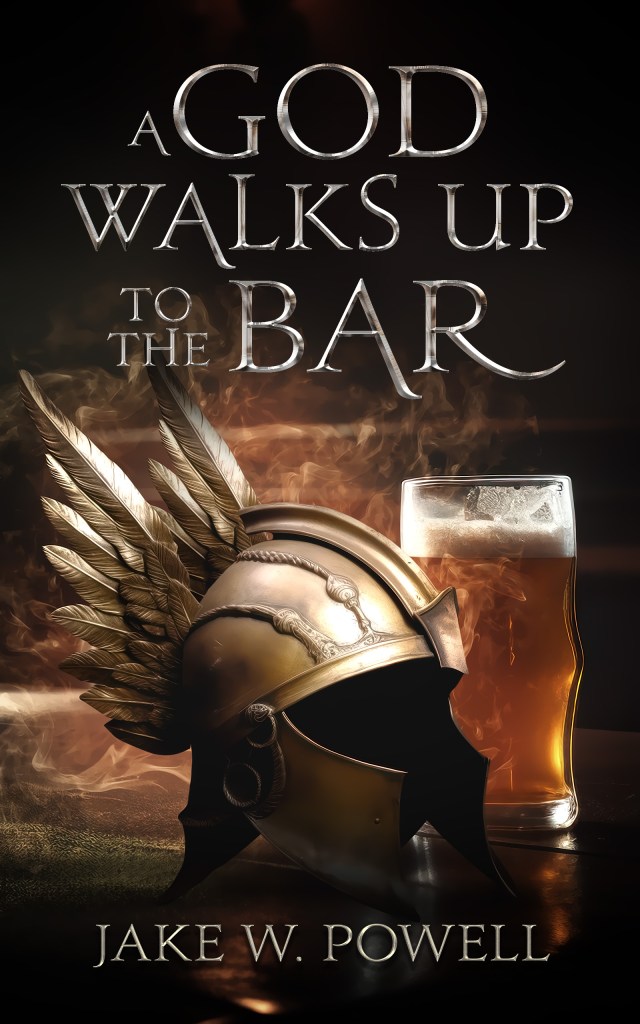
A God Walks Up to the Bar is available in paperback form on Amazon.com! Do you want to add a fun novella to your collection? Do you enjoy fantasy and classical mythology? Thrills? Chills? Humor? Gods beating up monsters? Then hop online and order yourself a copy! Or at the very least, do yourself the favor of admiring the lovely cover art.
And while you’re at it, don’t forget to like and subscribe to this blog. I’m just getting started!
Stories need characters to be stories. Stories are about people. Whether they be human or otherwise isn’t the point: They are defined personalities with concrete goals that drive the plot. Even a place can become a character in the hands of an imaginative writer. Whatever shape they take, every tale needs characters to be a tale. Otherwise, you might be dabbling in some form of avant-garde, and I can’t help you there.
Since characters are so vitally important, from the protagonist to the antagonist to the mentor to the love interest to the bit part, it is important as a writer to learn how to create an interesting and layered cast to inhabit the worlds we put down on paper. People have quirks and habits. They have desires. They have likes and dislikes. They have relationships. As authors, it is our job to make the cast come to life. We create the illusion that they are real people.
It’s impossible to create a fully fleshed-out person as you would meet in real life, simply because the sheer complexity and depth of a real person could never fit into any number of books. Pick a historical figure, say, Napoleon Bonaparte. How may books have been written about his life? And they all have something different to say. One man, and everyone sees something slightly different. A writer would have to dedicate his life and then some to even approach that degree of complexity. No, I believe that it is the author’s job to create enough of the character as is needed to serve the story.
That’s what I mean when I say writers create the illusion of real people (or dogs, cats, antelope, aliens, mythical monsters, etc. You get the idea). It’s a bit of literary sleight of hand. Each character is just a slice of reality, a digestible piece that is enough for the plot and reader. By giving layers and dimension to those slices, we approximate reality. The closer we create someone who acts mostly like a real person, the more our readers are convinced they truly are. Suspension of disbelief. Very rarely will you ever read or watch a character behave exactly like a person in real life behaves.
The victim in the slasher flick always heads into danger. The James Bond villain always monologues about his scheme before inexplicably letting the hero live. The cowboy cop always goes rogue and comes out a hero. Characters reflect reality, but they shouldn’t adhere to reality perfectly. They adhere to the plot. The story is everything, and characters serve to move the story forward. A little tinkering with common sense is a necessary evil.
So, how do you craft your characters? How do you make them their own unique person? Well, some people like to make complete backstories before they start. Some have bibles dictating their characters’ natures, quirks, and traits. Some, like me, start with a basic outline and then let their characters reveal themselves during the course of writing. When I wrote A God Walks Up to the Bar, I knew Hermes’ basic nature. But during the course of the project, I discovered new things about him. There were layers to him I did not anticipate, reactions to events that I did not expect. He’s a fictional character, and I have final say in what is on the published page, but even so, he feels alive.
And that’s good! When the character feels like a real person, I am better able to write them. It’s less like putting words into a dummy and more like having a conversation. I get to know Hermes, know what he’s like, glimpse into the parts of himself that he keeps hidden from all others. He reveals his history as I write him, and I am able to better write him because he has a history.
With that comes a knowledge of what is in-character and out-of-character. How does he react to this situation? And what does he not do? If every character acts the same, then they are interchangeable and the story is boring. Boring is the writer’s death knell. Even an awful story can be entertaining. Heck, I’d rather write an awful story than a boring one. If the reader’s bored, he stops reading. But a “so bad it’s good” kind of story at least keeps their attention.
Mind you, these are all my personal thoughts. Different authors have different styles. If you are a writer who finds it easier to write out a complete and detailed backstory for your characters before starting the first page of your book, then do so. I don’t think any writer should force themselves to do something that runs against their creative instinct. But be open to surprise. Inspiration is always active and strikes at any time, even mid-sentence.
The gods and beings of ancient myth never went away. They just moved on with the times.
My book, A God Walks up to the Bar, is currently available on Amazon.com. Venture into the world of the Greek god Hermes, a world filled with demigods, vampires, nymphs, ogres, magic, and trickery. It’s a tough job, being a god!
Enjoying my blog? Don’t want to miss a single post? Subscribe for updates on when I post and follow my writing career, musings on fiction and storytelling, and reflections about life in general!
We’ve all heard the glorious stories of the writer who dashed out a masterpiece over the course of a weekend, solicited it, and made big bucks. Or we hear about someone writing a book for kicks, posting in on Amazon, and suddenly getting offers from film studios to turn their sudden runaway success into a show. It’s a tempting motivation to become an author, or scriptwriter, or whatever. These guys made it. How hard can it be?
Pretty hard, actually. After all, we only hear about the successes. What about those stories written over a weekend that never took off? How many books on Amazon do you think there are that nobody’s ever read?
I don’t know where I first heard the story that the screenplay for Good Will Hunting was written by Matt Damon and Ben Affleck over a weekend. Probably one of those motivational stories my teachers told me as an example of how life doesn’t actually work. It’s not true, by the by. Matt Damon wrote the original 40-page script as a drama class project, then worked with Affleck on revising it into a full Hollywood script. So, no, they didn’t conjure a masterpiece out of thin air in just a couple days. The foundation was already there, and they still had to work hard to translate it from written word to big screen.
Hugh Howey wrote Wool as a one-off short story that he put up for sale on Amazon. And yes, it did become so successful that he ended up writing sequels and selling the film rights and getting a good deal out of the whole thing. But as unusual as the success of Wool is, it was still based on years of writing experience and hard work. Howey had already been a diligent writer long before he published Wool. The story may have been a one-off, but Howey’s efforts weren’t. He goes into detail at length about his writing on his own blog.
All of which is to say, if you hear about a runaway success, that success is probably the result of a lot of hard work, blood, sweat, and tears that rarely make their way into the story told in magazines. The humdrum routine of writing, or scripting, or painting, or sculpting, or whatever medium you can think of doesn’t usually make for a good story, after all. Customers want the end product. The tedious hours of chipping away at marble or revising a fourth draft aren’t what they’re buying. And, quite frankly, do they even need to know about all that sweat and work?
If you’re truly devoted to something, you’ll put in the effort necessary to see it through to completion. Writing isn’t a “get rich quick” scheme. In fact, it may be the worst method possible for getting rich quickly. Sure, there are plenty of authors out there who make a living off their books. Many of them are quite wealthy, even. But only because they work to an almost obsessive degree on their projects. They devote extreme amounts of time to writing to the near-exclusion of all else. That’s not the easy path to wealth.
So, no, there aren’t any “easy masterpieces” in the world. Just a lot of grunt work and diligence that is never seen by the public eye.
Do what you love, not what you think will make you rich. That’s one thing that can make life a bit easier.
The gods and beings of ancient myth never went away. They just moved on with the times.
My book, A God Walks up to the Bar, is currently available on Amazon.com. Venture into the world of the Greek god Hermes, a world filled with demigods, vampires, nymphs, ogres, magic, and trickery. It’s a tough job, being a god!
Enjoying my blog? Don’t want to miss a single post? Subscribe for updates on when I post and follow my writing career, musings on fiction and storytelling, and reflections about life in general!
It is my duty as an author to make my characters suffer. I must put them through the wringer, submit them to the lash, and force them to endure severe physical and psychological torment. Nothing must come easy to them. My characters must endure doubts, confrontations, and existential crises. They must be tested to their utmost, then pushed even further.
Why? Because authors are sadistic monsters Because the testing of a character forces them to grow, and the pleasure of reading a story is to see its heroes overcome the challenges they face. The greater the challenge and the greater the suffering they endure in conquering that challenge, the greater the catharsis of victory for both hero and reader. And there’s also no small amount of pleasure in giving my characters that final victory. I personally like happy endings.
Suffering can bring out the best and worst in people, whether they be real or they be fictional. It’s an interesting experiment to put a written character to the test and see how they react. What happens if I put the protagonist into THIS terrible situation? Or make them confront THAT unpleasant truth? Struggles let us see what makes people tick. Test your mettle and see how strong you are … and grow stronger.
All that being said, it boils down to this: a story is only as interesting as its characters and the situations they find themselves in. If the characters are flawed and have to work through their problems, then great! The readers share in their triumphs and failures, empathize with their foibles, and root for their success. Characters who never struggle and always succeed perfectly in everything they do can have a place in a story, but you might want to think twice about making them the protagonist. In a word: Boring. Invincibility is fine against bullets and blades, but even Superman is weak against kryptonite.
Authors should toss their characters into the furnace every now and again. Let them work for what they want. It’s what readers are paying for after all, and we got to fill those pages somehow.
The gods and beings of ancient myth never went away. They just moved on with the times.
My book, A God Walks up to the Bar, is currently available on Amazon.com. Venture into the world of the Greek god Hermes, a world filled with demigods, vampires, nymphs, ogres, magic, and trickery. It’s a tough job, being a god!
Enjoying my blog? Don’t want to miss a single post? Subscribe for updates on when I post and follow my writing career, musings on fiction and storytelling, and reflections about life in general!
Do you like doing pushups? What about arm curls? Or squats?
Eighty-five, eighty-six, eighty … eighty-seven …
They can take a lot out of you. How often have you been tempted to stop halfway through your exercise routine?
Ninety … ninety … ninety-FIVE … Ninety … SIX.
Or have you only gone as far as you could before the burn set in?
Ninety-NINE … ONE … HUNDRED.
Perseverance is when you keep going even when your body and mind don’t want to.
There’s an element of stubbornness in persistent people. They refuse to give up or go home when things are looking down, when the weather is cruddy, when they just want to curl up and sleep the afternoon away. Perseverance is the tenacious insistence on never leaving a task half-done.
Writers need to persevere. We need to never give up no matter the circumstances. How many books have been left half-finished, never to be read by others? How many books have never been written at all?
The most important thing, I’ve found, is to focus on the end goal. It’s easier (not easy, mind you, but certainly more bearable) to stick with it when you know how close you are to the end. And as I look back, I see how quickly that work time passed. Rather than focusing on present difficulties with drafting my book or stumbling over writer’s block, I quietly focused on the goal of finishing and publishing. It really does help.
Sometimes, I felt like I had nothing worthwhile to say, or that nothing I did say could measure up to other authors. What do you do during such times? You motor on. Perseverance is, quite simply, never giving up.
There’s a lot of books that will never be written. I take satisfaction in putting one more out into the world.
The gods and beings of ancient myth never went away. They just moved on with the times.
My book, A God Walks up to the Bar, is currently available on Amazon.com. Venture into the world of the Greek god Hermes, a world filled with demigods, vampires, nymphs, ogres, magic, and trickery. It’s a tough job, being a god!
Enjoying my blog? Don’t want to miss a single post? Subscribe for updates on when I post and follow my writing career, musings on fiction and storytelling, and reflections about life in general!




 Jake W. Powell