Not too long ago, my family and I saw a live radio play version of R.U.R.: Rossum’s Universal Robots at a local amateur theater. I am not an avid theater-goer, but seeing this performance gave me a new appreciation of the art, especially its homegrown incarnation.
Amateur performances are charming, and I mean that in the best way possible. I don’t use the word in the condescending sense of “look at this three-year-old’s watercolors splashed across the paper and table and floor, oh, bless his little heart, doesn’t he try so hard!” I mean charming as in witnessing the genuine passion and effort that non-professional actors put into their art. They do it because they love it and want to be part of the show.
I believe that all art has value. Amateur or professional, it’s all worthwhile if you enjoy it. Was the acting a little sketchy in places? Of course. Were the sound effects questionable? Sometimes. And did it have that coziness that is a distinctly different flavor of fun from the bombastic, big-budget hustle and bustle of professional theater and radio plays? Oh, yes. I went in not expecting very much, and came out thinking that maybe I should go to the theater more often.
Did you like what you just read? Are you a writer, or just looking for fun content? Do you want more, but are worried about missing new posts? Please subscribe! I post updates on my writing career, I muse over storytelling and fiction, and I reflect on the curious and wonderful things in life.
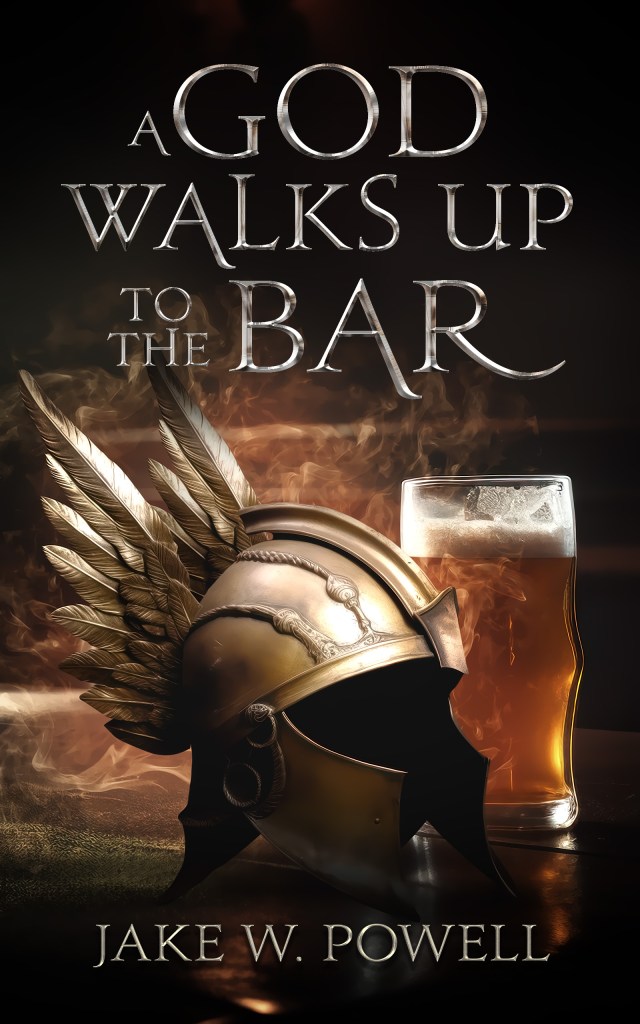
It hasn’t gone anywhere, and it won’t anytime soon! My first book, A God Walks Up to the Bar, is available on Amazon.com. Witness the modern day adventures of the Greek god Hermes in a world much like our own – plus with demigods, vampires, nymphs, ogres, and magic. The myths of old never went away, they just moved on with the times. It’s a tough job, being a god!
It’s the worst insult you can toss at a writer. It’s the deepest cut, the ultimate condemnation.
This reads like bad fan fiction.
Amateurish, incompetent, dubious, self-indulgent, outright moronic – these are the connotations those six words carry. Fan fiction is the respite of those who cannot write, but insist on doing so. Taking what others have already made and twisting it into their personal playground of poorly conceived plots. The refuge of the untalented.
Except it’s not true. Well, mostly.
Stories written by fans about their favorite movies or books or other franchises have garnered a collectively dismal reputation. They’re just a means for disgruntled people to “fix” stories they felt were ruined by the original creators or a way to make up romances between two characters that they happen to like. Now, these types of stories aren’t necessarily poor quality, but they tend to be made purely for the author’s own self-gratification. Consequently, quality isn’t an issue, only that the author gets what they want out of the story without regard for whether others will enjoy it (which beggars the question why it is posted online).
On the other hand, there is fan fiction that is comparable to published works, displaying not only raw talent but an understanding of plot structure, characterization, and reader engagement. Some of them are indeed so-called “fix fics” and romances, but just as many are original ideas, what-if scenarios, unofficial sequels, and other creative content. There’s the bad, the good, and the exceptional.
I wonder how many fan fiction writers could become successful mainstream authors if they so chose.
But what does this matter to you or me? What can aspiring writers who seek to publish, whether independently or through traditional publishers, find of worth in the world of fan fiction?
To put it plainly, writing fan fiction is really good practice for a writer.
I’ve written fan fiction. I wrote fan fiction before I published A God Walks Up to the Bar specifically to cut my teeth on writing for an audience. Fan fiction sites don’t require author names. You can make up any username or web appellation that you want. Anonymity can motivate shy writers, among whom I can be counted. The boldness inspired by a sobriquet can finally push you to take the plunge into getting your work out to the world. Plus, you get your first taste of criticism, good and bad, and develop the thick skin you’ll need and the ability to discern between worthwhile critiques and meaningless heckling.
If you’re a serious writer, fan fiction isn’t an exercise in self-indulgence. You want to tell a good story, and sometimes, building off a preexisting idea can be just the spark you need to flex your storytelling muscles. You can explore freely, experiment with writing styles to see what works for you and what doesn’t, and most importantly, you get to write. Practice, practice, practice. That’s how you improve as a writer.
And just as important, it’s completely free. The barrier of entry is even lower than for an indie publisher. No need for a budget to pay editors, beta readers, and cover artists. No need to maintain an author’s website. No need even for a business license! And the marketing is free, too. Fan fiction, by its nature, is about something already popular and well-known, so your writing can possibly attract more readers than your other, original works. Which is, well, not really fair, I suppose, but let’s try to stay optimistic here. More readers means more criticism means more improvement. Writing fan fiction is a fantastically low-risk method of developing your writing. It’s a great way to discover your own identity as an author without worrying about finances and other aspects of publishing.
All of which is to say, if you’re interested in getting into professional writing and feel you want to practice your skills and test the waters of public reception, fan fiction is a great starting point. And as someone who loves things to come full circle, I’ll just end by saying that someday, you may look back on these early experiments and chuckle … because now people are writing fan fiction about your work.
Did you like what you just read? Are you a writer, or just looking for fun content? Do you want more, but are worried about missing new posts? Please subscribe! I post updates on my writing career, I muse over storytelling and fiction, and I reflect on the curious and wonderful things in life.
It hasn’t gone anywhere, and it won’t anytime soon! My first book, A God Walks Up to the Bar, is available on Amazon.com. Witness the modern day adventures of the Greek god Hermes in a world much like our own – plus with demigods, vampires, nymphs, ogres, and magic. The myths of old never went away, they just moved on with the times. It’s a tough job, being a god!
It’s the most wonderful feeling in the world. You start writing, and you’re off to a rough start. You struggle, you groan, you’re on the verge of calling it a day. Then the words start to flow, one after the other. Bam. Bam. Bam. The prose is smooth, the dialogue is superb, and your story just falls into place like a well-made jigsaw puzzle. Everything suddenly fits.
You get into your groove. The wheels turn without a hitch. You are rocking your writing session and just loving being along for the ride while your fingers type away and your subconscious pulls surprises out of the depths of your mind.
I’m in my editing phase at the moment, working on the second draft of my second book. It doesn’t have a name, yet. I’m still working on that. Mostly, I’m trying to make what I originally wrote into something coherent and readable. Sometimes, I think to myself, “I’m not much up for writing today, maybe just a paragraph or two.” Once I get started, I then think, “Well, a little bit more,” and again, “Huh, this isn’t so bad. I can work with this.” And an hour slides by without me noticing. Or two hours. It’s such a great sensation to be pulled into your writing, to let everything else fade.
A bit scary, too! I lose track of time. I start in the morning, I wrap up and look at the clock and – What! It’s already the middle of the afternoon!?
If I was a fish, then writing would be bait on a hook. I can’t resist. We all have that, don’t we? Our hook. Our favorite activity. The thing that gets us in the groove.
It really is a feeling that’s hard to beat.
If you just so happen to be enjoying my blog, feel free to subscribe. I post updates on my writing career, I muse over storytelling and fiction, and I reflect on the curious and wonderful things in life.
My first book, A God Walks up to the Bar, is available on Amazon.com. Witness the modern day adventures of the Greek god Hermes in a world much like our own – and with demigods, vampires, nymphs, ogres, and magic. The myths never went away, they just learned to move on with the times. It’s a tough job, being a god!
I’ve never done one of WordPress’s daily prompts before, so I thought I’d give it a shot and see how things turn out.
For all the great drinks out there, my answer is really simple: Water.
Water isn’t exciting or fancy or showy. But after a long, hot summer day, nothing tastes better. After a vigorous workout session or a whole day without a chance to drink something, a cold cup of water is the sweetest thing you could ever hope to taste.
There’s something pure about water. It’s guilt-free pleasure. It’s not a cesspool of chemicals like soda, or sugary like juice or lemonade. It’s just water, simple water, and it is the stuff of life running through our veins.
I also realize that every drink of water I take is a privilege and opportunity not everyone has. Here in America, we don’t have to worry about waterborne illness or contamination the way that many other nations do. Heck, we don’t have to worry about not having any water at all. All I have to do is turn a faucet, and voila! Fresh water fit to drink, every minute of every day.
It’s simple. And that makes it very precious, indeed.
If you just so happen to be enjoying my blog, feel free to subscribe. I post updates on my writing career, I muse over storytelling and fiction, and I reflect on the curious and wonderful things in life.
My first book, A God Walks up to the Bar, is available on Amazon.com. Witness the modern day adventures of the Greek god Hermes in a world much like our own – and with demigods, vampires, nymphs, ogres, and magic. The myths never went away, they just learned to move on with the times. It’s a tough job, being a god!
The eternal pressing question: What is art? What defines it, what is its nature, how is it differentiated from the common dross, and how do we recognize it when we see it? What. Is. Art?
Ask a hundred people, and you’ll get a hundred and one different answers. Nobody can seem to decide, though everyone, from the working joe to the professional critic, seems convinced that they know exactly what art is. The artistic merits of literature, film, paintings, and even video games are debated again and again. Is it art? But can we know, when the definition of art is as fluid as the fresh paint dripping from a canvas?
Maybe we’re asking the wrong question. Maybe we should instead ask what isn’t art.
Can this process of elimination help answer this great question? Consider the humble spoon. Is a spoon art? Well, most people would say it isn’t. You use it to eat soup and cereal. It’s a mundane thing. It has an everyday utility. It isn’t art.
What about a car? Is a car art? Well, it also has a mundane use: transportation from point A to point B. But look at car commercials and car shows. Cars boast aesthetic pleasures and pleasing design. They are promoted based on appearance, performance, improvement, and flashy lights. People collect cars. People analyze cars. Are they art? Or are they merely utilities passed off as art? And how do we know, unless we can define what art is?
This is getting complicated.
Why do Jackson Pollack’s paintings get hung up in museums but a two-year old’s paint smears don’t? What’s the difference? Aren’t they both paintings? And aren’t both paintings art? Well, the latter obviously isn’t art art because nobody cares except the parents. But everyone must care about Sydney Pollack since he gets public exhibits.
Nobody cares about spoons unless they try eating soup with a fork. But everyone cares about cars, one way or another. They’re both a fact of life, but one is just plain more noticeable than the other.
Nobody cared about the pipe until René Magritte put up a picture of one alongside the words, “This is not a pipe.” A pipe is just a pipe until it isn’t.
Maybe that’s all there is to it. Maybe art isn’t art until you decide that it’s art.
Until you care whether or not it’s art.
If enough people say that something is true, does it become true? No. No matter how many people say you can fly by flapping your arms, you can’t. But it sure is easier to think you can.
Is that all that art is? A shared belief? A social construct? Just the idea that if we belief something has merit inherent in its composition, construction, appearance, and intent, it rises above the mundane to become something with social significance?
But what about your two-year-old’s paint splatters? Is that art? What loving parent would say, “No”? To them it’s art. It’s more precious than everything in the Louvre.
Maybe art is more than just innovation, messages, and composition. Maybe it’s something more personal than that. Maybe art lies in how much it is valued by the individual. I happen to think cars all look the same and are basically just glorified boxes on wheels. I don’t see the appeal. Cars aren’t art to me. But to others, they are masterpieces.
Critics say something is art, and so we believe them. They must know what they’re talking about, right? Then, a hundred years later, the great art of the time is depreciated. It’s not as important. And new art replaces it. Tastes and preferences change. The definition of art changes based on what we think is important.
A spoon can be a piece of art. In some ways, it is by default. “Art” is a relative of the word “artifice.” Artificial. Manmade.
Maybe everything is art. But if everything is, than nothing is art.
Oh, to heck with it. Art is whatever you want it to be.
If you just so happen to be enjoying my blog, feel free to subscribe. I post updates on my writing career, I muse over storytelling and fiction, and I reflect on the curious and wonderful things in life.
My first book, A God Walks up to the Bar, is available on Amazon.com. Witness the modern day adventures of the Greek god Hermes in a world much like our own – and with demigods, vampires, nymphs, ogres, and magic. The myths never went away, they just learned to move on with the times. It’s a tough job, being a god!
Do you like riddles? I love riddles. I think they’re interesting, fun, and come in infinite variety. They’ve been around for millennia, so someone thought they were worth keeping around.
The book I’m currently working on features a scene where two characters engage in a riddle contest. I used some riddles from history for the scene, but I also took a stab at making up my own. At least, they’re original as far as I know, assuming my subconscious wasn’t inspired by something I read fifteen years ago or some such.
Regardless, here they are. Highlight the space beneath each riddle for the answer. Enjoy!
Teary eyes and stolen breaths
So often found with death and wrath
No teeth to bite nor fists to strike
Yet destruction always marks my path
Smoke
A single eye, yet I cannot see
A single fang, yet I cannot bite
I have no hands nor feet
Yet many things can I complete
A needle
Clad in armor like the turtle, many do I command
Proud and vain like the eagle, on ground I need not stand
Beasts fantastic mark my name and honor,
Yet at day’s end, I die like any man
A knight
What are some of your favorite riddles? Maybe you’d like to take a shot at creating a few yourself!
If you just so happen to be enjoying my blog, feel free to subscribe. I post updates on my writing career, I muse over storytelling and fiction, and I reflect on the curious and wonderful things in life.
And speaking of my writing …
My first book, A God Walks up to the Bar, is available on Amazon.com. Witness the modern day adventures of the Greek god Hermes in a world much like our own – and with demigods, vampires, nymphs, ogres, and magic. The myths never went away, they just learned to move on with the times. It’s a tough job, being a god!
I must confess to a strange reading habit, one that might shock and horrify you. Do not judge me too harshly, for I shall explain myself.
When I start a fiction book, I like to skip to read the last couple of pages first.
“What?” I hear you cry out. “What is this blasphemy? Why ruin the story for yourself?” Calm yourself, please. Let me clear things up.
It’s true that I’m not sensitive to spoilers. I really don’t mind when plot twists are brought up in casual conversation. But this habit is more than just wanting to know how things end. Really, without context, knowledge of a story’s ending doesn’t have a terribly great impact on me as a reader. I have no grasp of the import of the scenes and dialogue. What I’m really interested in is catching a glimpse of the finished jigsaw puzzle, then going back to the beginning to see how the pieces fit together.
Rather than starting a book with no idea of how things end up, I know exactly how it ends. And so, the fun of the read shifts from the “what?” to the “why?” Why is this the ending? And how will my initial impression of it change as I get more pieces of the bigger picture?
I suppose I’m interested in perceiving the author’s mind. How do they assemble the various elements of the narrative into its final shape at story’s end? How are these characters and events inserted into the story? In short, how did we end up here?
Pieces click into place as I read on, and the ending’s significance becomes clearer. Sometimes, I feel like a detective solving a case in reverse. I already know whodunnit, but the howdunnit isn’t so obvious.
And I do it because I’m quirky and it’s kind of a fun exercise to try out. I neither recommend it nor warn against it. Reading style is a matter of personal preference. It’s up to you.
And there you have it. The true confessions of a skipper.
If you just so happen to be enjoying my blog, feel free to subscribe. I post updates on my writing career, I muse over storytelling and fiction, and I reflect on the curious and wonderful things in life.
The history of humanity is the history of crossing over the next hill.
Where are we without curiosity? Caves and mud huts. One day, someone steps outside with a mind filled with questions. What is over that next hill? What is in that valley? What is beyond that forest? Anther follows, and another. Further afield we walk, driven not by necessity but because we want to know.
Questions follow questions. Can I eat that? Can I grow it? Why does this reed make a sound when I blow through it? Food and music are discovered. Someone finds a sturdy stick. A walking stick, and soon a weapon. Lines are draw on sandy ground, then painted onto rock and hides. Maps are made to chart the wanderer’s path.
We cross the last hill and find a sea. But now is not the time to stop. Wood floats, this is known. A little later, and mankind sails out on boats across the water to find out what lies on the other side. They learn how to make the stars their guide. Navigation becomes more than simple wandering.
Where people grow tired and rest, they find new fruits and vegetables and animals. The nomad becomes the gardener and herdsman. Someone notices those mangy wolves following the camp for scraps. Someone tames them.
People build huts of straw and wood, of stone and brick. Cities appear. Curiosity turns inwards. How to make life better? Clever hands produce answers: the wheel, the hammer, the nail, the net, the plough, the saddle.
Not all stay in cities. Others keep wandering, looking for the next hill and sea and valley. They wander far afield, planting new cultures wherever they stop awhile. Downriver and up mountain and across desert. Because they can. Because they must know what is there.
The whole earth is charted. Mankind does not rest. The ocean deeps call out. The stars wink at humanity, inviting it to pay them a visit. Steam and electricity are harnessed. Fire no longer warms the camp, but lifts man and woman on ships of steel into the airless void to visit the moon. Other ships carry them beneath the ocean into the lightless abyss to glimpse its moody depths.
It is the never-ending journey. Why? Reasons are given, some long and eloquent, others little more than a careless shrug. Because we must know. Because we are curious creatures. Because we can scarce imagine what new mystery awaits us over the next hill.
If you just so happen to be enjoying my blog, feel free to subscribe. I post updates on my writing career, I muse over storytelling and fiction, and I reflect on the curious and wonderful things in life.
New Year’s Day is a day famous for resolutions. The day when people work up the courage to swear to permanent change in their lives. To resolve to start doing this, stop doing that, and make some adjustments to these other things. A time for fresh starts.
Now, let’s be honest with ourselves. How many of you have ever kept a resolution all the way through the entire year? If you have, you have my deep and abiding respect. You are a rare breed.
I don’t believe in New Year’s resolutions. I defy this societal concept. No, I’m not being contrary for contrariness’s sake, I just don’t understand the need for it. Why wait until one day out of 365 (or 366) when you can always decide to change TODAY? That is, if you really want to improve yourself. Maybe it’s just more comfortable to say, as little orphan Annie sings, “There’s always tomorrow.” And tomorrow always seems to be such a long time coming.
That being said, it’s all well and good to come up with new goals on New Year’s Day. It’s tempting to look out across the vastness of the new year, all those blank days ripe with promise, and imagine to oneself how this time you’ll do it differently. You’ll be better this year, just wait and see. You make that silent resolution to yourself. On the same day, of course, when everyone parties hard till midnight and carouses and gets drunk and gets into car accidents. A hangover and a car repair bill. An excellent start to the new year.
Some people take resolutions very seriously. And to those people who can keep them throughout the year, I say more power to you. Like I already said, you are a rare breed. Most people make a few half-hearted mentions of a few things in life they want to be different, then forget all about it in a couple weeks (or a couple drinks).
Which isn’t to say that the idea behind New Year’s resolutions is a bad thing. We should always strive to improve ourselves. But maturity and growth is a gradual process, not something that happens in leaps and spurts. It takes a lot of effort to change something about ourselves. We stubbornly cling to bad habits and thoughts because they’ve stuck with us for so long. A single day of swearing off a habit isn’t going to make much difference. You got to work at it every day. You got to practice. Change is slow.
So, I don’t bother with New Year’s resolutions. Why should I, when I can make that resolution any day of the year? Sometimes, I make the same resolution multiple times in a week or a month, because I stumble. We all stumble, especially after making a big show of the big changes in our lives. Life likes to set us up like that. It’s like setting the cute baby seal free into the ocean with cameras rolling and – oh, there’s the shark waiting to spoil the moment.
I will make resolutions as many days as it takes to improve myself for the better and change my bad habits. No one-and-done deals. One day’s quick and easy promises aren’t enough.
If you just so happen to be enjoying my blog, feel free to subscribe. I post updates on my writing career, I muse over storytelling and fiction, and I reflect on the curious and wonderful things in life.
Winter is approaching fast, and that means snow is on the way where I live. And snow means a clean split between those shivering with excitement and those groaning in despair.
Snow is weird. You want to paint a happy picture of winter fun? Throw in some snowmen and snowballs and snow forts. Want to paint a picture of a barren wasteland? Take OUT the snowmen and snowballs and snow forts.
Snow is great until it isn’t. Making snow angels and trekking through knee-deep drifts is all well and good until the melt seeps into your pants and you can’t feel your toes anymore. Or your fingers. Or your nose and ears. Hey, look! My pinkie just froze and snapped off! Isn’t this FUN?
When I was a kid, I loved snow. Snow meant days off school and winter play and running around trying to come up with new ways to use the stuff. I loved playing in it and rolling huge snowmen. Well, more like snow boulders. We would just roll a bunch of big uber-snowballs and leave them scattered across the field. And I have fond memories of watching snow slipping off the tallest tree branches during the thaw. Snow is fun – when you don’t have responsibilities.
Nowadays, I prefer to stay inside and enjoy it from a safe distance.
You see, kids don’t have to drive in snow. Or walk down to the mailbox in it. They might have to shovel the driveway, but pay them in cash or candy and they’re happy enough. Too bad adults can’t pay themselves for cracking their spines lugging shovelfuls of very heavy frozen water. Growing up is a terrible thing, sometimes.
Ah, yes, snow is water. Which means it melts. And that brings on the SLUSH. Nobody ever mentions SLUSH when discussing winter. It’s a wintry wonderland, happy and clean and pretty! And then it all turns to SLUSH. Dirty, half-melted bogs of detritus covering roads and pooling in every yard and gutter. The aftermath of winter.
There are people who never see snow, for whom the concept is a distant fantasy. These people probably enjoy snow very much because they never have to deal with it. Snow is a pleasant image on TV screens and picture books and never, ever interferes with their lives. They can safely imagine what it would be like to be in the snow without having to actually endure it.
Yeah, you grow up and little fun things become big pains. Alas. But, snow IS pretty, I’ll give it that. And freshly fallen snow is one of the purest, cleanest things you can see in the world. And the morning after a snowfall is so quiet and peaceful and contemplative. Or eerie and spooky if you’re so inclined.
To all the people who live in regions where there is snow most, if not all of, the year, hats off to you. You are tougher and more patient than I am. I would say that snow only belongs in regions uninhabited by all life, but since humanity always seems keen on colonizing the most desolate and inhospitable regions on Earth, I guess that bus has long since passed. At least some people know how to make really pretty art out of it.
Snow is just weird. It’s this twisted dichotomy of life and death. Snow-covered landscapes are either joyful, festive scenes or just pits of death. Maybe a person’s changing attitude toward snow is some sort of reflection of our changing nature from childhood into adulthood.
Or maybe we’re all crazy and should just stay inside where it’s warm.
Enjoying my blog? Don’t want to miss a single post? Subscribe for updates on when I post and follow my writing career, musings on fiction and storytelling, and reflections about life in general!




 Jake W. Powell