Tips on Draft Writing

Drafts are a vital part of any writing project. Very, very, very rarely is any book released on its first draft. You need to pour over your work many times to make sure it’s ready for publication. But, the question often arises: How many drafts should you write? Three? Four? Eleven? How many is enough?

There’s no hard and fast answer. It depends on the author. Different strokes for different writers.

Even so, I’ve come across a few general tips that can help you decide how long to spend in the drafting stage.

  1. Set yourself goals for each draft. Pick one specific thing to improve for each draft you write. Your first draft -the vomit draft, as I like to call it – is just getting your story onto paper. Your second draft, perhaps, can center around developing story and characterization. For the next one, pay attention to grammar and sentence structure. Whatever you choose, each draft sees definite and specific improvement, and you may find yourself not needing to go through as many as you expected.
  2. Don’t expect perfection. You’ll never get there. Drafting is about improvement, not reaching an ideal but unattainable state of “perfection.” Even the greatest writers make mistakes. Focus on refining and polishing. Every time you go through your story, you’re making it better. Each draft builds on the previous one.
  3. Pace yourself. Sometimes, wrapping up one draft and jumping straight into the next isn’t a good idea. Give yourself a few days to let your subconscious mull over things. A little break can be great for your writing as you begin anew rested and with a fresh perspective. You find yourself more easily spotting errors and opportunities.
  4. You have to publish eventually. If you want to release your book to the public, you will have to stop drafting at some point. You have to tell yourself that your story is ready. Remember: Refining and editing is all well and good, but if you never stop, then you will reach a point where you’re doing more harm than good. You lose sight of the whole and get buried in nitpicks that add nothing. A sculptor who never stops chiseling the marble ends up with nothing but gravel in the end.

Some people love the drafting stage, other people don’t. I find it a useful and interesting process. I not only clean up the chaos of my first draft, but also discover new things about my characters, new storytelling techniques, and just plain mature as a writer. However many you find necessary, remember the most important tip of all: Have fun with it!

Many thanks for visiting my blog. I post updates on my writing career, I muse over storytelling and fiction, and I reflect on the curious and wonderful things in life.

My City of the FUTURE

How would you design the city of the future?

Well, for starters, I’d figure out what the heck is meant by “city of the future.”

I mean, hypothetical, futuristic cities designed in the 1950s look a lot different from what we 2020ers think they should look like . A lot less art-deco and a lot more Apple aesthetic. Lots of white and curved corners. In fifty more years, the city of the future will probably be imagined as made of recyclable plastic or something.

But this is my city, right? I can do what I want. So, futuristic means pretty, practical, and maybe even a little sustainable.

First thing’s first, its streets are based on a grid system. I want a city that’s easy to navigate with no silly, loopy streets going every which way. If we live in the future, we should be able to make our own cities easy to drive in, a least. Also, wide streets. My city will acknowledge the existence of heavy traffic and anticipate it. Wide streets that can accommodate, oh, let’s say six lanes.

But I’m also going to offer incentives to not drive cars everywhere. Because we’re in the future, right? And cars are a thing of the past. Well, they might be. It’s the future, who knows what’s going to happen?

So, I’ll have elevated rail lines for the train and also lots and lots of rental stations with electric bikes. Just put in a quarter and ride your rental for an hour or so. Also, I’m bringing back trolleys. Trolleys are a great idea, and I’ll fight the gas companies to make my city’s public transportation system the best in the world.

Since my city is on a grid, I’m thinking it’ll be shaped like a big square or rectangle. In the center is where all the skyscrapers will be located; the major businesses and corporate headquarters will have their places in the center, and they aren’t going to be big blocks of glass. I want some curvature to these buildings, something a little softer on the eyes. No hard corners. Also, solar panels. I’ll coat the upper floors of these skyscrapers in solar panels. Fancy, futuristic solar panels that are transparent or something, so you can still see out the windows. Not possible? Well, guess what? It’s the future!

Ah, speaking of power, I’m also going to install revolutionary new generators under the city center sidewalks that convert the kinetic force of footsteps into electrical energy. That’s right, I’m going to design a city that generates power from people walking down the sidewalk. Impossible, you say? Need I remind you? Future!

The most vital part of my city design is trees. Lots and lots of trees. The streets will be lined with trees, and there will be dozens of parks. Big parks, little parks, flower gardens, all scattered throughout the city. The very center of the city, smack dab in the middle, will be the biggest park, with a lake, a sports field, a walking loop through the woods, and more. Trees are important. They provide fresh oxygen and help calm people who otherwise are trapped in an artificial world. My city of the future will have nature in it.

That’s about all I can think of. A nice, pretty city that’s livable. And preferably cheap to live in. It needs lots of incentives for businesses to come in and employ people, but I’m just the designer, not the economist, so I can’t answer that here. But I’m sure my revolutionary sidewalk power generators will cut down on costs somehow.

I took the time to describe my basic idea to AI and got this image spat out in response.

Not bad, actually. I was expecting worse from AI. The buildings aren’t quite what I wanted, but I like the distinct lack of traffic and lots of bicyclists. Also, trees. Yes, that many trees.

There you have it. My city of the future.

Many thanks for visiting my blog. I post updates on my writing career, I muse over storytelling and fiction, and I reflect on the curious and wonderful things in life.

A Story’s Skin: Setting Limits for Yourself as a Writer

We as human beings don’t like to hear about “limits.” We want to do our own thing without anything holding us back. But consider the breadth of human imagination and all the choices you have as a writer and ask yourself, “How do I even know where to start with my story? Where do I go with it? How do I keep it organized?”

The truth is, stories need boundaries. That’s the difference between a story and rambling. Stories have a point, and they stick to that point. Telling a story about shopping at the grocery store is not going to include what your kids did at school that day. And a story about grocery shopping isn’t going to take as long to tell as, say, the history of Great Britain. Different stories have different limits. But they do need limits.

Some of us like to meander. We have so many ideas and we want to shove them all in. It’s fun to type away at your computer and watch the words flow. But knowing when to stop – ah, there’s the rub.

Here’s a metaphor for you: Imagine your story is like the human body. It’s made of many different complex parts. But all those parts are able to stay together and function properly because of the skin. Skin covers the body and keeps it in place. If we didn’t have skin, we’d just sort of … ooze all over. And who wants that?

It’s the same with writing. You have an idea, or two or three. Great! Now stop. Organize those ideas, don’t add to them. Stories have a beginning, middle, and end. A triggering event, rising action, climax, and epilogue. In other words, stories have structure. And structure, by its very nature, is defined by boundaries and restrictions. They aren’t bad things. They’re necessary for anything to make sense and have form.

Outlining your story ahead of time is a great way to know what your story is about, to know what to put in and what to hold back. Yes, things will shift and change as you go through drafts. But don’t keep adding and adding and adding. Know when to stop and refine what you already have. Put a skin on your story.

If overwriting is a major problem for you, then put a limit on your word count. Something miraculous occurs when you suddenly have a ceiling you can bump your head on.

When we are deprived of the freedom to do everything, we discover a new well of creativity. We choose our words more carefully. We find focus. Words matter more, so we experiment until we find the right ones. We cut away cumbersome paragraphs and sentences. Knowing there’s a cap on our writing makes us pay extra special attention to dialogue, plotting, pacing, and everything else.

Limits are good. They force us to be better writers.

Many thanks for visiting my blog. I post updates on my writing career, I muse over storytelling and fiction, and I reflect on the curious and wonderful things in life.

Setting Your Own Pace: The Importance of Not Comparing Your Productivity to Others

It’s so easy to look at the writing community and be amazed at the writers who churn out novels like nobody’s business. A novel per year, two novels, even three! How can anyone hope to compete with that kind of productivity? For those of us just starting out, we may feel a burden being placed on our shoulders. We may feel that we have to “keep up” to be considered good writers.

Well, I say “Phooey” to that. Every writer is different, and we all have different paces at which we write. Some write slow, some fast. And not everyone has a dozen stories to share, or even two. Some people only have one good book in them for their entire lives. My respect to those who publish that one book.

Comparing yourself to other writers, using the accomplishments of others as the measure of your own worth and talent, is a flawed notion. What do you know about the life of those writers? How long have they been writing, and how much time do they have with which to write? And even more importantly, what sacrifices have they made to achieve their output?

I have a day job and other responsibilities. I have friends and a social calendar. As much as a part of me would love to write 8 hours a day every day, the simple truth is that I can’t. I make deadlines, I make an effort to write something every day, but I’m no book-making machine. But I can still be content with my work.

So, if you feel that your worth as a writer is measured by how prolific you are, take a breath and relax. Don’t rush your writing, and don’t seek quantity over quality. A rushed product is messy and rarely 100% of your potential. There is no race, except maybe against the deadlines you set for yourself. Don’t rob yourself of the enjoyment of what you do.

We’re all different. Our writing journeys are different. Figure out what works for you.

Many thanks for visiting my blog. I post updates on my writing career, I muse over storytelling and fiction, and I reflect on the curious and wonderful things in life.

No, It is Not Genius. You’re Not Genius. There is No Genius Here.

What is a word you feel that too many people use?

I have … several … words that I believe have seeped into the social fabric as overused and overrated vocabulary. Words used so often they don’t have any meaning left except as placeholders or hollow props to push a point. But one word I, as a storyteller and writer, really, really, really, really tire of seeing used at the drop of a hat is this:

Genius.

I see it everywhere online.

“Look at that camera shot! Genius!”

“Did you read this cool one-liner in this comic book? It’s awesome! Genius!”

“Look at what she’s wearing! I love it! The designer is a genius!”

“This music pumps me up! It must be genius!”

No, it’s not. It’s not genius. It’s likeable and memorable and probably technically very skillful. But it’s not genius just because you personally like it.

If I’m coming on strong with this, it’s because I don’t like it when people’s vocabulary is reduced to a handful of expressions and words to communicate a vast and varied array of feelings and situations. It cheapens words. Wait, what am I saying? Words are expensive. They must be, because so many people can’t seem to afford to learn any more.

Genius is a word with a history. The ancient Romans believed the genius was a type of spirit. Genii watched over people and resided in objects and locations. They were entities that guided and assisted people. They were an abstract, animistic concept with concrete benefits.

Genius evolved to mean an individual possessing remarkable and unique creative or intellectual ability. Geniuses are singular in their talents. They are rare, and often leave a significant impact on the world beyond that of simple aesthetic or crowd pleasing. Their minds are quantifiably beyond that of others.

Note that I said “rare.” Geniuses, true geniuses, don’t sprout up like dandelions. And yet, somewhere down the road, society lost the plot. It loves to attach the word to anything. And, I suspect, not because one truly believes the person or the work has intellectual or creative worth, but because of personal gratification. Genius is whatever you want it to be. Genius has become relative.

Maybe it always was? Maybe. But were Einstein or Turing or Leonardo da Vinci merely relatively smarter than the average joe? Or were they actually making remarkable and unprecedented achievements in their fields through learned and innate skill that is extremely hard to match? There’s nothing relative about genius. It is either present, or it isn’t.

This is not to tread over the achievements of others. Not everyone is a genius, but there are many, many skilled people in the arts and sciences who have produced amazing things for people to enjoy and benefit from. They should not be put down. And geniuses work hard, too. It’s the hard-working ones that we know about. But for the love of apple pie, please stop throwing the word around like confetti! Let it hold some meaning.

On the other hand, linguistic drift is a thing. Tragically, “genius” may very well go the way of so many other words with rich histories and meanings and become just another toy in pop culture’s box.

But not for us bloggers, right? Right?

Many thanks for visiting my blog. I post updates on my writing career, I muse over storytelling and fiction, and I reflect on the curious and wonderful things in life.

Publishing and Budgeting

As writers, we are doing something that we love. We also know that writing comes with wearisome but necessary tasks, such as budgeting. This is especially true if you’re self-publishing. As annoying as managing your budget can be, it is vital to getting your book onto the market. Here are a few tips I picked up in the course of publishing my first book.

  • Set your maximum budget. First and foremost, how much can you spend on your book? Some of us, like myself, write as a hobby. With writing not a main source of income, I need to pinch pennies. If you’re worried about overspending, do some research online to get an idea for the general cost of publishing. From there, set yourself an upper limit you won’t go over. Keeping within boundaries can not only help you keep a firm hand on your finances, it also narrows the field of available options and prevents overloading your brain with too many choices.

  • Budget in steps. You won’t be spending all your money at once. Getting your book ready requires multiple steps: Editing, cover art, marketing, formatting, and so forth. So, you can create a budget that accounts for each stage. Budget for the editors, and plan for what type of edits you’ll submit your draft for: copyediting, line editing, etc. Plan how much you will spend on cover art, and whether you will have your book formatted as an eBook, hardcopy, or both. How will you market your book, and how much are you able and willing to spend? Dividing up these tasks can make setting the budget much less overwhelming. You put money away for each stage, rather than viewing it all as one big vaguely defined blob.
  • Do research before you pay. The old adage rings true: “You get what you pay for.” As you look into available services, research company reviews online. What do other authors have to say about their experiences with this or that business? And furthermore, if you find someone offering what seems like a bargain, be cautious. Ask yourself: Are they cheap because they can’t keep any customers? Look around, build up a list of potential candidates, and check them out one by one until you find someone you can trust to do a good job. And remember that the quality options are inevitably going to command higher prices.

Money is a pain. It’s not why most of us write. But it’s a necessary evil, and it’s worth it in the end. The light at the end of the tunnel is seeing your book up for sale and available to the world.

Many thanks for visiting my blog. I post updates on my writing career, I muse over storytelling and fiction, and I reflect on the curious and wonderful things in life.

Just Like Ping-Pong: Crafting Conflict Between Hero and Villain

Let’s assume for a moment that we’re talking about a story featuring classic good versus evil. There’s a hero and a villain. They struggle with each other for victory.

What makes the story good? Lots of things, but interest is a biggie. We like interesting stories. Inversely, we avoid boring stories. What makes an interesting story? Conflict. The hero has to struggle to reach her goal. She must overcome obstacles great and small, and in so doing display character growth and maturity. At the heart of that struggle is their nemesis, the story’s villain.

Good villains go through their own struggles. Does that surprise you? The hero isn’t the only one who must overcome. After all, the best villains are the heroes of their own stories.

Like heroes, villains have goals. These goals run directly counter to the hero’s, hence why they clash. Now, a villain may be stronger than the hero, or smarter, or generally more intimidating. Which is great! It makes the hero’s victory all the sweeter. But if the villain always wins and succeeds in all their schemes right up until the last hour when the hero finally, conclusively defeats her opponent, well … It’s not a bad thing, per se, but it’s a tad predictable, and rather repetitive.

But what if the conflict becomes a ping-pong match?

The hero wins one round. The villain wins the next. They trade blows and barbs; they’re evenly matched up until the last. Now that’s a good story! It keeps the audience on their toes. You don’t know what’s going to happen next. You’re dangling in delicious suspense. “What if?” you ask yourself. What if this story doesn’t end happily? What if the bad guy wins? After all, the villain is a match for the hero. It’s just like ping-pong, which can get really intense if both competitors are skilled.

Okay, we know that good overcomes evil 90% of the time, but the illusion of doubt is introduced. Disbelief is suspended. We are caught up in the moment of the story.

Meaningful conflict is driven by a question that any good story should prompt in the audience: What happens next? It doesn’t matter if deep down we know the answer. The question should still be whispered on our lips.

Many thanks for visiting my blog. I post updates on my writing career, I muse over storytelling and fiction, and I reflect on the curious and wonderful things in life.

Music While I Work

What do you listen to while you work?

I’m no music afficionado or expert. If you ask me what type of music I like best, I’ll probably only manage something banal like “The music that sounds best to me” or “I like what I like.”

I have a pretty broad taste in music, though it usually comes down to music without lyrics while I’m working. Bear in mind “working” for me usually means doing something clever on the computer, so hearing words while trying to think about what to type next can be a little confusing. At any rate, while the types of music I listen to encompasses a range of genres, the origin of the music is usually the same: video games.

Sounds weird, doesn’t it? What do Super Mario Bros. and Pac-Man have to offer the music world? Well, after forty-odd years, it turns out that the music has, uh, evolved. A lot.

There’s a ton of variety, and there’s always something new to listen to. I rarely get bored. I often listen to music when reading, too. It helps my mind process better.

At any rate, it helps me get through the day, and that’s what counts.

Many thanks for visiting my blog. I post updates on my writing career, I muse over storytelling and fiction, and I reflect on the curious and wonderful things in life.

A Writer’s Lament

My friends and family know I’m a writer. They know that I’ve published one book and am currently working on a second. That arouses interest, and it invites a question. It’s a question I never feel I can adequately answer:

“How’s your book coming along?”

What do I say? Do I delve into the complexities of plotting and characterization or explain exactly how the story has evolved in the writing of it? Do I describe the process of drafting? Maybe we could have a chat about beta readers or commissioning cover art? Or perhaps I just jump into a lengthy spiel about how writing is so darn fun, the thrill you get when your ideas come together and your vision is realized?

It’s … hard to talk about my work with non-writers, not because of some elitist viewpoint that only writers can understand other writers, but, because I don’t have anything to show for my work until it’s done. That’s the weird thing about writing in the modern era. There’s no physical measure of progress.

I’m no artist or sculptor, whose progress is apparent from glimpsing the picture being painted or the block of stone being carved. I’m not an architect whose building people can watch being built day by day. I don’t even live in the era of the typewriter, when authors ground out their pages and stacked them into a pile. That’s progress you can see. But in this time of computers, all of my work is invisible. It’s in the hard drive, unseen and untouchable, and what isn’t there is in my head.

So, when people ask how my book is progressing, all I can really say, “It’s going good,” or “I’m on track.” Unless they want to be a reader reviewing my work, there’s nothing I can show them. The answer to their simple question – the full, glorious answer of what is going on inside a writer’s colorful mind – takes more than a quick word to fully portray. Microsoft Word documents aren’t glamorous. The writing process itself isn’t glamorous. You don’t see people lining up for tours to see authors at their desks. It isn’t fancy or visibly interesting. All the fun goes on in the writer’s imagination, unseen and unheard. It’s the result that grabs people’s attentions, and only the result.

Cal it a writer’s lament.

How’s my book coming along? Just fine, thank you for asking. But I can’t truly show you until it’s done.

Many thanks for visiting my blog. I post updates on my writing career, I muse over storytelling and fiction, and I reflect on the curious and wonderful things in life.

Big Buzzing Bullies

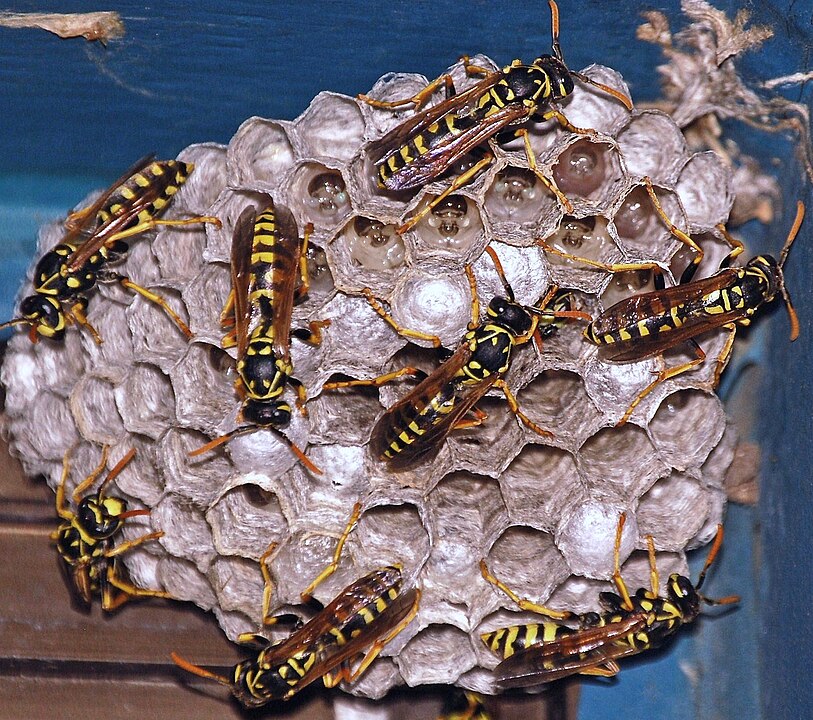
There are bullies under the summer sun. They have no sense of mercy, they inflict harm without cause, and they don’t even have the decency to enjoy it. They buzz around like yellow caution signs of doom. They set up shop exactly where it will worst inconvenience you – butting into your backyard and your homes like they own the place. And if you say anything, they stab you.

I am, of course, talking about wasps. Nature, for all its horrors, is pretty chill all told. Spiders only bother you when you bother them (“It’s not MY fault you walked into the web I set up at eye level”). Tigers and bears and wolves are just hungry, or you got too close to their cubs. Who doesn’t get angry when someone messes with their kids? Sharks are the victims of bad press. Just because someone can’t blink or smile or emote in any way comprehensible to human brains is no reason to discriminate (also, get out of the water). And crocodiles and hippos … okay, they’re pretty bad, but if you keep your distance they’re okay.

Wasps don’t keep their distance. Wasps don’t need a reason. Wasps go out looking for trouble. Those narrow, spindly bodies, those pitch-dark eyes … Just look at the villainous invertebrates!

Look at them! Look at the vile monstrosities!

Not at all like the humble bee. Bees are selfless. Bees are productive. Bees can coexist with mankind. If you rile them up, they’ll sting once and give their lives for the colony. See, even if you’re being swarmed by bees, they’re still quite heroic when you think about it. They give themselves for a greater cause. Not wasps. The only thing a wasp has to give is PAIN.

They don’t produce honey or wax or even jelly. They got nothing (except the aforementioned giving of pain). All animals, no matter how scary, are reasonable enough when you get to know them. Except wasps. They gang up on you because you looked at them funny. They are genocidal, resource-hording invaders. They’re under your feet. They’re in your walls. They want your PB&J sandwich. They’ve claimed your favorite climbing tree and will obliterate you if you get too close. Screw you, wasps.

Wasps are jerks.

Many thanks for visiting my blog. I post updates on my writing career, I muse over storytelling and fiction, and I reflect on the curious and wonderful things in life.

Image courtesy of Wikipedia; License under CC BY-SA 2.5