The Rule of Three: A Strange Ingredient for Storytellers

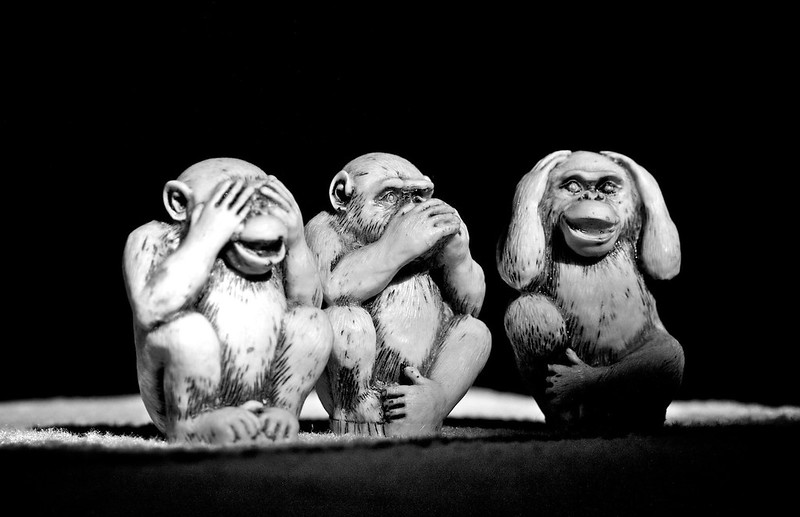
Image: “Three wise monkeys” by Anderson Mancini, licensed under CC BY 2.0.

What’s the most important number in the world? Let’s count.

One … two … three?

It’s an odd number to be fixated on. But we are. Look around you. Listen. Read. Everything comes in threes. We love things to be presented in trios.

Land, sea, sky. Birth, life, death. Child, adult, elder. Beginning, middle, end. Ready, set, go. Lights, camera, action. I came, I saw, I conquered. See no evil, hear no evil, speak no evil.

It’s a habit of humanity to divvy things up into threes. Maybe because it’s a nice prime number, like 5 or 7. There’s a pleasant sense of completeness in three, a satisfaction that you can’t quite get with two, and going up to four is a step too far. Three is everywhere, and it’s found a home in our collective psyche. Things always feel right when they’re grouped into threes. Stories feel right.

The number three is storytelling’s superstar. Stories rely on patterns, and the number three is the smallest number you can use to set up a pattern and then deviate from it. Take a glance at fairy tales and note how many times the third brother gets the prize, or how many trials the hero must overcome to succeed, or how many times the evil witch tries to stop him. Set up the expectation and then throw in a twist the third time around.

Good stories tend to be efficient with their time and words. Why go through the same pattern four times to set up the fifth’s deviation, when you can cut out two repetitions and get the same result? Maybe early oral storytellers were just lazy and hit on a good tactic to keep listeners engaged without wearing out their throats.

Either way, if you’re going to be a writer, consider the usefulness of the rule of three. Most stories are divided into three acts: The setup, the middle action, and the climax. Want to reinforce that a plot element is important? Mention it three times: Once to introduce it, a second time to remind your audience of its existence, and a third time for the payoff (alternatively, a third time to reinforce it in audience’s minds, and then give them the payoff).

Remember the oath that witnesses make in court? “Tell the truth, the whole truth, and nothing but the truth, so help me, God.” Here we see the principle in action: “Tell the truth” (introducing the concept to speak truthfully), “the whole truth” (reinforce the concept that you will be honest), “and nothing but the truth, so help me, God” (grinding it into your head that you will tell the truth, doggonit!)

As weird as the rule of three is if you think about it too hard, we’ve been raised on it for so long that it’s been hardwired into most societies. We tend to think in terms of threes when writing, when talking with friends, or even when giving a speech. It’s just such a common, reliable, and trustworthy trope. It’s in schools, it’s in media, it’s even in the academic community.

Ha, ha, yes, I’m so very clever. But you get the point. Don’t you? Need me to repeat it again?

In all seriousness, we humans do like patterns, and the rule of three is such a basic pattern that it fits pretty much anywhere. We recognize it, at least on a subconscious level, because we’ve been exposed to it since childhood. I can make that statement with confidence because it’s just. That. Widespread. And yes, I did just use the rule again to prove my point. Really, this whole article could drown in its own metatext.

Being so common, the rule of three is a reliable standby for writers both beginner and veteran. I use. You use it. And – Well, you get the idea.

The gods and beings of ancient myth never went away. They just moved on with the times.

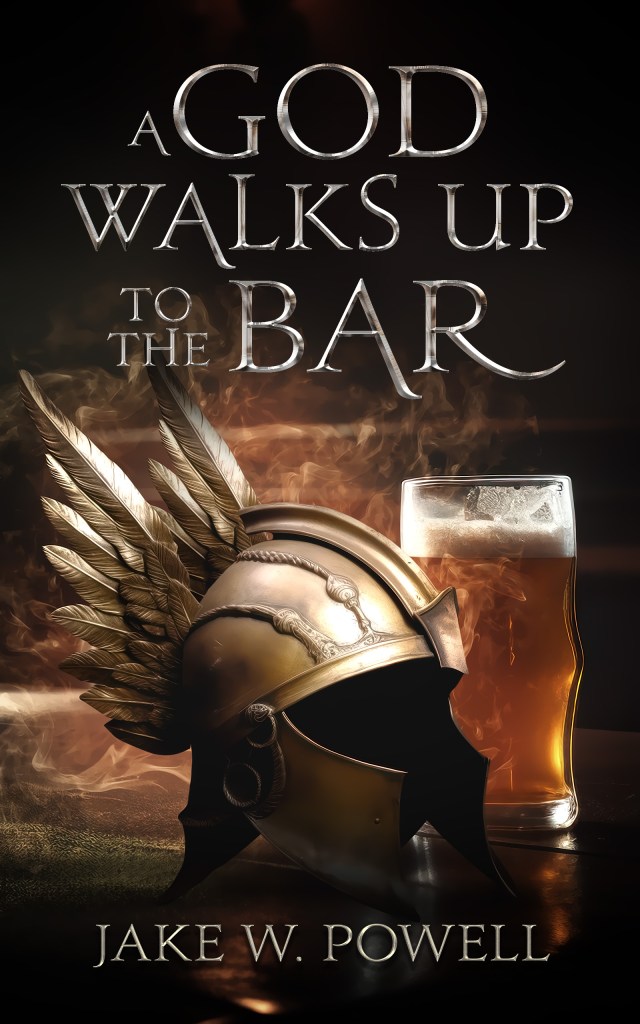
My book, A God Walks up to the Bar, is currently available on Amazon.com. Venture into the world of the Greek god Hermes, a world filled with demigods, vampires, nymphs, ogres, magic, and trickery. It’s a tough job, being a god!

Enjoying my blog? Don’t want to miss a single post? Subscribe for updates on when I post and follow my writing career, musings on fiction and storytelling, and reflections about life in general!
A Voice of Their Own: Crafting Your Characters

Stories need characters to be stories. Stories are about people. Whether they be human or otherwise isn’t the point: They are defined personalities with concrete goals that drive the plot. Even a place can become a character in the hands of an imaginative writer. Whatever shape they take, every tale needs characters to be a tale. Otherwise, you might be dabbling in some form of avant-garde, and I can’t help you there.

Since characters are so vitally important, from the protagonist to the antagonist to the mentor to the love interest to the bit part, it is important as a writer to learn how to create an interesting and layered cast to inhabit the worlds we put down on paper. People have quirks and habits. They have desires. They have likes and dislikes. They have relationships. As authors, it is our job to make the cast come to life. We create the illusion that they are real people.

It’s impossible to create a fully fleshed-out person as you would meet in real life, simply because the sheer complexity and depth of a real person could never fit into any number of books. Pick a historical figure, say, Napoleon Bonaparte. How may books have been written about his life? And they all have something different to say. One man, and everyone sees something slightly different. A writer would have to dedicate his life and then some to even approach that degree of complexity. No, I believe that it is the author’s job to create enough of the character as is needed to serve the story.

That’s what I mean when I say writers create the illusion of real people (or dogs, cats, antelope, aliens, mythical monsters, etc. You get the idea). It’s a bit of literary sleight of hand. Each character is just a slice of reality, a digestible piece that is enough for the plot and reader. By giving layers and dimension to those slices, we approximate reality. The closer we create someone who acts mostly like a real person, the more our readers are convinced they truly are. Suspension of disbelief. Very rarely will you ever read or watch a character behave exactly like a person in real life behaves.

The victim in the slasher flick always heads into danger. The James Bond villain always monologues about his scheme before inexplicably letting the hero live. The cowboy cop always goes rogue and comes out a hero. Characters reflect reality, but they shouldn’t adhere to reality perfectly. They adhere to the plot. The story is everything, and characters serve to move the story forward. A little tinkering with common sense is a necessary evil.

So, how do you craft your characters? How do you make them their own unique person? Well, some people like to make complete backstories before they start. Some have bibles dictating their characters’ natures, quirks, and traits. Some, like me, start with a basic outline and then let their characters reveal themselves during the course of writing. When I wrote A God Walks Up to the Bar, I knew Hermes’ basic nature. But during the course of the project, I discovered new things about him. There were layers to him I did not anticipate, reactions to events that I did not expect. He’s a fictional character, and I have final say in what is on the published page, but even so, he feels alive.

And that’s good! When the character feels like a real person, I am better able to write them. It’s less like putting words into a dummy and more like having a conversation. I get to know Hermes, know what he’s like, glimpse into the parts of himself that he keeps hidden from all others. He reveals his history as I write him, and I am able to better write him because he has a history.

With that comes a knowledge of what is in-character and out-of-character. How does he react to this situation? And what does he not do? If every character acts the same, then they are interchangeable and the story is boring. Boring is the writer’s death knell. Even an awful story can be entertaining. Heck, I’d rather write an awful story than a boring one. If the reader’s bored, he stops reading. But a “so bad it’s good” kind of story at least keeps their attention.

Mind you, these are all my personal thoughts. Different authors have different styles. If you are a writer who finds it easier to write out a complete and detailed backstory for your characters before starting the first page of your book, then do so. I don’t think any writer should force themselves to do something that runs against their creative instinct. But be open to surprise. Inspiration is always active and strikes at any time, even mid-sentence.

The gods and beings of ancient myth never went away. They just moved on with the times.

My book, A God Walks up to the Bar, is currently available on Amazon.com. Venture into the world of the Greek god Hermes, a world filled with demigods, vampires, nymphs, ogres, magic, and trickery. It’s a tough job, being a god!

Enjoying my blog? Don’t want to miss a single post? Subscribe for updates on when I post and follow my writing career, musings on fiction and storytelling, and reflections about life in general!

The Myth of the Easy Masterpiece

We’ve all heard the glorious stories of the writer who dashed out a masterpiece over the course of a weekend, solicited it, and made big bucks. Or we hear about someone writing a book for kicks, posting in on Amazon, and suddenly getting offers from film studios to turn their sudden runaway success into a show. It’s a tempting motivation to become an author, or scriptwriter, or whatever. These guys made it. How hard can it be?

Pretty hard, actually. After all, we only hear about the successes. What about those stories written over a weekend that never took off? How many books on Amazon do you think there are that nobody’s ever read?

I don’t know where I first heard the story that the screenplay for Good Will Hunting was written by Matt Damon and Ben Affleck over a weekend. Probably one of those motivational stories my teachers told me as an example of how life doesn’t actually work. It’s not true, by the by. Matt Damon wrote the original 40-page script as a drama class project, then worked with Affleck on revising it into a full Hollywood script. So, no, they didn’t conjure a masterpiece out of thin air in just a couple days. The foundation was already there, and they still had to work hard to translate it from written word to big screen.

Hugh Howey wrote Wool as a one-off short story that he put up for sale on Amazon. And yes, it did become so successful that he ended up writing sequels and selling the film rights and getting a good deal out of the whole thing. But as unusual as the success of Wool is, it was still based on years of writing experience and hard work. Howey had already been a diligent writer long before he published Wool. The story may have been a one-off, but Howey’s efforts weren’t. He goes into detail at length about his writing on his own blog.

All of which is to say, if you hear about a runaway success, that success is probably the result of a lot of hard work, blood, sweat, and tears that rarely make their way into the story told in magazines. The humdrum routine of writing, or scripting, or painting, or sculpting, or whatever medium you can think of doesn’t usually make for a good story, after all. Customers want the end product. The tedious hours of chipping away at marble or revising a fourth draft aren’t what they’re buying. And, quite frankly, do they even need to know about all that sweat and work?

If you’re truly devoted to something, you’ll put in the effort necessary to see it through to completion. Writing isn’t a “get rich quick” scheme. In fact, it may be the worst method possible for getting rich quickly. Sure, there are plenty of authors out there who make a living off their books. Many of them are quite wealthy, even. But only because they work to an almost obsessive degree on their projects. They devote extreme amounts of time to writing to the near-exclusion of all else. That’s not the easy path to wealth.

So, no, there aren’t any “easy masterpieces” in the world. Just a lot of grunt work and diligence that is never seen by the public eye.

Do what you love, not what you think will make you rich. That’s one thing that can make life a bit easier.

The gods and beings of ancient myth never went away. They just moved on with the times.

My book, A God Walks up to the Bar, is currently available on Amazon.com. Venture into the world of the Greek god Hermes, a world filled with demigods, vampires, nymphs, ogres, magic, and trickery. It’s a tough job, being a god!

Enjoying my blog? Don’t want to miss a single post? Subscribe for updates on when I post and follow my writing career, musings on fiction and storytelling, and reflections about life in general!

Planning Ahead vs. Winging It: A Reflection on Writing Styles

Ever heard the phrase “writing by the seat of your pants?” Some writers have a knack for making up the whole story as they go. They start with no outline and no treatment. They just start writing and end up wherever they may. Improvisation is a special skill and can lead to some truly inspired work when the author goes with his gut and lets the story flow out of his mind. Like a spring bubbling out of the rock, making things up as you go can produce the most unexpected and wonderful stories.

It’s also a skill that not everyone has the good fortune to possess. I, for one, need to know where my story is going before I begin. The outline is the foundation of every story I write. Every scene, every step, every action must be planned out in advance. Like an architect designing a building, I have the blueprints spread out before me so I have an inkling of where my plot will ultimately end up.

Otherwise, I’m adrift at sea and tossed about by a series of random events on a meandering journey with no point or overarching theme. Ok, some stories do work well with random-events plots, but these aren’t the type I’m trying to write. I try to stick to my strengths.

That being said, writing is a truly organic process, and I mean that in more ways than one. Stories come alive on the keyboard (or under the pen if you’re so inclined). Like living creatures, they have urges and inclinations of their own, and a writer develops the intuition to detect those urges and know when to follow them and when to restrain. “Story whisperer” isn’t a term you’re likely to ever hear, but like animal trainers, writers end up gaining a deeper understanding of how their story “thinks” and where it wants to go. Exploring new potentialities can lead to new plot threads that improve the overall end result. Writing is full of pleasant surprises like that.

As someone who loves to plan ahead, I’m not always interested in developing every new thread of a story that is revealed as I write it. But I do find that I tend towards winging it in certain circumstances. Dialogue, especially, lends itself to improvisation, if only because no matter how much I develop a story’s framework, the dialogue between characters never really falls into place until I sit down and write it in detail.

This is the fun of writing: Watching your characters come alive and gaining a deeper knowledge of how they think and relate to each other. I’ve surprised myself plenty of times with how my own creations grow beyond my expectations.

Action scenes can also end up going in completely unpredicted directions. Writing a fight scene or a chase can deviate from the “script” as it becomes apparent your original plan simply won’t work. So, I adapt and change course. Action scenes are hard enough to write as it is. Learning to wing it when necessary adds a whole new layer of challenge that can, nevertheless, improve your story if it lines up with the logic of the scene and the characters’ natures.

What does this all mean for you as a writer (assuming you are one, of course)? Well, maybe you’re a little freaked out by my talk of stories as living creatures and think I should get some therapy. Or maybe you’re nodding in agreement. How I write is certainly not how others write, and the ideas that friends and teachers tell you may not line up with your own. Everyone has a different style: Some love to go in without a clue and find out where they end up, others definitely need a solid framework before they can begin the first sentence.

Writing styles are unique to the writer. Everyone has their own process. Whether winging it or planning ahead, all writers find their sweet spot and use it to create something awesome.

The gods and beings of ancient myth never went away. They just moved on with the times.

My book, A God Walks up to the Bar, is currently available on Amazon.com. Venture into the world of the Greek god Hermes, a world filled with demigods, vampires, nymphs, ogres, magic, and trickery. It’s a tough job, being a god!

Enjoying my blog? Don’t want to miss a single post? Subscribe for updates on when I post and follow my writing career, musings on fiction and storytelling, and reflections about life in general!
Why Writers Should Make Their Character Suffer

It is my duty as an author to make my characters suffer. I must put them through the wringer, submit them to the lash, and force them to endure severe physical and psychological torment. Nothing must come easy to them. My characters must endure doubts, confrontations, and existential crises. They must be tested to their utmost, then pushed even further.

Why? Because authors are sadistic monsters Because the testing of a character forces them to grow, and the pleasure of reading a story is to see its heroes overcome the challenges they face. The greater the challenge and the greater the suffering they endure in conquering that challenge, the greater the catharsis of victory for both hero and reader. And there’s also no small amount of pleasure in giving my characters that final victory. I personally like happy endings.

Suffering can bring out the best and worst in people, whether they be real or they be fictional. It’s an interesting experiment to put a written character to the test and see how they react. What happens if I put the protagonist into THIS terrible situation? Or make them confront THAT unpleasant truth? Struggles let us see what makes people tick. Test your mettle and see how strong you are … and grow stronger.

All that being said, it boils down to this: a story is only as interesting as its characters and the situations they find themselves in. If the characters are flawed and have to work through their problems, then great! The readers share in their triumphs and failures, empathize with their foibles, and root for their success. Characters who never struggle and always succeed perfectly in everything they do can have a place in a story, but you might want to think twice about making them the protagonist. In a word: Boring. Invincibility is fine against bullets and blades, but even Superman is weak against kryptonite.

Authors should toss their characters into the furnace every now and again. Let them work for what they want. It’s what readers are paying for after all, and we got to fill those pages somehow.

The gods and beings of ancient myth never went away. They just moved on with the times.

My book, A God Walks up to the Bar, is currently available on Amazon.com. Venture into the world of the Greek god Hermes, a world filled with demigods, vampires, nymphs, ogres, magic, and trickery. It’s a tough job, being a god!

Enjoying my blog? Don’t want to miss a single post? Subscribe for updates on when I post and follow my writing career, musings on fiction and storytelling, and reflections about life in general!
Villains: Why We Love Such Hateful Scoundrels

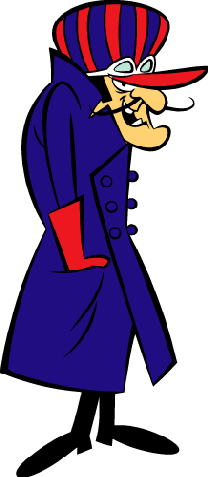
Image: Dick Dastardly, doomed to villainy from the day he was named. Wacky Races promotional material, courtesy of Wikipedia, fair use

Last week, I talked about antagonists and their importance to a good story. If you read it, you may have noted that I said antagonists are not necessarily villains. Antagonists are just a roadblock to the hero’s goal.

Today we are going to talk about villains.

What’s the difference? Simple. Villains are EEEEVVVIIILLL. They’re monstrous, greedy, murderous, and rude. They slaughter villages, rob innocents of all their possessions, conquer nations, and say really mean things. We love to hate them. We love villains. Why do we love villains? Why like something so vile?

That question gave me some food for thought, and here’s what I’ve come up with.

1: Villains are charismatic.

Darth Vader knows how to make an entrance. He strides down a hallway littered with corpses, black cape flourishing behind him. His breath is a low mechanical wheeze, and his face is concealed behind a skull-like mask. He casually strangles a rebel while interrogating him, takes charge of every situation, strangles fellow Imperials from a distance while cracking morbidly dry jokes, and in general is a terrifying threat to everyone he meets.

He’s a monster. But he’s a cool monster. He gets the cool armor, the cool lines, every appearance is accompanied by John Williams’s Imperial March, and if he’s not the mascot of the Star Wars franchise, he’s pretty dang close. Why? Because Vader has charisma. He’s memorable, he has stage presence, he has the physical acting of David Prowse and the rumbling baritone of James Earl Jones. Who doesn’t know who Darth Vader is? And how many little kids dress up as this cold-blooded mass murderer every Halloween? Oh, bitter irony! But such is the effect of a charismatic villain.

2. Villains are interesting.

We like to watch or read about interesting people. Ergo, we like to watch or read about interesting villains. Villains with unusual motives, or memorable quirks, or empathetic traits. We like villains who stick out from the mass of mundanity. We like villains who can keep us invested in the plot.

Take old Norman Bates, for example. He’s a psychotic serial killer. Well, nothing new there, fiction loves its depraved killers. But he’s a hotel owner with a split personality, that of his deceased domineering mother, who takes control and kills any woman that Norman expresses an interest in. Well, that’s certainly one form of interesting. What’s more, half the plot of Alfred Hitchcock’s Psycho follows him as the main character. And we learn that, sick as he is, he is a tad pitiable as well. That makes him, dare I say, quite interesting to watch.

We generally consume fiction for the purpose of being entertained. And a key part of entertainment consists of simply holding our attention. The best villains grab our attention and never let go. We look forward to seeing them onscreen, especially if they end up more endearing than the cardboard heroes.

3. Villains drive the plot.

Maybe, on some unconscious level, we like villains because we recognize how necessary they are. Villains, like all antagonists, drive the story. If they don’t start it, they at the very least keep it going. Conflict is key, and villains by their nature stir up conflict.

Take the Evil Queen from Disney’s Snow White and the Seven Dwarfs, for instance. There would be no story if she hadn’t gone up to her magic mirror and asked “Who is the fairest of them all?” And then tried to kill Snow White when she learned the girl was fairer than her. Then Snow White wouldn’t have ended up in the dwarfs’ cabin, and the Evil Queen wouldn’t have pursued her disguised as an old hag, and we wouldn’t have had the dwarfs’ climactic scene chasing her up the cliff during a thunderstorm.

There would be no movie. And we would not be entertained.

The gods and beings of ancient myth never went away. They just moved on with the times.

My book, A God Walks up to the Bar, is currently available on Amazon.com. Venture into the world of the Greek god Hermes, a world filled with demigods, vampires, nymphs, ogres, magic, and trickery. It’s a tough job, being a god!

Enjoying my blog? Don’t want to miss a single post? Subscribe for updates on when I post and follow my writing career, musings on fiction and storytelling, and reflections about life in general!

Antagonism: The Types of Conflict that Shape a Story

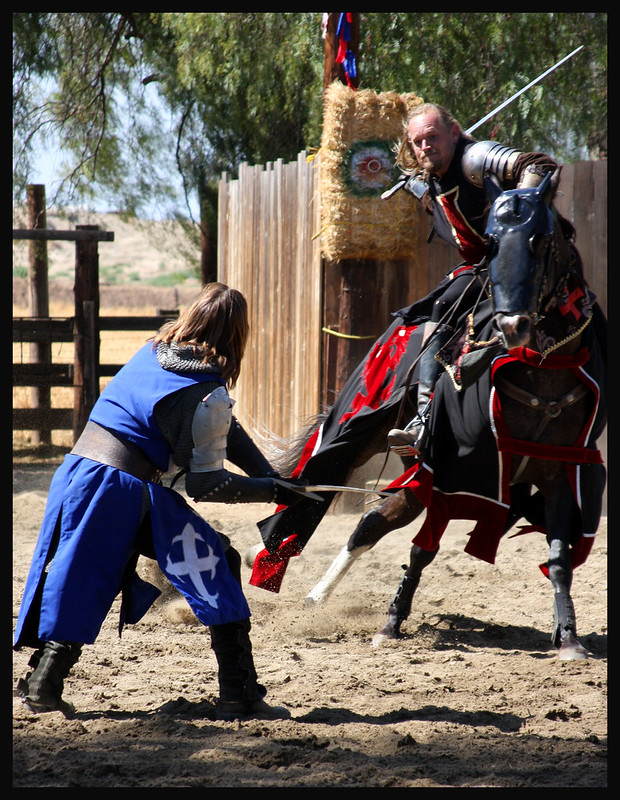
Featured Image: “Black Knight vs Blue Knight” by tinyfroglet is licensed under CC BY 2.0.

Funny thing about conflict: We don’t like it in real life, but we pay money to see people who aren’t real suffer. I mean, what good movie or book doesn’t have some sort of conflict at the heart of the story? The rebel leader fighting the evil empire, or the monster hunter confronting the vampire, or heck, the two lovers trying to overcome the forces keeping them apart. Conflict drives a story. Without it, there’s just nothing worth telling. No opposition, no struggle, no character arc, no story, no nothing.

With that in mind, it’s apparent that the source of conflict is pretty darn important. The protagonist wants something, and something else stands in their way. That “something else” is the antagonist, the source of the conflict. It’s not necessarily a villain. It’s not always another person. It may not even be a living thing. But it is opposed to the protagonist.

We humans are busy little storytellers. We’ve generated a wide variety of tales over the course of the millennia, and that means a variety of antagonistic forces have been invented. Let’s take a look at the basic types, shall we?

Firstly, we have the classic form of the antagonist: Man versus Man. It may not be an actual man against another man, but “Person versus Person” just lacks that dramatic je ne sais pas. Anyway, this is what most people think of when they think of the word “antagonist.” Darth Vader, Michael Myers, Dracula, the enemy army, werewolves, the high school principal, you name it. If it’s a unique, discrete entity, it falls under this category … usually. Mind you, however, that an antagonist is not necessarily a villain. They don’t have to be evil. Sure, Darth Vader is a classic antagonist and a legend of pop culture, but if the protagonist is an underdog football player trying to win the big game, the antagonist could be the arrogant captain of the opposing team: a jerk, but he doesn’t have to be a mustache-twirling, baby-kicking villain.

If it’s not Man versus Man, it just might be Man versus Nature. Think Robinson Crusoe. There is no one identifiable entity threatening the protagonist. Nature itself is the enemy. Maybe it’s a storm threatening a fishing community, a plague that scientists are racing to cure, or an asteroid on a collision course with Earth. Whatever it is, it’s generally a faceless threat that you can’t just beat up yourself.

Although, sometimes writers cheat and will throw in some form of threat that makes things more personal. Say, a pack of wolves that chase the protagonist throughout the story. Or maybe a really angry bear. Or a monstrous, man-eating shark (Hello, Jaws!). If there’s something to pinpoint as the source of the protagonist’s woes, it makes it easier for the audience to cheer for them when they beat it.

Man versus Society: Society is to blame! Here, we have a protagonist who is in some shape or form going up against their own culture. It could be going against expectations, fighting against injustice, or maybe just trying to flee an oppressive situation. Or maybe they’re rebels who want to defy norms and expectations as a means of proving their own individuality. Or maybe the protagonist’s actions aren’t justified at all, and the story shows why those norms exist. These sorts of conflicts can swing widely between the idealistic and the cynical. The protagonist wins, proving that society can’t keep you down. Or the protagonist wins, triggering a dystopian collapse. Or society wins, and the selfish protagonist learns an important lesson about sacrifice and duty. Or society wins, and the protagonist is reduced to just another cog in a life-sucking machine. Yeah, these stories can go all over the place, can’t they?

And finally, we have Man versus Self. The protagonist is their own worst enemy. Nobody is able to hinder their goals more than themself. Personally, I don’t see this particular form of conflict very often, but it’s there. I think it works best when combined with one of the three other antagonists above. The protagonist could succeed if only he would give himself a break or free himself from whatever chains are holding him back. Pretty good for a character study or more cerebral story rather than an action-focused piece. If you want to get really loopy, you could have the character’s inner demons manifest externally as something in the real world, usually in a symbolic way as something associated with their vices, or you could have a literal split-personality for them to talk to. All sorts of loopy possibilities.

And there you have it: A bare-bones breakdown of conflict and antagonists in a story. As basic as can be, but a solid foundation for any writer to use.

What other forms of conflict do you see in stories? Are there other types of antagonists you’ve found in media that you’d like to share?

The gods and beings of ancient myth never went away. They just moved on with the times.

My book, A God Walks up to the Bar, is currently available on Amazon.com. Venture into the world of the Greek god Hermes, a world filled with demigods, vampires, nymphs, ogres, magic, and trickery. It’s a tough job, being a god!

Enjoying my blog? Don’t want to miss a single post? Subscribe for updates on when I post and follow my writing career, musings on fiction and storytelling, and reflections about life in general!

Lessons I Learned Writing My First Book, Part 5: Humility

What’s the greatest challenge you face as a writer? The hours of hard work spent crafting your story? Pushing back against writer’s block? Trying to research a key piece of your book that you can’t quite get right? Finding a publisher? Finding the money to publish independently?

After all the effort you put into your book, there comes a point where you crave vindication of your efforts. After everything is said and done, you put it out onto the market and …

Where’s the jubilee? Where’s the praise? It’s MY book, it’s MY effort. Don’t I deserve it?

And here comes a hard truth: No, you actually don’t.       

We should all dream big, because big dreams encourage us to strive for excellence. But dreams alone are not the key to any sort of success. Hard work, diligence, and consistency are far greater allies in that regard. It’s easy to look at examples of literary success and think that somehow, through the mere act of wanting, we not only are able to join them, we deserve to join them. To stand up there with Hugh Howey, Brandon Sanderson, Dan Abnett, Jim Butcher, Ursula K. Le Guin, Terry Pratchett, et al.

Or, going even further, to see ourselves as the next William Faulkner or Charles Dickens or F. Scott Fitzgerald. And then we complete our book, we’re proud of it, and we put in on the market and … it’s another book.

A good book, maybe, but there are no laurels or songs or movie deals. It’s a book. One among hundreds of thousands. Roll up your sleeves if you want to get more notice, because it won’t get noticed by itself. You’re an author. Not THE author, not the greatest author. An author.

Harsh? Maybe. But eating humble pie is a bittersweet affair. Reflecting on my journey to where I am now, I’m darn proud of what I’ve done. I enjoyed writing my book, and I’m enjoying starting my second one. If I wanted glory, I’d pursue a different profession.

It still stings a little, though.

Humility comes in many different forms. Sometimes it whirls in and knocks us off our haughty high ground. Sometimes it’s a series of events that remind us we’re not as self-important as we thought. Sometimes, it’s doing something that others look down on as unimportant. It’s not something that’s enjoyable to learn (a running theme with my past few articles, I’m noticing) but, as I’ve already said before, it’s necessary. Pride and egotism can take a good job and hard-earned goodwill built up with your audience and turn it to ash. We’ve all seen it. Maybe you’ve even been there before.

Keeping ourselves in perspective can, I hope, help us to understand our place in the very big and crowded world of publishing and, rather than discourage us with delusions of insignificance, drive us to work harder toward a successful and fulfilling career. Humility helps us see ourselves clearly and to see the things we can do to make ourselves the best people we can be.

The gods and beings of ancient myth never went away. They just moved on with the times.

My book, A God Walks up to the Bar, is currently available on Amazon.com. Venture into the world of the Greek god Hermes, a world filled with demigods, vampires, nymphs, ogres, magic, and trickery. It’s a tough job, being a god!

Enjoying my blog? Don’t want to miss a single post? Subscribe for updates on when I post and follow my writing career, musings on fiction and storytelling, and reflections about life in general!

Lessons I Learned Writing My First Book, Part 4: Patience

Waiting, waiting, waiting. All things come to those who wait, or so they say. It’s a bit glib, isn’t it? Besides, waiting is only half the game.

Patience isn’t just about waiting. It’s about focus. It’s about working without complaint. It’s about denying yourself instant gratification in favor of long-term benefits. It’s about enduring the terrible uncertainty of whether your hard work will pay off.

It’s not … fun, per se. It’s useful. And, in the words of knowing parents everywhere, patience “builds character.”

As you may have already gathered from my previous ramblings, writing isn’t a fast process. Therefore, it takes patience. And I learned to be so while writing and publishing my book. But you know what? The writing part wasn’t where patience came into play for me. I LIKE writing, so it never felt dull or slow.

The real test was submitting my work for beta reading and editing. Not because the people I worked with took an unduly long time to respond, mind you. I’ve had the pleasure of working with great people. But it tested ME. Waiting for critiques, I could only think, “What will others think of my book? Is it good enough? Is it bad?” And I couldn’t get instant feedback and sate my desires to know. I had to sit back and wait.

There’s fear in the waiting, sometimes. Patience requires a modicum of courage. The horrible question, “What if?” pervades our minds when we think about what COULD happen. And the longer we wait for something, anything, the more “What if?” needles our minds. What if my book is bad and nobody likes it? What if I don’t get to my child’s rehearsal in time because of this red light? What if I can’t get off work in time because of this one slow customer? And so on and so on.

So, I was tested. I had to wait in inaction for a little while. I didn’t like it, but watcha gonna do? And there is a certain cathartic relief when your patience pays off and the wait is over. Delayed gratification and all that.

Discipline, perseverance, and patience. These qualities are like muscles. They must be exercised on a regular basis to grow strong. My last lesson, however, is the hardest because it is something we can’t directly govern. Life is happy to teach it, and we either learn … or we don’t. I’ll discuss it in more detail in my next post.

The gods and beings of ancient myth never went away. They just moved on with the times.

My book, A God Walks up to the Bar, is currently available on Amazon.com. Venture into the world of the Greek god Hermes, a world filled with demigods, vampires, nymphs, ogres, magic, and trickery. It’s a tough job, being a god!

Enjoying my blog? Don’t want to miss a single post? Subscribe for updates on when I post and follow my writing career, musings on fiction and storytelling, and reflections about life in general!

Lessons I Learned Writing My First Book, Part 3: Perseverance

Seventy-eight, seventy-nine, eighty …

Do you like doing pushups? What about arm curls? Or squats?

Eighty-five, eighty-six, eighty … eighty-seven …

They can take a lot out of you. How often have you been tempted to stop halfway through your exercise routine?

Ninety … ninety … ninety-FIVE … Ninety … SIX.

Or have you only gone as far as you could before the burn set in?

Ninety-NINE … ONE … HUNDRED.

Perseverance is when you keep going even when your body and mind don’t want to.

There’s an element of stubbornness in persistent people. They refuse to give up or go home when things are looking down, when the weather is cruddy, when they just want to curl up and sleep the afternoon away. Perseverance is the tenacious insistence on never leaving a task half-done.

Writers need to persevere. We need to never give up no matter the circumstances. How many books have been left half-finished, never to be read by others? How many books have never been written at all?

The most important thing, I’ve found, is to focus on the end goal. It’s easier (not easy, mind you, but certainly more bearable) to stick with it when you know how close you are to the end. And as I look back, I see how quickly that work time passed. Rather than focusing on present difficulties with drafting my book or stumbling over writer’s block, I quietly focused on the goal of finishing and publishing. It really does help.

Sometimes, I felt like I had nothing worthwhile to say, or that nothing I did say could measure up to other authors. What do you do during such times? You motor on. Perseverance is, quite simply, never giving up.

There’s a lot of books that will never be written. I take satisfaction in putting one more out into the world.

The gods and beings of ancient myth never went away. They just moved on with the times.

My book, A God Walks up to the Bar, is currently available on Amazon.com. Venture into the world of the Greek god Hermes, a world filled with demigods, vampires, nymphs, ogres, magic, and trickery. It’s a tough job, being a god!

Enjoying my blog? Don’t want to miss a single post? Subscribe for updates on when I post and follow my writing career, musings on fiction and storytelling, and reflections about life in general!