The smartphone. Not the cellular phone in general, but specifically the smartphone with its advanced computing capabilities, online access and instant information retrieval.
Cell phones have been around a long time, before I was born, but the smartphone came into its own during my lifetime. Funny how science fiction seems to predict these things. Star Trek had those little handheld doodads that could scan anything and tell you if somebody was sick or healthy or mindmelded by Vulcans or whatever, and nowadays we have near-identical gadgets that can scan, measure distances, forecast the weather, monitor health, take pictures, and far too many other things.
Smartphones are interesting devices because few of their features are truly new, but they are devices that can do everything at once. That’s their significance – the number of features contained within one item. All that plus instant communication via phone call, text or email. That sort of versatility and the speed with which one can look up info and immediately apply it to the situation at hand make smartphones into what I consider the most important invention developed during my lifetime.
***
Many thanks for visiting my blog. I post updates on my writing career, I muse over storytelling and fiction, and I reflect on the curious and wonderful things in life.
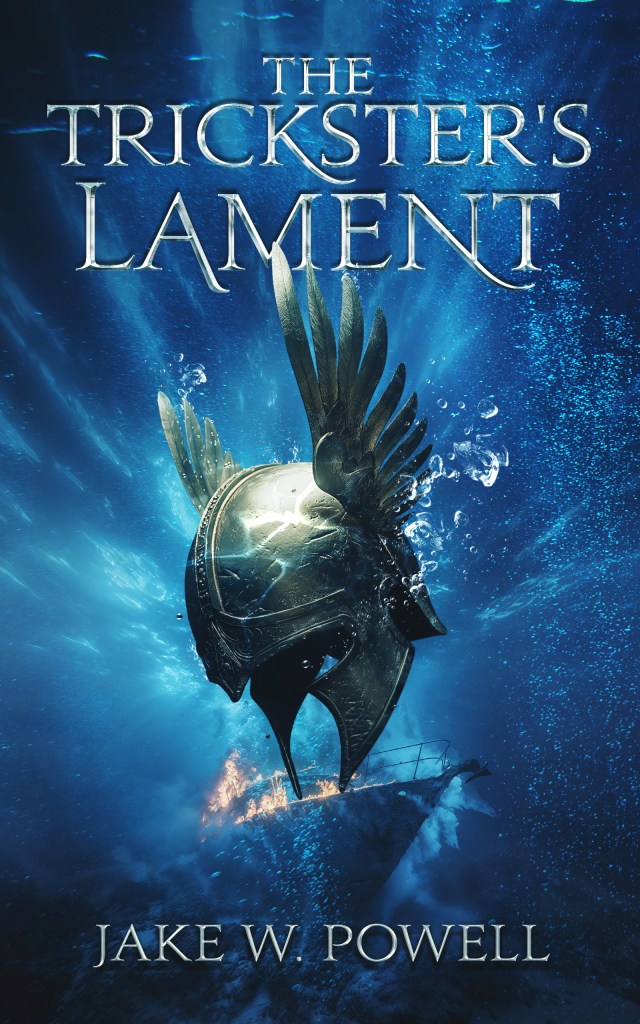
“Hermes is not having the best time. He walks a fine line, and his duty as messenger of Olympus weighs heavily on him. Being a god in the modern age means living in a world that no longer believes in gods. How much can one deity accomplish when no one respects him anymore? And why do his instincts tell him that he, the son of Zeus, is losing favor with his own family?
Tensions abound. The upstart Young Gods play dangerous games using entire cities as their boards. Formless monsters strike from the nighttime shadows, terrorizing hapless mortals. Agents of rival pantheons scheme to thwart Olympus’ designs. In the thick of it all, Hermes does what he does best: trick, lie, and cheat his way to victory.“
The first time I ever used a computer was back in the ancient days of dial-up, GeoCities and flip phones. My parents owned a word processor. No, not a computer. A word processor. As in, an electronic box with a blank, black screen on which you could type sentences and do nothing else. No programs, no Internet, no background wallpaper. This was a simpler time.
So, there I was, a kid not even in the double digits who thought he was going to write his first novel. Never got past the second page, of course. Or I was writing backstories for my action figures and posting them on my bedroom corkboard. Either way, those were the days when I first began cutting my teeth as a writer.
My first personal computer, as in the first I actually owned, was a bigtime birthday gift from my parents. I was in sixth grade, I think. It was a ponderous contraption. Computers weren’t flat back then. Like the word processor, it was a large box filled with many arcane electronic secrets. More importantly, it came with a tower, which was the actual device doing all the processing, because these were the days when the average PC couldn’t contain all that delicious data in just one piece. It needed a second box to actually run the data, and mine needed a whole desk cabinet to be kept in.
And then there were floppy discs and compact discs. Old PCs used to have slots into which you slid the CD or floppy in order to access them. Do computers even still have slots anymore? I have no idea. What with streaming and online gaming and the Internet in general, I doubt they’re needed anymore.
Those were the days. I’m not sure what kind of days, exactly, but those were them. Just turning on a computer felt like an amazing feat accomplished. Before digital phones and instant online access, personal computers were lighthouses of knowledge and wonder. Nowadays, computers are rather mundane and even old-fashioned. But I remember.
***
Many thanks for visiting my blog. I post updates on my writing career, I muse over storytelling and fiction, and I reflect on the curious and wonderful things in life.
“Hermes is not having the best time. He walks a fine line, and his duty as messenger of Olympus weighs heavily on him. Being a god in the modern age means living in a world that no longer believes in gods. How much can one deity accomplish when no one respects him anymore? And why do his instincts tell him that he, the son of Zeus, is losing favor with his own family?
Tensions abound. The upstart Young Gods play dangerous games using entire cities as their boards. Formless monsters strike from the nighttime shadows, terrorizing hapless mortals. Agents of rival pantheons scheme to thwart Olympus’ designs. In the thick of it all, Hermes does what he does best: trick, lie, and cheat his way to victory.“
If you could un-invent something, what would it be?
I must warn you, today is something of a rant. Take it as you will.
Planned obsolescence. Machines nowadays, especially electronics, are designed to last only a certain number of years before needing to be replaced. If I could go back in time and unmake this form of technological “innovation,” I would.
I mean, having to buy a new computer or mobile phone every few years is a hassle of money and time. I try to keep mine as long as possible, defying their gradual decline. I like things to be permanent. I like technology to be supportive, not a safety net with a big hole cut in the middle.
What happens if the phone factory collapses into rubble or all the schematics needed to make the hottest new model are lost? Then we’re stuck with old phones that will eventually no longer receive updates and stop working properly, and we won’t have a way to replace them with the new, fancy-schmancy versions. Then society collapses, and we’re all back to the Stone Age because our technology is no longer built to last. This is how Mad Max really starts, people!
… All joking aside, I really don’t like planned obsolescence. I believe it to be detrimental to technological progress and a real pain in the neck for ordinary folks. You could say that I hope it one day … becomes obsolete.
***
Many thanks for visiting my blog. I post updates on my writing career, I muse over storytelling and fiction, and I reflect on the curious and wonderful things in life.
“Hermes is not having the best time. He walks a fine line, and his duty as messenger of Olympus weighs heavily on him. Being a god in the modern age means living in a world that no longer believes in gods. How much can one deity accomplish when no one respects him anymore? And why do his instincts tell him that he, the son of Zeus, is losing favor with his own family?
Tensions abound. The upstart Young Gods play dangerous games using entire cities as their boards. Formless monsters strike from the nighttime shadows, terrorizing hapless mortals. Agents of rival pantheons scheme to thwart Olympus’ designs. In the thick of it all, Hermes does what he does best: trick, lie, and cheat his way to victory.“
AI looms over us all like a brooding shadow. Fears of AI replacing human-created novels, magazines, photography, illustrations and more have wormed their way into people’s minds.
“Human-created.” That gives me an idea. I bet I could do something with that.
The surge of AI content isn’t new. In fact, it is very similar to the rise of factory-made goods during and immediately after the Industrial Revolution. Mass-produced furniture, mass-produced clothing, mass-produced vehicles, mass-produced toys … The list goes on.
And now, in this present age, we have the advent of mass-produced media. AI-generated books by the hundreds. Essays written by a computer trained on patterns and Internet-scouring. Art produced in seconds by an artificial mind.
Horrific? Maybe. But if history told us something about mass production, it is that the value of bespoke goods subsequently became much, much higher.
AI slop is all the same. It blends together, united by bland, tedious styles that bear little semblance to the elaborate creativity of the human mind. That makes human-made art and writing valuable. And if AI slop becomes the norm, if large businesses make extensive use of it, than a new niche market opens up.
Bespoke entertainment. Non-AI media. The personal touch of a living person. Stories and art pieces created by human minds for human minds.
It’s not a new business. People have been publishing books for centuries. People have been drawing pictures for millennia. They have charged money for both.
But if AI content becomes the norm, then human-made content becomes rarer. Skilled employees are being laid off by big businesses in favor of replacing their skills with cheaper AI. If I was a small to medium-sized business owner, I’d be snapping up as many of those people as possible. The value of their skills is going to increase.
A suit custom-made for an individual, crafted by the hands of skilled labor, demands a higher price than a generic suit made in a factory. A custom car is more expensive than a basic model.
Imagine then, the value of a book, a magazine, a comic, a painting, a textbook that, in an age where AI-generation is the norm, has been created personally by a living, breathing person.
That’s not a fear. That’s an opportunity.
***
Many thanks for visiting my blog. I post updates on my writing career, I muse over storytelling and fiction, and I reflect on the curious and wonderful things in life.
“Hermes is not having the best time. He walks a fine line, and his duty as messenger of Olympus weighs heavily on him. Being a god in the modern age means living in a world that no longer believes in gods. How much can one deity accomplish when no one respects him anymore? And why do his instincts tell him that he, the son of Zeus, is losing favor with his own family?
Tensions abound. The upstart Young Gods play dangerous games using entire cities as their boards. Formless monsters strike from the nighttime shadows, terrorizing hapless mortals. Agents of rival pantheons scheme to thwart Olympus’ designs. In the thick of it all, Hermes does what he does best: trick, lie, and cheat his way to victory.“
Life without music would be insufferably boring. And, I think, it would be impossible to live life without it.
Not because we would drop dead from lack of music or lose all motivation and will, but because humans must make music. We feel rhythm and melody in everything. Nature sings: birds, wind, waves, thunder and lightning. Small wonder that man found ways to make musical sounds of his own.
For me, personally, music is a means of relaxation and inspiration. Relaxation from stress and worries, and inspiration for my imagination and writing. I have no particular taste in music; all genres are fair game. I just enjoy music as a means of processing ideas and, perhaps, of hyping myself up for a project.
Music also helps keep me sane when I’m mired in boredom or doing repetitive chores. Music is very important in my life, and I would be lesser for its absence. I think most people would.
And it’s impossible to avoid it. Music runs through my head during the day with or without headphones. It’s always there, drawn from an archive of songs and melodies. We are musical beings. People need music. I certainly do.
***
Many thanks for visiting my blog. I post updates on my writing career, I muse over storytelling and fiction, and I reflect on the curious and wonderful things in life.
“Hermes is not having the best time. He walks a fine line, and his duty as messenger of Olympus weighs heavily on him. Being a god in the modern age means living in a world that no longer believes in gods. How much can one deity accomplish when no one respects him anymore? And why do his instincts tell him that he, the son of Zeus, is losing favor with his own family?
Tensions abound. The upstart Young Gods play dangerous games using entire cities as their boards. Formless monsters strike from the nighttime shadows, terrorizing hapless mortals. Agents of rival pantheons scheme to thwart Olympus’ designs. In the thick of it all, Hermes does what he does best: trick, lie, and cheat his way to victory.“
Nostalgia gets a bad rap for being a blindfold that prevents us from perceiving hard truths about our childhoods. That can be true, but let’s not throw the baby out with the bathwater. I have very fond memories of my childhood that nostalgia helps keep alive, and that includes the TV shows I watched. Particularly the animated ones.
I spent many evenings with my dad watching some of our favorite cartoons: Justice League, X-Men Evolution, Samurai Jack, Teen Titans. And also one Transformers show that I can’t remember the name of (and wasn’t really all that good, but it was in the same time block, so we watched it anyway).
It was very cozy, watching TV with my dad. Television is great entertainment, but it’s somehow more meaningful when enjoyed with others. I recall those days with no small amount of wistfulness. Simpler times, for him and for me.
It’s strange how as children we take things for granted that we yearn to have back now. Saturday morning cartoons were just part of the routine. They weren’t a golden age of our lives, a precious memory to hold near and dear to our hearts. They were just … there. Fun, sure, but not precious. Not yet, anyway.
And if that’s the case, nostalgia possesses at least one positive quality: It preserves our best memories.
***
Many thanks for visiting my blog. I post updates on my writing career, I muse over storytelling and fiction, and I reflect on the curious and wonderful things in life.
“Hermes is not having the best time. He walks a fine line, and his duty as messenger of Olympus weighs heavily on him. Being a god in the modern age means living in a world that no longer believes in gods. How much can one deity accomplish when no one respects him anymore? And why do his instincts tell him that he, the son of Zeus, is losing favor with his own family?
Tensions abound. The upstart Young Gods play dangerous games using entire cities as their boards. Formless monsters strike from the nighttime shadows, terrorizing hapless mortals. Agents of rival pantheons scheme to thwart Olympus’ designs. In the thick of it all, Hermes does what he does best: trick, lie, and cheat his way to victory.“
WordPress’s daily prompt made me think long and hard today …
These are my top ten favorite movies (in no particular order):
Porco Rosso – One of Studio Ghibli’s lesser known creations, a lowkey, introspective movie set in 1930s Italy. The protagonist is an ace pilot cursed to have the face of a pig. Why? Well, symbolism abounds, as do themes of survivor’s guilt, redemption and freedom. Also beautiful flying scenes, as per Studio Ghibli’s usual standard.
The Count of Monte Cristo (2002) – A great adaptation of Alexandre Dumas’s classic tale of revenge and its consequences. Less character study and more swashbuckling action, but it’s very well-choreographed swashbuckling, and the movie has an overall more optimistic tone than the novel.
Disney’s Beauty and the Beast – I grew up with Disney and will always have a soft spot for its animated films from the 1990s, but this one is my favorite. If you had to tie me to a chair to watch a romance, make it this movie.
Coraline – And if you had to tie me to a chair to watch a spooky animated movie, make it this one. A children’s film that manages to avoid cheap jokes and talking down to its audience, and most importantly, can also be enjoyed by adults. Very bizarre and surreal in a way that still makes a lick of sense.
The Rocketeer – Good old-fashioned pulp fiction adventure, based on a comic book character that surprisingly was less than a decade old at the time. Man with jetpack fights mafia thugs and Nazis. Straightforward, upbeat, and refreshingly earnest compared to the sardonic self-commentary of many of today’s superhero films.
Stargate – Ancient aliens done right – as science fiction. Very good flick that doesn’t try to reinvent the wheel, it just fills itself with likeable characters fighting an eeeeevil villain amidst great special effects. Sparked off an even better television show that ranks among my favorite TV series.
John Wick – A bit of a cheat, since I like the entire series, but I’ll stick with the first one for the purpose of this list. After a decade of jitter cam action antics, filmmakers realized that they could make stylish, creative action sequences and keep the camera steady. The action (and violence) generally takes precedence over the story, but the story that we see is actually quite poignant and painful in its humanity, as many of the best action films tend to be.
Tombstone– A manly Western starring manly men with manly mustaches. Joking aside, it’s a great film for everyone. Based on real-life events surrounding 19th-century lawman Wyatt Earp’s time in the town of Tombstone, Arizona, this film is made and memorialized by its cast. Really, really great acting all around, dialogue that sticks in your brain, and memorably tense confrontations between heroes and villains. Only in this film could the words, “Well, bye,” be made a stupendously amazing line.
The 7th Voyage of Sinbad – We’re going old school now. A 1950s fantasy flick with special effects by Ray Harryhausen, the man, the myth, the legend. Modern visual effects wouldn’t exist without him, nor half the monster designs you and I take for granted these days. The visuals are the real star here; the story is typical “Arabian Nights” fare: Sinbad the sailor fights evil sorcerer to save princess. Features a fire-breathing dragon, perpetually angry cyclops, and most famously, a swordfight with a living skeleton. This is the foundation of modern fantasy visuals as we know it, you young whippersnappers!
Hook – This movie’s premise is very bold: Tell a story about Peter Pan growing up. Sounds like a disaster on paper (and to be fair, this movie is a bit divisive, I understand), but I always enjoyed it. Robin Williams makes the film work with his acting chops, and the film is more grounded in James Barrie’s original story than you might suspect, and indeed more so than many later Peter Pan adaptations. Dustin Hoffman’s Captain Hook is a treat – even if he’s not my favorite version of Hook, he serves as a great foil to Williams. Also probably my favorite realization of Neverland on film – colorful, fantastical and like something out of a storybook.
***
Many thanks for visiting my blog. I post updates on my writing career, I muse over storytelling and fiction, and I reflect on the curious and wonderful things in life.
“Hermes is not having the best time. He walks a fine line, and his duty as messenger of Olympus weighs heavily on him. Being a god in the modern age means living in a world that no longer believes in gods. How much can one deity accomplish when no one respects him anymore? And why do his instincts tell him that he, the son of Zeus, is losing favor with his own family?
Tensions abound. The upstart Young Gods play dangerous games using entire cities as their boards. Formless monsters strike from the nighttime shadows, terrorizing hapless mortals. Agents of rival pantheons scheme to thwart Olympus’ designs. In the thick of it all, Hermes does what he does best: trick, lie, and cheat his way to victory.“
Real life is hard. Can we all agree on that? Real life is really hard to deal with. If it’s not the troubles and calamities of real life intruding on our status quo, it’s the dreary monotony of everyday activities. Going to work, washing the dishes, walking the dog. Sometimes, we just hit a rut. What to do?
People are imaginative, and there’s nothing better at firing up the creative juices then boredom.
There are people out there prone to daydreaming. They come up with whole worlds in their heads. The really ambitious ones commit those worlds to paper. Voila! A new fantasy story is created.
Fantasy helps us cope with the real world. It is a form of escapism that gives us a few precious moments away from humdrum reality, a chance to catch our breath and maybe let out a couple screams, then return to the grind. A little fantasizing is good for our mental health. Relaxation and rest is a good thing, and fantasy is a form of that. A jaunt into a made-up world where heroes always win, good triumphs over evil, magic can make food and water out of nothing, and we can fly on winged horses is just … fun. That’s the point of fantasy. Just like some people like car racing or hiking or painting or math (such people do exist), so do some enjoy fantasy because it’s just plain fun.
To deny ourselves recreation is to trap ourselves inside a metal box at the bottom of the ocean. We can’t move, can’t escape, can’t even see the light. We suffocate under the inability to exert ourselves. Our minds along with our bodies atrophy from the lack of exercise. And from the lack of challenge. Fantasy is a challenge. Fairy tales and epics challenge us to see the world in a new way and ponder how these stories match up against our own experiences. And they let us see something new, period. Don’t we humans crave novelty? Why go on vacation, if not to “get away from it all?” And what are we getting away from? The ordinary and the familiar.
Fantasy is all that writ large. It is the unfamiliar and the extraordinary. A chance to wonder: What if?
And at an even more fundamental level, fantasy taps into that all-consuming human urge to create. We all want to create something. We tinker, we write, we draw, we brainstorm, we organize, we build, we muck about. We like to make things, whether things concrete or things abstract. Fantasy is creation. It’s a powerful impulse, the urge to create, and making fantastical worlds is the perfect outlet for what, I believe, is a basic human need.
Does fantasy matter? Absolutely. We can’t resist it’s siren call. To get away from mundanity, to satisfy our basic natures, to keep ourselves sane. Fantasy is very, very important.
If you just so happen to be enjoying my blog, feel free to subscribe. I post updates on my writing career, I muse over storytelling and fiction, and I reflect on the curious and wonderful things in life.
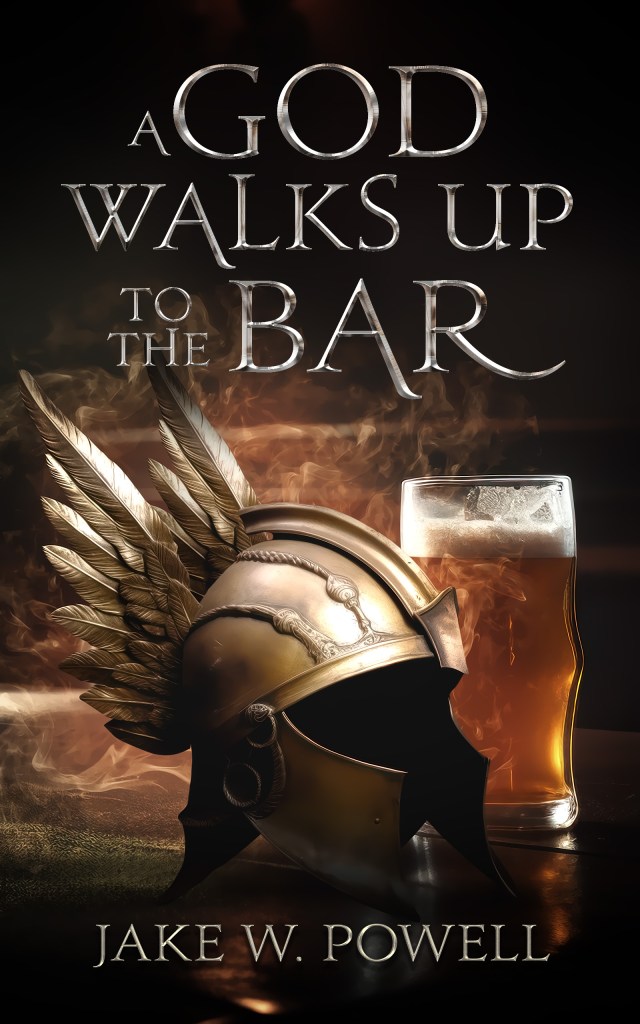
My first book, A God Walks up to the Bar, is available on Amazon.com. Witness the modern day adventures of the Greek god Hermes in a world much like our own – and with demigods, vampires, nymphs, ogres, and magic. The myths never went away, they just learned to move on with the times. It’s a tough job, being a god!
Let’s be honest. With a question like that, and the fact that my blog is subtitled “Writer of Modern Day Fantasy,” you can pretty easily guess that the answer is, “Yes.” But, hey, did I catch your attention? I did? Good. Let’s dive into it, then.
Fantasy is an important genre. Myths and legends have existed for almost as long as humankind has. There is an almost natural urge in people to invent and make up lands, species, events, and other such things that don’t exist in nature. The urge to create things that defy natural law: flying carpets, giants, dragons, dryads, genies, wishing stars, talking puppets, elves, hobbits, fairies, people the size of your thumb, people as tall as a mountain, alien worlds, life on the moon, and so on and so on. The earliest myths probably were meant to explain phenomena that man couldn’t yet fully understand, like the weather or earthquakes. But even after science has offered its explanations, the fantasies endure. Do old habits die hard? Or maybe we need fantasy in our lives.
Consequently, fantasy is a versatile thing. At its heart, it is the telling of things that not only don’t exist, but can’t exist. There are no elves in the forest. There are no genies trapped in bottles. There is no Fountain of Youth or cities at the bottom of the ocean. But the stories are still told.
For a long time, though, there was a problem.
For the last century or so, fantasy got a bad rap. It was viewed as this sort of nerdish subject that is impractical and of no relevance to “real life.” Dungeons & Dragons was the epitome of loser geek culture for decades. It was a “loser” subject because, in part, it was something that wasn’t real – but people took it so seriously! Why make such a big fuss over the unreal? Why obsess over the rules for a game about fighting made-up creatures? If you’re going to obsess over statistics, at least apply that obsession to football and baseball, not orcs and hobgoblins!
For many people, deriving so much enjoyment from something made-up is just plain childish. Oh, when we are children, it’s fine to enjoy stories of knights versus dragons. Fairy tales are quaint little things that amuse us when we’re young. Then we grow up and enter the serious real world where we need to be interested in grown-up things. Like cars and sports and art and the latest celebrity gossip. You know, important stuff.
That association with the immature has been a stain on fantasy’s reputation for a long time, as well as its sister genre, science fiction. The dominions of nerds and other people who can’t handle reality. There were exceptions, of course. Star Wars, for example, was a major blockbuster in 1977. But by and large, fantasy movies and books and games were strictly niche. There was an audience, but a highly specific one.
Then things changed.
I think the Lord of the Rings film trilogy in the early 2000s was the big turning point. Here was a fantasy series with major, respected stars that took itself seriously. It had a big budget, it was being produced by a major studio, it had marketing and advertising out the wazoo. The critics liked it. It was art.
Suddenly, fantasy lost its stigma. It wasn’t so bad to admit you liked the genre.
Others followed. Game of Thrones was a biggie. And there was Stranger Things, which proudly wore its 1980s nostalgia on its sleeve. And what was big in the 1980s? Yup, Dungeons & Dragons. Speaking of which, a Dungeons and Dragons movie released last year was warmly received. Oh, how the tables had turned!
The fact is, there are lots of people who like the unreal. They like to step away from reality for a few hours. It is called escapism. Personally, I think part of fantasy’s bad reputation is that escapism is confused with retreat. One is the willingness to step away from your problems or worries for a little while to refresh yourself. The other is an ultimately selfish choice to ignore one’s real-life obligations in favor of never leaving the fantasy. But many non-fantasy fans view the genre strictly through the latter lens. A bunch of guys and gals without jobs living in their parents’ basements reading silly books about silly people in silly lands. Fantasy is for the weak, for people can’t handle their own responsibilities.
It’s not fair, really. J. R. R. Tolkien wrote fantasy, after all. You know, the highly respected scholar and linguist? A man with a very productive and well-balanced life? And it gets more unfair.
So, fantasy has hit it big, as I just mentioned. And why did it hit it big? Well, a few successful movies certainly helped. But also, you know, the average person finds out that people like Henry Cavill and Joe Manganiello play stuff like D&D and Warhammer 40,000. Hey, they’re not nerds! Fantasy must be cool!
Sometimes, the best way to get people to take something seriously is to find the right spokesperson. All this time, fantasy just needed better PR.
It worked. Fantasy is widely accepted now. People aren’t ashamed to say that they like it. Nerds aren’t social pariahs. Heck, most of them are running major corporations. And the people writing those hit fantasy movies? They’re nerds, too. That’s the other big shift in the fantasy genre in mainstream culture. Four, five decades ago, fantasy films and TV shows were mainly being written by people who saw it as harmless, inconsequential fun. But the people who grew up with those shows and films, the people who fell in love with them, are the ones calling the shots now. And their beloved childhood is anything but inconsequential. Fans tend to pour their hearts into their work, and the quality of the product (hopefully) goes up. The bigger budgets certainly help.
By and large, fantasy has found public acceptance. Fairy tales aren’t just for kids anymore.
But the question posed at the beginning of this article is only half-answered. Does fantasy matter? Yes, yes it does. Financially, socially, culturally, it matters very much. But why does it matter? And in what other ways does it affect us besides providing something to do on a Saturday night?
Stay tuned …
If you just so happen to be enjoying my blog, feel free to subscribe. I post updates on my writing career, I muse over storytelling and fiction, and I reflect on the curious and wonderful things in life.
My first book, A God Walks up to the Bar, is available on Amazon.com. Witness the modern day adventures of the Greek god Hermes in a world much like our own – and with demigods, vampires, nymphs, ogres, and magic. The myths never went away, they just learned to move on with the times. It’s a tough job, being a god!
Escapist entertainment. What thoughts run through your head when you hear that phrase? Positive? Negative? Joy? Disapproval?
Escapism gets a bit of a bad rap. Life is serious business, and there’s a lot of work to be done. People are suffering. Injustice is rampant. And when are you going to pay those bills? Why are you wasting time on fluff?
But is escapism a bad thing?
Imagine yourself going up against the hard knocks of life every day. Life is a jerk. It hits you hard without letting up. And it doesn’t play fair. It pulls your hair, throws sucker punches, and it cheats you out of a rightful win.
Even when life lets up, work and responsibilities can weigh heavily. Imagine a rock on the coast, battered by the waves every hour of every day of every year. The rock stands tall for a time, but every wave takes a little bit of it into the sea. The stone is smoothed and weathered. Eventually, it wears away completely. That is a person who works and works and works, but never takes time for a moment’s respite. Life just … wears you down to nothing.
We need to escape, sometimes.
Some light reading, a silly movie, an action-filled comic book, a walk in the park, a thrilling sports activity. For someone somewhere in the world, they’re all ways to distance oneself from the daily grind and relax. They are ways to refresh the mind and body and forget about our troubles for a few precious moments. We need escapism for the sake of our sanity.
Escapist fiction allows us to suspend disbelief and accept that there can be stories that don’t have to reflect reality. Superman and James Bond and Indiana Jones aren’t high art, but they are fun. And what’s the point of entertainment that isn’t fun? There is art and literature that dwells on philosophical questions and searches for meaning in the tragedies of life, but here’s another nugget to chew on: Real life never goes away. It’s waiting for you right outside the door. There is plenty of time to dwell on the deep questions. But don’t we just want to – need to – take a break from it once in a while?
Ah, but here comes the counterpoint: Escapism is withdrawing from responsibility to society and ourselves. It’s evading the important things in life, the things that we must do to live healthily and productively. But all things in moderation. A life of nothing but escapist fantasy is as bad as a life of nothing but grim obligation to work.
Still, there’s a reason why people like fluff entertainment. There’s a reason why people want to laugh at silliness and cheer on the hero fighting the evil villain. Such stories are simple and inspiring. Why do you think cartoons and comics were thriving during the Great Depression? Or during the more recent Great Recession, for that matter? People need something good in their lives, and for many, that can only be found in stories. And it is a healthy thing, because people need hope. We all need a counterbalance against the mundane and dreary.
The greatest responsibility, then, of the escapist is to remember that there is a time and place for everything. A time to mourn, and a time to laugh. A time to work, and a time to play. But don’t forget to take a moment’s respite. You might need it more than you think.
Enjoying my blog? Don’t want to miss a single post? Subscribe for updates on when I post and follow my writing career, musings on fiction and storytelling, and reflections about life in general!


 Jake W. Powell