Idle Questions for a Monday Evening

Monday is finally over. The mind is tired from thinking hard. Time to let it mull over silly questions:

Why can we say “sunshine” and people know we mean sunlight, but not say “moonshine” without meaning homemade alcohol?

Why are eggs in the dairy department when they have nothing to do with milk and cheese?

Why do we say “head over heels? in love?” Our heads are above our heels by default.

Why does everyone have to buckle up in cars, but only the drivers get seatbelts on buses?

Why do we say “make a cup of coffee?” Nobody makes a whole new cup, just the coffee to put into it.

Why do people keep trying to make squirrel-proof birdfeeders? They never work.

Why do people want to colonize Mars? What’s there that’s worth colonizing?

Why is it that the more expensive your meal at a restaurant is, the more likely the chef was touching it all over with his fingers? That’s gross.

How many more idle questions can you come up with?

Many thanks for visiting my blog. I post updates on my writing career, I muse over storytelling and fiction, and I reflect on the curious and wonderful things in life.

Stuck Between Morning and Night

Are you more of a night or morning person?

Ah, the old night/day dichotomy. Do you come alive at night, or do you start the day peppy and excited?

I admit that I get more done early in the day, and I relax more at night. But the cold hard truth is, I’m neither. That’s right, I’m taking a third option. I’m a midday person.

What does that mean? It means I feel most energetic and focused in the smack-dab middle of the day, between about 10AM and 4PM. That’s when I feel really alive and able to tackle any challenge. It’s when I most enjoy writing, when I have the opportunity.

Alas, I usually don’t. Midday is, after all, when I’m in the middle of work and not able to pursue leisure. Sitting in an office chair when you’re bristling with energy and ideas for a new story are rushing through your head isn’t exactly the most pleasant sensation.

But such is life.

Many thanks for visiting my blog. I post updates on my writing career, I muse over storytelling and fiction, and I reflect on the curious and wonderful things in life.

Exactly Where I Want to Live

If you could live anywhere in the world, where would it be?

I would live in a comfortable cabin in the middle of a sparse but lush forest with no neighbors within shouting distance and located exactly one hour away from the nearest town. I would also have electricity and a hot tub.

Those who read my musings on my city of the future may be aware that when a daily prompt asks me what I want, I go whole hog with exactly what I want. Will I ever get it? Probably not, but my imagination doesn’t have to agree with reality. I want a cozy cabin, I want peace and quiet, and I want to huddle up on my couch and watch my big-screen TV while the birds chirp outside. And when I need to go shopping, I want the store to be an hour’s drive away.

Fantasizing about an idyllic, Arcadian existence is all fun and dandy, but actually living it is a different case entirely. Loafing around on a tropical island is fine until you need to take a shower and have no soap and shampoo. Or towels and washcloths. Or plumbing. Not to mention the bugs and the heat and the storms. Yes, I admit it, I like modern amenities as much as I like nature. So, I would live close to nature, but not too close, thank you very much.

Civilization strove for millennia to invent the modern conveniences we currently enjoy, and some of them were invented for very good reason. Who am I to throw aside all that hard work?

Okay, maybe I could go without the hot tub …

Many thanks for visiting my blog. I post updates on my writing career, I muse over storytelling and fiction, and I reflect on the curious and wonderful things in life.

Deep Questions about Deep Literature

Do you remember literature classes in high school? How you would spend hours every day discussing the symbolic value of the billboard in The Great Gatsby and analyzing what each character represented in The Lord of the Flies? A spade is never just a spade in lit class. There is always a deeper meaning.

So can anyone explain to me why all the books students have to read are so dang depressing?

Looking back, this is what I feel that we were doing: Taking a beautiful flower and plucking its petals and cutting the stem and digging up the roots to see why it was a beautiful flower. And we very scientifically removed everything beautiful about it.

But darn it, we got educated about great literature. We knew what metaphor was. And allegory. And the subtle social critiques and genre deconstructions that mark all literary classics. We obtained knowledge! We justified our tuition!

There are people who make their living by reading stories and telling other people whether they are good or not. And their word is law, because there is no such thing as an opinion they understand the rules that govern quality writing. Where they obtain this arcane knowledge is unknown. Presumably, they dissected enough flowers.

Good stories seem to be a case of majority rules. If enough people say it’s good, it must be good. Maybe. But I didn’t like The Great Gatsby, so does that mean it’s not a good book or I’m not a good writer? Or perhaps if I had read it on my own time instead of being forced to analyze that darn stupid billboard I would have liked it.

What does it matter what color the curtains are or what suit the one character is wearing in each scene? It matters because somebody important says it matters, but what if it’s not the author saying it? Are we seeing what the writer put there, or what we think is there? Are we seeing meaning where there is none, or is the meaning not what we think it means? Does it mean what people say it means, or does it mean something else, which means that what I want it to mean means that it means the wrong thing from what everyone else thinks it means? Because that’s just mean.

Or maybe we’re just really good at gaslighting ourselves into thinking a book somebody wrote to pay their bills is a magnum opus. The writer wings it, hears what critics say, nods sagely and says, “Yes, that’s exactly what it means.”

Many thanks for visiting my blog. I post updates on my writing career, I muse over storytelling and fiction, and I reflect on the curious and wonderful things in life.

A Word of Wisdom Regarding Books and Dogs

Outside of a dog, a book is man’s best friend. Inside of a dog it’s too dark to read.

Groucho Marx (probably)

If you’re a cat person, then sorry, I really don’t know what to tell you.

Many thanks for visiting my blog. I post updates on my writing career, I muse over storytelling and fiction, and I reflect on the curious and wonderful things in life.

My City of the FUTURE

How would you design the city of the future?

Well, for starters, I’d figure out what the heck is meant by “city of the future.”

I mean, hypothetical, futuristic cities designed in the 1950s look a lot different from what we 2020ers think they should look like . A lot less art-deco and a lot more Apple aesthetic. Lots of white and curved corners. In fifty more years, the city of the future will probably be imagined as made of recyclable plastic or something.

But this is my city, right? I can do what I want. So, futuristic means pretty, practical, and maybe even a little sustainable.

First thing’s first, its streets are based on a grid system. I want a city that’s easy to navigate with no silly, loopy streets going every which way. If we live in the future, we should be able to make our own cities easy to drive in, a least. Also, wide streets. My city will acknowledge the existence of heavy traffic and anticipate it. Wide streets that can accommodate, oh, let’s say six lanes.

But I’m also going to offer incentives to not drive cars everywhere. Because we’re in the future, right? And cars are a thing of the past. Well, they might be. It’s the future, who knows what’s going to happen?

So, I’ll have elevated rail lines for the train and also lots and lots of rental stations with electric bikes. Just put in a quarter and ride your rental for an hour or so. Also, I’m bringing back trolleys. Trolleys are a great idea, and I’ll fight the gas companies to make my city’s public transportation system the best in the world.

Since my city is on a grid, I’m thinking it’ll be shaped like a big square or rectangle. In the center is where all the skyscrapers will be located; the major businesses and corporate headquarters will have their places in the center, and they aren’t going to be big blocks of glass. I want some curvature to these buildings, something a little softer on the eyes. No hard corners. Also, solar panels. I’ll coat the upper floors of these skyscrapers in solar panels. Fancy, futuristic solar panels that are transparent or something, so you can still see out the windows. Not possible? Well, guess what? It’s the future!

Ah, speaking of power, I’m also going to install revolutionary new generators under the city center sidewalks that convert the kinetic force of footsteps into electrical energy. That’s right, I’m going to design a city that generates power from people walking down the sidewalk. Impossible, you say? Need I remind you? Future!

The most vital part of my city design is trees. Lots and lots of trees. The streets will be lined with trees, and there will be dozens of parks. Big parks, little parks, flower gardens, all scattered throughout the city. The very center of the city, smack dab in the middle, will be the biggest park, with a lake, a sports field, a walking loop through the woods, and more. Trees are important. They provide fresh oxygen and help calm people who otherwise are trapped in an artificial world. My city of the future will have nature in it.

That’s about all I can think of. A nice, pretty city that’s livable. And preferably cheap to live in. It needs lots of incentives for businesses to come in and employ people, but I’m just the designer, not the economist, so I can’t answer that here. But I’m sure my revolutionary sidewalk power generators will cut down on costs somehow.

I took the time to describe my basic idea to AI and got this image spat out in response.

Not bad, actually. I was expecting worse from AI. The buildings aren’t quite what I wanted, but I like the distinct lack of traffic and lots of bicyclists. Also, trees. Yes, that many trees.

There you have it. My city of the future.

Many thanks for visiting my blog. I post updates on my writing career, I muse over storytelling and fiction, and I reflect on the curious and wonderful things in life.

Big Buzzing Bullies

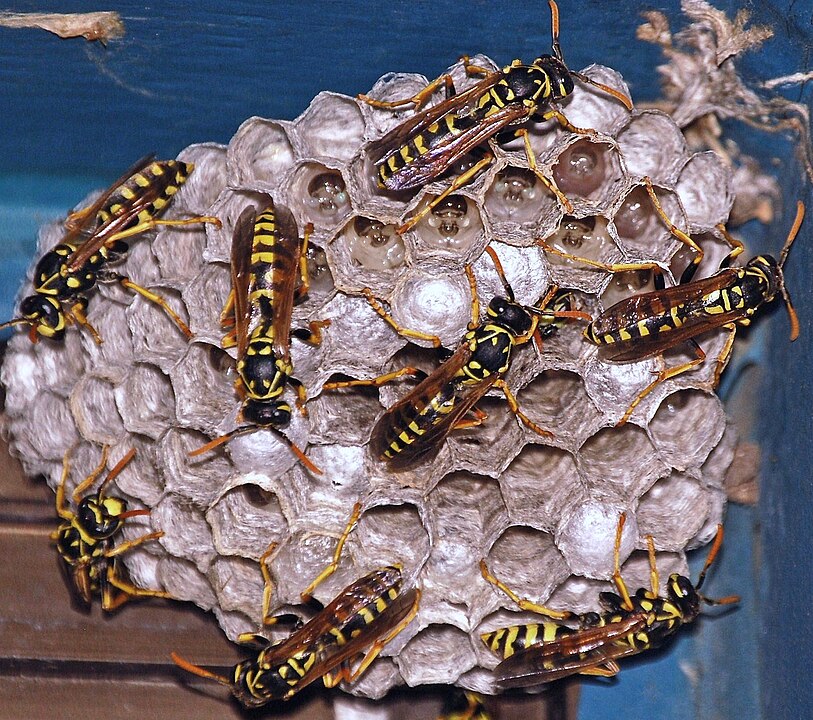
There are bullies under the summer sun. They have no sense of mercy, they inflict harm without cause, and they don’t even have the decency to enjoy it. They buzz around like yellow caution signs of doom. They set up shop exactly where it will worst inconvenience you – butting into your backyard and your homes like they own the place. And if you say anything, they stab you.

I am, of course, talking about wasps. Nature, for all its horrors, is pretty chill all told. Spiders only bother you when you bother them (“It’s not MY fault you walked into the web I set up at eye level”). Tigers and bears and wolves are just hungry, or you got too close to their cubs. Who doesn’t get angry when someone messes with their kids? Sharks are the victims of bad press. Just because someone can’t blink or smile or emote in any way comprehensible to human brains is no reason to discriminate (also, get out of the water). And crocodiles and hippos … okay, they’re pretty bad, but if you keep your distance they’re okay.

Wasps don’t keep their distance. Wasps don’t need a reason. Wasps go out looking for trouble. Those narrow, spindly bodies, those pitch-dark eyes … Just look at the villainous invertebrates!

Look at them! Look at the vile monstrosities!

Not at all like the humble bee. Bees are selfless. Bees are productive. Bees can coexist with mankind. If you rile them up, they’ll sting once and give their lives for the colony. See, even if you’re being swarmed by bees, they’re still quite heroic when you think about it. They give themselves for a greater cause. Not wasps. The only thing a wasp has to give is PAIN.

They don’t produce honey or wax or even jelly. They got nothing (except the aforementioned giving of pain). All animals, no matter how scary, are reasonable enough when you get to know them. Except wasps. They gang up on you because you looked at them funny. They are genocidal, resource-hording invaders. They’re under your feet. They’re in your walls. They want your PB&J sandwich. They’ve claimed your favorite climbing tree and will obliterate you if you get too close. Screw you, wasps.

Wasps are jerks.

Many thanks for visiting my blog. I post updates on my writing career, I muse over storytelling and fiction, and I reflect on the curious and wonderful things in life.

Image courtesy of Wikipedia; License under CC BY-SA 2.5

Give and Take: Developing Characters with Banter

So, in my last post I went on a bit of a rant about how I dislike how much quip humor is overused in today’s media. So, maybe you’re wondering what kind of comedic writing I do like. Well, lucky you! That’s what I’m here to talk about today.

In all seriousness, comedy is a great way to develop and humanize characters. We use humor in all situations, including dangerous ones. It relieves stress, it helps us relate to each other, and it can lighten a grim situation. Most everyone has a sense of humor. And you know what? Nobody’s is exactly the same. So what happens when two people pit their humor against each other? Well, sometimes a black eye, but in most situations you get the normal, casual banter that marks so many conversations in real life. And as in real life, writing banter can reveal a lot about what people are really like.

Banter is defined by Dictionary.com as “an exchange of light, playful, teasing remarks; good-natured raillery.” While I doubt anyone uses the word “raillery” in casual conversation anymore, this definition gets the point across: Banter is a two-way (or more) street. It is dialogue, and it is reliant on character interaction. Where two characters interact, you get development and characterization. You also get exposition explained in a palatable way. You can get plot progression, foreshadowing, romance, conflict, and all sorts of other things. Why? Because it is dialogue. Because it is character interaction. Because, unlike quipping, banter relies on sharing the spotlight with someone else.

Good-natured ribbing is a form of camaraderie the world over. Inside jokes and bad puns and the playful critique thereof illustrate the history of a relationship more succinctly and beautifully than a full paragraph detailing the backstory. Verbal sparring is fun to read or watch and can be laden with subtext that delivers multiple messages in a single conversation. Just check out movies and books with great dialogue. Well-written banter makes characters feel like real people.

And quips … well, people do quip in real life, but it’s a lonely game to play. It’s a one-trick pony. What happens when people get tired of one-liners? Banter is more flexible. People throw different types of funny at each other. To quip is to play golf: You hit the ball and off it goes. One and done. Banter is tennis. You hit the ball back and forth, leaping and twisting around to catch it and keep up the rhythm.

I promise my blog won’t turn into a campaign against types of writing I don’t like. I don’t despise quipping. But I do prefer variety and versatility in writing. Banter simply offers more options and has more applicability. Not everyone talks in one-liners. But everyone enjoys a spot of teasing and ribbing. Want to flesh out your cast? Add some banter.

If you just so happen to be enjoying my blog, feel free to subscribe. I post updates on my writing career, I muse over storytelling and fiction, and I reflect on the curious and wonderful things in life.

My first book, A God Walks up to the Bar, is available on Amazon.com. Witness the modern day adventures of the Greek god Hermes in a world much like our own – and with demigods, vampires, nymphs, ogres, and magic. The myths never went away, they just learned to move on with the times. It’s a tough job, being a god!

Overused and Old Hat: Why I’m No Longer a Fan of Quipping

We live in an age of quips. Quipping has gripped modern entertainment. Quick, glib, clever one-liners are all the rage nowadays. You see it in blockbuster movies, television, comic books, and general writing. Pithy turns of phrase to sum up a situation, shove humor into it, or just to show off how clever the writer is.

And like anything in excess, people eventually become tired of it. One-liners aren’t bad in and of themselves, but I feel that overexposure to any style of writing can sour people against it. Like eating ice cream and pizza three meals a day for a month, something you originally enjoyed now just leaves you feeling sick and disgusted.

Humor is very important. Without it, a story can feel lifeless and dull. But humor comes in many forms, and we aren’t limited to the simple quip. I’m not saying that quipping is bad in and of itself. James Bond can get away with his cheeky one-liners all day long. But variety is the spice of life. More importantly, not every story needs that type of writing.

Maybe I should start from the beginning. What is quipping?

Dictionary.com defines “quip” as “a clever or witty remark or comment” or “a sharp, sarcastic remark; a cutting jest.” And that pretty much sums it up. Quips are one-liners, punchlines, and statements to show off a character’s biting wit. They can be used to characterize and flesh out the tone of a story, but modern writers, especially in film and television, have become obsessed with this one form of humor. What happens when you’re exposed to one, and only one, type of funny for ten years? It becomes boring.

What’s worse, writers can fall into the temptation to constantly strive to outdo themselves and each other. Stories lose their focus and become quip-a-thons. What wacky thing will the hero say next? And how will it completely disrupt the otherwise somber tone of the scene? Because that’s what a poorly used quip can do: It destroys the mood. Too often, I watch movies that are afraid to end on a quiet note. The tone needs “lightening up” with some funny, silly observation. And suddenly, the characters aren’t taking anything seriously. And if they aren’t, why should the audience? Main hero in mortal danger? He makes a quip, and it’s just a big joke, no reason to be on the edge of your seat. A scene of exposition establishing the stakes? Sum it up with some pithy, self-aware remark that illustrates the characters are more concerned with pointing out cliches and proving how clever they are than getting the job done. Guess the audience shouldn’t care, either.

Can you tell I really don’t like this style of humor?

I used to. I enjoyed Marvel movies. I liked Arnold Schwarzenegger’s cheesy one-liners. But overexposure soured me against quips. No, let me revise that statement. It soured me against every main character in the story using quips. That’s the biggest gripe I have against the style, because it makes every character basically the same. Oh, sure, they might have different motivations, different backstories, different personalities, but they all sound the same. Same remarks, same puns, same tendency toward glibness. They all react the same way to a situation. And that is, I emphasize again, boring.

That being said, there are stories I enjoy where quipping is used. I like The Dresden Files, and the protagonist’s tendency toward wise-guy remarks. And I don’t mind James Bond’s use of hilariously callous puns after killing someone. Heck, I enjoy the Marx Brothers’ old films, and Groucho Marx is a machine at quipping. A bona fide master. And you know why I can tolerate these examples? Because they are the only characters in the story who rely on quipping for humor. They stand out because of it. Other forms of humor are used by other characters. Rather than being the default fallback for extracting humor, their smart-aleck words are used to define their character and place in the story. It’s part of who they are.

What’s that old saying? If everyone is special, nobody is. I don’t know about that, but I do think that if everyone is funny in the same way, than nobody is funny at all. Put some variety into your story’s humor!

If you just so happen to be enjoying my blog, feel free to subscribe. I post updates on my writing career, I muse over storytelling and fiction, and I reflect on the curious and wonderful things in life.

My first book, A God Walks up to the Bar, is available on Amazon.com. Witness the modern day adventures of the Greek god Hermes in a world much like our own – and with demigods, vampires, nymphs, ogres, and magic. The myths never went away, they just learned to move on with the times. It’s a tough job, being a god!

Image: “Dear Old Hat” by Muffet: Licensed under CC BY 2.0.

Confessions of a Skipper

I must confess to a strange reading habit, one that might shock and horrify you. Do not judge me too harshly, for I shall explain myself.

When I start a fiction book, I like to skip to read the last couple of pages first.

“What?” I hear you cry out. “What is this blasphemy? Why ruin the story for yourself?” Calm yourself, please. Let me clear things up.

It’s true that I’m not sensitive to spoilers. I really don’t mind when plot twists are brought up in casual conversation. But this habit is more than just wanting to know how things end. Really, without context, knowledge of a story’s ending doesn’t have a terribly great impact on me as a reader. I have no grasp of the import of the scenes and dialogue. What I’m really interested in is catching a glimpse of the finished jigsaw puzzle, then going back to the beginning to see how the pieces fit together.

Rather than starting a book with no idea of how things end up, I know exactly how it ends. And so, the fun of the read shifts from the “what?” to the “why?” Why is this the ending? And how will my initial impression of it change as I get more pieces of the bigger picture?

I suppose I’m interested in perceiving the author’s mind. How do they assemble the various elements of the narrative into its final shape at story’s end? How are these characters and events inserted into the story? In short, how did we end up here?

Pieces click into place as I read on, and the ending’s significance becomes clearer. Sometimes, I feel like a detective solving a case in reverse. I already know whodunnit, but the howdunnit isn’t so obvious.

And I do it because I’m quirky and it’s kind of a fun exercise to try out. I neither recommend it nor warn against it. Reading style is a matter of personal preference. It’s up to you.

And there you have it. The true confessions of a skipper.

If you just so happen to be enjoying my blog, feel free to subscribe. I post updates on my writing career, I muse over storytelling and fiction, and I reflect on the curious and wonderful things in life.