In honor of of one of the greatest writers of our, and any time, here are some choice quotes from the works of Charles Dickens. Some advice, some funny observations, maybe even a little wisdom.
The most important thing in life is to stop saying, ‘I wish’ and start saying, ‘I will’. Consider nothing impossible, then treat possibilities as probabilities.”
David Copperfield
“There are books of which the backs and covers are by far the best parts.”
Oliver Twist
“Trifles make the sum of life.”
Great Expectations
“There are very few moments in a man’s existence when he experiences so much ludicrous distress, or meets with so little charitable commiseration, as when he is in pursuit of his own hat.”
The Pickwick Papers
“Love, though said to be afflicted with blindness, is a vigilant watchman.”
Our Mutual Friend
Many thanks for visiting my blog. I post updates on my writing career, I muse over storytelling and fiction, and I reflect on the curious and wonderful things in life.
What’s the biggest risk you’d like to take — but haven’t been able to?
I’m not much of a big risk-taker in general, but then again, everyone’s definition of “risk” varies. What’s mundane for you can be nerve-rattling for me, and vice versa.
A friend of mine runs a podcast and has invited me to join it one day. For me, that’s a risk, not because I really stand to lose anything, but because I’m the nervous sort. Podcasts aren’t the same as public speaking, but they are public, and I’m neither the most photogenic nor the most outgoing person. The risk, then, would be the risk of me making a fool of myself across the Internet, or the corner of it that listens to my friend’s podcast, anyway.
There’s a lot of fear, there, but that’s what makes it a risk, right? And maybe someday I’ll muster up the courage to take him up on his offer.
Many thanks for visiting my blog. I post updates on my writing career, I muse over storytelling and fiction, and I reflect on the curious and wonderful things in life.
A life without music would be dull, that’s easy enough to say. But for me, it would also be a great deal more difficult to write anything noteworthy.
It is my belief that music is the purest expression of emotions and feelings available to humankind, just as written words are the purest expression of structured ideas. How do we describe good music? Moving, exciting, stirring, heartbreaking, uplifting, thrilling, contemplative. Music makes us feel. Words can, too, of course, but where a written story might give us a good shove now and then, music slaps us in the face – in a good way. Take any scene from a movie or stage play and remove the music. What do you have left? A bunch of people yelling and prancing around, usually. But add the music, and your heart beats to a gallop, or sinks in defeat or halts in anticipation. You no longer see something silly, but an experience of deep sincerity.
So what does this have to do with my writing? Simple. I listen to music for inspiration. Lots of people do, and I’m one of them. If you’re a writer and haven’t tried music as a way to come up with new ideas and work through the details of current ones, then I highly recommend it. Music stirs up emotions into a bubbling well, and from that well I draw my inspiration to fuel my projects.
I suppose that music and words go hand in hand. Two different forms of passion that perfectly compliment each other.
Many thanks for visiting my blog. I post updates on my writing career, I muse over storytelling and fiction, and I reflect on the curious and wonderful things in life.
If you’re a cat person, then sorry, I really don’t know what to tell you.
Many thanks for visiting my blog. I post updates on my writing career, I muse over storytelling and fiction, and I reflect on the curious and wonderful things in life.
Well, for starters, I’d figure out what the heck is meant by “city of the future.”
I mean, hypothetical, futuristic cities designed in the 1950s look a lot different from what we 2020ers think they should look like . A lot less art-deco and a lot more Apple aesthetic. Lots of white and curved corners. In fifty more years, the city of the future will probably be imagined as made of recyclable plastic or something.
But this is my city, right? I can do what I want. So, futuristic means pretty, practical, and maybe even a little sustainable.
First thing’s first, its streets are based on a grid system. I want a city that’s easy to navigate with no silly, loopy streets going every which way. If we live in the future, we should be able to make our own cities easy to drive in, a least. Also, wide streets. My city will acknowledge the existence of heavy traffic and anticipate it. Wide streets that can accommodate, oh, let’s say six lanes.
But I’m also going to offer incentives to not drive cars everywhere. Because we’re in the future, right? And cars are a thing of the past. Well, they might be. It’s the future, who knows what’s going to happen?
So, I’ll have elevated rail lines for the train and also lots and lots of rental stations with electric bikes. Just put in a quarter and ride your rental for an hour or so. Also, I’m bringing back trolleys. Trolleys are a great idea, and I’ll fight the gas companies to make my city’s public transportation system the best in the world.
Since my city is on a grid, I’m thinking it’ll be shaped like a big square or rectangle. In the center is where all the skyscrapers will be located; the major businesses and corporate headquarters will have their places in the center, and they aren’t going to be big blocks of glass. I want some curvature to these buildings, something a little softer on the eyes. No hard corners. Also, solar panels. I’ll coat the upper floors of these skyscrapers in solar panels. Fancy, futuristic solar panels that are transparent or something, so you can still see out the windows. Not possible? Well, guess what? It’s the future!
Ah, speaking of power, I’m also going to install revolutionary new generators under the city center sidewalks that convert the kinetic force of footsteps into electrical energy. That’s right, I’m going to design a city that generates power from people walking down the sidewalk. Impossible, you say? Need I remind you? Future!
The most vital part of my city design is trees. Lots and lots of trees. The streets will be lined with trees, and there will be dozens of parks. Big parks, little parks, flower gardens, all scattered throughout the city. The very center of the city, smack dab in the middle, will be the biggest park, with a lake, a sports field, a walking loop through the woods, and more. Trees are important. They provide fresh oxygen and help calm people who otherwise are trapped in an artificial world. My city of the future will have nature in it.
That’s about all I can think of. A nice, pretty city that’s livable. And preferably cheap to live in. It needs lots of incentives for businesses to come in and employ people, but I’m just the designer, not the economist, so I can’t answer that here. But I’m sure my revolutionary sidewalk power generators will cut down on costs somehow.
I took the time to describe my basic idea to AI and got this image spat out in response.
Not bad, actually. I was expecting worse from AI. The buildings aren’t quite what I wanted, but I like the distinct lack of traffic and lots of bicyclists. Also, trees. Yes, that many trees.
There you have it. My city of the future.
Many thanks for visiting my blog. I post updates on my writing career, I muse over storytelling and fiction, and I reflect on the curious and wonderful things in life.
I have … several … words that I believe have seeped into the social fabric as overused and overrated vocabulary. Words used so often they don’t have any meaning left except as placeholders or hollow props to push a point. But one word I, as a storyteller and writer, really, really, really, really tire of seeing used at the drop of a hat is this:
Genius.
I see it everywhere online.
“Look at that camera shot! Genius!”
“Did you read this cool one-liner in this comic book? It’s awesome! Genius!”
“Look at what she’s wearing! I love it! The designer is a genius!”
“This music pumps me up! It must be genius!”
No, it’s not. It’s not genius. It’s likeable and memorable and probably technically very skillful. But it’s not genius just because you personally like it.
If I’m coming on strong with this, it’s because I don’t like it when people’s vocabulary is reduced to a handful of expressions and words to communicate a vast and varied array of feelings and situations. It cheapens words. Wait, what am I saying? Words are expensive. They must be, because so many people can’t seem to afford to learn any more.
Genius is a word with a history. The ancient Romans believed the genius was a type of spirit. Genii watched over people and resided in objects and locations. They were entities that guided and assisted people. They were an abstract, animistic concept with concrete benefits.
Genius evolved to mean an individual possessing remarkable and unique creative or intellectual ability. Geniuses are singular in their talents. They are rare, and often leave a significant impact on the world beyond that of simple aesthetic or crowd pleasing. Their minds are quantifiably beyond that of others.
Note that I said “rare.” Geniuses, true geniuses, don’t sprout up like dandelions. And yet, somewhere down the road, society lost the plot. It loves to attach the word to anything. And, I suspect, not because one truly believes the person or the work has intellectual or creative worth, but because of personal gratification. Genius is whatever you want it to be. Genius has become relative.
Maybe it always was? Maybe. But were Einstein or Turing or Leonardo da Vinci merely relatively smarter than the average joe? Or were they actually making remarkable and unprecedented achievements in their fields through learned and innate skill that is extremely hard to match? There’s nothing relative about genius. It is either present, or it isn’t.
This is not to tread over the achievements of others. Not everyone is a genius, but there are many, many skilled people in the arts and sciences who have produced amazing things for people to enjoy and benefit from. They should not be put down. And geniuses work hard, too. It’s the hard-working ones that we know about. But for the love of apple pie, please stop throwing the word around like confetti! Let it hold some meaning.
On the other hand, linguistic drift is a thing. Tragically, “genius” may very well go the way of so many other words with rich histories and meanings and become just another toy in pop culture’s box.
But not for us bloggers, right? Right?
Many thanks for visiting my blog. I post updates on my writing career, I muse over storytelling and fiction, and I reflect on the curious and wonderful things in life.
I’m no music afficionado or expert. If you ask me what type of music I like best, I’ll probably only manage something banal like “The music that sounds best to me” or “I like what I like.”
I have a pretty broad taste in music, though it usually comes down to music without lyrics while I’m working. Bear in mind “working” for me usually means doing something clever on the computer, so hearing words while trying to think about what to type next can be a little confusing. At any rate, while the types of music I listen to encompasses a range of genres, the origin of the music is usually the same: video games.
Sounds weird, doesn’t it? What do Super Mario Bros. and Pac-Man have to offer the music world? Well, after forty-odd years, it turns out that the music has, uh, evolved. A lot.
There’s a ton of variety, and there’s always something new to listen to. I rarely get bored. I often listen to music when reading, too. It helps my mind process better.
At any rate, it helps me get through the day, and that’s what counts.
Many thanks for visiting my blog. I post updates on my writing career, I muse over storytelling and fiction, and I reflect on the curious and wonderful things in life.
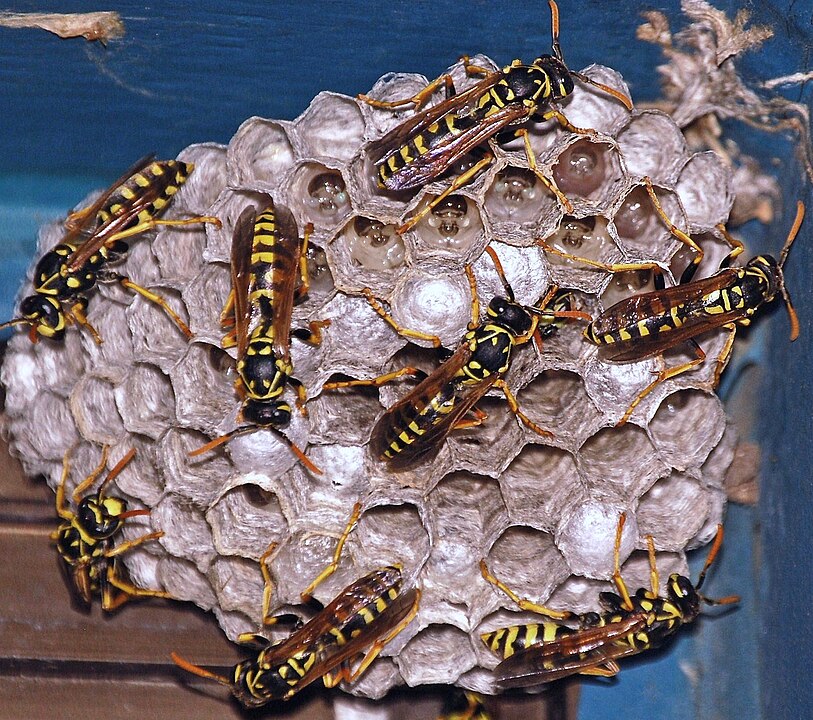
There are bullies under the summer sun. They have no sense of mercy, they inflict harm without cause, and they don’t even have the decency to enjoy it. They buzz around like yellow caution signs of doom. They set up shop exactly where it will worst inconvenience you – butting into your backyard and your homes like they own the place. And if you say anything, they stab you.
I am, of course, talking about wasps. Nature, for all its horrors, is pretty chill all told. Spiders only bother you when you bother them (“It’s not MY fault you walked into the web I set up at eye level”). Tigers and bears and wolves are just hungry, or you got too close to their cubs. Who doesn’t get angry when someone messes with their kids? Sharks are the victims of bad press. Just because someone can’t blink or smile or emote in any way comprehensible to human brains is no reason to discriminate (also, get out of the water). And crocodiles and hippos … okay, they’re pretty bad, but if you keep your distance they’re okay.
Wasps don’t keep their distance. Wasps don’t need a reason. Wasps go out looking for trouble. Those narrow, spindly bodies, those pitch-dark eyes … Just look at the villainous invertebrates!
Look at them! Look at the vile monstrosities!
Not at all like the humble bee. Bees are selfless. Bees are productive. Bees can coexist with mankind. If you rile them up, they’ll sting once and give their lives for the colony. See, even if you’re being swarmed by bees, they’re still quite heroic when you think about it. They give themselves for a greater cause. Not wasps. The only thing a wasp has to give is PAIN.
They don’t produce honey or wax or even jelly. They got nothing (except the aforementioned giving of pain). All animals, no matter how scary, are reasonable enough when you get to know them. Except wasps. They gang up on you because you looked at them funny. They are genocidal, resource-hording invaders. They’re under your feet. They’re in your walls. They want your PB&J sandwich. They’ve claimed your favorite climbing tree and will obliterate you if you get too close. Screw you, wasps.
Wasps are jerks.
Many thanks for visiting my blog. I post updates on my writing career, I muse over storytelling and fiction, and I reflect on the curious and wonderful things in life.
Crossover, crossovers. People from different worlds smashing into each other. Different genres, different styles, different stories. Throw them in a mixer and see what happens.
What’s the appeal? I’d say it comes down to simple curiosity. What would happen if Superman met Captain America? How would Greek myths get on with Chinese myths? Can a pirate really defeat a ninja?
It’s a popular trend these days. Maybe not so much in novel writing, but movies love them, video games really love them, and comics are practically built on them. And they’re fun. But there’s something about these companies’ strategy that is missing the point of a crossover. Every time one occurs (multiple times a year), it’s built up as the MOST INCREDIBLE THING EVER. And people get excited sure. But not like they used to.
Way back in 2008, when Nick Fury stepped out of the shadows at the end of the first Iron Man film to talk about “the Avenger Initiative,” fans squealed with joy and anticipation. Nowadays, the next big Marvel crossover film elicits a non-committal “Eh,” at best.
As a writer, my professional opinion is that crossovers are not easy to pull off anymore, largely because they’ve been done to death.
And that, I think, is the strength and weakness of the concept. Crossovers are big events. They’re something special, something noteworthy. Two completely different worlds colliding is interesting, and fans are curious to see if it can be pulled off. Batman and Elmer Fudd? Yeah, it’s been done, and it won’t be done again because you can’t capture that kind of lightning in a bottle twice. Crossovers are like a fine wine, best in small sips. Overuse just makes you feel overwhelmed. Try imagining a world where the Super Bowl happens every month.
Another example: Back in the 1980s, Mario and Sonic the Hedgehog were the pinnacle of dueling video game mascots. Who was better? Who was cooler? Then, one fateful day, they appeared together in the same game. Awesome! But they’ve done so again and again, and what was something that nobody ever saw coming is now ho-hum, another day in the neighborhood. Video game characters appear in each other’s franchises all the time, now. It’s practically an industry standard.
As it turns out, such “events” are best when served rare. Very rare. Otherwise, they aren’t events. They’re business as usual.
Many thanks for visiting my blog. I post updates on my writing career, I muse over storytelling and fiction, and I reflect on the curious and wonderful things in life.

 Jake W. Powell
