When I was a kid, the thing I wanted to be when I grew up was an “everyologist.” I wanted to do everything: science, literature, travel, architecture, painting, history. A five-year-old can easily imagine doing all those things. After all, he has all the time in the world. When a single year is one-fifth your total lifespan, the future stretches out to infinity.
Of course, our lives aren’t infinite, and as we grow up we learn that we don’t have all the time we want. I’m not an “everyologist,” though I do maintain a variety of interests and love to learn new things. I focus on my writing, my job, being with friends, reading, and living quietly. The more I learn I can’t do everything, the more I learn to focus on what I actually find worth doing.
I’d probably be a lousy architect, for one. And I’ve toyed with the visual arts, but it doesn’t hold my attention like writing does. And hey, I can always cheat: the Internet has lots of ways to learn and explore without actually, well, doing anything. It’s something, right?
But the Internet itself takes up our time (yes, I am aware of the irony of that statement on a blog). Too much? Well, that’s up to you. What else do you hope to do today?
All that being said, something else I’ve learned in life is that I have a lot more time than I sometimes suspect. It’s the things I feel I have to do – little things, like finish this book by such-and-such a date, or catch up on that TV series everyone is talking about – that eat away at our “free” time. It’s not really free if we treat our hobbies as a strange set of obligations. A career is one thing, but entertainment quite another. Anyway, the point I’m trying to make is that viewing our lives from new angles reveals that we don’t need much to fill up our time in a satisfying way.
I’m not a master of everything, and I’m okay with that. I have time enough for what I enjoy.
Many thanks for visiting my blog. I post updates on my writing career, I muse over storytelling and fiction, and I reflect on the curious and wonderful things in life.
Masterpiece. It’s a word you hear often. So often, I feel that its meaning has been drained out of it. Like “genius” and “magnum opus,” it’s a label we often apply to something that we enjoy on a personal level, regardless of whether it deserves the title.
A little harsh? Probably. There’s nothing wrong with liking something. In fact, I encourage you to like lots of things. Enjoy life. But I like to overthink things and write them down, so why not dig a little deeper?
Masterpiece. It’s actually two words. Master. Piece. A master piece. In ye olden days, guilds and academies required their apprentices and journeymen to submit a masterpiece as part of their application to the status of master. Hence, they presented a piece that marked mastery of their craft, be it carpentry, smithing, jewelry, baking, or what have you. Proof and demonstration that they were worthy of attaining the highest rank, as judged by their superiors.
So, it was something that was measured against quantifiable standards. A masterpiece was actually a lot like today’s college senior capstones: a final paper or project that demonstrates the graduate’s understanding of their degree subject. Or perhaps more appropriately, it is like a doctorate or master’s thesis (and there’s the word “master” again!). That’s not really surprising, considering that guilds, like schools, train people for careers.
But the word’s meaning changed over time, as words are wont to do. Now, a masterpiece has come to hold an even more elevated meaning. It is not simply proof of an individual’s skill, but it is the apex of their skill. Mona Lisa is Leonardo da Vinci’s masterpiece. Not his first work, but widely considered his best. 1984 is George Orwell’s masterpiece, and Star Wars is George Lucas’s.
So what does the word mean nowadays? It means something superlative, something that represents the epitome of the creator’s talent and understanding of the art. It is applied to anything that can be considered great or notable. And in so doing, we have, oddly enough, brought the word down. A masterpiece is declared as such by critics who are not necessarily practitioners of the art. Anyone who favors a particular artist or author and is eager to share that love can declare their favorite work to be a masterpiece, regardless of what merit it actually represents. That happens with all words – their meanings change and are shaped by usage into something quite different, and will again in a hundred years or so – but looking back at a word’s origin can make you look at it a little differently. A little more carefully.
A masterpiece was originally something that proved the apprentice was worthy of the master’s rank as judged by his teachers. It was a stepping stone from a lower tier to a higher one. It was a gateway and a turning point in one’s life. It was something singular and unique. It was the masterpiece of your career. It was something special.
Call me grumpy, but I think we can be more mindful when using words like masterpiece. They are powerful words, and applying them more prudently can in turn make us consider the media we consume more carefully. A bit of critical thinking put into evaluating whether something is truly a master’s piece. And that’s good practice for any artist.
Many thanks for visiting my blog. I post updates on my writing career, I muse over storytelling and fiction, and I reflect on the curious and wonderful things in life.
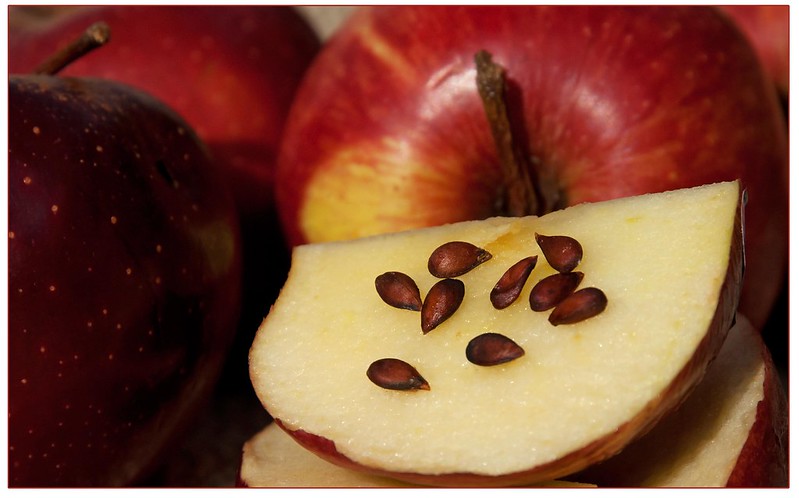
Apple seeds are small and insignificant. They’re tiny specks of black that you carve out of an apple and throw away. They’re detritus tossed on the ground. But give it rich soil to take root in …
The apple tree comes from the small and insignificant seed. It is tall and strong. It’s branches are broad and its leaves green. It bears good fruit. Just give it time. Be patient. Nurture it. Graft in healthy branches. Care for it and watch it produce an abundance. Time invested is time rewarded.
So it is with dreams. Nurture your dreams, give them care, treat them patiently. They won’t emerge fully formed in a day. Months and years and decades. These are the lifespans of realized dreams. Work. Wait. Watch. They will grow. They will bear fruit.
Many thanks for visiting my blog. I post updates on my writing career, I muse over storytelling and fiction, and I reflect on the curious and wonderful things in life.
I like dark stories. I like stories that are grim and violent and seemingly hopeless. I like stories where the heroes are battered, bruised, beaten, foiled, and know great loss. I like stories filled with injustice and overwhelming evil trying to smother out the good.
I don’t like the darkness for its own sake. It’s true that I enjoy battle scenes and war stories and am not averse to violence. But I don’t enjoy the blood for its own sake, either. And I’m no masochist who watches bitter stories simply to sit alone later on and feel bad about the state of the world.
I like dark stories because the lights in them shine all the brighter. The sun is easily ignored on a sunny day, but it makes itself known when it breaks through the storm clouds. Moments of compassion and hope are all the more meaningful in a story filled with sorrow and cruelty.
We know what good is when it is juxtaposed against evil. We know what heroes are when they stand in the face of the impossible. We know what hope is when it defies despair.
When a writer understands that a dark story can still be uplifting and not merely a means to rage impotently against the wrongs they have known in life, then that story can be something great. We learn that life can be cruel, but we don’t have to be.
Did you like what you just read? Are you a writer, or just looking for fun content? Do you want more, but are worried about missing new posts? Please subscribe! I post updates on my writing career, I muse over storytelling and fiction, and I reflect on the curious and wonderful things in life.
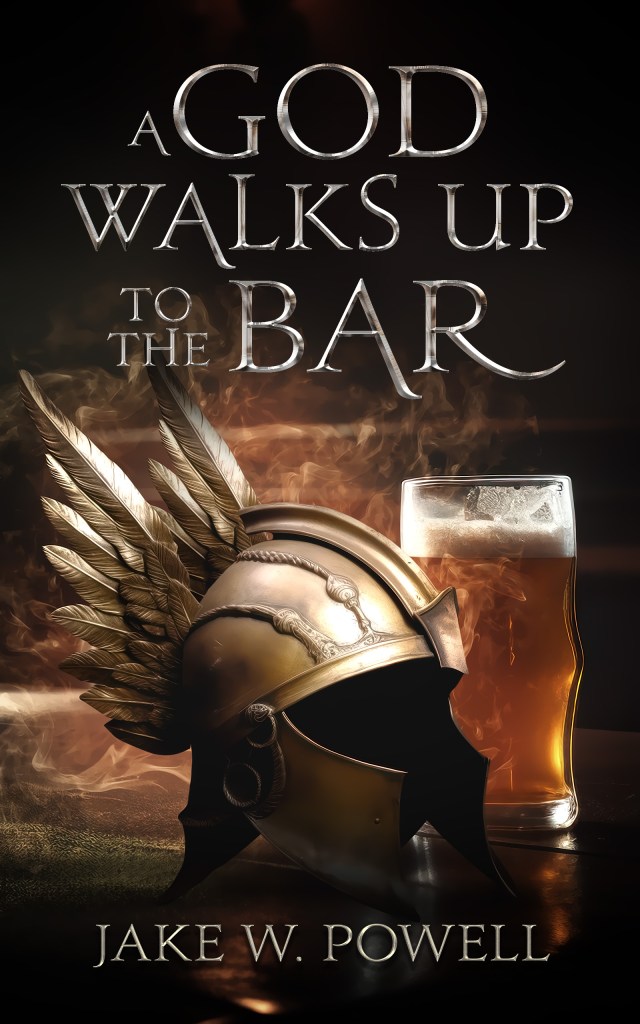
It hasn’t gone anywhere, and it won’t anytime soon! My first book, A God Walks Up to the Bar, is available on Amazon.com. Witness the modern day adventures of the Greek god Hermes in a world much like our own – plus with demigods, vampires, nymphs, ogres, and magic. The myths of old never went away, they just moved on with the times. It’s a tough job, being a god!
Feeling down in the dumps? Feeling like nothing you do is right or ever will be? If not, don’t worry, you will.
I’ve detected a pattern to discouragement in my life. It likes to come at certain times. I wonder if that’s true for everyone.
I find that nighttime is the worst for me. A couple of hours before bedtime, when I start to tire and my mind starts shutting down, fear and worry slither into my brain.
I need to start thinking about this. I haven’t done that yet. Do I have enough time to complete my book? Do I have enough money to pay for editing and publishing and marketing? Is it even any good?
It’s inevitable. For the writer, it can be debilitating. We work hard to finish our projects. We march on with stubborn determination to see our dreams through to the end. And we dread … not failure exactly. Inadequacy. Anyone can write, but can we write well? Or is it all just crap that would be better off hidden away in our computer’s hard drive, or better yet, in our own minds?
Even worse, what if it’s a good story, but nobody knows it exists? The unnoticed, inconsequential curiosity of the online store.
The night is a quiet and still time. My brain has time to process all these fears. When the excitement of the actual writing process stops, these nagging thoughts are heard most clearly.
But we don’t have to listen to such fears. They come, they stay a while, and then they leave. Yes, they do leave, if we press on regardless. Discouragement isn’t something we always have control over, but we can control how we act in response to it. Feelings of worry are not eternal. They only have real power to influence our life and work if we give them permission. Emotions run up and down. I look at my work today and feel it’s my best yet, and look at it tomorrow and cringe in disgust.
To continue writing in spite of that hollow feeling, to trudge along, to persevere through grim thoughts, this is is what we must do. Night isn’t forever.
Fear debilitates. Depression paralyzes. Writing is a joy for me, but I don’t feel excited about it all the time. Not 24/7. I have rough spots. I have times where I wonder if I should just leave it all behind. And I wait. I don’t act on those impulses of giving up, because I realize that they don’t last.
Writing is a marathon. Like athletes, we tire. We can feel inadequate and unable to rise up to the challenge. Write anyway. If you feel like crap, write. If you feel like nothing is coming to you, write something. A paragraph, a single sentence, anything so that you can say that you wrote for the day. Persevere. Be stubborn.
After night comes morning.
If you just so happen to be enjoying my blog, feel free to subscribe. I post updates on my writing career, I muse over storytelling and fiction, and I reflect on the curious and wonderful things in life.
My first book, A God Walks up to the Bar, is available on Amazon.com. Witness the modern day adventures of the Greek god Hermes in a world much like our own – and with demigods, vampires, nymphs, ogres, and magic. The myths never went away, they just learned to move on with the times. It’s a tough job, being a god!
Funny thing, emotions. In the grips of an emotional high, we feel invincibility and never-ending optimism. Any choice we make is a good one and can only yield good things. And then, with a snap of the fingers and a blink of the eye, we plummet into the doldrums. Everything is wrong, and what can we possibly do to make it better?
The truth is, our emotions are in constant flux. We all have off days where we just feel miserable for no good reason. And we have pleasant days when we feel like everything will keep going swell forever.
We talk about our off days, but what about when just an hour feels off? Have you have ever had a really terrific minute? Sounds silly, doesn’t it? But passions can snap back and forth that quickly. Happy warps into angry after an unexpected phone call, then changes back to happy forty minutes later after a tasty dinner. We wake up feeling listless, but after an invigorating workout, we perk up. In point of fact, all of us can jump from sad to happy to sad again to upset to tranquil all in one afternoon … and for no apparent reason at all.
In short, emotions are really weird. Do you want to feel differently from how you’re feeling now? Wait twenty minutes.
Now, when I talk about emotions, I’m not talking about medical depression. That’s an entirely different conversation. A diagnosed case of depression is a far cry from just feeling “bleh” or lacking joy in our lives. But in most everyday situations, irritation and sorrow walk hand-in-hand with joy and happiness, and they all get mixed together into a crazed tapestry that forms our emotional spectrum. They all take turns. Just because we feel a certain way about something at any given time, doesn’t meant that our opinion won’t make a one-eighty at any given moment.
There’s a somewhat unpleasant implication to take away from this: We can’t trust our feelings when making important choices. We can’t ignore them either, but something so changeable doesn’t strike me as a solid foundation on which to build decisions and opinions. I certainly can’t. I’m a moody guy, and I’ve simply learned that if I’m feeling rotten, I need to be patient and wait for it to run its course. Or heck, I’m hungry and just need a snack.
Now, don’t get me wrong. I’m not talking about medical depression. That’s an entirely different conversation. A diagnosed case of depression is something different from everyday emotional turbulence. Our normal emotions are something perfectly natural. To feel is to walk down a road alternatively smooth and bumpy.
When you’re feeling good, you know you can take on the world. So, you make that impulse buy. You dive into building that house. You decide, perhaps, to start writing a book. And you start out strong! Everything is going exactly as planned. Alas, you eventually run into a problem. And the good feeling fades. What’s left? Well, you still made your choice. Do you abandon it until you feel nice again, or do you resolve to keep trucking along regardless?
As a writer, there are days when I’m 100% satisfied with my work, and there are days when I know my book is crap, my writing skill is garbage, and maybe I should just find a new hobby. But, I write anyway. Emotions come and go, but they shouldn’t take our goals and dreams with them. Life is hard. How much harder would it be if employees only went to work when they were happy? Or parents only paid attention to their kids when they were in a good mood? Or doctors only decided to treat their patients when they were riding that emotional high?
People change. Change is the only constant (besides taxes), so maybe we should bear in mind that our current state of mind can flex and bend and not be hasty to make big decisions based on our emotional response. After all, eventually you will calm down, and then your brain will take over and help you make a more rational choice. Or even better, you’ll learned how to disassociate from your emotions and think logically even in the midst of turbulence. It is possible. Hard, but possible.
Emotions are a good thing. They help us get through hard times, and they teach us empathy and compassion. But they aren’t the sole guiding light in our lives. And they shouldn’t be the only director of our choices. After all, who wants a compass that doesn’t always point north?
If you just so happen to be enjoying my blog, feel free to subscribe. I post updates on my writing career, I muse over storytelling and fiction, and I reflect on the curious and wonderful things in life.
My first book, A God Walks up to the Bar, is available on Amazon.com. Witness the modern day adventures of the Greek god Hermes in a world much like our own – and with demigods, vampires, nymphs, ogres, and magic. The myths never went away, they just learned to move on with the times. It’s a tough job, being a god!
The eternal pressing question: What is art? What defines it, what is its nature, how is it differentiated from the common dross, and how do we recognize it when we see it? What. Is. Art?
Ask a hundred people, and you’ll get a hundred and one different answers. Nobody can seem to decide, though everyone, from the working joe to the professional critic, seems convinced that they know exactly what art is. The artistic merits of literature, film, paintings, and even video games are debated again and again. Is it art? But can we know, when the definition of art is as fluid as the fresh paint dripping from a canvas?
Maybe we’re asking the wrong question. Maybe we should instead ask what isn’t art.
Can this process of elimination help answer this great question? Consider the humble spoon. Is a spoon art? Well, most people would say it isn’t. You use it to eat soup and cereal. It’s a mundane thing. It has an everyday utility. It isn’t art.
What about a car? Is a car art? Well, it also has a mundane use: transportation from point A to point B. But look at car commercials and car shows. Cars boast aesthetic pleasures and pleasing design. They are promoted based on appearance, performance, improvement, and flashy lights. People collect cars. People analyze cars. Are they art? Or are they merely utilities passed off as art? And how do we know, unless we can define what art is?
This is getting complicated.
Why do Jackson Pollack’s paintings get hung up in museums but a two-year old’s paint smears don’t? What’s the difference? Aren’t they both paintings? And aren’t both paintings art? Well, the latter obviously isn’t art art because nobody cares except the parents. But everyone must care about Sydney Pollack since he gets public exhibits.
Nobody cares about spoons unless they try eating soup with a fork. But everyone cares about cars, one way or another. They’re both a fact of life, but one is just plain more noticeable than the other.
Nobody cared about the pipe until René Magritte put up a picture of one alongside the words, “This is not a pipe.” A pipe is just a pipe until it isn’t.
Maybe that’s all there is to it. Maybe art isn’t art until you decide that it’s art.
Until you care whether or not it’s art.
If enough people say that something is true, does it become true? No. No matter how many people say you can fly by flapping your arms, you can’t. But it sure is easier to think you can.
Is that all that art is? A shared belief? A social construct? Just the idea that if we belief something has merit inherent in its composition, construction, appearance, and intent, it rises above the mundane to become something with social significance?
But what about your two-year-old’s paint splatters? Is that art? What loving parent would say, “No”? To them it’s art. It’s more precious than everything in the Louvre.
Maybe art is more than just innovation, messages, and composition. Maybe it’s something more personal than that. Maybe art lies in how much it is valued by the individual. I happen to think cars all look the same and are basically just glorified boxes on wheels. I don’t see the appeal. Cars aren’t art to me. But to others, they are masterpieces.
Critics say something is art, and so we believe them. They must know what they’re talking about, right? Then, a hundred years later, the great art of the time is depreciated. It’s not as important. And new art replaces it. Tastes and preferences change. The definition of art changes based on what we think is important.
A spoon can be a piece of art. In some ways, it is by default. “Art” is a relative of the word “artifice.” Artificial. Manmade.
Maybe everything is art. But if everything is, than nothing is art.
Oh, to heck with it. Art is whatever you want it to be.
If you just so happen to be enjoying my blog, feel free to subscribe. I post updates on my writing career, I muse over storytelling and fiction, and I reflect on the curious and wonderful things in life.
My first book, A God Walks up to the Bar, is available on Amazon.com. Witness the modern day adventures of the Greek god Hermes in a world much like our own – and with demigods, vampires, nymphs, ogres, and magic. The myths never went away, they just learned to move on with the times. It’s a tough job, being a god!
The snow is here. Winter continues its dismal march. I walk through slush and ice in the dark to work every morning, and return home at twilight. I don’t see much of daylight. It’s a dreary time of year. Makes it hard to write and create.
But the days are getting longer! The dismal darkness won’t last forever. I’ll see the sun again on a daily basis, and enjoy the cheer of spring.
No deep reflections today, or musings on storytelling. Just a piece of encouragement to all you creators out there to keep creating. Keep motoring on when things feel gloomy. This, too, shall pass, and tomorrow will be a little bit brighter.
I’m an introvert by nature. I like being alone. Being isolated holds no real terror for me. Sure, it can be a bit monotonous at times, but I have a knack for finding ways to amuse myself. All in all, I enjoy being by myself. And in today’s word of Zoom meetings and work-from-home job schedules, I have more time to myself then ever. Most of us do. Heck, the Internet has made in-person interaction almost a secondary social trait.
That being said, I will never decry the importance – the essentiality – of physically being with friends.
I recently celebrated New Year’s with a group of close friends. We spent the night playing board games and laughing at each other’s corny jokes. Not being a social butterfly, such events are relatively rare for me, which makes them all the sweeter. Being with people is fun. And if I say that as if it’s some grand discovery, maybe that’s just the millennial in me talking.
We need people. Not just people’s words on social media, or their faces on the web camera. We need to be with people. Humans are social animals.
“Relationship” is a word that’s easy to bandy about. What other words are there to use to illustrate its complexity? Friendship. Camaraderie. Partnership. Sharing. Connecting. Time investment. Yup, relationships demand our time. Maybe a friendship in person is more precious because you sacrifice the time to be there in the flesh, rather than sit on your butt in front of your computer typing from a distance.
That New Year’s party was time well-spent. The spontaneity, the laughter, the jokes, the simple act of being there. It stirred memories of when that was commonplace for me. Maybe for all of us? Before the advent of social distancing. High school and college days where I hung out with friends during lunch and chatted with them throughout the week. Things that I took for granted. Ah, but hindsight is always bittersweet.
So, this New Year has gotten me thinking about the importance of in-person relationships. Writing is a solitary activity, and that means socializing is something I must seek elsewhere. I do have a social life, mind you, but perhaps I was starting to treat it a little too casually and valuing it a little less than I should have. We all need to see a living face every once in a while.
If you just so happen to be enjoying my blog, feel free to subscribe. I post updates on my writing career, I muse over storytelling and fiction, and I reflect on the curious and wonderful things in life.
New Year’s Day is a day famous for resolutions. The day when people work up the courage to swear to permanent change in their lives. To resolve to start doing this, stop doing that, and make some adjustments to these other things. A time for fresh starts.
Now, let’s be honest with ourselves. How many of you have ever kept a resolution all the way through the entire year? If you have, you have my deep and abiding respect. You are a rare breed.
I don’t believe in New Year’s resolutions. I defy this societal concept. No, I’m not being contrary for contrariness’s sake, I just don’t understand the need for it. Why wait until one day out of 365 (or 366) when you can always decide to change TODAY? That is, if you really want to improve yourself. Maybe it’s just more comfortable to say, as little orphan Annie sings, “There’s always tomorrow.” And tomorrow always seems to be such a long time coming.
That being said, it’s all well and good to come up with new goals on New Year’s Day. It’s tempting to look out across the vastness of the new year, all those blank days ripe with promise, and imagine to oneself how this time you’ll do it differently. You’ll be better this year, just wait and see. You make that silent resolution to yourself. On the same day, of course, when everyone parties hard till midnight and carouses and gets drunk and gets into car accidents. A hangover and a car repair bill. An excellent start to the new year.
Some people take resolutions very seriously. And to those people who can keep them throughout the year, I say more power to you. Like I already said, you are a rare breed. Most people make a few half-hearted mentions of a few things in life they want to be different, then forget all about it in a couple weeks (or a couple drinks).
Which isn’t to say that the idea behind New Year’s resolutions is a bad thing. We should always strive to improve ourselves. But maturity and growth is a gradual process, not something that happens in leaps and spurts. It takes a lot of effort to change something about ourselves. We stubbornly cling to bad habits and thoughts because they’ve stuck with us for so long. A single day of swearing off a habit isn’t going to make much difference. You got to work at it every day. You got to practice. Change is slow.
So, I don’t bother with New Year’s resolutions. Why should I, when I can make that resolution any day of the year? Sometimes, I make the same resolution multiple times in a week or a month, because I stumble. We all stumble, especially after making a big show of the big changes in our lives. Life likes to set us up like that. It’s like setting the cute baby seal free into the ocean with cameras rolling and – oh, there’s the shark waiting to spoil the moment.
I will make resolutions as many days as it takes to improve myself for the better and change my bad habits. No one-and-done deals. One day’s quick and easy promises aren’t enough.
If you just so happen to be enjoying my blog, feel free to subscribe. I post updates on my writing career, I muse over storytelling and fiction, and I reflect on the curious and wonderful things in life.


 Jake W. Powell