I’ve never done one of WordPress’s daily prompts before, so I thought I’d give it a shot and see how things turn out.
For all the great drinks out there, my answer is really simple: Water.
Water isn’t exciting or fancy or showy. But after a long, hot summer day, nothing tastes better. After a vigorous workout session or a whole day without a chance to drink something, a cold cup of water is the sweetest thing you could ever hope to taste.
There’s something pure about water. It’s guilt-free pleasure. It’s not a cesspool of chemicals like soda, or sugary like juice or lemonade. It’s just water, simple water, and it is the stuff of life running through our veins.
I also realize that every drink of water I take is a privilege and opportunity not everyone has. Here in America, we don’t have to worry about waterborne illness or contamination the way that many other nations do. Heck, we don’t have to worry about not having any water at all. All I have to do is turn a faucet, and voila! Fresh water fit to drink, every minute of every day.
It’s simple. And that makes it very precious, indeed.
If you just so happen to be enjoying my blog, feel free to subscribe. I post updates on my writing career, I muse over storytelling and fiction, and I reflect on the curious and wonderful things in life.
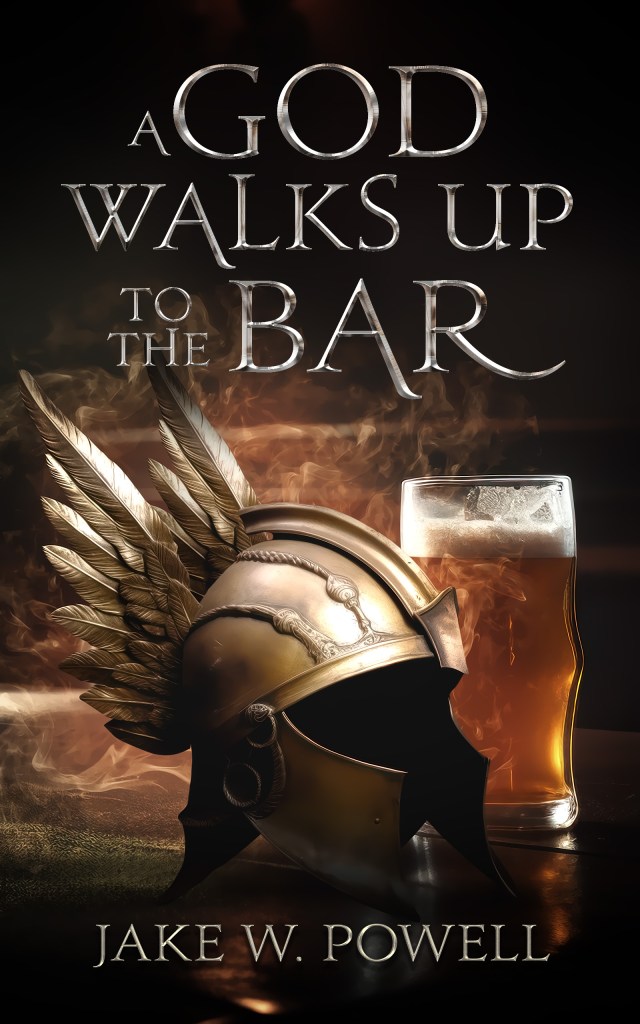
My first book, A God Walks up to the Bar, is available on Amazon.com. Witness the modern day adventures of the Greek god Hermes in a world much like our own – and with demigods, vampires, nymphs, ogres, and magic. The myths never went away, they just learned to move on with the times. It’s a tough job, being a god!
Don’t let the title scare you away. I’m not talking about specific politics or social issues. Rather, this is about how fantasy can be a tool for analyzing society undercover. That is to say, the fantasy genre gives authors a knack for talking about real life without actually talking about real life.
Now, the fantasy genre isn’t real, obviously. That’s kind of the point. However, fantasy’s detachment from reality can give it a very unique perspective on the world we do live in.
This comes, I think, from the fact that the fantasy genre can be used to observe elements of our world by substituting real groups, issues, events, or locations with fictional analogues. These same analogues allow readers to perceive them more objectively than if they were the real thing. Real-life issues tend to get our defenses up, consciously or not, and we let our own biases color our lenses. Fantasy equivalents are, well, fantasy, so we don’t view them in the same way, even if they are equivalent to the same social issues that otherwise get our hackles up. It’s a bit of a literary trick, really.
Whether or not a writer gets their message across to the audience depends on two things: One, whether the readers recognize the subtext, and two, whether they connect the subtext with the correct issue. Yes, we must trust our readers to infer what we want them to infer. And sometimes, alas, they don’t. All writers reach a point where their authority dies, and their readership draws its own conclusions independent of the author’s intent. So, you might very well have been writing a hard-hitting social critique using elves and pixies, but the audience comes away thinking it was about the virtues of natural conservation rather than the consequences of war.
On the other hand, maybe your story has no message. You just wanted to write something fun and light. Yet, for some reason, readers are convinced there’s a hidden meaning buried in your writing. Tell me, dear reader, what is the message of Little Red Riding Hood? Is it just a story about a girl and her grandma who are eaten by a wolf, then saved by a woodsman, end of story? Or is it about:
The dangers of nature
Man’s triumph over nature
Listen to your parents
Pay attention to the task at hand
Don’t trust strangers
Rebirth from death into a better person
A metaphor for puberty
A metaphor for sexual predators
A metaphor for rape
A metaphor for how people read sex into everything
Axes are useful for killing animals
If you think a wolf looks like your grandmother, you really should buy glasses
And so forth.
Maybe we don’t really know for sure? Maybe there is no analogy, but there is applicability. Applicability is a very different animal. It is the reader’s independence of the writer and ability to view the story through their own lives and beliefs. In short, they see the story as matching their own notions.
Or maybe, we’re just thinking too hard about it all.
If you just so happen to be enjoying my blog, feel free to subscribe. I post updates on my writing career, I muse over storytelling and fiction, and I reflect on the curious and wonderful things in life.
My first book, A God Walks up to the Bar, is available on Amazon.com. Witness the modern day adventures of the Greek god Hermes in a world much like our own – and with demigods, vampires, nymphs, ogres, and magic. The myths never went away, they just learned to move on with the times. It’s a tough job, being a god!
Real life is hard. Can we all agree on that? Real life is really hard to deal with. If it’s not the troubles and calamities of real life intruding on our status quo, it’s the dreary monotony of everyday activities. Going to work, washing the dishes, walking the dog. Sometimes, we just hit a rut. What to do?
People are imaginative, and there’s nothing better at firing up the creative juices then boredom.
There are people out there prone to daydreaming. They come up with whole worlds in their heads. The really ambitious ones commit those worlds to paper. Voila! A new fantasy story is created.
Fantasy helps us cope with the real world. It is a form of escapism that gives us a few precious moments away from humdrum reality, a chance to catch our breath and maybe let out a couple screams, then return to the grind. A little fantasizing is good for our mental health. Relaxation and rest is a good thing, and fantasy is a form of that. A jaunt into a made-up world where heroes always win, good triumphs over evil, magic can make food and water out of nothing, and we can fly on winged horses is just … fun. That’s the point of fantasy. Just like some people like car racing or hiking or painting or math (such people do exist), so do some enjoy fantasy because it’s just plain fun.
To deny ourselves recreation is to trap ourselves inside a metal box at the bottom of the ocean. We can’t move, can’t escape, can’t even see the light. We suffocate under the inability to exert ourselves. Our minds along with our bodies atrophy from the lack of exercise. And from the lack of challenge. Fantasy is a challenge. Fairy tales and epics challenge us to see the world in a new way and ponder how these stories match up against our own experiences. And they let us see something new, period. Don’t we humans crave novelty? Why go on vacation, if not to “get away from it all?” And what are we getting away from? The ordinary and the familiar.
Fantasy is all that writ large. It is the unfamiliar and the extraordinary. A chance to wonder: What if?
And at an even more fundamental level, fantasy taps into that all-consuming human urge to create. We all want to create something. We tinker, we write, we draw, we brainstorm, we organize, we build, we muck about. We like to make things, whether things concrete or things abstract. Fantasy is creation. It’s a powerful impulse, the urge to create, and making fantastical worlds is the perfect outlet for what, I believe, is a basic human need.
Does fantasy matter? Absolutely. We can’t resist it’s siren call. To get away from mundanity, to satisfy our basic natures, to keep ourselves sane. Fantasy is very, very important.
If you just so happen to be enjoying my blog, feel free to subscribe. I post updates on my writing career, I muse over storytelling and fiction, and I reflect on the curious and wonderful things in life.
My first book, A God Walks up to the Bar, is available on Amazon.com. Witness the modern day adventures of the Greek god Hermes in a world much like our own – and with demigods, vampires, nymphs, ogres, and magic. The myths never went away, they just learned to move on with the times. It’s a tough job, being a god!
Let’s be honest. With a question like that, and the fact that my blog is subtitled “Writer of Modern Day Fantasy,” you can pretty easily guess that the answer is, “Yes.” But, hey, did I catch your attention? I did? Good. Let’s dive into it, then.
Fantasy is an important genre. Myths and legends have existed for almost as long as humankind has. There is an almost natural urge in people to invent and make up lands, species, events, and other such things that don’t exist in nature. The urge to create things that defy natural law: flying carpets, giants, dragons, dryads, genies, wishing stars, talking puppets, elves, hobbits, fairies, people the size of your thumb, people as tall as a mountain, alien worlds, life on the moon, and so on and so on. The earliest myths probably were meant to explain phenomena that man couldn’t yet fully understand, like the weather or earthquakes. But even after science has offered its explanations, the fantasies endure. Do old habits die hard? Or maybe we need fantasy in our lives.
Consequently, fantasy is a versatile thing. At its heart, it is the telling of things that not only don’t exist, but can’t exist. There are no elves in the forest. There are no genies trapped in bottles. There is no Fountain of Youth or cities at the bottom of the ocean. But the stories are still told.
For a long time, though, there was a problem.
For the last century or so, fantasy got a bad rap. It was viewed as this sort of nerdish subject that is impractical and of no relevance to “real life.” Dungeons & Dragons was the epitome of loser geek culture for decades. It was a “loser” subject because, in part, it was something that wasn’t real – but people took it so seriously! Why make such a big fuss over the unreal? Why obsess over the rules for a game about fighting made-up creatures? If you’re going to obsess over statistics, at least apply that obsession to football and baseball, not orcs and hobgoblins!
For many people, deriving so much enjoyment from something made-up is just plain childish. Oh, when we are children, it’s fine to enjoy stories of knights versus dragons. Fairy tales are quaint little things that amuse us when we’re young. Then we grow up and enter the serious real world where we need to be interested in grown-up things. Like cars and sports and art and the latest celebrity gossip. You know, important stuff.
That association with the immature has been a stain on fantasy’s reputation for a long time, as well as its sister genre, science fiction. The dominions of nerds and other people who can’t handle reality. There were exceptions, of course. Star Wars, for example, was a major blockbuster in 1977. But by and large, fantasy movies and books and games were strictly niche. There was an audience, but a highly specific one.
Then things changed.
I think the Lord of the Rings film trilogy in the early 2000s was the big turning point. Here was a fantasy series with major, respected stars that took itself seriously. It had a big budget, it was being produced by a major studio, it had marketing and advertising out the wazoo. The critics liked it. It was art.
Suddenly, fantasy lost its stigma. It wasn’t so bad to admit you liked the genre.
Others followed. Game of Thrones was a biggie. And there was Stranger Things, which proudly wore its 1980s nostalgia on its sleeve. And what was big in the 1980s? Yup, Dungeons & Dragons. Speaking of which, a Dungeons and Dragons movie released last year was warmly received. Oh, how the tables had turned!
The fact is, there are lots of people who like the unreal. They like to step away from reality for a few hours. It is called escapism. Personally, I think part of fantasy’s bad reputation is that escapism is confused with retreat. One is the willingness to step away from your problems or worries for a little while to refresh yourself. The other is an ultimately selfish choice to ignore one’s real-life obligations in favor of never leaving the fantasy. But many non-fantasy fans view the genre strictly through the latter lens. A bunch of guys and gals without jobs living in their parents’ basements reading silly books about silly people in silly lands. Fantasy is for the weak, for people can’t handle their own responsibilities.
It’s not fair, really. J. R. R. Tolkien wrote fantasy, after all. You know, the highly respected scholar and linguist? A man with a very productive and well-balanced life? And it gets more unfair.
So, fantasy has hit it big, as I just mentioned. And why did it hit it big? Well, a few successful movies certainly helped. But also, you know, the average person finds out that people like Henry Cavill and Joe Manganiello play stuff like D&D and Warhammer 40,000. Hey, they’re not nerds! Fantasy must be cool!
Sometimes, the best way to get people to take something seriously is to find the right spokesperson. All this time, fantasy just needed better PR.
It worked. Fantasy is widely accepted now. People aren’t ashamed to say that they like it. Nerds aren’t social pariahs. Heck, most of them are running major corporations. And the people writing those hit fantasy movies? They’re nerds, too. That’s the other big shift in the fantasy genre in mainstream culture. Four, five decades ago, fantasy films and TV shows were mainly being written by people who saw it as harmless, inconsequential fun. But the people who grew up with those shows and films, the people who fell in love with them, are the ones calling the shots now. And their beloved childhood is anything but inconsequential. Fans tend to pour their hearts into their work, and the quality of the product (hopefully) goes up. The bigger budgets certainly help.
By and large, fantasy has found public acceptance. Fairy tales aren’t just for kids anymore.
But the question posed at the beginning of this article is only half-answered. Does fantasy matter? Yes, yes it does. Financially, socially, culturally, it matters very much. But why does it matter? And in what other ways does it affect us besides providing something to do on a Saturday night?
Stay tuned …
If you just so happen to be enjoying my blog, feel free to subscribe. I post updates on my writing career, I muse over storytelling and fiction, and I reflect on the curious and wonderful things in life.
My first book, A God Walks up to the Bar, is available on Amazon.com. Witness the modern day adventures of the Greek god Hermes in a world much like our own – and with demigods, vampires, nymphs, ogres, and magic. The myths never went away, they just learned to move on with the times. It’s a tough job, being a god!
Do you like riddles? I love riddles. I think they’re interesting, fun, and come in infinite variety. They’ve been around for millennia, so someone thought they were worth keeping around.
The book I’m currently working on features a scene where two characters engage in a riddle contest. I used some riddles from history for the scene, but I also took a stab at making up my own. At least, they’re original as far as I know, assuming my subconscious wasn’t inspired by something I read fifteen years ago or some such.
Regardless, here they are. Highlight the space beneath each riddle for the answer. Enjoy!
Teary eyes and stolen breaths
So often found with death and wrath
No teeth to bite nor fists to strike
Yet destruction always marks my path
Smoke
A single eye, yet I cannot see
A single fang, yet I cannot bite
I have no hands nor feet
Yet many things can I complete
A needle
Clad in armor like the turtle, many do I command
Proud and vain like the eagle, on ground I need not stand
Beasts fantastic mark my name and honor,
Yet at day’s end, I die like any man
A knight
What are some of your favorite riddles? Maybe you’d like to take a shot at creating a few yourself!
If you just so happen to be enjoying my blog, feel free to subscribe. I post updates on my writing career, I muse over storytelling and fiction, and I reflect on the curious and wonderful things in life.
And speaking of my writing …
My first book, A God Walks up to the Bar, is available on Amazon.com. Witness the modern day adventures of the Greek god Hermes in a world much like our own – and with demigods, vampires, nymphs, ogres, and magic. The myths never went away, they just learned to move on with the times. It’s a tough job, being a god!
The history of humanity is the history of crossing over the next hill.
Where are we without curiosity? Caves and mud huts. One day, someone steps outside with a mind filled with questions. What is over that next hill? What is in that valley? What is beyond that forest? Anther follows, and another. Further afield we walk, driven not by necessity but because we want to know.
Questions follow questions. Can I eat that? Can I grow it? Why does this reed make a sound when I blow through it? Food and music are discovered. Someone finds a sturdy stick. A walking stick, and soon a weapon. Lines are draw on sandy ground, then painted onto rock and hides. Maps are made to chart the wanderer’s path.
We cross the last hill and find a sea. But now is not the time to stop. Wood floats, this is known. A little later, and mankind sails out on boats across the water to find out what lies on the other side. They learn how to make the stars their guide. Navigation becomes more than simple wandering.
Where people grow tired and rest, they find new fruits and vegetables and animals. The nomad becomes the gardener and herdsman. Someone notices those mangy wolves following the camp for scraps. Someone tames them.
People build huts of straw and wood, of stone and brick. Cities appear. Curiosity turns inwards. How to make life better? Clever hands produce answers: the wheel, the hammer, the nail, the net, the plough, the saddle.
Not all stay in cities. Others keep wandering, looking for the next hill and sea and valley. They wander far afield, planting new cultures wherever they stop awhile. Downriver and up mountain and across desert. Because they can. Because they must know what is there.
The whole earth is charted. Mankind does not rest. The ocean deeps call out. The stars wink at humanity, inviting it to pay them a visit. Steam and electricity are harnessed. Fire no longer warms the camp, but lifts man and woman on ships of steel into the airless void to visit the moon. Other ships carry them beneath the ocean into the lightless abyss to glimpse its moody depths.
It is the never-ending journey. Why? Reasons are given, some long and eloquent, others little more than a careless shrug. Because we must know. Because we are curious creatures. Because we can scarce imagine what new mystery awaits us over the next hill.
If you just so happen to be enjoying my blog, feel free to subscribe. I post updates on my writing career, I muse over storytelling and fiction, and I reflect on the curious and wonderful things in life.
Writing characters require us to dive into their heads and figure out their backstories, beliefs, and personalities. It’s a fun diversion in and of itself to discover a character, much less to incorporate those discoveries into a greater narrative. Learning more about our protagonists can make us as attached to them as we hope our readers will be.
But what about writing people who are … less than agreeable? Or worse, who don’t share our values and principles? What about writing those whose motivations and beliefs are diametrically opposed to our own? What is it like to dig around in the head of someone who we don’t agree with?
It can feel almost like a betrayal of ourselves. He can’t say that, I don’t believe in it! She can’t do this, it’s not part of who I am! But putting yourself into your writing doesn’t necessarily mean you are your writing. You are creating a world with words, and that world will be filled with a motley mix of individuals who all possess their own strong personalities.
This can apply to antagonists and villains, but really, it includes any character you write. They play roles in a story, and sometimes those roles require them to be someone drastically different from yourself. Can that be awkward? Sure. Maybe there’s the nagging feeling in the back of your head that writing a character who deviates from your own worldview is somehow condoning things you don’t agree with. But if the story demands it and it develops your world, then it must be done. It’s not betrayal, it’s the mark of a maturing writer. I write people who do and say things I don’t personally find tasteful, but which do fit their own personality. I’m not that person. They’re a work of fiction, after all.
Besides, characters who disagree with you are likely to disagree with other characters, and that creates conflict. And conflict is how you keep a story going.
Even if you don’t agree with a character, they’re still yours and serve a purpose in the story. So, roll up your sleeves and figure out what to do with them. The first thing is to put yourself into their shoes. Think like them for a bit, practice seeing the world through different eyes. How do they feel about this thing or that other individual? How do they feel about your protagonist? Why?
Learning a bit of empathy and a bit about other worldviews certainly helps, as does reading good literature and learning from example how other authors write. It’s valuable to learn how to write characters whose voice and opinions don’t echo your own. Why? Because it is too easy to put yourself into every character and have everyone essentially act and believe as you do. And that makes a story boring and predictable.
And besides, for all that characters have a habit of taking on a life of their own, you are ultimately the final authority here. Like a director herding meddlesome actors, you learn to work with your cast and guide them toward your vision.
Ultimately, story is king. It comes first, and we do what we must to tell it. It’s all part of growing as writers.
If you just so happen to be enjoying my blog, feel free to subscribe. I post updates on my writing career, I muse over storytelling and fiction, and I reflect on the curious and wonderful things in life.
Why do jerks seem worse than villains? Villains are grand and powerful and fierce and evil. They deserve our disdain. But jerks are just plain petty. What’s worse? A dictator bent on conquering a nation, or a man who keys your car because you bumped him in the parking lot? Well, the former, obviously, but the latter certainly seems to steam people a heck of a lot more.
But I’m not here today to talk about “why’s,” but rather “how’s.” Namely: How do you write a jerk protagonist so that he’s likeable?
Think about it for a moment, writers. There are plenty of villains that people like. I’ve even written about it in a previous post. Mass murderers? Evil tyrants? Amoral thieves? They’ve all got fans. They’ve all got that special something called charisma. People will forgive a lot if you have charisma.
But jerks? They’re personal to the audience. We may never have met a murderer or a dictator (hopefully), but we all know a few knuckleheads with attitudes who stoop to the lowliest of cheap shots. Spend a week in customer service and you’ll meet jerks on the regular. They come in all flavors, but they all have something in common.
THEY AREN’T LIKEABLE.
Thus, going back to my first question, is there a way to write a protagonist who is unpleasant, rude, and otherwise just plain mean, and still make that character someone the audience can enjoy? Well, yes and no. The main thing about writing jerks is that if you keep them that way from start to finish, chances are you’re shooting yourself in the foot.
Consider a classic example of jerkdom in literature: A Christmas Carol’s Ebenezer Scrooge. A miserly, heartless, soulless businessman who has no mercy or pity for the poor. He’s on the up-and-up – he’s an honest man in the original story, believe it or not – but he has no redeeming traits. At first. The entire story is about Scrooge’s character development into a better person. And that’s the key to writing jerks: They shouldn’t still be jerks by the end of the story.
Side characters can stay jerks. Antagonists, of course, can remain jerks. But the protagonist should not remain static at the best of times. They evolve and mature. And if they start out as jerks and bullies, then they should show some sort of marked improvement by story’s end. Less of a jerk, kinder, more patient. Like Scrooge, they should learn something. There is nothing stopping you from writing a protagonist who remains the same come the conclusion, but if they were nasty and unlikeable to begin with, you risk leaving your audience with a sour last impression.
On the other hand, maybe the jerk not changing is the point. Maybe this is a more cynical piece, an introspective look into what makes a meanie tick – or maybe it’s just a comedy. Well, there is a way to make the audience side with the jerk, and that’s to introduce an even bigger jerk to square off against. Have a protagonist who’s belligerent and petty? Bring in someone else who’s even more so. It worked for British sitcom Fawlty Towers. Basil Fawlty is a Class-A Jerk through and through, but he frequently dances with people even worse than he is. See for yourself.
We like someone to root for, you see. If we’re given two flavors of unpleasantness, we’re naturally going to compare them. And if one is slightly less bad than the other, we’ll favor that one and despise the other. The lesser of two jerks, if you will.
There are those rare occasions where your story doesn’t require that the protagonist change for the better, or circumstances dictate that there isn’t a worse character to compare against. So, what to do? Well, you can make the jerk empathetic. That’s not saying you give the protagonist the capacity for empathy, but rather that you give them traits the audience can relate to. Humanize them a bit, just a little, so that they’re a tad more understandable. Maybe they are the way they are because of a bad childhood, or ill health, or they’re just plain unlucky.
Let us consider the case of Disney’s Donald Duck. He’s … not the most pleasant individual, especially in his 1930s and 1940s cartoon shorts. But oh, boy, does he have bad luck at every turn. Nothing turns out right for him. No wonder he has such a chip on his shoulder. If we had the rotten fortune that Donald does, we’d be short-tempered, irritable scoundrels, too.
So, there you have it. My two cents on writing jerk protagonists. It can be done. It has been done. You can do it, too.
If you just so happen to be enjoying my blog, feel free to subscribe. I post updates on my writing career, I muse over storytelling and fiction, and I reflect on the curious and wonderful things in life.
I like movies. I’m a visual person, and I enjoy seeing things portrayed on the screen. Little details are the most fun. Characters’ tics and interesting events happening in the background. Sometimes, I envy filmmakers. Creating their worlds are a little bit easier, because they can convey in a minute what can take a writer four or five paragraphs to communicate. ESPECIALLY when they are able to tell the story without a single word being said.
We writers, of course, don’t have that luxury. Books are nothing but words, which got me thinking: How do you show the reality of a story, that is, communicate character traits and worldbuilding details, when you can’t reallyshow anything at all?
It’s a different game from simply describing a scene or a character. That’s to be expected. But where to stop? Where’s the line between “This is what Joe looks like and how he acts” and “This is Joe’s personality and character, let me tell you without ever referring to it again and thus making this paragraph pointless.”
So, I’ve thought about it, and here’s what I’ve come up with so far.
Stories are best told when the writer doesn’t need to explain everything. A good story unfurls through action, whether visual or written. Actions define a character, a group of characters, even a location. The way a person carries himself, dresses, talks – these all express relevant elements without the need for a mountain of exposition.
And they can be brief. For example: A wizard appears in the story. He dresses in fancy clothes and has clean, well-groomed hair. He talks formally with a condescending tone. He casually refers to esoteric subjects. He sniffs loudly whenever he disapproves of the other characters’ comments. He kills a wolf with a single, well-timed spell. Short, succinct statements that tell us what we need to know – and give us the freedom to paint a picture of the character in our minds. We don’t always have to go into detail about hair color, eye color, body type, or a detailed analysis of clothing. Heck, just the word “wizard” probably had you paint half the picture from a single word, didn’t it?
But then, another character brings in the Artifact of Doom for the wizard to identify. The wizard immediately panics and backs away, demanding that the object not be brought near him. Well, that tells us immediately that the Artifact of Doom is really bad news. If Mr. High-and-Mighty is scared, it just might be a serious problem for everyone.
So, yeah, books aren’t visual, but they can still tell a story without having to tell us everything. In short, leave some space for the reader. Now, I’m not going to say that I’m necessarily good at this as a writer. I’m still learning, but I’ve learned as much from reading as writing. And I get annoyed when books pause everything to describe the POV character’s emotional state or appearance in long, flowery detail. It just seems … excessive.
Maybe it’s just the mark my journalism classes left on me. I like simple and to-the-point. And I like to think that my readers can be trusted to have a little imagination to fill in the blank spaces of the mind that words can’t reach by themselves.
What are your thoughts? How do you think a story can “show, not tell?”
If you just so happen to be enjoying my blog, feel free to subscribe. I post updates on my writing career, I muse over storytelling and fiction, and I reflect on the curious and wonderful things in life.
The snow is here. Winter continues its dismal march. I walk through slush and ice in the dark to work every morning, and return home at twilight. I don’t see much of daylight. It’s a dreary time of year. Makes it hard to write and create.
But the days are getting longer! The dismal darkness won’t last forever. I’ll see the sun again on a daily basis, and enjoy the cheer of spring.
No deep reflections today, or musings on storytelling. Just a piece of encouragement to all you creators out there to keep creating. Keep motoring on when things feel gloomy. This, too, shall pass, and tomorrow will be a little bit brighter.

 Jake W. Powell